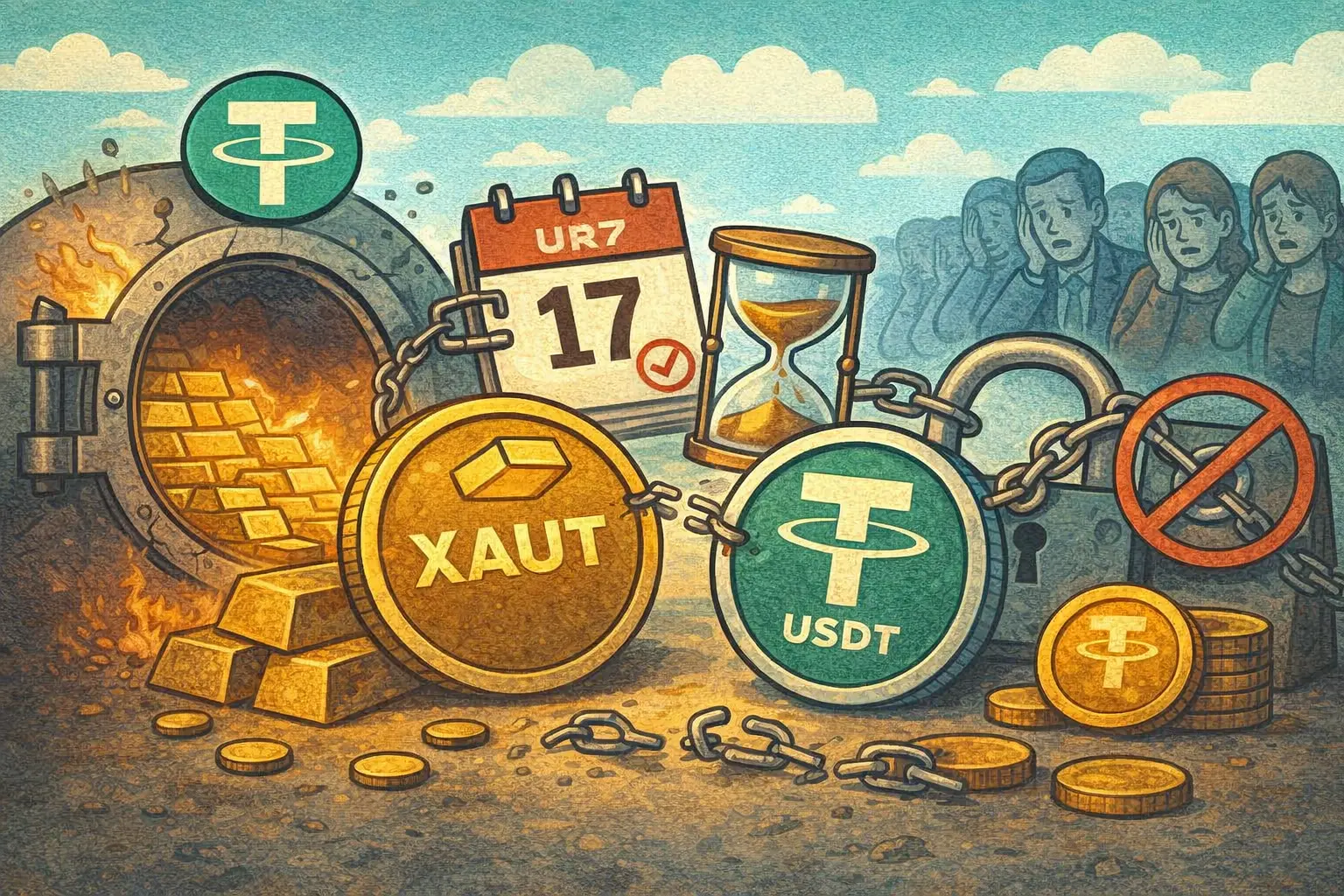
On June 17, Tether issued an official announcement saying it will stop operating the Alloy by Tether platform and its gold-backed derivative stablecoin aUSDT. The product was launched in June 2024 and has been operating for about two years so far. Tether said that after evaluating user activity, market demand, and the company’s “broader priorities,” it decided to concentrate resources on product lines with stronger demand.
Three-stage timeline for deactivating aUSDT
According to Tether’s official announcement, the deactivation process is divided into three stages:
Stage 1 (starting today): prohibit opening new positions and minting new aUSDT.
Stage 2 (three-month grace period): existing holders can return aUSDT before the deadline and redeem the originally collateralized XAUT gold token.
Stage 3 (deadline: September 17): all positions that have not completed redemption will be handled after this date.
aUSDT uses a model similar to DeFi overcollateralized stablecoins: users collateralize XAUT to mint aUSDT, and the locked XAUT value must be greater than the value of the issued aUSDT.
XAUT’s ongoing scale: $3 billion market cap and 22,169 kilograms of physical gold backing
In contrast to aUSDT, XAUT has continued to perform strongly. Its market cap is currently $3 billion, backed by 22,169 kilograms of physical gold. Earlier this year, after the gold price broke the historical high of $5,300 per ounce, XAUT’s market cap surged and then fell back by about 19%.
In February 2026, Tether acquired a 12% stake in the precious metals platform Gold.com for $150 million. It plans to integrate XAUT into the platform to further expand use cases for gold tokens.
Three stablecoin products that Tether has already discontinued in 2025–2026
aUSDT is the third stablecoin product Tether has discontinued within roughly a year:
· In November 2025, Tether discontinued the euro stablecoin EURT due to European regulatory issues and shifted resources to the asset tokenization platform Hadron, which launched in 2024.
· In February 2026, Tether announced it would stop issuing the RMB stablecoin CNHT, citing “changes in the market environment, waning product interest, and limited community demand.”
· In June 2026, aUSDT was added to the deactivation list.
On the other hand, in May 2026, Tether announced a cooperation plan with the Georgian government to launch the Georgia lari stablecoin GELT, indicating it still has new plans in the stablecoin space pegged to sovereign currencies.
Tether’s investment shift: robots, AI, and a $1 billion NEURA funding round
Beyond its stablecoin business, Tether’s investment footprint has expanded to include Bitcoin mining infrastructure, artificial intelligence, cloud computing, and robotics technology. On June 11, 2026, Tether led a $1 billion funding round for German robotics company NEURA.
The article notes that judging by the pace of product line adjustments, Tether is moving from being a “pure stablecoin issuer” toward becoming a “crypto and technology holding group”—shutting down small stablecoins with weak demand (CNHT, EURT, aUSDT) while making major investments in areas such as AI, robotics, and gold tokens.
FAQ
What happens to aUSDT holders if they don’t redeem before September 17?
Tether’s announcement sets September 17 as the redemption deadline, but it did not specify in detail what will happen to positions that have not been redeemed after the deadline. Holders should contact Tether before the deadline or complete the redemption through the Alloy platform to ensure they can recover the pledged XAUT.
Why was aUSDT discontinued after operating for two years?
According to Tether’s announcement, the decision was based on a comprehensive assessment of “user activity, market demand, and the company’s broader priorities.” Specific figures are part of the issue: aUSDT’s current market cap is only about $1.2 million. Compared with XAUT’s $3 billion market cap, the scale gap is significant, making it difficult to support the ongoing resource investment required to keep it running.
Does shutting down aUSDT mean Tether is abandoning gold-related business?
No. Tether explicitly stated in the announcement that the XAUT gold token remains an ongoing focus. The company’s acquisition of a 12% stake in Gold.com for $150 million in February 2026 also supports the integration of XAUT. The shutdown of aUSDT is aimed at a derivative product with insufficient demand, not core gold token business.


