
The U.S. Securities and Exchange Commission (SEC) released in early June a draft FY2026-2030 strategic plan that, for the first time, lists digital assets and blockchain technology as a standalone objective. It defines them as technologies that are “capable of fundamentally changing the United States’ financial infrastructure,” alongside investor protection, capital formation, and institutional modernization. Jamie Selway, head of the SEC’s Division of Trading and Markets, confirmed that the division is developing a framework for listing and trading tokenized securities.
Policy shift in the draft SEC FY2026-2030 strategic plan
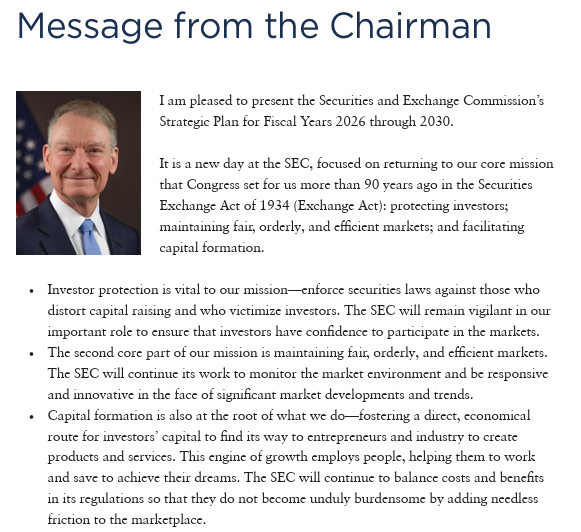 (Source: SEC)
According to the SEC document, the draft strategic plan confirms the following policy directions:
Tokenization definition: Tokenized issuance and on-chain financial infrastructure are areas the SEC plans to support for compliant capital formation
Service framework: Custody, trading, and staking services should be able to operate under appropriate regulation, and should not face duplicative or conflicting requirements
Methodology framework: Establish a regulatory foundation for the industry through a “reasonable, coherent, and principled approach”
Relevant SEC actions already confirmed:
· Consider innovative exemptions for tokenized stocks
· April 2026: Staff statement grants market participants five years to obtain broker licenses for self-custody trading interfaces
· March 2026: Nasdaq approved to begin trading tokenized versions of certain stocks
· April 2026: New York Stock Exchange (NYSE) approved to begin trading tokenized versions of certain stocks alongside traditional stocks
Institutional risk assessment logic shift confirmed by Levin
Jennie Levin, chief legal and operating officer of the Algorand Foundation (former federal prosecutor), told CryptoSlate: “For institutions, removing the term ‘cryptocurrency’ from the discussion and replacing it with ‘market modernization’ fundamentally changes how risk is assessed. Compliance teams that used to sit on the sidelines are no longer required to evaluate a speculative asset class—instead, they are required to evaluate a more efficient and safer way to operate the financial infrastructure of their day-to-day operations.”
Levin described the SEC’s position as an “invitation for everyone to build within the known legal framework, rather than waiting for enforcement agencies to define the boundaries.” She added that even a non-binding roadmap can affect capital allocation years before any formal rules are issued, because institutions’ written commitments provide specific grounds for internal risk committees’ approvals.
Legislative progress and likelihood confirmed by the CLARITY Act
According to reported updates on the latest legislative progress:
Passed in the House: July 2025, 294 votes in favor and 134 against
Passed in the Senate Banking Committee: May 2026, 15 votes in favor and 9 against
Current status: In early June 2026, placed on the Senate legislative agenda; still needs 60 votes to pass before the August recess
Galaxy Digital assessment: Reduced the probability of passage in 2026 from 75% to 60% (mainly due to calendar pressure)
Polymarket prediction: Final probability of passage is about 50%
FAQ
How legally binding is the “tokenization goal” in the SEC’s five-year plan?
According to reporting, the SEC’s draft five-year strategic plan is a non-binding roadmap and does not directly create legal obligations. The article notes that even a non-binding roadmap can have substantive impact on institutional capital allocation ahead of formal regulations, because institutional risk committees typically incorporate regulatory direction into early project approval processes.
What is the relationship between the CLARITY Act and the SEC’s five-year plan?
The SEC’s five-year plan confirmed tokenization as a policy direction, but Levin said “interpretation is a bridge, not the destination.” The CLARITY Act will codify a unified token classification framework into formal law—key legislation to convert the SEC’s policy intent into an enforceable legal framework.
Why is SEC-CFTC coordination crucial for tokenized markets?
According to reporting, over the years, due to uncertainty over whether an asset falls under SEC or CFTC jurisdiction—even after technology has matured—institutional projects have been stalled for a long time. Levin said that “the biggest friction point is structural paralysis caused by institutional fragmentation,” and that a unified token classification enables risk committees to make decisions with confidence; the first market impact will be “faster internal decision-making.”


