According to blockchain analytics firm Allium, over the past 12 months, wallets linked to the US have executed $571 million in notional trading volume on Polymarket's political trading markets. Although Polymarket is currently prohibited by law from serving US users, users can access the platform simply with a VPN and an existing crypto wallet. Geopolitical bets from US users account for 46% of their notional bet volume (36% across the entire platform).
Why Polymarket's IP Blocking Is Ineffective: Crypto Wallets Require No Identity Verification, VPNs Are Enough to Bypass
According to Allium's report, Polymarket blocks US users via IP addresses, but this blockade has limited effect due to the following reasons: Polymarket operates on cryptocurrency, using wallets and stablecoins without any involvement from banks or brokers; regulators cannot reject account applications, nor can banks prevent payments; the platform requires no identity verification, so users only need a VPN (software that hides location) and an existing crypto wallet to access it.
Allium further notes that its country tags come from wallets' on-chain behavior rather than IP addresses. That is why US wallets that bypass Polymarket's blockade using a VPN still appear in Allium's data.
Distribution of US User Bets: Geopolitics Accounts for 46%, Elections for 16%
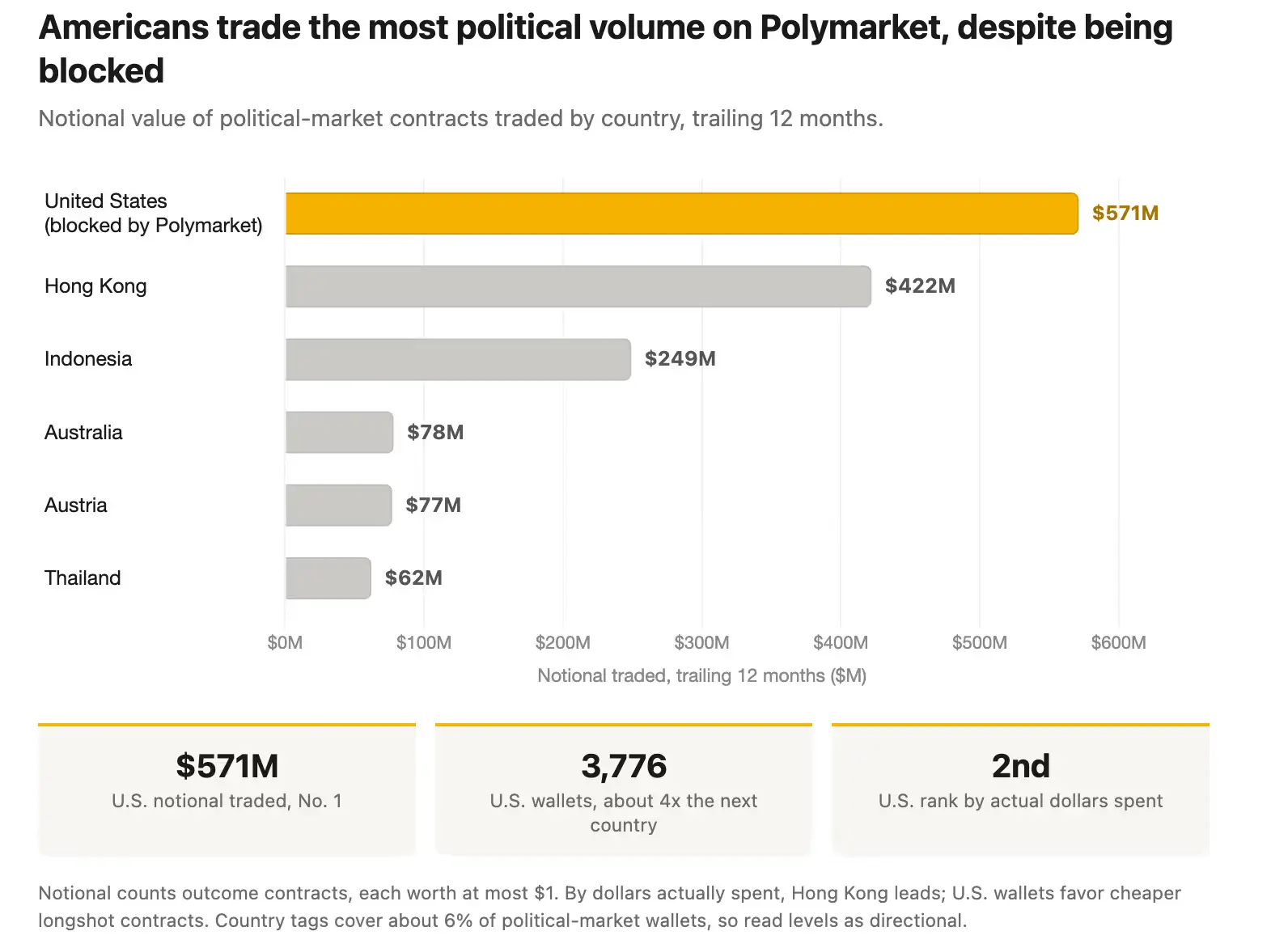 (Source: Allium)
According to Allium's report, US users' betting preferences on Polymarket differ significantly from the platform's overall user base:
Geopolitical Bets: Account for 46% of US users' notional bet volume, compared to 36% across the entire platform.
Election Bets: Account for 16% of US users' notional bet volume, compared to 32% across the entire platform.
Relative Ratio: US users bet on overseas wars nearly three times as often as on elections (relative to the ratio among all platform users).
Allium states that Kalshi and Polymarket's US-compliant affiliates primarily focus on economic data, interest rate decisions, and elections, so demand for markets like regime change and ceasefires flows to the offshore version that can list such markets.
Largest Single Bet of $20.8 Million on Zelenskyy Wearing a Suit, 5 of the Top 12 Markets Involve War with Iran
According to Allium's report, the largest single bet by a US user was $20.8 million, wagering on whether Ukrainian President Zelenskyy would wear a suit; among the top 12 betting markets for US users, five are related to war with Iran. US users at one point allocated 53% of their funds to bets on a US invasion of Iran, compared to 26% in the same markets from other users during the same period.
Prediction Accuracy and Data Notes: US Users Pick Winners 81.9% of the Time; Allium's Data Coverage is Only 6%
According to Allium's report, in markets where outcomes have been determined, US users backed the winner 81.9% of the time, while other users did so 80.3% of the time—a negligible difference; holding positions also yields similar returns. Allium also notes an important limitation of its data: the firm can link only about 6% of Polymarket's political market wallet funds to specific countries, so all country-level figures should be viewed as directional rather than precise.
As of the time of reporting, Polymarket had not responded to media requests for comment regarding the data.
Frequently Asked Questions
Why can US users bypass Polymarket's IP block?
According to Allium's analysis, Polymarket operates on cryptocurrency, using wallets and stablecoins without requiring bank accounts or identity verification; regulators and banks cannot intervene. Users only need a VPN and an existing crypto wallet to access the platform, and Allium identifies US users through on-chain wallet behavior (rather than IP addresses), so a VPN cannot hide wallet identity from on-chain analysis.
What is the trading volume of US users on Polymarket over the past 12 months?
According to Allium's report, over the past 12 months, wallets linked to the US have executed $571 million in notional trading volume on Polymarket's political trading markets, surpassing second-ranked Hong Kong ($422 million); however, Allium notes that the data covers only about 6% of wallet funds and should be viewed as directional.
How accurate are US users' predictions on Polymarket?
According to Allium's report, in markets where outcomes have been determined, US users backed the winner 81.9% of the time, while other users did so 80.3% of the time—a negligible difference, and holding returns are also similar.


