
# BTCProbes60KKeySupportLevel

67.09K

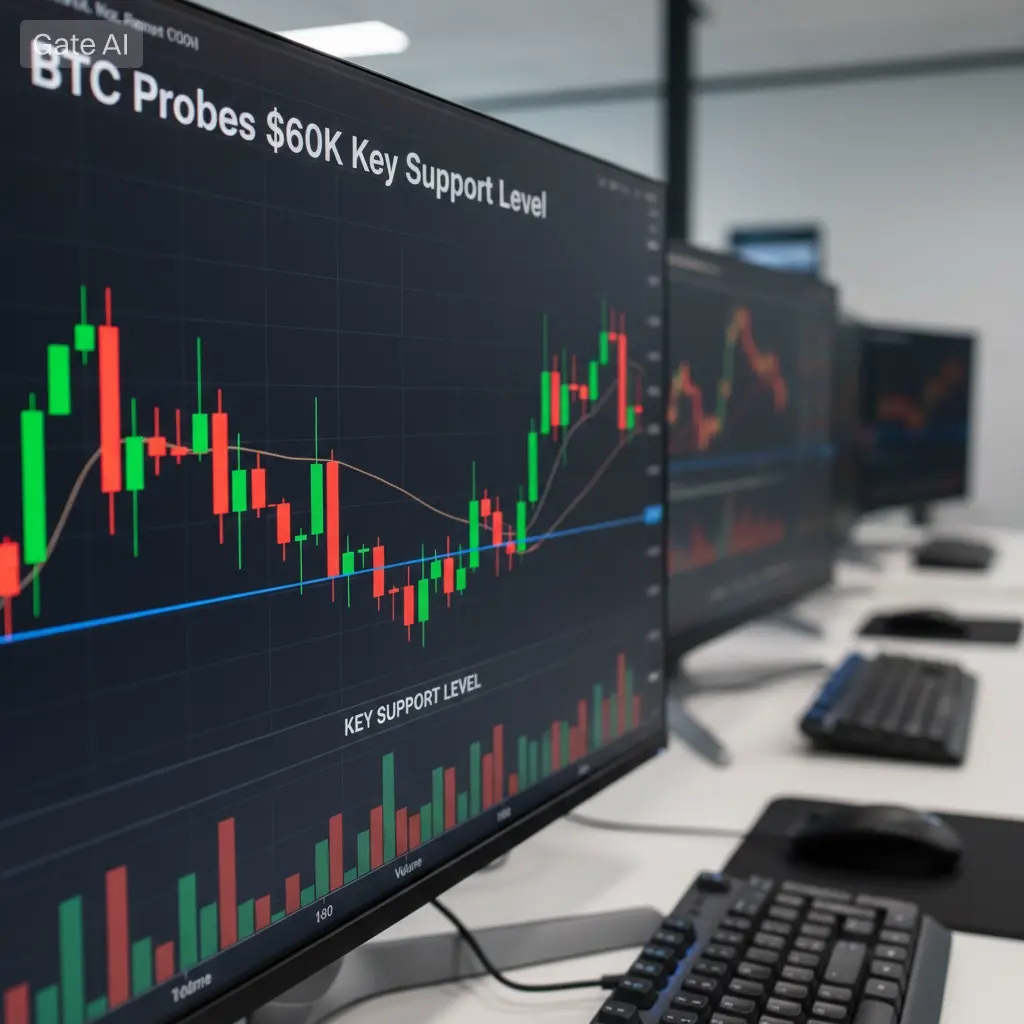
On June 24, Bitcoin broke below the $60,000 level, hitting a low of $59,023 — its lowest since October 2024. The selloff is driven by multiple headwinds: hawkish Fed signals strengthening rate hike expectations, rising Treasury yields pressuring risk assets, seven consecutive weeks of ETF outflows, and Strategy's ~$13.9 billion paper loss on its BTC holdings fueling market fear. The $60,000 level is a critical near-term support — a breakdown could open the door to $55,000. Over $650 million in long positions were liquidated, with the bearish trend firmly in place. Caution is advised for counter-trend buying attempts.

The crypto market's downturn stems from a "perfect storm" of macroeconomic pressures, structural market dynamics, and a shift in investor sentiment . Here’s the breakdown:
#BTCProbes60KKeySupportLevel
🏛️ Macroeconomic Headwinds
The biggest driver is the high-interest-rate environment and global liquidity crunch . With interest rates high, safer assets become more attractive, and the "cheap money" that fueled crypto speculation has dried up . As a result, crypto is repriced as a high-risk asset alongside tech stocks—and traditional safe havens like gold are outperforming it .
💥 Internal Mark
XAUUSD0.37%
  • Reward
  • Comment
  • Repost
  • Share
$BTC
#BTCProbes60KKeySupportLevel
Bitcoin is currently testing one of its most critical support zones in recent memory. As of June 26, 2026, BTC has dipped to approximately $59,700, marking its lowest level since October 2024. This $60,000 threshold represents more than just a psychological barrier it is a technical fulcrum that could determine the direction of the market for months to come.
From a technical analysis perspective, Bitcoin has formed a concerning bear flag pattern on the daily charts. The price action shows three consecutive TBO breakdowns, with the most recent daily low hit
BTC-2.43%
post-image
post-image
User_any
Alright, let's cut through the noise and look at what actually happened with Bitcoin. It's been a wild ride, and not the fun kind.
To get straight to it: the headline you saw about $58,000 was spot on for a moment during the chaos, but the dust has settled a bit. As of June 25th, Bitcoin is trading around $61,665, which is a bit of a rebound from that nightmare low. But it's still down about 4.2% for the week and is sitting more than 50% below its all-time high from last year.
So, what the hell happened? It wasn't just one thing; it was a perfect storm.
The Immediate Trigger: A Liquidation Cascade
The spark that lit the fire was a massive wave of forced selling. A ton of traders were heavily leveraged on long positions (betting the price would go up). When the price started to dip, it triggered a cascade of liquidations, forcing those positions to sell, which pushed the price down even further, triggering more liquidations. It was a brutal feedback loop. We're talking about a massive $1.27 billion to $1.5 billion in liquidations across the crypto market in just 24 hours. It was ugly.
The Structural Problem: ETF Outflows
Underneath that flash crash is a slower, more worrying trend. U.S. spot Bitcoin ETFs have seen net outflows for seven straight weeks now, with one of the largest single-day withdrawals recently being around $459 million. This is the real headwind. It's institutional money walking away, draining a key source of demand and preventing any sustainable recovery.
The Macro Mess: Hawkish Fed and a Strong Dollar
You can't look at crypto in a vacuum. The macro environment is toxic for risk assets right now. The Federal Reserve has turned decisively hawkish, with some policymakers projecting rate hikes in 2026. This has sent the U.S. Dollar Index (DXY) surging to a 13-month high, and a stronger dollar is a classic headwind for Bitcoin. At the same time, crypto is selling off alongside AI and tech stocks, as they've become part of the same "risk-on/risk-off" institutional trade.
And Then There's the Supply Glut Looming
On top of all that, the market is staring down the barrel of some major potential supply overhangs. The creditors from the collapsed exchange are expected to start receiving around $9 billion in Bitcoin starting in July. The fear is that a lot of that will be sold into the market. At the same time, the German government has been transferring seized Bitcoin to exchanges, adding to the selling pressure.
Key Levels to Watch
So, where do we stand technically?
· Critical Support: The recent low around $59,000 is the most immediate level to hold. A break below that could open the door to a much deeper drop, with some analysts eyeing the $50,000-$55,000 range.
· Immediate Resistance: On the upside, Bitcoin needs to reclaim the $62,800 area first, with the more significant resistance zone sitting at $65,000. Until that happens, bounces are likely to be sold.
The market is in a state of extreme fear, and the path of least resistance still seems to be lower. While there are always dip-buyers and corporate accumulators like Strategy out there, they haven't been able to offset the heavy ETF outflows yet. It's a tough environment. Risk management is everything right now.
#BTCProbes60KKeySupportLevel
⚠️ Not financial advice.

repost-content-media
  • Reward
  • 4
  • Repost
  • Share
Yusfirah:
To The Moon 🌕
View More
#STRCHitsAllTimeLow
STRC which stands for Strategy Variable Rate Series A Perpetual Stretch Preferred Stock has officially hit its all time low position in the market creating significant concern among investors and traders. This financial instrument was launched by Strategy Inc formerly known as MicroStrategy in July 2025 and has become a critical component of the company's Bitcoin accumulation strategy. The stock recently closed at 88.59 dollars marking a new all time low with an intraday low touching 82.50 dollars during the trading session. This represents a substantial de-anchoring from
BTC-2.43%
post-image
post-image
post-image
  • Reward
  • 5
  • Repost
  • Share
CryptoDiscovery:
To The Moon 🌕
View More
#STRCHitsAllTimeLow
STRC which stands for Strategy Variable Rate Series A Perpetual Stretch Preferred Stock has officially hit its all time low position in the market creating significant concern among investors and traders. This financial instrument was launched by Strategy Inc formerly known as MicroStrategy in July 2025 and has become a critical component of the company's Bitcoin accumulation strategy. The stock recently closed at 88.59 dollars marking a new all time low with an intraday low touching 82.50 dollars during the trading session. This represents a substantial de-anchoring from
BTC-2.43%
HighAmbition
#STRCHitsAllTimeLow
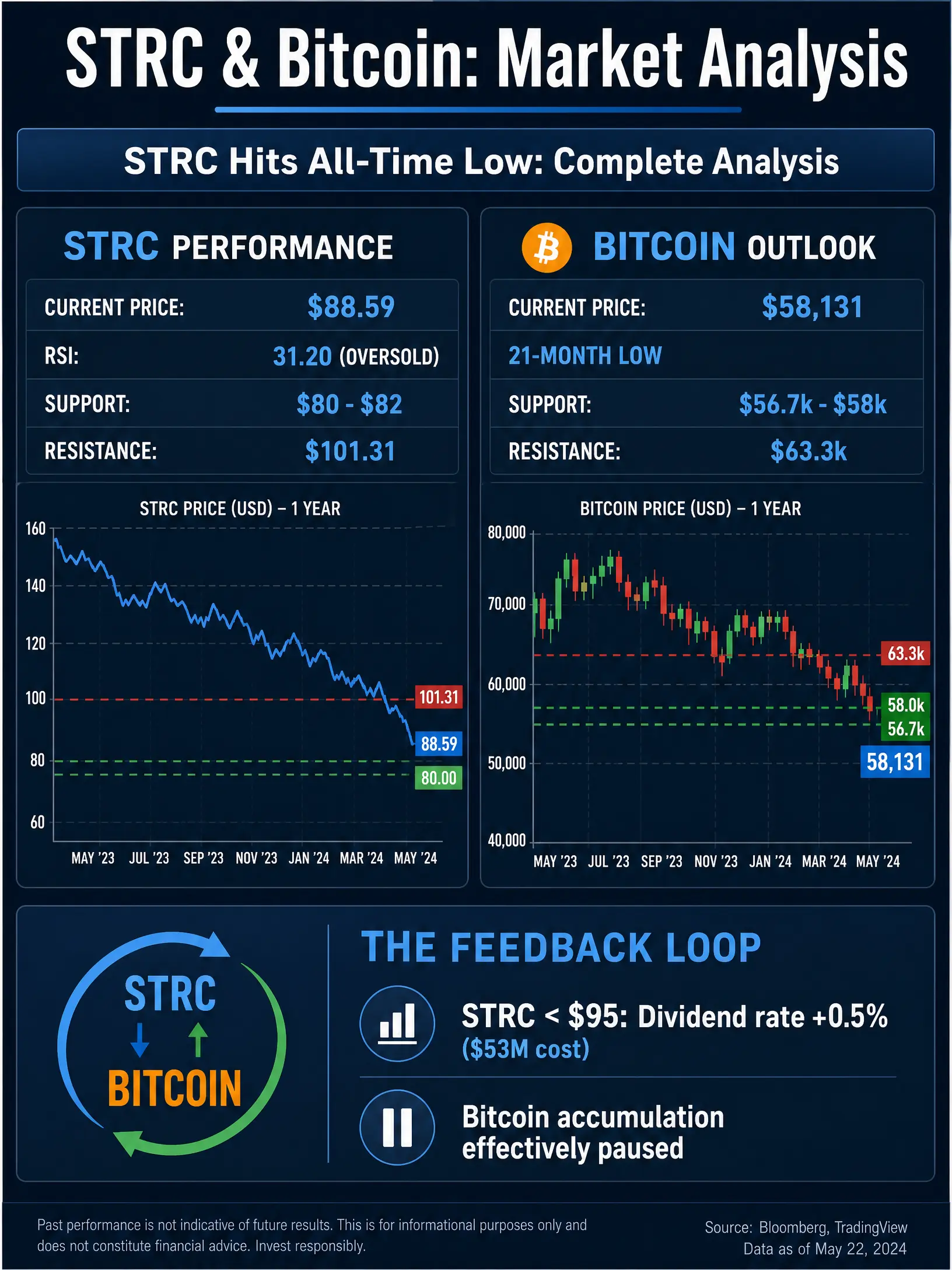
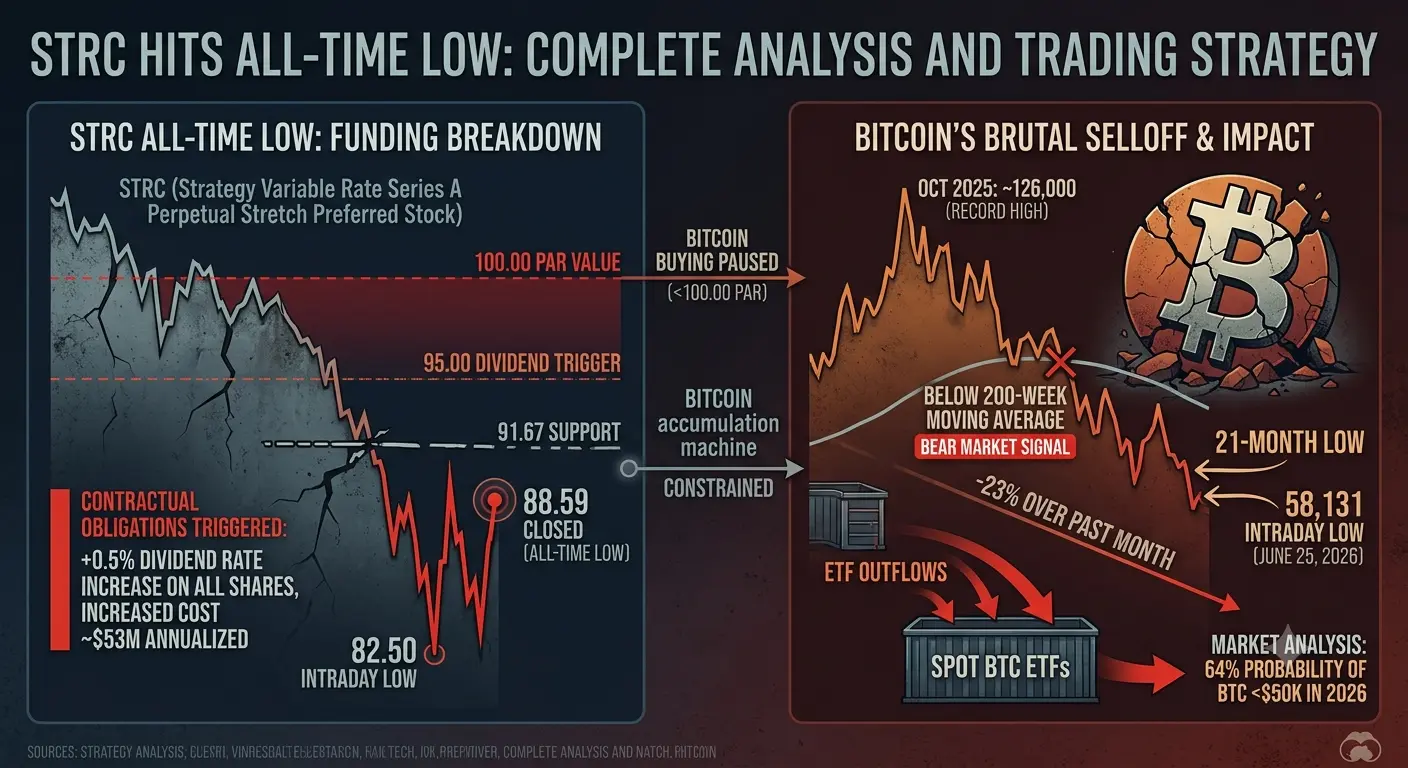
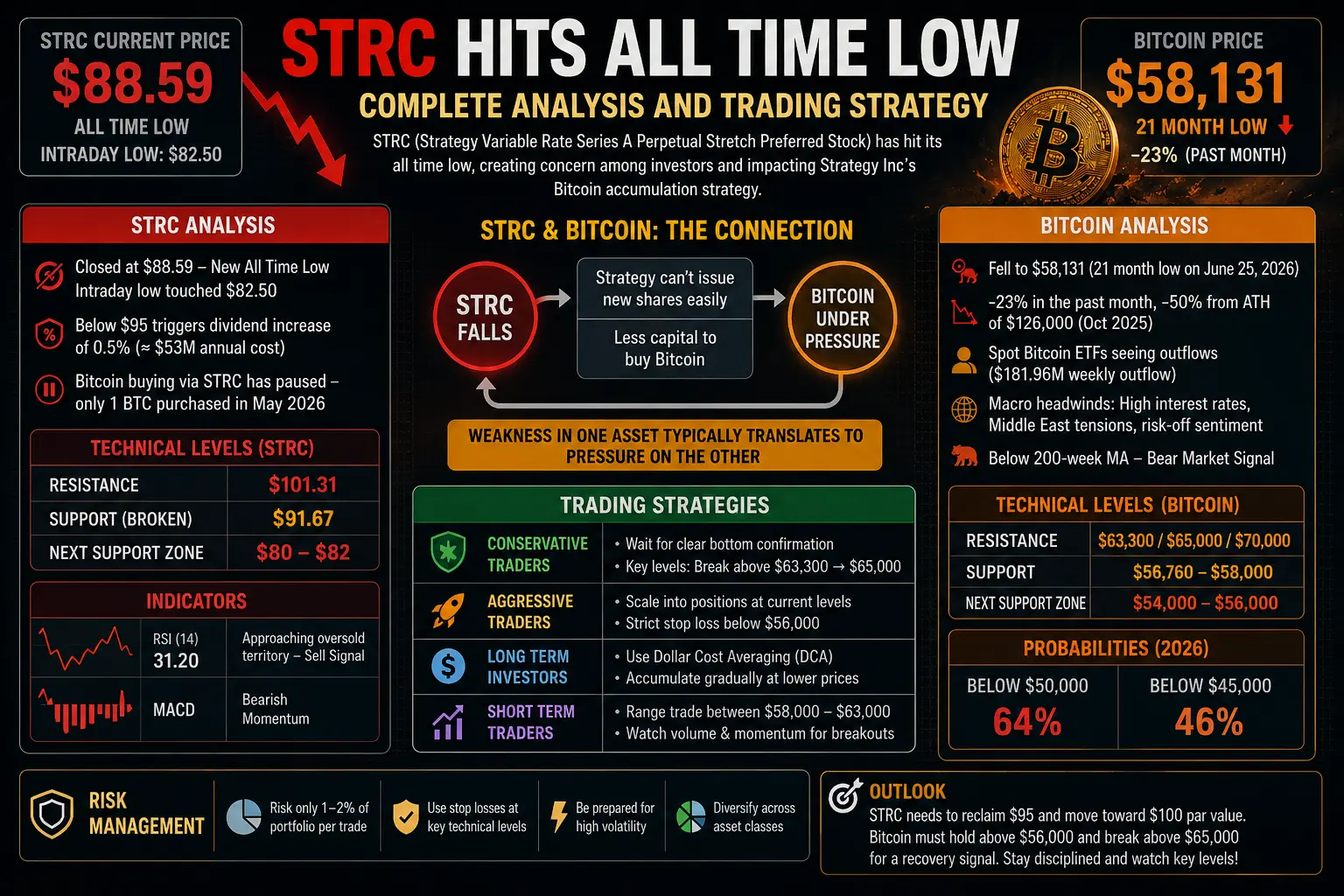
STRC which stands for Strategy Variable Rate Series A Perpetual Stretch Preferred Stock has officially hit its all time low position in the market creating significant concern among investors and traders. This financial instrument was launched by Strategy Inc formerly known as MicroStrategy in July 2025 and has become a critical component of the company's Bitcoin accumulation strategy. The stock recently closed at 88.59 dollars marking a new all time low with an intraday low touching 82.50 dollars during the trading session. This represents a substantial de-anchoring from its 100 dollar par value which has triggered several contractual obligations and raised questions about the sustainability of Strategy's Bitcoin buying mechanism.
The relationship between STRC and Bitcoin is deeply interconnected and understanding this correlation is essential for any trader or investor. STRC was designed specifically as a funding vehicle to finance Strategy's aggressive Bitcoin accumulation strategy. When STRC trades above its par value Strategy can issue new shares at favorable terms to raise capital for purchasing more Bitcoin. However when STRC falls below 95 dollars the company becomes contractually obligated to increase the dividend rate by 0.5 percent on all outstanding shares which raises annual dividend costs by approximately 53 million dollars. This creates a challenging scenario where Bitcoin buying has effectively paused since STRC fell below 100 dollars par value with only 1 Bitcoin purchased through this mechanism in May 2026.
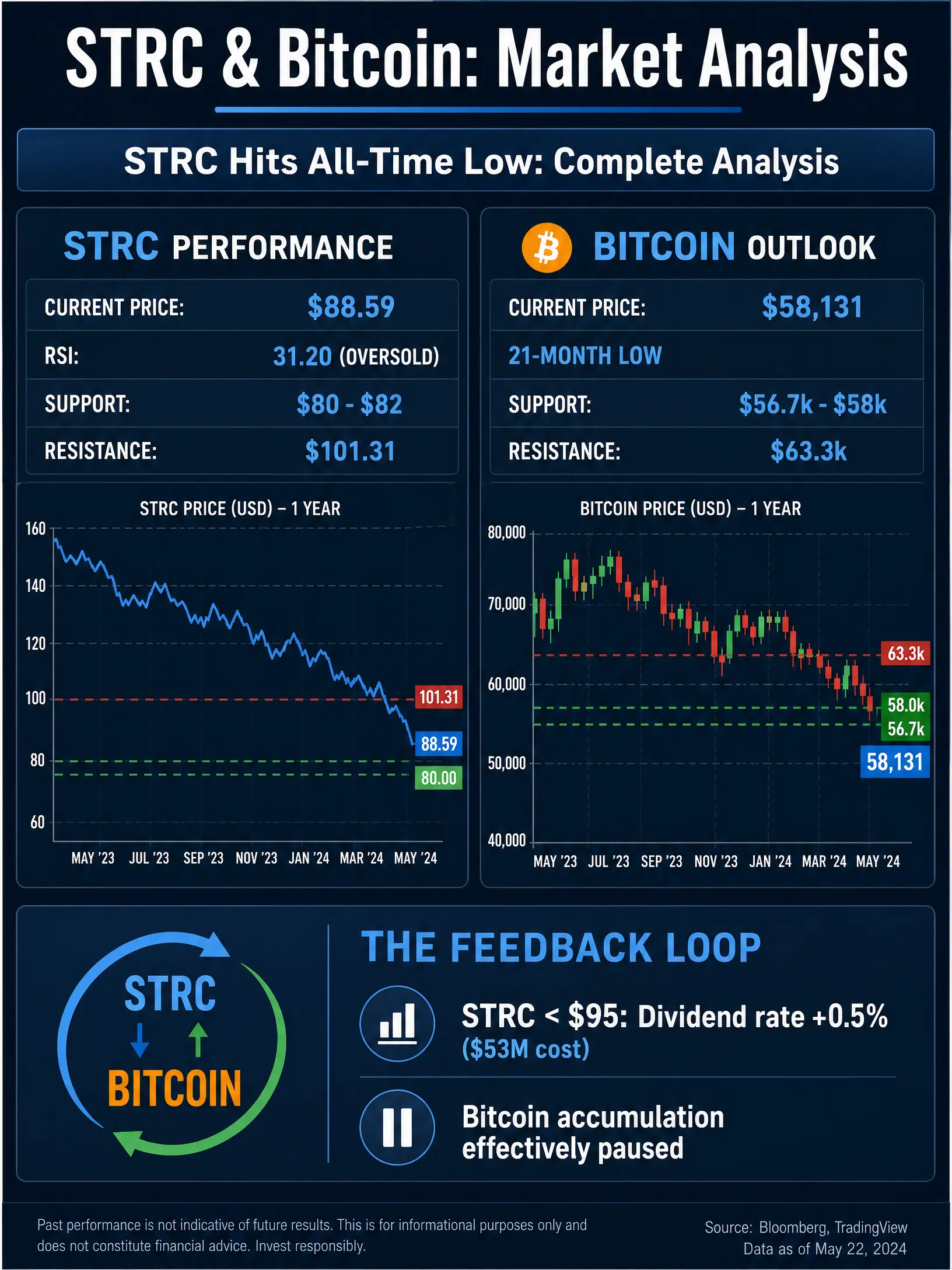
From a technical analysis perspective STRC is currently trading in a precarious position with well defined support at 91.67 dollars and resistance at 101.31 dollars. However given that the stock has broken below this support level the next critical support zone appears to be around 80 to 82 dollars based on recent price action. The Relative Strength Index for STRC over the 14 day period is currently at 31.20 which technically suggests the stock is approaching oversold territory but still indicates a sell signal. Traders should watch for any potential bounce from current levels but be prepared for further downside if the 80 dollar level fails to hold. The Moving Average Convergence Divergence indicator is showing bearish momentum which aligns with the overall negative sentiment surrounding the stock.
Bitcoin's current price action has been equally challenging with the cryptocurrency experiencing a brutal selloff that has sent shockwaves through the entire digital asset market. Bitcoin recently fell to an intraday low of 58,131 dollars on June 25 2026 marking its lowest level since September 2024 and representing a 21 month low. This extends a 6.6 percent decline over the last week with the cryptocurrency now down approximately 23 percent over the past month. The price has dropped more than 50 percent from its record high of just over 126,000 dollars reached in October 2025 creating significant pain for holders and forcing many investors to reassess their positions.
Several key factors have contributed to Bitcoin's dramatic decline and understanding these drivers is crucial for developing an effective trading strategy. First and foremost continued money outflows from spot Bitcoin ETFs have created persistent selling pressure with United States spot Bitcoin ETFs recording net outflows of 113.78 million dollars as of June 23 while weekly outflows stood at 181.96 million dollars. This institutional exodus represents a major shift in sentiment among large investors who had previously been accumulating Bitcoin through these regulated vehicles. Additionally expectations that interest rates could remain higher for longer have made investors more cautious about riskier assets including Bitcoin as the Federal Reserve maintains a hawkish stance on monetary policy.
Macroeconomic headwinds have also played a significant role in Bitcoin's decline with geopolitical tensions and uncertainty surrounding the Middle East conflict creating risk off sentiment across global markets. The cryptocurrency has fallen below its 200 week moving average which technically signals a bear market for Bitcoin and indicates that more investors are holding bearish positions. Furthermore approximately 10 billion dollars in options bets on Bitcoin are set to expire which could fuel additional volatility and potentially trigger a cascade of selling if key support levels are breached.
From a technical analysis standpoint Bitcoin is currently facing critical support and resistance levels that will determine its next major move. The immediate support zone lies between 56,760 dollars and 58,000 dollars with a breakdown below this level potentially opening the door to a move toward 54,000 to 56,000 dollars. Analysts have warned that a sustained break below 60,000 dollars could trigger a cascade effect leading to significantly lower prices. On the upside resistance is expected around 63,300 dollars followed by 65,000 dollars and ultimately the psychologically important 70,000 dollar level. The probability of Bitcoin falling below 50,000 dollars in 2026 has jumped to 64 percent according to market analysis while the odds of a move below 45,000 dollars stand at 46 percent.
For traders looking to navigate the current environment several strategies should be considered based on risk tolerance and market outlook. Conservative traders may want to wait for clear confirmation of a bottom formation before entering new long positions with key levels to watch being a sustained break above 63,300 dollars followed by 65,000 dollars. More aggressive traders might consider scaling into positions at current levels while using strict stop losses below 56,000 dollars to manage downside risk. Dollar cost averaging remains a viable strategy for long term believers in Bitcoin allowing investors to accumulate at lower prices while reducing the impact of volatility. Short term traders should focus on range bound strategies between 58,000 and 63,000 dollars while monitoring volume and momentum indicators for breakout signals.
The relationship between STRC and Bitcoin remains symbiotic with weakness in one asset typically translating to pressure on the other. As STRC continues to trade below par value Strategy's ability to fund additional Bitcoin purchases is constrained which removes a significant source of buying pressure from the market. This dynamic creates a feedback loop where declining Bitcoin prices hurt STRC which in turn limits Bitcoin accumulation potential. Traders should monitor both assets simultaneously as any recovery in STRC above 95 dollars could signal renewed institutional appetite for Bitcoin while continued weakness may foreshadow further downside.
Risk management is paramount in the current environment given the elevated volatility and uncertainty surrounding both STRC and Bitcoin. Position sizing should be conservative with traders risking no more than 1 to 2 percent of their portfolio on any single trade. Stop losses should be placed at logical technical levels and traders should be prepared for the possibility of rapid price movements in either direction. Diversification across different asset classes can help mitigate the risks associated with concentrated exposure to cryptocurrency markets.
Looking ahead the outlook for both STRC and Bitcoin remains uncertain with much depending on broader macroeconomic conditions and institutional sentiment. For STRC to recover it will need to reclaim the 95 dollar level and ideally move back toward its 100 dollar par value which would restore confidence in Strategy's funding mechanism. Bitcoin will need to hold above 56,000 dollars and eventually break back above 65,000 dollars to signal that the worst of the selling is over. Traders should remain vigilant monitoring key technical levels and news flow while maintaining disciplined risk management practices in this challenging market environment.#USMayPCEInflationRisesTo4.1%HighestIn3Years #BTCProbes60KKeySupportLevel
repost-content-media
  • Reward
  • 1
  • Repost
  • Share
HighAmbition:
2026 GOGOGO 👊
📉 Grayscale GBTC Redemption History – The Original Outflow Engine
Grayscale Bitcoin Trust (GBTC) was the first major publicly traded Bitcoin vehicle in the US (launched as a trust in 2013). Its conversion to a spot ETF on January 11, 2024 triggered one of the largest and most sustained redemption waves in crypto ETF history.
Key Redemption Timeline
Pre-ETF (as Trust): Traded at significant premiums for years. No direct redemption mechanism — investors had to sell on secondary market.
Jan 11, 2024 – ETF Conversion: Creation/redemption program launched. Massive wave of redemptions began immedia
BTC-2.43%
ETH-5.37%
  • Reward
  • 3
  • Repost
  • Share
GateUser-0834a1ba:
1000x Vibes 🤑
View More
$BTC
Bitcoin continues to trade under significant market pressure as investors closely monitor whether the world’s largest cryptocurrency can stabilize above its current support zone. Following several weeks of elevated volatility, BTC remains in a critical phase in which price action is being shaped more by macroeconomic conditions, institutional positioning, liquidity dynamics, and shifting investor sentiment than by speculation alone.
The current market structure reflects a period of consolidation after sustained selling pressure. While short-term traders continue to react to economic he
BTC-2.43%
post-image
  • Reward
  • 7
  • Repost
  • Share
CryptoNova:
2026 GOGOGO 👊
View More
#BTCProbes60KKeySupportLevel
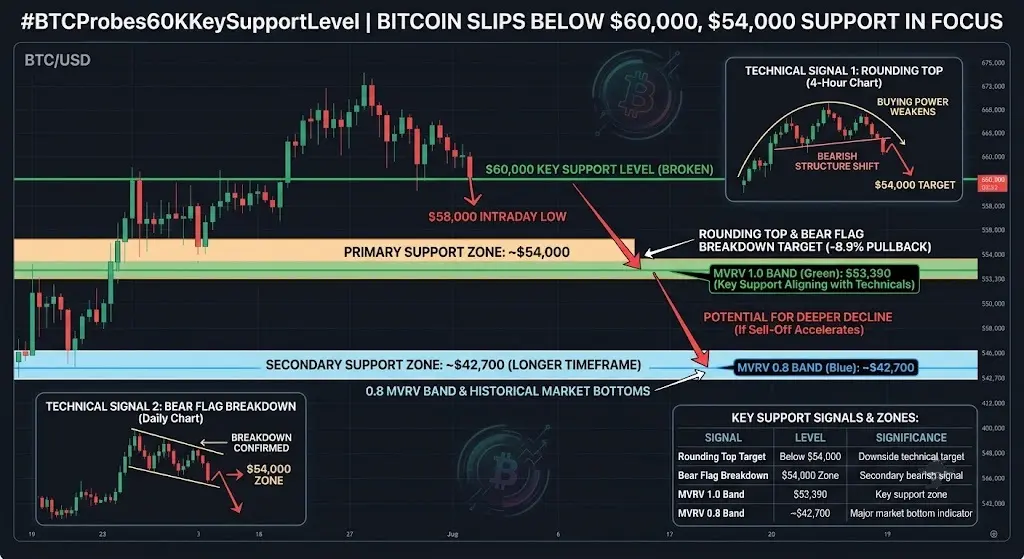
Bitcoin slips below $60,000, bringing the $54,000 support level into focus
Bitcoin fell below $60,000 on Thursday, dropping as low as $58,000.
Technical indicators point to the area just below $54,000 as a common target for BTC.
Data places the 1.0 MVRV band at $53,390, a level that aligns with the technical outlook.
If the sell-off intensifies, the $42,700 level—corresponding to the 0.8 MVRV band—is also being monitored.
Bitcoin’s drop below $60,000 on Thursday heightened selling pressure across the cryptocurrency market. Losses in technology stocks dampened risk
BTC-2.43%
ybaser
#BTCProbes60KKeySupportLevel
Bitcoin slips below $60,000, bringing the $54,000 support level into focus
Bitcoin fell below $60,000 on Thursday, dropping as low as $58,000.
Technical indicators point to the area just below $54,000 as a common target for BTC.
Data places the 1.0 MVRV band at $53,390, a level that aligns with the technical outlook.
If the sell-off intensifies, the $42,700 level—corresponding to the 0.8 MVRV band—is also being monitored.
Bitcoin’s drop below $60,000 on Thursday heightened selling pressure across the cryptocurrency market. Losses in technology stocks dampened risk appetite, placing additional strain on a market that already appeared fragile. BTC, which retreated to around $58,000 during intraday trading, erased its gains from June.
The $54,000 level stands out in the technical outlook
Analysis indicates that Bitcoin’s slide below $60,000 triggered multiple bearish signals simultaneously. A "rounding top" pattern forming on the four-hour chart suggests that buying power is gradually weakening and the bullish trend is shifting toward a bearish structure. Within this framework, a downside target can be technically calculated once the price breaks below the pattern's support level.
Bitcoin’s drop below $60,000 completely wiped out the gains recorded throughout June and confirmed multiple bearish patterns.
Based on this metric, the downside target lies just below $54,000. This level implies a further pullback of approximately 8.9% from current prices. The fact that the bearish flag breakdown observed on the daily chart also points to the same region reinforces the technical scenario.
MVRV is an indicator that compares Bitcoin’s market value to the average cost basis at the time the coins were last moved on-chain. This metric is used to monitor whether the price is approaching zones of historical extreme profit or extreme loss.
Rounding top formation Below $54,000 Downside technical target
Bear flag breakdown $54,000 zone Secondary bearish signal
MVRV 1.0 band $53,390 Key support zone
On-chain data also pointed to the same zone
On-chain price bands revealed a similar picture. MVRV price bands compare Bitcoin’s market price with the average price at which it last moved on-chain.
On Wednesday, while Bitcoin was trading around the $60,997 level, the 1.0 MVRV band (indicated in green) was situated near $53,390. The fact that this level largely coincides with the $54,000 zone—highlighted in technical analysis—has made this area even more significant.
Possibility of a deeper pullback also noted
However, if selling pressure accelerates, lower levels could also come into play. The analysis noted that the 0.8 MVRV band (indicated in blue) sits at approximately $42,700. It is observed that in past market cycles, major market bottoms formed near this band, and selling pressure intensified during periods when unrealized losses rose sharply.
Therefore, while the $54,000 area is being monitored as the primary support in the short term, the $42,700 band is being watched as another key zone over a longer timeframe in the event of a deeper decline.
$BTC
repost-content-media
  • Reward
  • 10
  • Repost
  • Share
Yajing:
2026 GOGOGO 👊
View More
#BTCProbes60KKeySupportLevel
📉 Every Bull Market Faces a Test—Bitcoin Is Now Approaching One of Its Most Important Levels
Financial markets rarely move in a straight line, and Bitcoin is proving that once again. After months of optimism, a combination of macroeconomic uncertainty and weakening investor sentiment has pushed the market into a challenging phase, placing one of its most closely watched price levels under pressure.
The recent decline isn't being driven by a single event. Persistent inflation concerns, expectations of tighter monetary policy, rising Treasury yields, and continued
BTC-2.46%
post-image
post-image
  • Reward
  • 6
  • Repost
  • Share
Yusfirah:
2026 GOGOGO 👊
View More
$USD1
USD1 is doing exactly what a strong stablecoin should do during market volatility: staying stable, holding the peg, and attracting strong inflows. While BTC, ETH, and SOL are red, USD1 remains firm around $1.0006.
The real bullish signal here is not price movement, it is stability plus adoption. With strong 24h volume and major inflow, USD1 is proving its role as a safe liquidity layer while the rest of the market is volatile. In a shaky market, stable demand is also a bullish signal.
#USMayPCEInflationRisesTo4.1%HighestIn3Years
#PredictionMarketsHitRecordVolume
#Get2SharesOfSKHynixAt
USD1-0.08%
  • Reward
  • 4
  • Repost
  • Share
TheCandlestickChartLooksLikeAn:
When BTC, ETH, and SOL all turn green, the 1.0006 of USD1 is a soothing pill.
View More
#BTCProbes60KKeySupportLevel
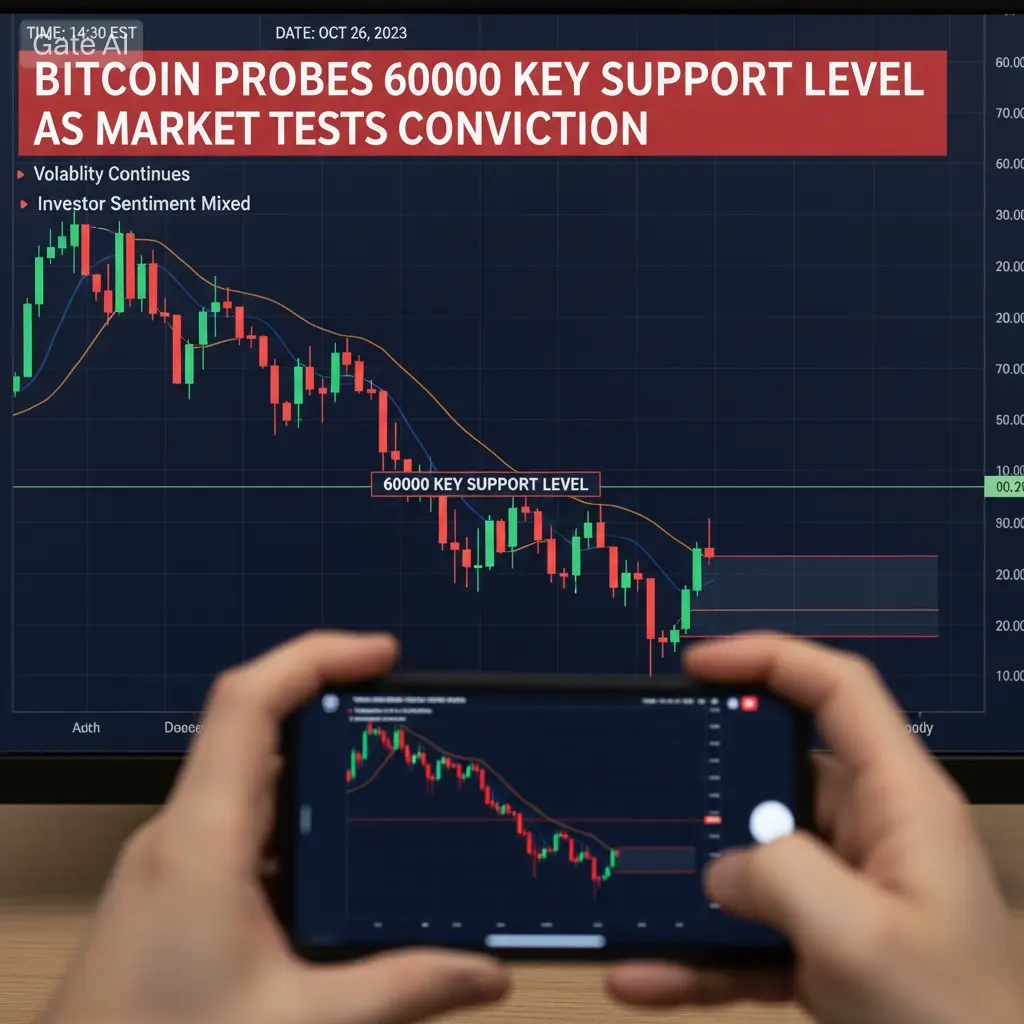
**Bitcoin Probes 60000 Key Support Level as Market Tests Conviction**
Bitcoin is currently probing the important 60000 psychological support level as the market assesses buyer interest following recent volatility. This zone has acted as both resistance and support in previous cycles, making the current test particularly significant for near-term price action.
Personally, I think the way Bitcoin interacts with this level will provide useful information about underlying market strength. Another important factor is the volume and buyer response around 60000. Right no
BTC-2.43%
post-image
  • Reward
  • 1
  • Repost
  • Share
HighAmbition:
thnx for sharing
Load More

Join 40 M users in our growing community

⚡️ Join 40 M users in the crypto craze discussion
💬 Engage with your favorite top creators
👍 See what interests you
  • Pinned