
# USOCCIssuesNewStablecoinRules

9.4K
#USOCCIssuesNewStablecoinRules — The Digital Dollar Grows Up
Something significant just happened in U.S. crypto policy and it didn’t come in the form of a ban, a lawsuit, or a crackdown headline.
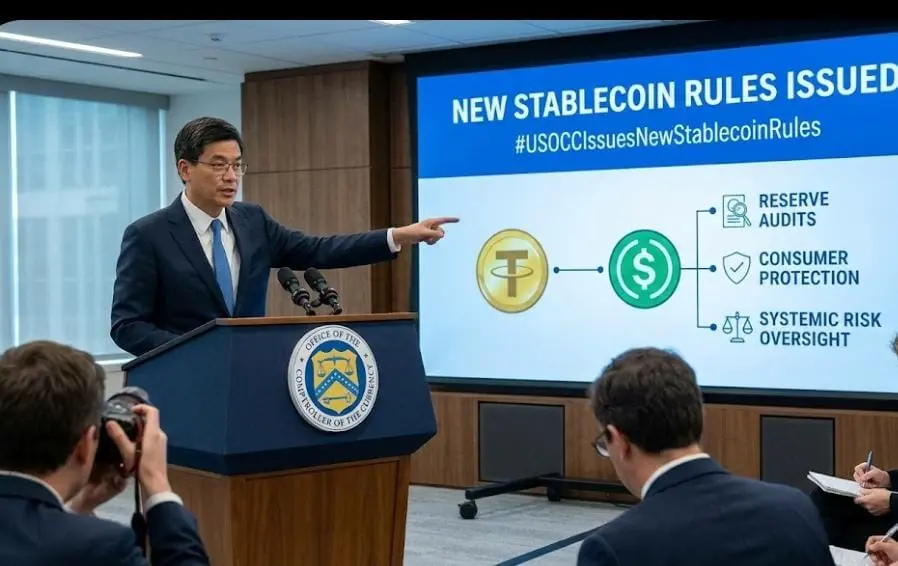
Instead, the Office of the Comptroller of the Currency (OCC) issued structured guidance clarifying how federally regulated banks can engage with stablecoins. It’s not dramatic. It’s not loud. But it may be one of the most important signals yet that stablecoins are moving from the edge of finance to its core.
For years, stablecoins have powered the crypto ecosystem quietly in the background. They are t
USDC-0.01%
post-image
post-image
  • Reward
  • 10
  • Repost
  • Share
MissCryptovip:
Ape In 🚀
View More
#USOCCIssuesNewStablecoinRules
Recent developments in the United States regulatory landscape have brought significant attention to stablecoin regulation. The hashtag #USOCCIssuesNewStablecoinRules refers to newly proposed guidance from the U.S. Office of the Comptroller of the Currency regarding how stablecoin issuers should operate, hold reserves, and manage risk.
This shift is part of a broader effort by U.S. regulators to provide clearer boundaries for stablecoin markets, improve consumer protections, and reduce systemic risk tied to digital dollar‑like assets that are increasingly used fo
post-image
  • Reward
  • 6
  • Repost
  • Share
SheenCryptovip:
2026 GOGOGO 👊
View More
#USOCCIssuesNewStablecoinRules – A Defining Moment for Digital Finance
The U.S. financial system is entering a new era as the Office of the Comptroller of the Currency (OCC) introduces updated regulatory guidance for stablecoins
. Under the trending hashtag #USOCCIssuesNewStablecoinRules, the development is being viewed as a pivotal step toward bringing greater clarity, oversight, and legitimacy to the rapidly expanding digital asset ecosystem.
Stablecoins — cryptocurrencies designed to maintain a stable value by being pegged to fiat currencies like the U.S. dollar — have grown into a multi-bi
USDC-0.01%
  • Reward
  • Comment
  • Repost
  • Share
#USOCCIssuesNewStablecoinRules – A Defining Moment for Digital Finance
The U.S. financial system is entering a new era as the Office of the Comptroller of the Currency (OCC) introduces updated regulatory guidance for stablecoins
. Under the trending hashtag #USOCCIssuesNewStablecoinRules, the development is being viewed as a pivotal step toward bringing greater clarity, oversight, and legitimacy to the rapidly expanding digital asset ecosystem.
Stablecoins — cryptocurrencies designed to maintain a stable value by being pegged to fiat currencies like the U.S. dollar — have grown into a multi-bi
USDC-0.01%
post-image
  • Reward
  • 1
  • Repost
  • Share
ybaservip:
Diamond Hands 💎
#USOCCIssuesNewStablecoinRules
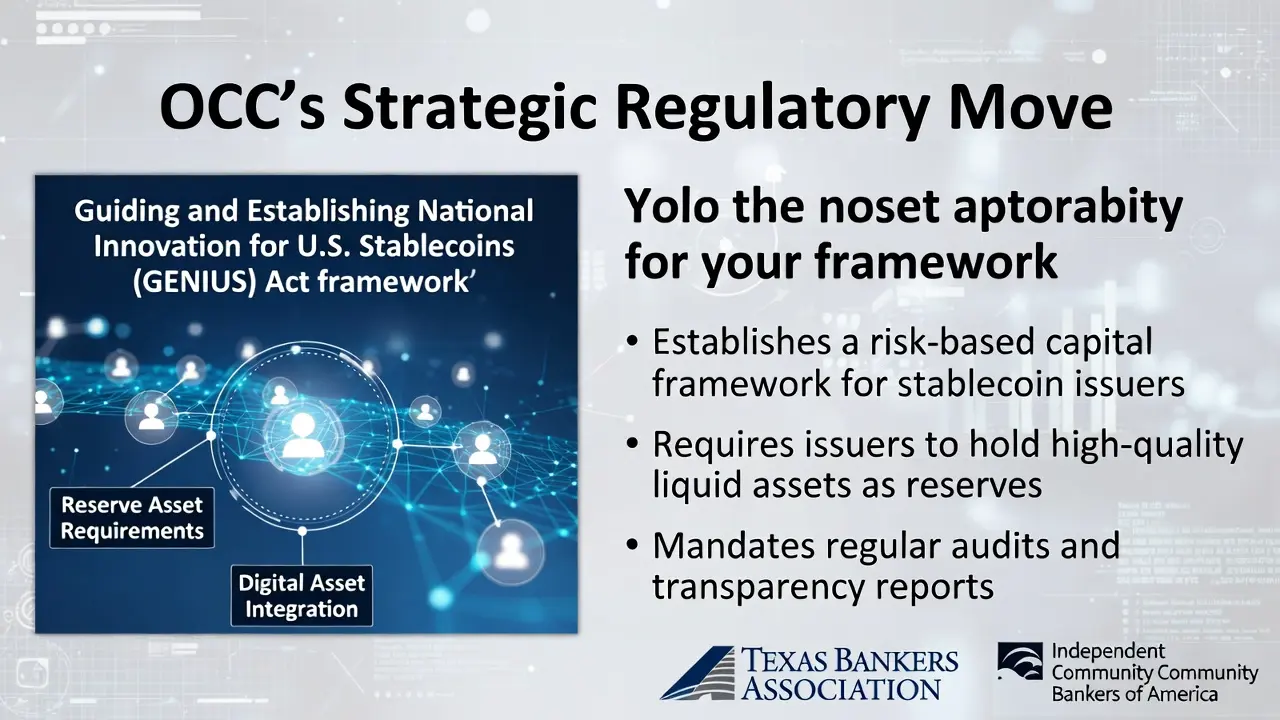
The Office of the Comptroller of the Currency has released a landmark draft proposal that could fundamentally redefine how stablecoins operate inside the United States financial system. Under the broader framework of the GENIUS Act, this proposal moves stablecoins away from regulatory gray zones and toward a structured, bank-supervised model.
As of March 2026, this is not just a compliance update it is a structural pivot. The U.S. is signaling that payment stablecoins are to be treated as digital cash equivalents, not speculative crypto assets, and certainly no
USDC-0.01%
post-image
  • Reward
  • 8
  • Repost
  • Share
MoonGirlvip:
Ape In 🚀
View More
#USOCCIssuesNewStablecoinRules The new stablecoin regulatory proposal released by the Office of the Comptroller of the Currency marks a significant step toward federal oversight of the U.S. digital payment asset ecosystem under the framework of the GENIUS Act. The draft rule introduces a tightly controlled licensing system for payment stablecoin issuers, emphasizing risk management, reserve transparency, and operational compliance for institutions operating within U.S. jurisdiction. Regulators aim to position stablecoins as cash-like financial instruments rather than investment products, which
MrFlower_XingChenvip
#USOCCIssuesNewStablecoinRules The new stablecoin regulatory proposal released by the Office of the Comptroller of the Currency marks a significant step toward federal oversight of the U.S. digital payment asset ecosystem under the framework of the GENIUS Act. The draft rule introduces a tightly controlled licensing system for payment stablecoin issuers, emphasizing risk management, reserve transparency, and operational compliance for institutions operating within U.S. jurisdiction. Regulators aim to position stablecoins as cash-like financial instruments rather than investment products, which could fundamentally reshape how digital dollar equivalents function in global finance.
One of the most important requirements in the proposal is the strict 1:1 reserve backing rule. Issuers of permitted payment stablecoins will be required to maintain segregated and non-commingled reserve assets equal to or greater than the value of outstanding tokens. These reserves must be held either directly by the issuing institution or within approved financial custodians. The policy defines eight categories of eligible reserve assets and requires continuous fair-value monitoring to ensure that the redemption value of the stablecoin remains stable and reliable for users.
The proposal also strengthens redemption guarantees by mandating fast and secure conversion mechanisms that allow stablecoin holders to exchange their tokens for traditional currency at the fixed nominal value. At the same time, the rule explicitly prohibits interest-based yield programs or indirect return incentives tied to stablecoin storage or usage. This restriction is designed to prevent stablecoins from evolving into yield-generating investment assets and instead maintain their role as payment settlement tools within the financial system.
Regulators are also considering limiting each issuer to a single branded stablecoin product, which could significantly affect multi-token issuance platforms and white-label infrastructure providers operating in the digital asset sector. Companies and financial technology bridges associated with institutional payment networks may need to redesign their business models if this restriction is finalized. Additionally, the proposal sets a minimum capital requirement of approximately five million U.S. dollars for new stablecoin issuers entering the market.
The public comment period for the draft rule will remain open for sixty days after its publication in the Federal Register, allowing industry participants, banks, and technology firms to provide feedback. If implemented, the regulation could create a unified federal framework for stablecoin issuance in the United States, replacing fragmented state-level oversight with centralized supervision. Market analysts believe the policy may encourage institutional adoption while simultaneously imposing stricter compliance burdens on emerging digital asset startups.

repost-content-media
  • Reward
  • 1
  • Repost
  • Share
Yunnavip:
2026 GOGOGO 👊
#USOCCIssuesNewStablecoinRules
The regulatory landscape for stablecoins just shifted.
The Office of the Comptroller of the Currency (OCC) has issued new guidance on how federally chartered banks can engage with stablecoins — and this move could reshape the intersection of traditional finance and crypto infrastructure.
This isn’t just a policy update. It’s a signal.
Stablecoins sit at the core of the digital asset economy. They power trading pairs, cross-border settlements, DeFi protocols, payroll systems, and increasingly, real-world asset tokenization. When a U
  • Reward
  • 2
  • Repost
  • Share
EagleEyevip:
watching closely
View More
#USOCCIssuesNewStablecoinRules 🚨
The U.S. is finally drawing the line for stablecoins. On Feb 25, 2026, the Office of the Comptroller of the Currency (OCC) unveiled a massive 376-page proposal implementing the GENIUS Act—a federal framework for payment stablecoins (USD-pegged coins built for payments and settlements). This is not guidance—it’s enforceable rules, and it’s going to reshape the game.
Who’s affected?
✅ National bank subsidiaries
✅ Federal-qualified and large state-qualified issuers
✅ Foreign issuers operating in the U.S.
❌ Smaller issuers, DeFi-only tokens, or non-payment stablec
USDC-0.01%
post-image
post-image
  • Reward
  • 3
  • Repost
  • Share
Yunnavip:
Buy To Earn 💰️
View More
🚨 #USOCCIssuesNewStablecoinRules 🚨
The U.S. Office of the Comptroller of the Currency (OCC) has announced new regulatory guidelines for stablecoins, aiming to strengthen oversight and ensure financial stability. Under these new rules:
Banks can now issue stablecoins directly, provided they meet strict compliance and reserve requirements.
Enhanced transparency is required for stablecoin reserves, ensuring that each token is fully backed by liquid assets.
Risk management protocols must be implemented to safeguard against operational, cyber, and liquidity risks.
Consumer protections are emphasi
post-image
  • Reward
  • 4
  • Repost
  • Share
EagleEyevip:
Absolutely impressive post
View More
#USOCCIssuesNewStablecoinRules
The U.S. Office of the Comptroller of the Currency (OCC) has taken a landmark step in crypto regulation by issuing a comprehensive Notice of Proposed Rulemaking (NPRM) on February 25, 2026, to implement key provisions of the Guiding and Establishing National Innovation for U.S. Stablecoins Act (commonly known as the GENIUS Act), which was signed into law on July 18, 2025. This 376-page proposal—often referred to in headlines as the "new stablecoin rules"—lays out the first detailed federal supervisory framework specifically for payment stablecoins (USD-pegged di
USDC-0.01%
DAI0.04%
ETH5.12%
HighAmbitionvip
#USOCCIssuesNewStablecoinRules
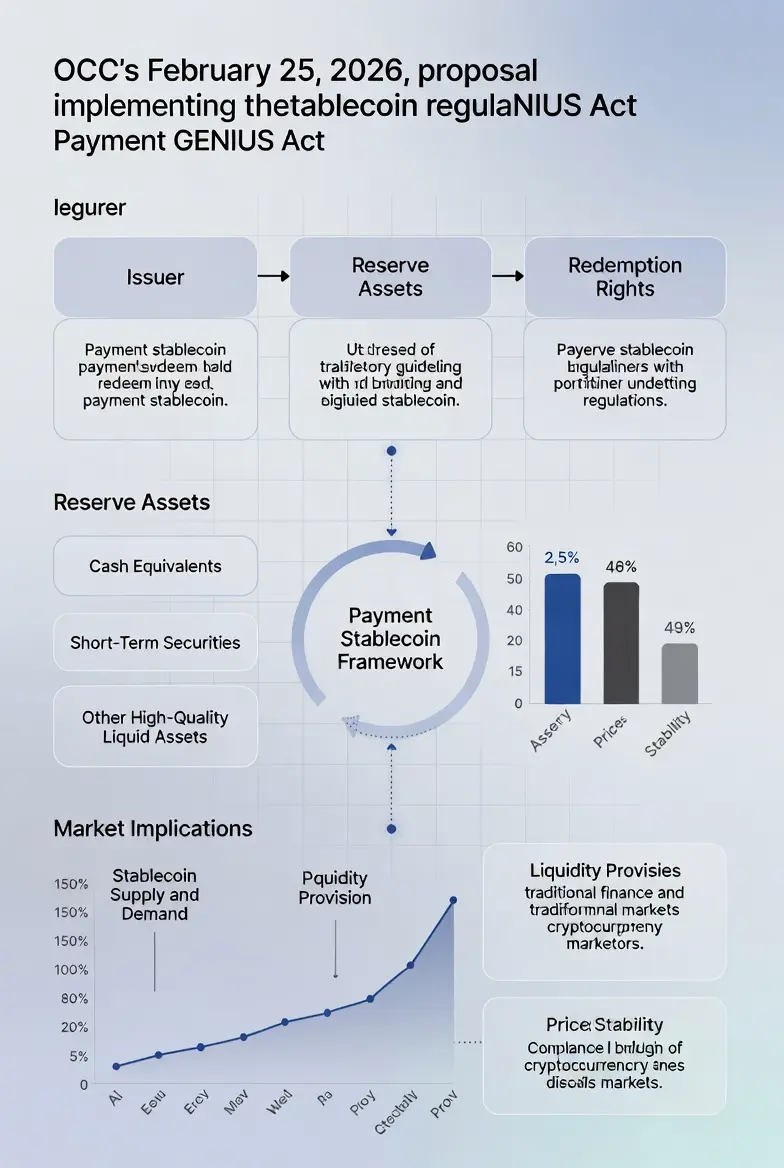
The U.S. Office of the Comptroller of the Currency (OCC) has taken a landmark step in crypto regulation by issuing a comprehensive Notice of Proposed Rulemaking (NPRM) on February 25, 2026, to implement key provisions of the Guiding and Establishing National Innovation for U.S. Stablecoins Act (commonly known as the GENIUS Act), which was signed into law on July 18, 2025. This 376-page proposal—often referred to in headlines as the "new stablecoin rules"—lays out the first detailed federal supervisory framework specifically for payment stablecoins (USD-pegged digital assets designed for payments and settlement). It applies to entities under OCC jurisdiction, including national bank subsidiaries, federal qualified issuers, certain state-qualified issuers, and foreign issuers operating in the U.S.
.
1. Background: The GENIUS Act and Why the OCC's Proposal Matters
GENIUS Act Overview (Enacted July 18, 2025): Establishes a federal framework for "payment stablecoins" — digital assets that maintain a stable value relative to fiat currency (primarily USD) and are intended for use as a means of payment or settlement.
Core prohibitions: Only "permitted payment stablecoin issuers" (PPSIs) can issue payment stablecoins in the U.S. Digital asset service providers (e.g., exchanges) generally cannot offer or sell them to U.S. persons unless issued by a PPSI or qualifying foreign issuer.
The Act left detailed rules (capital, liquidity, reserves, risk management, etc.) to federal regulators like the OCC to implement via rulemaking.
OCC's Role: As the primary regulator for national banks and certain nonbanks, the OCC now proposes new Part 15 to Title 12 of the Code of Federal Regulations. This covers issuance, custody, reserves, redemption, capital, and more for OCC-supervised entities.
Effective Date Timeline: The GENIUS Act becomes effective 18 months after enactment (January 2027) or 120 days after final rules from primary regulators—whichever comes first. The OCC's proposal is a major piece; comments are due 60 days after Federal Register publication (expected early March 2026).
2. Scope and Who It Applies To
Permitted Payment Stablecoin Issuers (PPSIs) under OCC jurisdiction:
Subsidiaries of national banks or federal savings associations.
Federal qualified nonbank issuers.
State-qualified nonbank issuers (if they exceed $10 billion in issuance, they must transition to federal oversight within 360 days or cease net new issuance; waiver possible).
Foreign payment stablecoin issuers (OCC has regulatory authority).
Excludes non-payment stablecoins (e.g., algorithmic or yield-bearing tokens) and issuers without OCC authority.
Also covers custody activities by OCC-supervised banks (e.g., holding reserves or stablecoins).
3. Key Requirements in the Proposed Rules
Reserve Assets (1:1 Backing):
Issuers must hold identifiable, segregated reserves with fair value ≥ outstanding stablecoins at all times.
Permissible assets: High-quality, liquid items (e.g., U.S. Treasuries, central bank deposits, cash equivalents—mirroring GENIUS Act list).
Reserves can be held directly or via eligible custodians (including affiliates).
Strict segregation and record-keeping to prevent commingling.
Redemption Rights:
Holders must be able to redeem stablecoins promptly at par value (1:1 with USD).
Clear processes for timely redemption, even in stress scenarios.
Capital Requirements:
Minimum $5 million for newly formed (de novo) issuers.
Risk-based capital for ongoing operations to ensure safety and soundness.
Prohibition on Interest/Yield:
Bright-line ban: PPSIs cannot pay interest, yield, or rewards to holders solely for holding/using/retaining the stablecoin.
Rebuttable presumption against arrangements where issuers pay yield to third parties (e.g., affiliates/exchanges) that then pass it to holders—aimed at preventing bypass via white-label or partnership models.
This could impact platforms like Coinbase (which shares revenue with issuers like Circle for USDC rewards).
Risk Management & Operational Standards:
Robust policies for liquidity, operational risk, cybersecurity, AML/BSA compliance (separate rulemaking pending).
Limits on activities to prevent balance-sheet expansion beyond core payment functions.
Licensing & Supervision:
Application process for becoming a PPSI.
Ongoing examination, reporting (quarterly), and enforcement authority.
Potential restriction: One brand per issuer (with streamlined affiliate approvals) to reduce contagion risks.
4. Why This Matters: Broader Context and Goals
Clarity & Safety: Ends years of uncertainty post-2022 collapses (e.g., TerraUSD, concerns over Tether/USDC reserves).
Integration with Traditional Finance: Encourages banks to issue or custody stablecoins safely, bridging TradFi and crypto.
Consumer Protection: 1:1 reserves, audits, and redemption reduce run risks and fraud.
Innovation Balance: Aims to let the industry "flourish in a safe and sound manner" while preventing misuse.
Global Impact: Sets a precedent; foreign issuers must comply if serving U.S. users.
5. Market Implications & Potential Effects
Positive for Regulated Issuers:
USDC (Circle) and similar bank-affiliated tokens could gain trust and institutional adoption.
Banks may enter/expand stablecoin activities confidently.
Challenges & Risks:
Yield/reward restrictions could pressure business models (e.g., DeFi integrations, exchange incentives).
Compliance costs may raise barriers for smaller issuers.
Short-term volatility if markets interpret rules as restrictive.
Stablecoin Market Reaction:
Major USD stablecoins (USDT, USDC, DAI, etc.) dominate ~$150B+ market cap.
Proposal reinforces USD dominance but could shift volume to fully compliant issuers.
Institutional inflows may accelerate; retail/DeFi users watch for yield impacts.
Broader Crypto Ecosystem:
Boosts legitimacy, potentially lifting ETH/BTC sentiment amid regulatory progress.
Complements other efforts (e.g., Clarity Act discussions).
If finalized, could reduce offshore risks and enhance U.S. competitiveness.
6. Next Steps & How to Engage
Comment Period: 60 days from Federal Register publication—industry groups, issuers, and users encouraged to submit feedback.
Final Rule: Expected later in 2026; could evolve based on comments.
Monitoring: Track OCC site, Federal Register, and updates from issuers like Circle/Paxos.
Conclusion
The OCC's February 25, 2026, proposal to implement the GENIUS Act marks the most comprehensive federal stablecoin framework yet—shifting from guidance/interpretive letters to enforceable rules. It prioritizes safety, transparency, and 1:1 backing while banning yield to keep stablecoins cash-like. This bridges traditional banking and digital assets, fostering responsible growth but requiring adaptation from issuers and platforms.
Short-term: Expect scrutiny on yield models and compliance adjustments. Long-term: Stronger foundation for mainstream adoption and institutional confidence.
repost-content-media
  • Reward
  • 2
  • Repost
  • Share
Yusfirahvip:
2026 GOGOGO 👊
View More
Load More
Trade Crypto Anywhere Anytime
qrCode
Scan to download Gate App
Community
English
  • 简体中文
  • English
  • Tiếng Việt
  • 繁體中文
  • Español
  • Русский
  • Français (Afrique)
  • Português (Portugal)
  • Bahasa Indonesia
  • 日本語
  • بالعربية
  • Українська
  • Português (Brasil)