



#加密市场回升 Earth-shattering reversal! US-Iran ceasefire sparks Bitcoin to break through $74k, with shorts wiped out by $2.6 billion overnight
The smoke from the US military blockade of the Strait of Hormuz has yet to clear, yet surprisingly, the US and Iran have sat down at the negotiation table. Iran has issued a strong signal of peace, instantly igniting market risk appetite, causing Bitcoin to surge sharply, breaking through the $74k mark. However, in this sudden celebration, shorts suffered a bloodbath, with a total liquidation of $531 million across the network within 24 hours, with shorts accounting for over 80%. Contrasting sharply with the new high in price is the outflow of ETF funds, which reversed course and withdrew $291 million. The bulls and bears are entering a fierce contest, and the market stands at a crossroads.
1. Market overview: dual currencies soar, Bitcoin hits four-week high
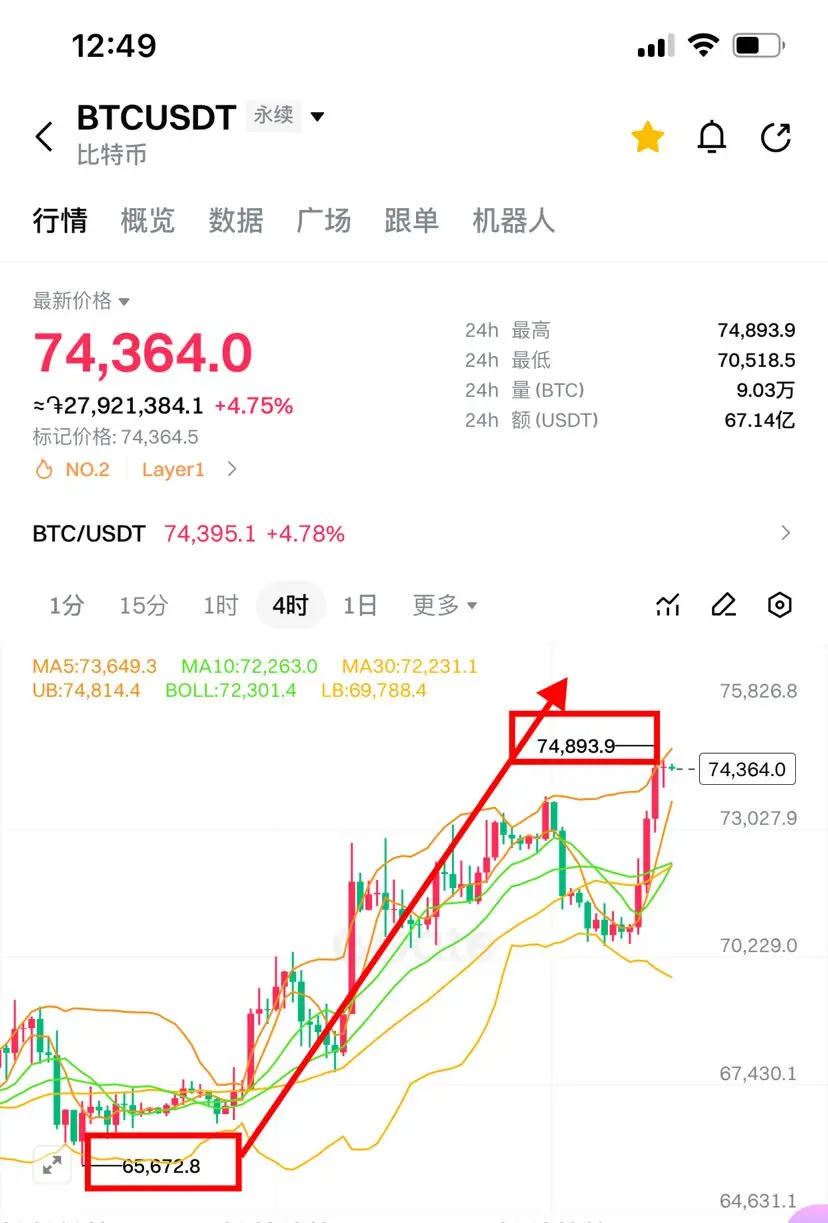
On April 14, the cryptocurrency market experienced a long-awaited rally. Bitcoin (BTC) showed strong upward momentum, briefly rising to $74,900 in early trading, hitting the highest level since March 17. As of press time, Bitcoin’s price stabilized around $74,418, up 4.78% in 24 hours, with an 8.4% increase over the past 7 days. Intraday, the price steadily rose from the support level of $70,470, eventually breaking through previous resistance with increased volume, setting a new high at $74,800, establishing a fully bullish short-term structure.
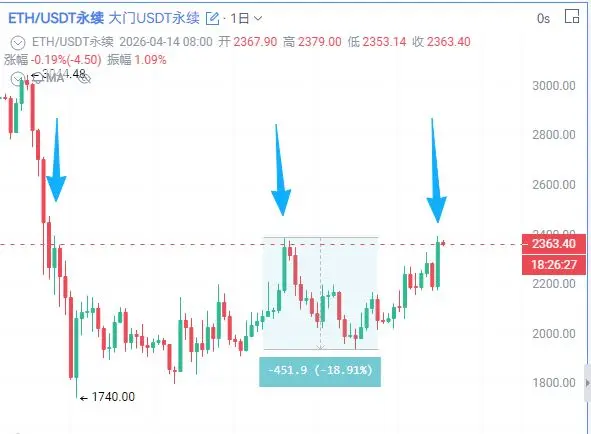
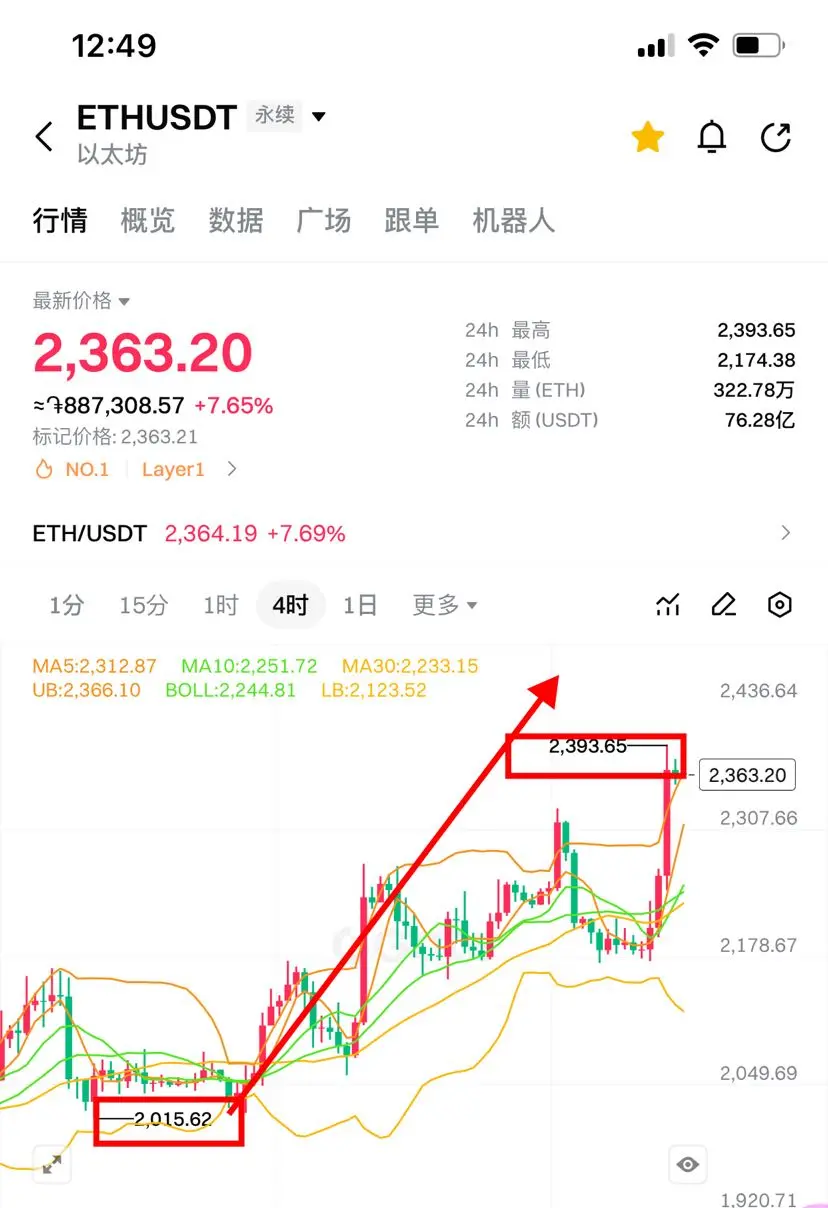
Ethereum (ETH) performed even more aggressively, rising in tandem and testing the $2,393 high. As of press time, ETH is quoted around $2,350, up 6% in 24 hours, completely breaking previous consolidation patterns, with the prior range now serving as strong support.
From trading volume, market enthusiasm is high. Bitcoin spot trading volume is about $7.1 billion, with futures trading reaching $77.6 billion; ETH spot volume also increased, with futures following closely. The total crypto market cap rebounded to approximately $1.48 trillion, a 4% increase in 24 hours.
2. The cause of the surge: US-Iran peace signals ignite risk appetite
The core catalyst for this rally comes from a dramatic turn in Middle East geopolitical tensions. On April 13, U.S. President Trump claimed Iran had engaged with the U.S. government on potential peace negotiations, despite the U.S. having begun a maritime blockade of the Strait of Hormuz. This news completely reversed the previous pessimistic expectations of ongoing deterioration.
Damien Loh, Chief Investment Officer of Ericsenz Capital, analyzed: "Although the blockade has started, the market generally believes that Trump has actually extended the timetable for reaching an agreement, and he is repeatedly seeking new negotiations, which is a positive signal."
As a result, oil prices, which had surged on the blockade news, retreated sharply, with WTI crude futures falling by 3%, to $96.07 per barrel. Asian stock markets rose, risk assets rebounded across the board, and market optimism grew that an agreement would help ease oil prices and boost economic growth.
Against this backdrop, the crypto market completed a stunning reversal, with Bitcoin strongly breaking through previous consolidation ranges. Digital assets not only absorbed the spillover of risk appetite from U.S. stocks but also benefited from the retreat of geopolitical risk premiums. This rally is similar in logic to the one two weeks ago when ceasefire news was announced—once the US and Iran return to negotiations, the previously accumulated high geopolitical risk premiums will quickly dissipate, and cryptocurrencies, as high-beta risk assets, will rebound first.
3. Liquidation data: shorts suffer a bloodbath, $426 million liquidated overnight
This sudden surge caused many short traders betting on declines to pay a painful price. CoinGlass data shows that in the past 24 hours, the total liquidation across the network reached $531 million. In the battle between bulls and bears, shorts became the absolute "biggest casualties"—short liquidations totaled $426 million, while long liquidations were only $105 million. By coin, Bitcoin longs suffered heavy losses, with $11.53 million in long liquidations and $218 million in short liquidations; ETH was similarly brutal, with $21.76 million in long liquidations and $114 million in short liquidations. About 177,236 traders were liquidated in total, with the largest single liquidation order coming from Aster trading pair, valued at $12.4 million. This liquidation structure shows a clear "short-dominated" characteristic.
Notably, just before the surge, Bitcoin derivatives market funding rates briefly dropped to -0.253%, meaning short holders were paying longs, indicating a dominant bearish sentiment. When extremely negative funding rates coincide with declining exchange reserves, it often signals a short squeeze—this is the technical root of the bloodbath among shorts.
4. Internal market contradictions: dark currents behind new highs
Despite the strong price rally, internal market signals show signs of divergence that warrant caution.
🔴 Abnormal signal: ETF outflows of $291 million against the trend
Amid Bitcoin’s strong push above $74k and mainstream assets rallying, U.S. spot ETFs recorded a net outflow of $291 million on April 13, with price gains coinciding with capital withdrawal, creating a classic "strong price but weak funds" scenario.
Structurally, this net outflow was mainly driven by Fidelity’s FBTC: a single-day outflow of $229 million, nearly accounting for all the loss; Ark ARKB and Grayscale GBTC recorded outflows of about $62.89 million and $38.25 million respectively. This is not an isolated phenomenon for individual products but a coordinated capital exit across several leading institutions on the same day, which can be seen as a typical "profit-taking at high levels" signal: early institutions that entered via discount arbitrage or trend-following strategies are reducing positions after the price hits new highs. However, unlike the usual "ETF outflows pressure spot prices," this round of concentrated outflows did not immediately drag Bitcoin below high levels; it remains near high ground, leaving a clear question mark over whether funds will flow back or continue to retreat.
🟢 Positive signals: on-chain data shows multiple favorable signs
Meanwhile, on-chain data shows a very different picture. Exchange reserves continue to decline: from February 15 to April 10, total Bitcoin reserves on exchanges decreased from 2.8 million BTC to 74k BTC, a reduction of about 100k BTC (~$7.3 billion at current prices) in roughly two months. The decrease in tokens held on exchanges reduces immediate sell pressure.
Whales betting on longs: contrasting with the high-level profit-taking in ETFs, on-chain whales are actively accumulating. A whale address associated with a crypto financial service currently holds 120k ETH (~$283.5 million) and 700 BTC (~$52 million) in long positions, with unrealized gains exceeding $36 million. Four other addresses have jointly accumulated 112.86 WBTC, worth about $74k, reflecting strong institutional confidence in Bitcoin spot at current levels. This divergence—ETF outflows versus whale accumulation—reveals a core market contradiction: traditional financial institutions are taking profits at high levels, while "old money" on-chain is increasing positions. The battle between bulls and bears is intensifying, and who will ultimately prevail remains uncertain.
5. Market battle and outlook: three key catalysts to watch
Analysts believe that the current Bitcoin price is oscillating between $68,000 and $75,000, entering a critical trading window leading up to 2026, with three major catalysts expected to unfold in the next two weeks.
Catalyst 1: Iran ceasefire agreement expiry (April 22)
The current US-Iran temporary ceasefire is set to expire on April 22. If both sides reach a formal agreement, risk appetite will further increase, and Bitcoin could break above $75,000 to test $78,000-$80,000; if negotiations fail and tensions escalate again, Bitcoin may retest support at $68,000 or even drop to $65,000.
Catalyst 2: Senate review of the "Clarity Act" (late April)
The highly anticipated U.S. "Clarity Act" (CLARITY Act) is expected to enter Senate review in late April. If the bill progresses smoothly, it will provide clearer regulatory frameworks for crypto assets and could serve as a mid-term catalyst.
Catalyst 3: FOMC meeting (April 28-29)
The Federal Reserve’s FOMC meeting will be held on April 28-29. CME FedWatch shows a over 98% probability of holding rates steady in April and June, with rate cut expectations essentially zero. Market will focus heavily on Powell’s comments on inflation and rate outlook. Dovish signals will boost risk assets; hawkish stance may suppress rebounds.
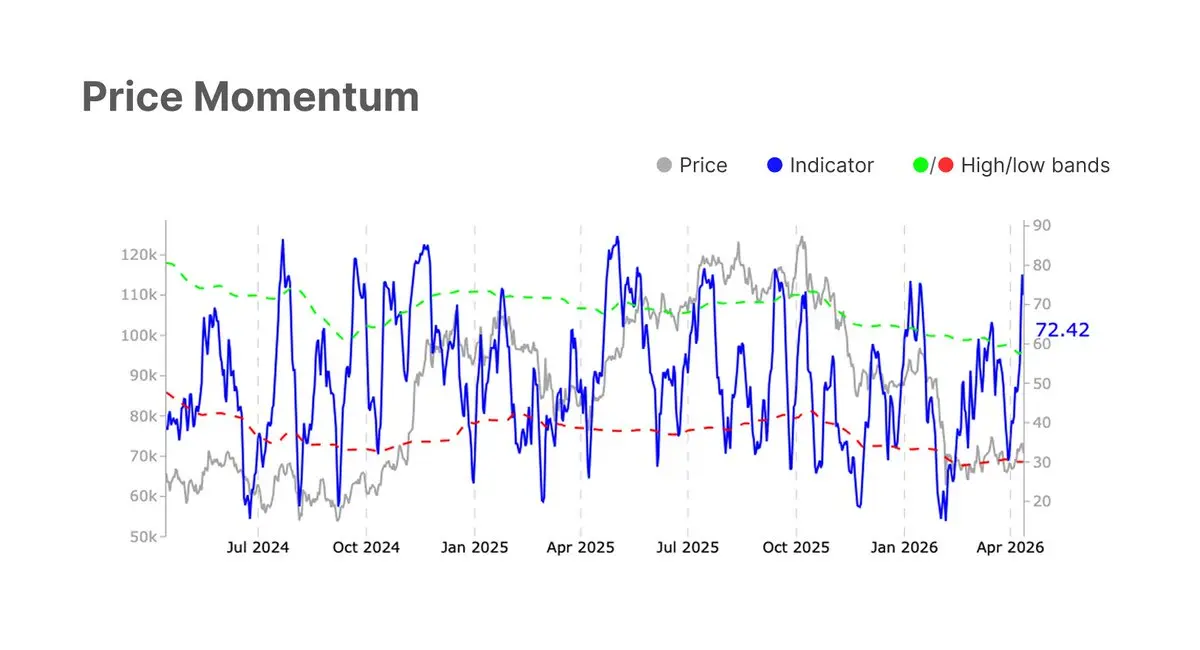
Technical outlook: From a technical perspective, Bitcoin’s 4-hour chart shows a rising low structure, forming a strong relay pattern, with previous consolidation zones turning into solid support. ETH also broke above the range with volume, thoroughly ending its previous consolidation pattern.
Key levels: Bitcoin: short-term support at $70,500 (former resistance now support), key support at $68,000; short-term resistance at $75,000, with a breakout targeting $76,000-$78,000. Liquidation pressure on exchanges is concentrated around $75,000; breaking this level could trigger a larger short squeeze.
Ethereum: short-term support at $2,200 (former upper boundary of consolidation), key support at $2,000; short-term resistance at $2,400-$2,500, with a breakout testing $2,600. ETH faces sell walls around $2,275-$2,350, but on-chain data shows buyers are accumulating on dips around $2,150-$2,180.
6. Institutional views: cautious optimism but beware of "last dip"
Damien Loh, CIO of Ericsenz Capital: "Although the blockade has started, the market generally believes Trump has extended the timetable for reaching an agreement, and he is repeatedly seeking new negotiations, which is a positive sign."
Analyst Thielen: predicts Bitcoin could rebound to $88,000 under basic scenarios, citing oversold signals in technical analysis and improved overall risk appetite.
Technical analysts warn: based on the recurring four-year cycle in Bitcoin bull markets, the current market is still interpreted as in a "selling phase," and the "last dip" may be near, so caution is advised for potential technical corrections.
ETF fund flow signals: despite Bitcoin approaching $72,262 and the "Fear & Greed Index" at a level of 12 ("extreme fear"), this combination indicates institutional buying remains resilient compared to overall market sentiment.
7. Trading strategies: responses in a divided market
Short-term traders
The market is in a heated battle between bulls and bears, with prices at key resistance zones of $74,000-$75,000.
Bullish approach: monitor support at $70,500-$71,000; if the price dips and stabilizes with volume, consider small long entries targeting $75,000-$76,000, with stops below $70,000. If volume breaks through $75,000 resistance, add to longs with targets of $78,000-$80,000.
Bearish approach: if the price rebounds to $75,000-$76,000 and shows signs of stagnation, consider small short positions targeting $72,000-$73,000, with stops above $76,500. Note that shorts are currently at a very disadvantageous position with high leverage risk.
Mid- to long-term holders are at a critical turning point—geopolitical risks easing, whales continuing to accumulate, and exchange reserves dropping to the lowest since 2023. For long-term investors, levels below $68,000 have long-term value and can be considered for phased accumulation. Focus on geopolitical developments after the ceasefire agreement expires on April 22.
Core risk warnings
Geopolitical volatility: The current ceasefire is temporary, expiring on April 22, with uncertainties. Any signs of negotiation breakdown could trigger renewed volatility, representing the biggest short-term risk.
ETF outflows: Continued large-scale outflows from ETFs could suppress price gains, creating a "strong price but weak funds" divergence.
Tax-driven sell-off: April 15 is the US tax deadline, with a potential $2.8 billion tax-related sell pressure, possibly disturbing prices in the short term.
Leverage risk: Current Bitcoin futures positions amount to about $56.3 billion, Ethereum about $30 billion, with high leverage levels that can be liquidated in volatile conditions.
Macroeconomic uncertainty: The probability of a rate cut by the Fed in April is virtually zero, and the high-interest-rate environment will continue to weigh on risk assets.
The smoke from the US military blockade of the Strait of Hormuz has yet to clear, yet surprisingly, the US and Iran have sat down at the negotiation table. Iran has issued a strong signal of peace, instantly igniting market risk appetite, causing Bitcoin to surge sharply, breaking through the $74k mark. However, in this sudden celebration, shorts suffered a bloodbath, with a total liquidation of $531 million across the network within 24 hours, with shorts accounting for over 80%. Contrasting sharply with the new high in price is the outflow of ETF funds, which reversed course and withdrew $291 million. The bulls and bears are entering a fierce contest, and the market stands at a crossroads.
1. Market overview: dual currencies soar, Bitcoin hits four-week high
On April 14, the cryptocurrency market experienced a long-awaited rally. Bitcoin (BTC) showed strong upward momentum, briefly rising to $74,900 in early trading, hitting the highest level since March 17. As of press time, Bitcoin’s price stabilized around $74,418, up 4.78% in 24 hours, with an 8.4% increase over the past 7 days. Intraday, the price steadily rose from the support level of $70,470, eventually breaking through previous resistance with increased volume, setting a new high at $74,800, establishing a fully bullish short-term structure.
Ethereum (ETH) performed even more aggressively, rising in tandem and testing the $2,393 high. As of press time, ETH is quoted around $2,350, up 6% in 24 hours, completely breaking previous consolidation patterns, with the prior range now serving as strong support.
From trading volume, market enthusiasm is high. Bitcoin spot trading volume is about $7.1 billion, with futures trading reaching $77.6 billion; ETH spot volume also increased, with futures following closely. The total crypto market cap rebounded to approximately $1.48 trillion, a 4% increase in 24 hours.
2. The cause of the surge: US-Iran peace signals ignite risk appetite
The core catalyst for this rally comes from a dramatic turn in Middle East geopolitical tensions. On April 13, U.S. President Trump claimed Iran had engaged with the U.S. government on potential peace negotiations, despite the U.S. having begun a maritime blockade of the Strait of Hormuz. This news completely reversed the previous pessimistic expectations of ongoing deterioration.
Damien Loh, Chief Investment Officer of Ericsenz Capital, analyzed: "Although the blockade has started, the market generally believes that Trump has actually extended the timetable for reaching an agreement, and he is repeatedly seeking new negotiations, which is a positive signal."
As a result, oil prices, which had surged on the blockade news, retreated sharply, with WTI crude futures falling by 3%, to $96.07 per barrel. Asian stock markets rose, risk assets rebounded across the board, and market optimism grew that an agreement would help ease oil prices and boost economic growth.
Against this backdrop, the crypto market completed a stunning reversal, with Bitcoin strongly breaking through previous consolidation ranges. Digital assets not only absorbed the spillover of risk appetite from U.S. stocks but also benefited from the retreat of geopolitical risk premiums. This rally is similar in logic to the one two weeks ago when ceasefire news was announced—once the US and Iran return to negotiations, the previously accumulated high geopolitical risk premiums will quickly dissipate, and cryptocurrencies, as high-beta risk assets, will rebound first.
3. Liquidation data: shorts suffer a bloodbath, $426 million liquidated overnight
This sudden surge caused many short traders betting on declines to pay a painful price. CoinGlass data shows that in the past 24 hours, the total liquidation across the network reached $531 million. In the battle between bulls and bears, shorts became the absolute "biggest casualties"—short liquidations totaled $426 million, while long liquidations were only $105 million. By coin, Bitcoin longs suffered heavy losses, with $11.53 million in long liquidations and $218 million in short liquidations; ETH was similarly brutal, with $21.76 million in long liquidations and $114 million in short liquidations. About 177,236 traders were liquidated in total, with the largest single liquidation order coming from Aster trading pair, valued at $12.4 million. This liquidation structure shows a clear "short-dominated" characteristic.
Notably, just before the surge, Bitcoin derivatives market funding rates briefly dropped to -0.253%, meaning short holders were paying longs, indicating a dominant bearish sentiment. When extremely negative funding rates coincide with declining exchange reserves, it often signals a short squeeze—this is the technical root of the bloodbath among shorts.
4. Internal market contradictions: dark currents behind new highs
Despite the strong price rally, internal market signals show signs of divergence that warrant caution.
🔴 Abnormal signal: ETF outflows of $291 million against the trend
Amid Bitcoin’s strong push above $74k and mainstream assets rallying, U.S. spot ETFs recorded a net outflow of $291 million on April 13, with price gains coinciding with capital withdrawal, creating a classic "strong price but weak funds" scenario.
Structurally, this net outflow was mainly driven by Fidelity’s FBTC: a single-day outflow of $229 million, nearly accounting for all the loss; Ark ARKB and Grayscale GBTC recorded outflows of about $62.89 million and $38.25 million respectively. This is not an isolated phenomenon for individual products but a coordinated capital exit across several leading institutions on the same day, which can be seen as a typical "profit-taking at high levels" signal: early institutions that entered via discount arbitrage or trend-following strategies are reducing positions after the price hits new highs. However, unlike the usual "ETF outflows pressure spot prices," this round of concentrated outflows did not immediately drag Bitcoin below high levels; it remains near high ground, leaving a clear question mark over whether funds will flow back or continue to retreat.
🟢 Positive signals: on-chain data shows multiple favorable signs
Meanwhile, on-chain data shows a very different picture. Exchange reserves continue to decline: from February 15 to April 10, total Bitcoin reserves on exchanges decreased from 2.8 million BTC to 74k BTC, a reduction of about 100k BTC (~$7.3 billion at current prices) in roughly two months. The decrease in tokens held on exchanges reduces immediate sell pressure.
Whales betting on longs: contrasting with the high-level profit-taking in ETFs, on-chain whales are actively accumulating. A whale address associated with a crypto financial service currently holds 120k ETH (~$283.5 million) and 700 BTC (~$52 million) in long positions, with unrealized gains exceeding $36 million. Four other addresses have jointly accumulated 112.86 WBTC, worth about $74k, reflecting strong institutional confidence in Bitcoin spot at current levels. This divergence—ETF outflows versus whale accumulation—reveals a core market contradiction: traditional financial institutions are taking profits at high levels, while "old money" on-chain is increasing positions. The battle between bulls and bears is intensifying, and who will ultimately prevail remains uncertain.
5. Market battle and outlook: three key catalysts to watch
Analysts believe that the current Bitcoin price is oscillating between $68,000 and $75,000, entering a critical trading window leading up to 2026, with three major catalysts expected to unfold in the next two weeks.
Catalyst 1: Iran ceasefire agreement expiry (April 22)
The current US-Iran temporary ceasefire is set to expire on April 22. If both sides reach a formal agreement, risk appetite will further increase, and Bitcoin could break above $75,000 to test $78,000-$80,000; if negotiations fail and tensions escalate again, Bitcoin may retest support at $68,000 or even drop to $65,000.
Catalyst 2: Senate review of the "Clarity Act" (late April)
The highly anticipated U.S. "Clarity Act" (CLARITY Act) is expected to enter Senate review in late April. If the bill progresses smoothly, it will provide clearer regulatory frameworks for crypto assets and could serve as a mid-term catalyst.
Catalyst 3: FOMC meeting (April 28-29)
The Federal Reserve’s FOMC meeting will be held on April 28-29. CME FedWatch shows a over 98% probability of holding rates steady in April and June, with rate cut expectations essentially zero. Market will focus heavily on Powell’s comments on inflation and rate outlook. Dovish signals will boost risk assets; hawkish stance may suppress rebounds.
Technical outlook: From a technical perspective, Bitcoin’s 4-hour chart shows a rising low structure, forming a strong relay pattern, with previous consolidation zones turning into solid support. ETH also broke above the range with volume, thoroughly ending its previous consolidation pattern.
Key levels: Bitcoin: short-term support at $70,500 (former resistance now support), key support at $68,000; short-term resistance at $75,000, with a breakout targeting $76,000-$78,000. Liquidation pressure on exchanges is concentrated around $75,000; breaking this level could trigger a larger short squeeze.
Ethereum: short-term support at $2,200 (former upper boundary of consolidation), key support at $2,000; short-term resistance at $2,400-$2,500, with a breakout testing $2,600. ETH faces sell walls around $2,275-$2,350, but on-chain data shows buyers are accumulating on dips around $2,150-$2,180.
6. Institutional views: cautious optimism but beware of "last dip"
Damien Loh, CIO of Ericsenz Capital: "Although the blockade has started, the market generally believes Trump has extended the timetable for reaching an agreement, and he is repeatedly seeking new negotiations, which is a positive sign."
Analyst Thielen: predicts Bitcoin could rebound to $88,000 under basic scenarios, citing oversold signals in technical analysis and improved overall risk appetite.
Technical analysts warn: based on the recurring four-year cycle in Bitcoin bull markets, the current market is still interpreted as in a "selling phase," and the "last dip" may be near, so caution is advised for potential technical corrections.
ETF fund flow signals: despite Bitcoin approaching $72,262 and the "Fear & Greed Index" at a level of 12 ("extreme fear"), this combination indicates institutional buying remains resilient compared to overall market sentiment.
7. Trading strategies: responses in a divided market
Short-term traders
The market is in a heated battle between bulls and bears, with prices at key resistance zones of $74,000-$75,000.
Bullish approach: monitor support at $70,500-$71,000; if the price dips and stabilizes with volume, consider small long entries targeting $75,000-$76,000, with stops below $70,000. If volume breaks through $75,000 resistance, add to longs with targets of $78,000-$80,000.
Bearish approach: if the price rebounds to $75,000-$76,000 and shows signs of stagnation, consider small short positions targeting $72,000-$73,000, with stops above $76,500. Note that shorts are currently at a very disadvantageous position with high leverage risk.
Mid- to long-term holders are at a critical turning point—geopolitical risks easing, whales continuing to accumulate, and exchange reserves dropping to the lowest since 2023. For long-term investors, levels below $68,000 have long-term value and can be considered for phased accumulation. Focus on geopolitical developments after the ceasefire agreement expires on April 22.
Core risk warnings
Geopolitical volatility: The current ceasefire is temporary, expiring on April 22, with uncertainties. Any signs of negotiation breakdown could trigger renewed volatility, representing the biggest short-term risk.
ETF outflows: Continued large-scale outflows from ETFs could suppress price gains, creating a "strong price but weak funds" divergence.
Tax-driven sell-off: April 15 is the US tax deadline, with a potential $2.8 billion tax-related sell pressure, possibly disturbing prices in the short term.
Leverage risk: Current Bitcoin futures positions amount to about $56.3 billion, Ethereum about $30 billion, with high leverage levels that can be liquidated in volatile conditions.
Macroeconomic uncertainty: The probability of a rate cut by the Fed in April is virtually zero, and the high-interest-rate environment will continue to weigh on risk assets.