# 2025 LAI Price Prediction: Expert Analysis and Market Forecast for the Next 12 Months
## Article Overview
This comprehensive LAI price prediction report provides investors with expert analysis covering LayerAI's market position, historical performance, and detailed price forecasts through 2031. The article addresses critical investment decisions by examining current market metrics, identifying core price drivers, and delivering actionable strategies across conservative, active, and institutional investor profiles. Structured through six analytical sections, this guide helps cryptocurrency participants understand LAI's volatility, risk exposure, and growth potential while emphasizing secure trading on Gate. Whether you're evaluating long-term holdings or active trading opportunities, this report equips you with data-driven insights to navigate LAI's emerging AI-focused Layer 2 blockchain ecosystem with informed risk management protocols.
Introduction: LAI's Market Position and Investment Value
LayerAI (LAI) is a Layer 2 blockchain specifically designed for AI development, building upon the foundation of CryptoGPT. Since its transition from the GPT token to LAI, the project has established itself as a specialized blockchain solution leveraging zkRollup technology for scalability. As of January 2, 2026, LAI boasts a market capitalization of $208,519.38, with a circulating supply of approximately 2.29 billion tokens, trading at a current price of $0.00007202. This innovative asset, recognized for its "EVM-compatible Layer 2 for AI" designation, is increasingly playing a critical role in enabling developers and institutions to access blockchain technology with enhanced scalability and interoperability.
This article will provide a comprehensive analysis of LAI's price trajectory from 2026 through 2031, integrating historical performance patterns, market supply and demand dynamics, ecosystem development progress, and broader macroeconomic conditions to deliver professional price forecasts and actionable investment strategies for market participants seeking exposure to this emerging AI-focused blockchain infrastructure.
LAI (LayerAI) Market Analysis Report
I. LAI Price History Review and Current Market Status
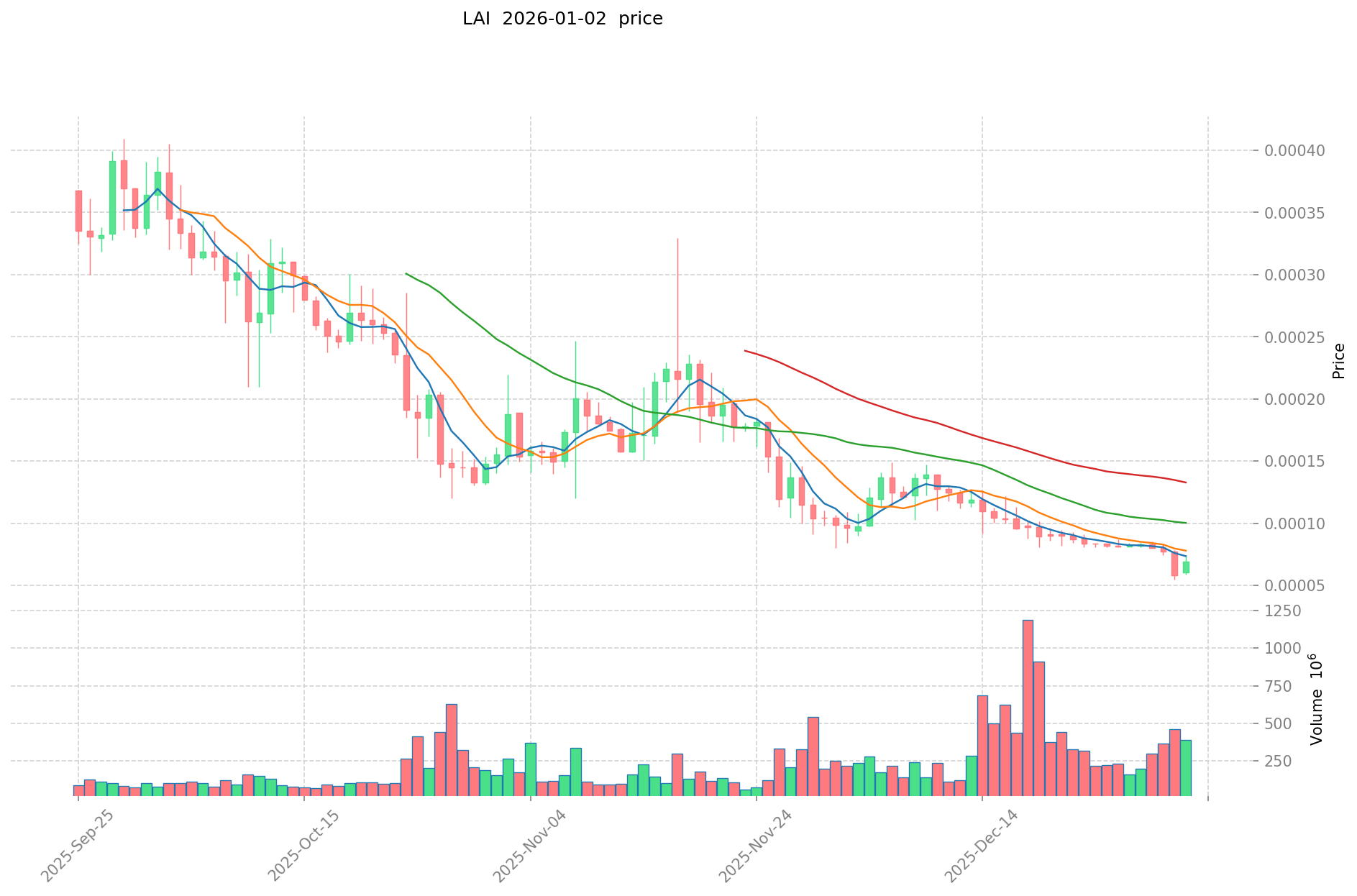
LAI Historical Price Evolution
- March 2024: LayerAI token reached its all-time high of $0.094762, marking a peak in market valuation following the project's transition from CryptoGPT to LayerAI.
- December 2025: LAI hit its all-time low of $0.0000547, representing a significant correction from historical highs.
- 2025 Year Performance: The token experienced a dramatic decline of 99.48% over the one-year period, demonstrating substantial volatility in the market.
LAI Current Market Position
As of January 2, 2026, LAI is trading at $0.00007202, reflecting a 24-hour price increase of 16.57% despite longer-term bearish trends. The token maintains a market capitalization of approximately $165,257.57 in circulating supply value, with a fully diluted valuation of $208,519.38.
The current trading metrics show:
- 24-hour trading volume: $23,576.15
- Circulating supply: 2,294,606,592.99 LAI tokens (76.49% of total supply)
- Total supply: 2,895,298,317.65 LAI tokens
- Maximum supply: 3,000,000,000 LAI tokens
- Active holders: 10,138 addresses
Recent price movements indicate volatility, with the 7-day change at -12.50% and the 30-day change at -24.34%, suggesting ongoing downward pressure despite the short-term rally. The token ranks 4,352 by market capitalization with a market dominance of 0.0000065%.
View current LAI market price
LAI Market Sentiment Index
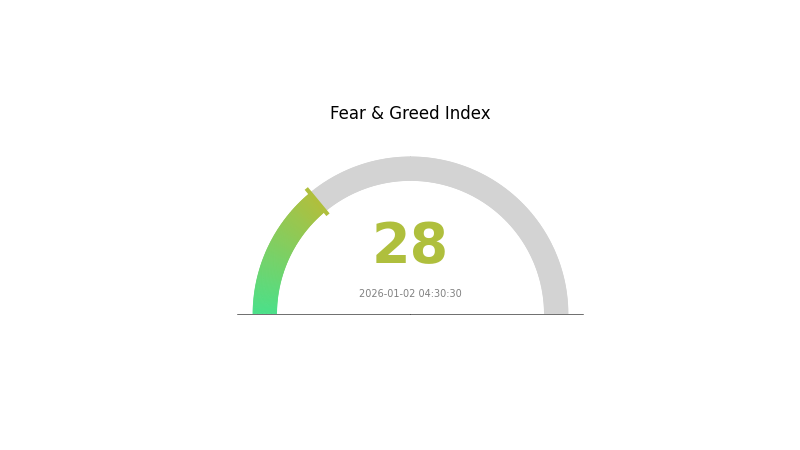
2026-01-02 Fear and Greed Index: 28 (Fear)
Click to view the current Fear & Greed Index
The cryptocurrency market is currently experiencing a fear-driven sentiment with an index reading of 28. This indicates heightened market anxiety and risk aversion among investors. Market participants are showing cautious behavior, with concerns potentially stemming from macroeconomic factors or broader market volatility. During periods of fear, opportunities may emerge for contrarian investors. Monitor key support levels and market catalysts closely. Consider maintaining a disciplined investment strategy on Gate.com and avoiding emotional decision-making in volatile conditions.
LAI Holdings Distribution
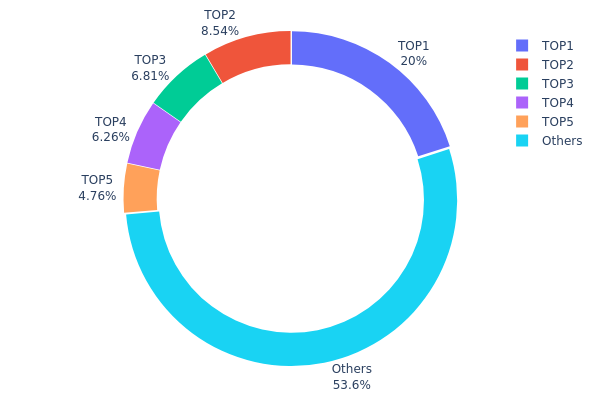
An address holdings distribution chart reveals the concentration pattern of token ownership across the blockchain network. By analyzing the top holders and their respective share of total supply, this metric provides critical insights into the decentralization degree, potential manipulation risks, and overall market structure stability of the asset.
LAI currently exhibits moderate concentration characteristics in its holder distribution. The top five addresses collectively control approximately 46.38% of the token supply, with the largest holder accounting for 20.02% of total circulation. While this concentration level raises certain considerations, it remains within acceptable parameters for a cryptocurrency at this development stage. Notably, the remaining 53.62% of tokens are distributed among other addresses, indicating that the majority of LAI supply is held by a dispersed set of stakeholders. This fragmentation of ownership among smaller holders provides a meaningful counterbalance to the concentrated positions.
The current distribution pattern suggests a relatively healthy market structure with limited immediate manipulation risk. The lack of extreme concentration by any single entity, combined with significant retail and institutional participation reflected in the "Others" category, supports reasonable price discovery mechanisms. However, market participants should monitor whether the top holders maintain their positions or increase their stakes, as substantial accumulation by major addresses could alter the risk profile. The relatively distributed nature of LAI ownership at present promotes a more resilient on-chain ecosystem while allowing for legitimate token appreciation potential driven by genuine market demand rather than speculative concentration plays.
For current LAI holdings distribution data, please visit Gate.com.
| Top |
Address |
Holding Qty |
Holding (%) |
| 1 |
0x9ede...92edd8 |
600691.72K |
20.02% |
| 2 |
0x0529...c553b7 |
256323.60K |
8.54% |
| 3 |
0xbb36...03b65d |
204237.42K |
6.80% |
| 4 |
0x74de...a2f9a1 |
187915.41K |
6.26% |
| 5 |
0xf335...c4c34b |
142905.54K |
4.76% |
| - |
Others |
1607926.31K |
53.62% |
Analysis of Core Factors Influencing LAI Future Price
II. Core Factors Impacting LAI Future Price
Macroeconomic Environment
-
Monetary Policy Impact: Central bank monetary policy stance directly affects cryptocurrency market liquidity. Loose monetary policy increases market money supply and enhances liquidity, potentially driving asset inflows. Conversely, tight monetary policy reduces available capital in markets. The uncertainty surrounding future rate adjustments creates volatility in cryptocurrency valuations.
-
Geopolitical Factors: Persistent geopolitical and economic uncertainties continue to shape market dynamics. Market risk premiums respond to international tensions and trade policies, which influence broader asset allocation decisions including cryptocurrency holdings.
-
Risk Sentiment and Market Confidence: During periods of economic uncertainty and policy shifts, market participants reassess risk exposure. Federal Reserve policy adjustments and government fiscal positioning impact investor confidence in asset markets, including digital assets.
Market Sentiment and Behavioral Factors
-
Market Sentiment: Cryptocurrency prices experience short-term fluctuations driven by market sentiment. Positive market psychology can stimulate price appreciation, while negative sentiment triggers selling pressure. Market participants' collective psychology significantly influences price discovery and volatility.
-
Technical Market Dynamics: Supply and demand imbalances in trading markets create price pressures. Large trading volumes and position changes reflect market participants' conviction levels and can amplify price movements in either direction.
Disclaimer: This analysis is provided for informational purposes only and does not constitute investment advice. Cryptocurrency investments carry substantial risk. Investors should conduct thorough research and consult independent financial advisors before making investment decisions. All trading involves risk of loss.
III. LAI Price Forecast for 2026-2031
2026 Outlook
- Conservative Forecast: $0.00005 - $0.00006
- Neutral Forecast: $0.00006 - $0.00007
- Optimistic Forecast: $0.00007 - $0.00008 (requires increased institutional adoption and positive regulatory developments)
2027-2029 Mid-term Outlook
- Market Phase Expectation: Gradual recovery and accumulation phase with moderate growth trajectory
- Price Range Forecast:
- 2027: $0.00004 - $0.0001
- 2028: $0.00006 - $0.00009
- 2029: $0.00008 - $0.00009
- Key Catalysts: Enhanced ecosystem development, strategic partnerships, improving market sentiment, and potential breakthrough in use case adoption
2030-2031 Long-term Outlook
- Base Case: $0.00006 - $0.00011 (assuming steady market expansion and mainstream recognition)
- Optimistic Case: $0.00011 - $0.00012 (assuming accelerated protocol upgrades and significant mainstream integration)
- Transformative Case: Above $0.00012 (assuming disruptive technological breakthrough and widespread institutional involvement)
- 2031-12-31: LAI at $0.00012 (potential peak in predicted range with sustained upward momentum)
Note: These forecasts are based on historical trend analysis and market modeling. Investors should conduct independent research on Gate.com and other platforms before making investment decisions. Market volatility and unforeseen events may significantly impact actual price performance.
| 年份 |
预测最高价 |
预测平均价格 |
预测最低价 |
涨跌幅 |
| 2026 |
0.00008 |
0.00007 |
0.00005 |
0 |
| 2027 |
0.0001 |
0.00007 |
0.00004 |
3 |
| 2028 |
0.00009 |
0.00008 |
0.00006 |
17 |
| 2029 |
0.00009 |
0.00009 |
0.00008 |
21 |
| 2030 |
0.00011 |
0.00009 |
0.00006 |
25 |
| 2031 |
0.00012 |
0.0001 |
0.00007 |
37 |
LayerAI (LAI) Professional Investment Strategy and Risk Management Report
IV. LAI Professional Investment Strategy and Risk Management
LAI Investment Methodology
(1) Long-term Holding Strategy
- Suitable for: Investors with medium to long-term cryptocurrency exposure goals and high risk tolerance who believe in the potential of AI-focused Layer 2 blockchain solutions
- Operational recommendations:
- Accumulate LAI during market downturns when prices are significantly depressed, given the token's 99.48% decline over the past year
- Implement dollar-cost averaging (DCA) strategies to mitigate timing risk over quarterly or semi-annual intervals
- Secure storage on Gate.com with withdrawal to a secure hardware solution for holdings exceeding exchange thresholds
(2) Active Trading Strategy
- Technical analysis tools:
- Support/Resistance Levels: Identify key price floors at recent low of $0.00005961 (24H low) and resistance at $0.00007416 (24H high) for entry and exit points
- Volume Analysis: Monitor the 24-hour trading volume of 23,576.15 LAI to assess liquidity and price stability before executing trades
- Wave trading key points:
- Execute short-term trades during the 24-hour recovery period showing +16.57% gains, capitalizing on volatility
- Exercise caution during sustained downtrend periods such as the 30-day decline of -24.34%
LAI Risk Management Framework
(1) Asset Allocation Principles
- Conservative investors: 0.5-1% of total cryptocurrency portfolio
- Active investors: 1-3% of total cryptocurrency portfolio
- Professional investors: 3-5% of total cryptocurrency portfolio, with hedging mechanisms in place
(2) Risk Hedging Solutions
- Portfolio diversification: Combine LAI with established Layer 2 solutions and stable assets to reduce concentration risk
- Position sizing: Limit individual LAI holdings to manageable portions, particularly given the high volatility reflected in the 99.48% year-over-year decline
(3) Secure Storage Solutions
- Hot wallet approach: Gate.com exchange wallet for active trading positions and frequent transactions
- Cold storage recommendation: Transfer significant holdings to secure offline storage solutions for long-term preservation
- Security considerations: Enable two-factor authentication on all exchange accounts; never share private keys or recovery phrases; regularly verify contract addresses before transactions to avoid phishing scams
V. LAI Potential Risks and Challenges
LAI Market Risk
- Extreme price volatility: The token has experienced a catastrophic 99.48% decline over one year, indicating severe market risk and investor confidence erosion
- Low liquidity environment: With a 24-hour trading volume of only 23,576.15 LAI and 3 exchange listings, market depth is severely limited, creating slippage risks for larger positions
- Market sentiment deterioration: The token's low market share (0.0000065%) and minimal trading activity suggest declining investor interest and adoption
LAI Regulatory Risk
- Blockchain regulatory uncertainty: Layer 2 solutions and AI-focused protocols face evolving global regulatory frameworks that could impact operational status
- Token classification ambiguity: Regulatory authorities may reclassify LAI or similar tokens, potentially affecting trading and holding permissions in certain jurisdictions
- Compliance complexity: Cross-chain operations and regulatory requirements in different markets could impose operational constraints on the LayerAI ecosystem
LAI Technical Risk
- Layer 2 scalability execution: While zkRollup technology offers theoretical scalability benefits, real-world implementation challenges could impact network performance and user adoption
- Smart contract security: EVM compatibility, while enabling rapid developer onboarding, may introduce security vulnerabilities if smart contracts are inadequately audited
- Ecosystem development uncertainty: The success of LayerAI depends on sustained developer activity and project adoption, which remains unproven given the current market conditions
VI. Conclusion and Action Recommendations
LAI Investment Value Assessment
LayerAI (LAI), formerly CryptoGPT, represents a speculative high-risk asset focused on AI-oriented Layer 2 blockchain development. The token's 99.48% decline over the past year signals severe market challenges and investor skepticism regarding its value proposition. While the underlying technology concept combining AI applications with blockchain scalability through zkRollup technology has theoretical merit, the project faces substantial execution risks, minimal trading liquidity, and uncertain market adoption. Current market metrics—including extremely low market capitalization, minimal trading volume, and only 10,138 token holders—indicate early-stage or stagnating project conditions. Investment in LAI should only be considered as a high-risk, speculative allocation by investors capable of bearing total capital loss.
LAI Investment Recommendations
✅ Beginners: Avoid direct LAI investment; instead, gain exposure to established Layer 2 solutions through diversified portfolio strategies on Gate.com
✅ Experienced investors: Consider LAI only as a small speculative position (0.5-1% of cryptocurrency portfolio) with strict stop-loss discipline at predetermined levels
✅ Institutional investors: Conduct comprehensive due diligence on LayerAI's development roadmap, team credentials, and token economics before any position consideration; implement robust position monitoring and exit strategies
LAI Trading Participation Methods
- Direct spot trading on Gate.com: Purchase LAI through the exchange's spot trading interface using stablecoins or established cryptocurrencies
- Gate.com wallet integration: Store and manage LAI tokens directly within the exchange ecosystem for seamless trading execution
- Multi-chain exposure: Access LAI across both the native LayerAI chain and Ethereum chain through appropriate contract addresses to maximize flexibility
Cryptocurrency investment carries extreme risk. This report does not constitute investment advice. Investors must make decisions based on their individual risk tolerance and financial situation. Consultation with professional financial advisors is strongly recommended. Never invest funds you cannot afford to lose entirely.
FAQ
What is the current price of LAI token, and what are its all-time high and all-time low prices?
LAI token has reached an all-time high of US$0.1475 and an all-time low of US$0.00007078. For the most current price information, please check real-time market data.
What are the main factors affecting LAI price?
LAI price is primarily influenced by market demand and trading volume, network adoption and utility expansion, macroeconomic conditions, and sentiment within the crypto community. Additionally, technological upgrades and regulatory developments impact price movements significantly.
How to use technical analysis methods to predict future LAI price trends?
Analyze LAI's historical price data and trading volume using technical indicators like moving averages, RSI, and support/resistance levels. Identify chart patterns and trends to forecast potential price movements and market direction.
How is LAI's price competitiveness compared to similar tokens?
LAI demonstrates strong price competitiveness driven by its technological advantages and growing market demand. With increasing adoption and ecosystem expansion, LAI is positioned attractively against comparable tokens, offering superior value potential and long-term growth prospects in the current market landscape.
What are professional analysts' price predictions for LAI?
Professional analysts predict LAI will continue its upward trajectory through 2026-2027, with potential new highs anticipated in 2027. Long-term forecasts through 2028-2030 suggest sustained growth momentum. Predictions are based on comprehensive technical and fundamental analysis of market dynamics.
What are the risks and uncertainties in LAI price prediction?
LAI price prediction faces risks from market volatility, policy changes, and technological developments. Uncertainties stem from fluctuating market demand, competitive dynamics, and data accuracy issues affecting prediction models.
* The information is not intended to be and does not constitute financial advice or any other recommendation of any sort offered or endorsed by Gate.