# 2025 TOKO Price Prediction: Expert Analysis and Market Forecast
**Article Overview**
This comprehensive guide delivers professional TOKO price forecasts spanning 2026-2031, combining historical performance analysis, tokenomics evaluation, and market sentiment assessment. TOKO, a government-supported blockchain infrastructure token, presents both opportunities and risks for institutional investors seeking exposure to ecosystem adoption plays. The analysis addresses critical investment questions: Should you buy TOKO? What price targets justify entry? How should portfolio allocation be structured? Through detailed market positioning, supply mechanics review, and risk management frameworks, this article equips investors with actionable strategies for navigating TOKO's volatile micro-cap landscape while protecting capital against extreme liquidity and concentration risks inherent in emerging blockchain projects.
Introduction: TOKO's Market Position and Investment Value
Tokoin (TOKO) is a government-supported blockchain technology ecosystem designed to provide institutions with comprehensive solutions for onboarding blockchain technology across all business aspects including technology, funding, and business development. As of January 2026, TOKO has established itself as a niche player in the blockchain infrastructure sector with a market capitalization of $237,800 and a circulating supply of approximately 1.87 billion tokens, currently trading at $0.0001189.
This analysis will comprehensively examine TOKO's price trends from 2026 to 2031, integrating historical performance data, market supply dynamics, ecosystem development, and macroeconomic factors to provide investors with professional price forecasts and actionable investment strategies.
I. TOKO Price History Review and Current Market Status
TOKO Historical Price Evolution
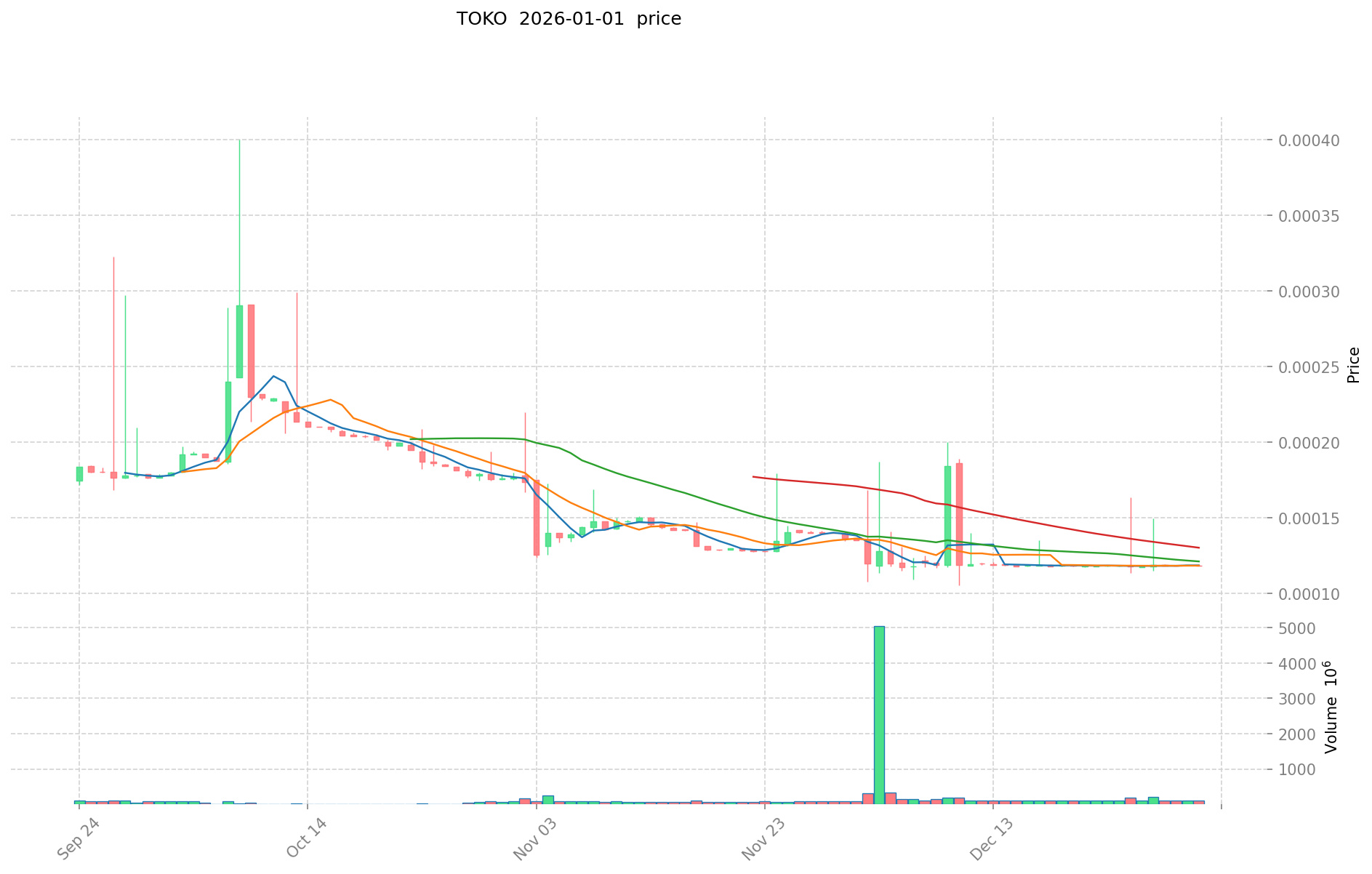
Based on available data, TOKO reached its all-time high of $0.0056 on February 9, 2024, and subsequently declined to its all-time low of $0.0001 on the same date. This represents a significant 98.21% decline from peak levels.
TOKO Current Market Situation
As of January 1, 2026, TOKO is trading at $0.0001189, reflecting a 24-hour price change of -0.41%. The token has experienced notable weakness over extended timeframes:
- 1-hour performance: -0.25%
- 7-day performance: +0.08%
- 30-day performance: -12.21%
- 1-year performance: -83.71%
The 24-hour trading volume stands at $12,018.02, with a market capitalization of $222,452.07. The circulating supply comprises 1,870,917,323.29 TOKO out of a total supply of 2,000,000,000 tokens, representing a circulation ratio of 84.79%. The fully diluted valuation totals $237,800.00, with TOKO commanding a market dominance of 0.0000075%.
The token maintains a market ranking of 4,021 and is held by 1,785 addresses. TOKO operates on the Ethereum blockchain as an ERC20 token with a maximum supply of 2,206,654,056 tokens.
Click to view current TOKO market price
TOKO Market Sentiment Indicator
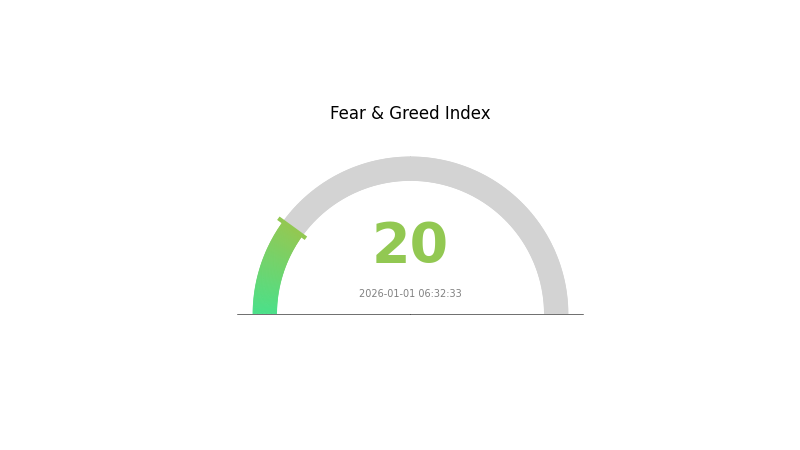
2026-01-01 Fear and Greed Index: 20 (Extreme Fear)
Click to view current Fear & Greed Index
The crypto market is currently experiencing extreme fear, with the Fear and Greed Index standing at 20. This indicates heightened market pessimism and significant selling pressure among investors. During such periods, risk-averse traders typically reduce positions, while contrarian investors may identify potential buying opportunities at depressed valuations. Market volatility remains elevated, and traders should exercise caution with position sizing. Monitor key support levels closely and consider dollar-cost averaging strategies if maintaining long-term exposure to TOKO tokens.
TOKO Holdings Distribution
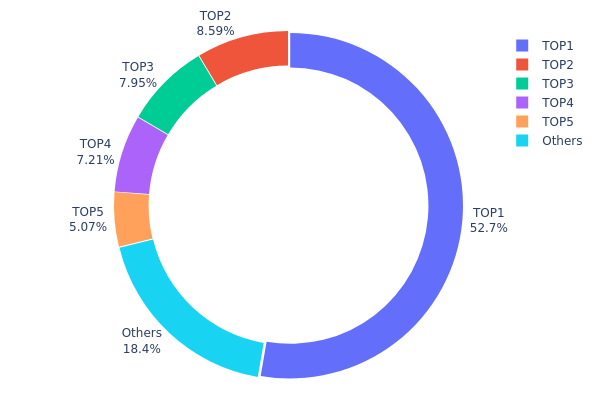
The address holdings distribution map illustrates the concentration of TOKO tokens across the blockchain network by tracking the top individual addresses and their proportional stake in total token supply. This metric serves as a critical indicator of token decentralization and market structure, revealing potential risks associated with whale concentration and governance dynamics.
TOKO demonstrates pronounced concentration characteristics, with the top address commanding 52.73% of the total token supply—a level that substantially exceeds healthy decentralization thresholds. The top five addresses collectively control 81.53% of all TOKO tokens, while the remaining 18.47% is dispersed among other holders. This distribution pattern indicates significant centralization risk, as the leading address possesses sufficient holdings to materially influence market dynamics unilaterally. The steep concentration gradient, particularly the dominance of the first address, suggests that TOKO's token supply may be heavily influenced by early investors, development teams, or strategic stakeholders.
Such extreme concentration carries notable implications for market stability and price mechanics. The concentrated holder base creates elevated vulnerability to sudden large-scale liquidations or transfers, which could precipitate sharp price volatility. Additionally, the governance potential concentrated in the top addresses raises questions regarding protocol decision-making and the practical decentralization of network operations. From a market structure perspective, the current distribution reflects early-stage tokenomics typical of projects in development phases, where foundational stakeholders retain substantial positions. Monitoring whether this concentration gradually disperses through natural market mechanisms or remains static will be essential for assessing TOKO's long-term decentralization trajectory and institutional viability.
Click to view current TOKO holdings distribution
| Top |
Address |
Holding Qty |
Holding (%) |
| 1 |
0x91dc...20dc92 |
1039687.27K |
52.73% |
| 2 |
0x0d07...b492fe |
169261.12K |
8.58% |
| 3 |
0xd621...d19a2c |
156771.40K |
7.95% |
| 4 |
0x58ed...a36a51 |
142123.26K |
7.20% |
| 5 |
0x3c02...5fe7c6 |
100000.00K |
5.07% |
| - |
Others |
363708.61K |
18.47% |
II. Core Factors Affecting TOKO's Future Price
Supply Mechanism
-
Annual Token Burn (Deflation Design): TOKO implements a unique deflationary mechanism that destroys 2% of total token supply annually. With a total supply of 496,196,900.66 tokens, approximately 9,923,938 tokens are burned each year, continuously reducing circulating supply.
-
Historical Patterns: The consistent annual burn creates a progressively decreasing supply environment. This deflationary design is intended to increase token scarcity over time, potentially supporting long-term value appreciation.
-
Current Impact: The ongoing 2% annual token destruction mechanism attracts long-term investors seeking exposure to deflationary assets. However, the actual price impact depends on broader market demand, project development progress, and overall cryptocurrency market conditions.
Community Governance and Token Distribution
-
Community-Centric Allocation: TOKO's token distribution demonstrates a strong commitment to community participation, with 50% of tokens allocated to the community, significantly higher than industry averages. Team holdings comprise 20% while investors hold 30%.
-
Governance Rights: TOKO token holders enjoy substantial governance rights through a DAO (Decentralized Autonomous Organization) framework. Holders can propose improvement proposals, participate in community discussions, and vote on critical decisions affecting the protocol.
-
Token-Weighted Voting System: The governance model employs token-weighted voting, where TOKO holdings directly determine voting power in platform decisions. Governance proposals typically require a voting threshold of approximately 10% of circulating tokens for passage, ensuring sufficient community support for major decisions.
-
Governance Scope: Decision-making authority extends across protocol upgrades, parameter adjustments, and resource allocation, enabling TOKO to evolve continuously based on market conditions and community needs.
This article is not intended as investment advice or any other type of recommendation provided by Gate. Investing carries risks; please exercise caution when entering the market.
Three: 2026-2031 TOKO Price Forecast
2026 Outlook
- Conservative Forecast: $0.0001
- Neutral Forecast: $0.00012
- Optimistic Forecast: $0.00016
2027-2029 Medium-term Outlook
- Market Stage Expectation: Gradual recovery and accumulation phase with steady growth momentum
- Price Range Forecast:
- 2027: $0.00007 - $0.00021 (18% increase)
- 2028: $0.00016 - $0.00025 (47% increase)
- 2029: $0.00019 - $0.00027 (80% increase)
- Key Catalysts: Ecosystem expansion, increasing adoption, market sentiment recovery, and institutional interest in mid-cap tokens
2030-2031 Long-term Outlook
- Base Case: $0.00016 - $0.00029 with 105% cumulative growth (assuming steady ecosystem development and mainstream adoption)
- Optimistic Case: $0.00029 - $0.00032 with 126% cumulative growth (assuming accelerated protocol upgrades and strategic partnerships)
- Transformative Case: $0.00032+ (assuming major breakthrough in tokenomics utility, substantial exchange listings including Gate.com, and breakthrough market conditions)
- 2031-12-31: TOKO reaches $0.00032 (potential milestone for multi-year holders)
| 年份 |
预测最高价 |
预测平均价格 |
预测最低价 |
涨跌幅 |
| 2026 |
0.00016 |
0.00012 |
0.0001 |
0 |
| 2027 |
0.00021 |
0.00014 |
0.00007 |
18 |
| 2028 |
0.00025 |
0.00018 |
0.00016 |
47 |
| 2029 |
0.00027 |
0.00021 |
0.00019 |
80 |
| 2030 |
0.00029 |
0.00024 |
0.00016 |
105 |
| 2031 |
0.00032 |
0.00027 |
0.00017 |
126 |
Tokoin (TOKO) Professional Investment Strategy and Risk Management Report
IV. TOKO Professional Investment Strategy and Risk Management
TOKO Investment Methodology
(1) Long-term Holding Strategy
- Target Audience: Institutional investors and believers in blockchain ecosystem adoption
- Operational Recommendations:
- Accumulate during market downturns when TOKO trades below historical support levels, particularly given the -83.71% annual decline suggesting potential oversold conditions
- Hold positions through market cycles to benefit from Tokoin's one-stop blockchain ecosystem development
- Dollar-cost averaging (DCA) approach to mitigate volatility exposure across multiple purchase points
(2) Active Trading Strategy
- Technical Analysis Considerations:
- Price momentum analysis: Monitor the 24-hour (-0.41%), 7-day (+0.08%), and 30-day (-12.21%) price movements to identify trend reversal patterns
- Volatility measurement: Track the range between 24-hour high (0.0001191) and low (0.0001185) to identify breakout opportunities
- Wave Operation Key Points:
- Capitalize on micro-movements within tight trading ranges given current low volatility
- Monitor volume patterns relative to the 24-hour volume baseline of 12,018 TOKO to confirm directional moves
TOKO Risk Management Framework
(1) Asset Allocation Principles
- Conservative Investors: 1-2% of portfolio allocation maximum
- Active Investors: 3-5% of portfolio allocation
- Professional Investors: 5-10% of portfolio allocation with hedging strategies
(2) Risk Hedging Solutions
- Portfolio diversification: Combine TOKO with stable-value blockchain projects to offset concentration risk from its current market cap of $237,800
- Position sizing: Implement strict position limits given the token's 1,785 holder concentration risk and thin liquidity
(3) Secure Storage Solutions
- Hot Wallet Option: Gate.com Web3 Wallet for active trading and frequent transactions
- Cold Storage Approach: For long-term holdings exceeding 30 days, maintain tokens in secure self-custody solutions with multi-signature verification
- Security Precautions: Never share private keys; enable two-factor authentication on all exchange accounts; regularly audit wallet activity; consider storing recovery phrases in secure physical locations
V. TOKO Potential Risks and Challenges
TOKO Market Risks
- Extreme Illiquidity: With only 1,785 holders and minimal 24-hour volume of 12,018 TOKO, the token faces severe liquidity constraints that could result in significant slippage during buy or sell orders
- Severe Downtrend: The -83.71% one-year decline indicates sustained selling pressure and potential loss of market confidence in the project
- Low Market Capitalization: Total market cap of $237,800 represents micro-cap territory with elevated volatility and exit liquidity concerns for larger positions
TOKO Regulatory Risks
- Regulatory Compliance Uncertainty: As an ERC20 token operating through government-supported initiatives, changing regulatory frameworks in different jurisdictions could impact institutional adoption
- Institutional Adoption Barriers: Blockchain regulatory restrictions in certain regions could limit the target customer base for Tokoin's one-stop ecosystem services
- Cross-Border Compliance: Government-supported projects may face additional scrutiny regarding data privacy and international operations
TOKO Technology Risks
- ERC20 Standard Limitations: As an Ethereum-based token, TOKO inherits Ethereum network risks including congestion and transaction fee volatility
- Ecosystem Dependency: The project's success relies on sustained institutional adoption of its blockchain products and services, which remains unproven at scale
- Network Concentration: Low holder diversity (1,785 addresses) creates vulnerability to large wallet movements and potential flash crash scenarios
VI. Conclusion and Action Recommendations
TOKO Investment Value Assessment
Tokoin presents a niche-focused blockchain infrastructure project targeting institutional adoption through a government-supported model. However, the token exhibits characteristics of a distressed micro-cap asset with severe liquidity constraints, a 12-month drawdown exceeding 83%, and minimal market capitalization. While the long-term vision of facilitating institutional blockchain adoption through a one-stop ecosystem has merit, current market conditions reflect significant skepticism regarding execution capability and market demand. The token's extremely thin trading volume and concentrated holder base present considerable risks for most investor profiles.
TOKO Investment Recommendations
✅ Beginners: Avoid direct TOKO investment until the project demonstrates meaningful institutional adoption metrics and improved liquidity conditions. If interested in blockchain infrastructure exposure, consider more established alternatives.
✅ Experienced Investors: Consider TOKO only as a speculative micro-cap position (1-2% portfolio maximum) if you believe in the government-supported institutional blockchain thesis. Implement strict stop-loss orders at 10-15% below entry price given volatility.
✅ Institutional Investors: Evaluate direct engagement with Tokoin's partnership ecosystem rather than secondary market token trading, as the illiquid token market provides poor capital efficiency for institutional position sizing.
TOKO Trading Participation Methods
- Spot Trading on Gate.com: Purchase and sell TOKO directly through Gate.com's spot market for market participants seeking exposure, with standard exchange security protocols
- Peer-to-Peer Coordination: Direct institutional partnerships with Tokoin for ecosystem participation may offer better terms than secondary market trading
- Portfolio Rebalancing: Use controlled exit strategies for existing positions given the thin liquidity to minimize market impact
Cryptocurrency investment carries extreme risk. This report does not constitute investment advice. Investors should make careful decisions based on their individual risk tolerance and financial circumstances. It is strongly recommended to consult with professional financial advisors before making investment decisions. Never invest funds you cannot afford to lose completely.
FAQ
What is the current price of TOKO token? What are its all-time high and all-time low prices?
TOKO is currently trading between $0.08062 and $0.08303. The all-time high stands at $4.98934755, while the all-time low is $0.07473117256272259.
What are the main factors affecting TOKO price fluctuations?
TOKO price is primarily influenced by market demand, investor sentiment, project development progress, trading volume, and overall cryptocurrency market trends.
TOKO在2024-2025年的价格预测是怎样的?
Based on market analysis, TOKO showed declining trends through 2025, with price reaching 0.0001763 USD by October 2025. Market capitalization stood at approximately 329,842 USD with moderate trading activity. Future performance depends on adoption developments and market conditions.
What is the total supply of TOKO tokens? What percentage does circulating supply represent?
TOKO has a total supply of 1.369 billion tokens. The circulating supply is 1.871 billion, representing a circulation rate of 136.67%, exceeding total supply due to token mechanics.
Tokocrypto's growth through ecosystem expansion and user adoption could drive TOKO price appreciation. Platform innovations, trading volume increases, and strategic partnerships are key catalysts. Market sentiment and crypto adoption trends will significantly influence long-term price movement.
What are the risks to pay attention to when investing in TOKO tokens?
TOKO tokens carry significant volatility and market risks. Price fluctuations can be substantial due to market sentiment and liquidity conditions. Investors should conduct thorough due diligence, understand tokenomics, and only invest capital they can afford to lose. Market conditions are unpredictable.
What are the advantages and disadvantages of TOKO compared to other exchange tokens like BNB and FTT?
TOKO offers higher volatility and growth potential for investors seeking larger returns. However, BNB maintains a larger ecosystem and stronger market foundation. TOKO presents higher risk but greater upside opportunity in emerging market segments.
* The information is not intended to be and does not constitute financial advice or any other recommendation of any sort offered or endorsed by Gate.