# Article Overview: Is Lynex (LYNX) a Good Investment?
Lynex (LYNX) is an LST-centric DEX on the Linea blockchain offering automated liquidity management solutions, currently trading at $0.001727 with a market cap of $168,357. This comprehensive analysis examines LYNX's dramatic 97.61% year-over-year price decline from its $0.49 ATH, evaluating investment viability through performance metrics, risk assessment, and price forecasts through 2031. The article addresses critical concerns including extreme volatility, minimal liquidity ($11,722 daily volume), unlimited token supply, and competitive pressures, while providing guidance for different investor profiles. Designed for experienced cryptocurrency investors seeking data-driven perspectives, this report delivers structured insights on market fundamentals, regulatory risks, technology dependencies, and realistic return projections—helping readers make informed decisions on whether LYNX constitutes a viable high-risk investment opportunity or should be avoide
Introduction: Lynex (LYNX) Investment Position and Market Prospects
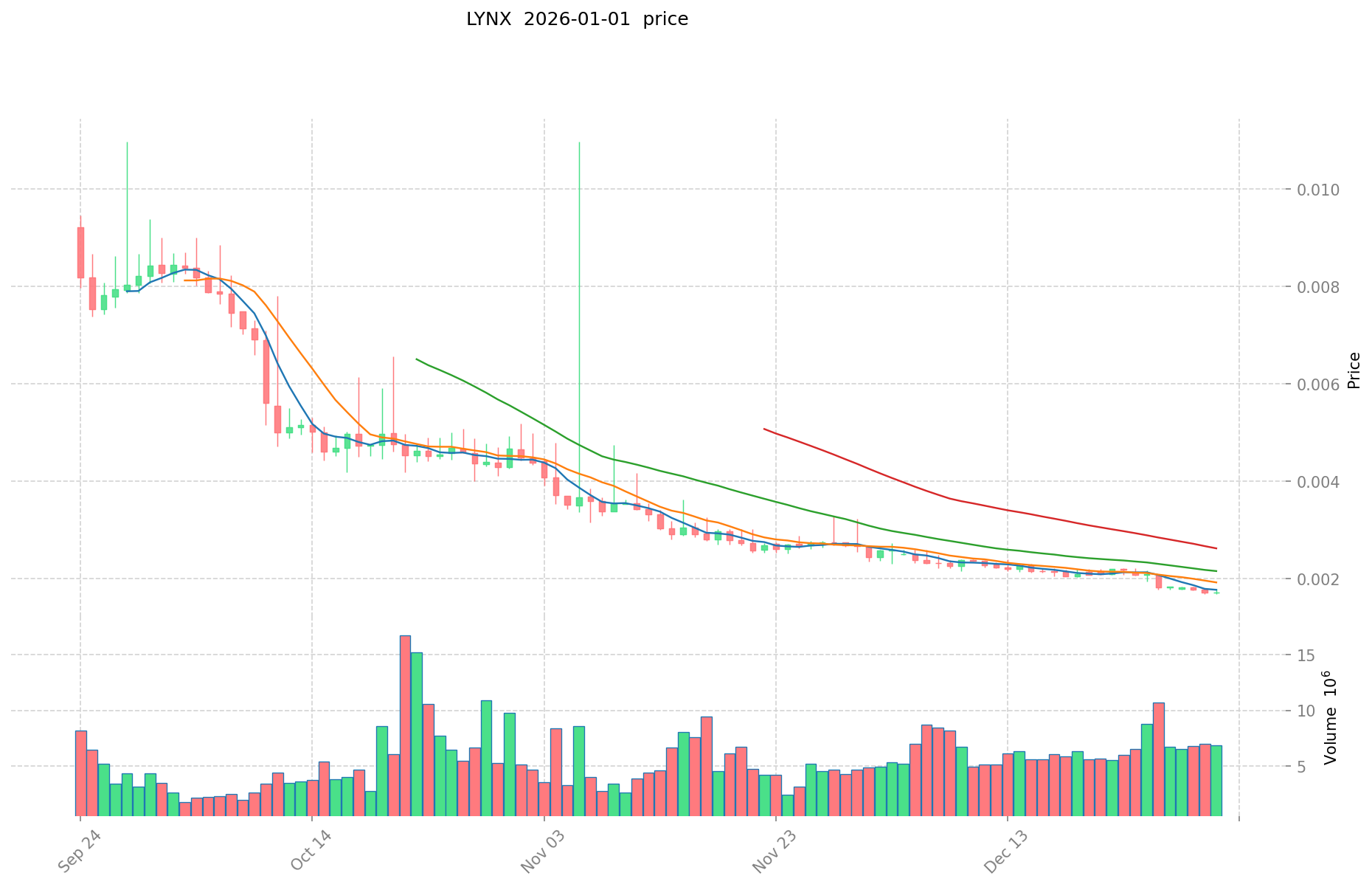
Lynex is an LST-centric DEX and liquidity marketplace on the Linea Blockchain, making advanced liquidity strategies accessible to all users with its competitive array of automated liquidity managers (ALMs), ensuring optimal returns and minimal impermanent loss. As of January 2, 2026, LYNX maintains a market capitalization of $172,700.00, with a circulating supply of approximately 97.49 million tokens and a current price around $0.001727. The token has experienced significant market volatility, declining 97.61% over the past year from its all-time high of $0.49 (reached on March 29, 2024) to its recent low of $0.001672 (on December 30, 2025). This dramatic price movement has made LYNX a focal point for investors questioning the investment viability and recovery potential of the project. This article will comprehensively analyze LYNX's investment value, historical price trends, future price forecasts, and associated investment risks to provide investors with informed perspective on this Linea ecosystem token.
Lynex (LYNX) Token Research Report
I. Lynex (LYNX) Price History Review and Current Investment Value
Key Price Milestones:
- All-Time High (ATH): USD 0.49, reached on March 29, 2024
- All-Time Low (ATL): USD 0.001672, reached on December 30, 2025
- Current Price (January 2, 2026): USD 0.001727
Price Deterioration Across Timeframes:
| Timeframe |
Price Change |
Percentage Change |
| 1 Hour |
-0.000003 |
-0.20% |
| 24 Hours |
+0.000008 |
+0.45% |
| 7 Days |
-0.000281 |
-14.00% |
| 30 Days |
-0.000752 |
-30.34% |
| 1 Year |
-0.070532 |
-97.61% |
The token has experienced a catastrophic decline of 97.61% over the past year, falling from a launch price of USD 0.06 to its current level.
II. Current Lynex (LYNX) Market Status (January 2, 2026)
Market Data Overview
| Metric |
Value |
| Current Price |
USD 0.001727 |
| 24-Hour Trading Volume |
USD 11,722.07 |
| Market Capitalization |
USD 168,356.95 |
| Fully Diluted Valuation |
USD 172,700.00 |
| Circulating Supply |
97,485,206.67 LYNX |
| Total Supply |
100,000,000 LYNX |
| Market Dominance |
0.0000054% |
| Market Cap to FDV Ratio |
97.49% |
Market Sentiment Analysis
- Market Emotion Index: 1 (indicating extremely bearish sentiment)
- 24-Hour Trading Range: USD 0.001713 - USD 0.001782
- Exchange Listings: 2 exchanges
III. Project Overview: Lynex Protocol
Project Description
Lynex is an LST-centric DEX (Decentralized Exchange) and liquidity marketplace deployed on the Linea Blockchain. The protocol provides advanced liquidity management solutions through its competitive array of Automated Liquidity Managers (ALMs), designed to enable all users to implement sophisticated liquidity strategies while optimizing returns and minimizing impermanent loss.
Blockchain Integration
- Primary Chain: Linea Ethereum (LINEAETH)
- Smart Contract Address: 0x1a51b19CE03dbE0Cb44C1528E34a7EDD7771E9Af
- Official Website: https://www.lynex.fi/
IV. Financial Metrics and Market Position
Supply Structure
- Circulating Supply: 97,485,206.67 LYNX (97.49% of total)
- Total Supply: 100,000,000 LYNX
- Maximum Supply: Unlimited (∞)
- Circulation Ratio: 97.48%
Market Classification
- CMC Ranking: 4,325
- Market Share: 0.0000054%
- Classification: Ultra-low market cap token with minimal market relevance
V. Risk Assessment
Critical Observations
- Extreme Price Collapse: 97.61% depreciation over 12 months represents substantial value destruction for holders
- Minimal Liquidity: 24-hour trading volume of approximately USD 11,700 indicates severe liquidity constraints
- Bearish Market Sentiment: Market emotion index at its lowest level signals negative investor confidence
- Limited Exchange Access: Availability on only 2 exchanges restricts market accessibility
- Market Capitalization Decline: Fully diluted valuation of USD 172,700 represents minimal market presence
Access real-time LYNX market price on Gate
Report Date: January 2, 2026
Data Source: Gate Cryptocurrency Data Platform
Disclaimer: This report presents factual market data and protocol information. Market conditions in cryptocurrency are highly volatile and subject to rapid changes. This analysis does not constitute investment advice or recommendations.
Lynex (LYNX) Investment Analysis Report
Report Date: January 2, 2026
I. Executive Summary
Lynex (LYNX) is an LST-centric decentralized exchange and liquidity marketplace operating on the Linea blockchain. As of January 2, 2026, LYNX trades at $0.001727 USD with a market capitalization of approximately $168,357 USD and a fully diluted valuation of $172,700 USD. The token has experienced significant depreciation over the past year, declining 97.61% from its historical high of $0.49 USD (reached on March 29, 2024).
II. Core Factors Affecting Whether Lynex (LYNX) is a Good Investment
Supply Mechanism and Scarcity
- Token Supply Structure: LYNX has a circulating supply of 97,485,206.67 tokens out of a total supply of 100,000,000 tokens. The maximum supply is unlimited (∞), which presents a significant consideration for long-term value preservation.
- Circulating Ratio: Currently, 97.49% of the total supply is in circulation, indicating a relatively mature distribution stage. The presence of an unlimited maximum supply reduces scarcity characteristics compared to tokens with fixed caps.
- Investment Implication: The unlimited maximum supply framework may create ongoing inflation pressure on token valuation, making scarcity-based value appreciation more challenging compared to fixed-supply assets.
Ecosystem and Technology Foundation
- Platform Purpose: Lynex functions as an LST (Liquid Staking Token)-centric DEX and liquidity marketplace, offering automated liquidity managers (ALMs) designed to optimize returns and minimize impermanent loss for users.
- Blockchain Infrastructure: Built on the Linea blockchain, Lynex operates within an emerging Layer 2 ecosystem. The project's viability is interconnected with Linea adoption rates and technological development.
- Market Positioning: The focus on LST-centric services addresses the growing DeFi segment related to liquid staking derivatives, positioning the protocol within an active area of decentralized finance.
Price Action and Trends
| Time Period |
Price Change |
Absolute Change |
| 1 Hour |
-0.20% |
-$0.000003 |
| 24 Hours |
+0.45% |
+$0.000008 |
| 7 Days |
-14.00% |
-$0.000281 |
| 30 Days |
-30.34% |
-$0.000752 |
| 1 Year |
-97.61% |
-$0.070532 |
Key Observations:
- Short-term (24-hour) recovery of +0.45% suggests modest buying interest
- Significant medium-term weakness with 7-day decline of -14.00% and 30-day decline of -30.34%
- Severe long-term depreciation of 97.61% from historical high indicates sustained downward pressure
- Current price ($0.001727) approaches the historical low of $0.001672 (December 30, 2025)
Liquidity and Trading Activity
- 24-Hour Volume: $11,722.07 USD
- Market Cap Ranking: #4,325
- Market Dominance: 0.0000054% of total cryptocurrency market
- Exchanges Listed: 2 trading venues
The limited trading volume and minimal market dominance indicate low liquidity conditions and restricted market accessibility.
IV. Investment Considerations and Risk Assessment
Risk Factors
-
Extreme Price Volatility: The 97.61% year-over-year decline reflects severe downward volatility and loss of investor confidence from peak valuations.
-
Liquidity Constraints: With a 24-hour volume of $11,722.07 USD on a market cap of $168,357 USD, the token exhibits relatively illiquid trading conditions. This creates potential difficulties for entry and exit at desired price levels.
-
Unlimited Supply Structure: The absence of a fixed maximum supply cap removes a traditional scarcity mechanism, potentially enabling indefinite token issuance and future dilution.
-
Limited Market Integration: Listed on only 2 exchanges with minimal market dominance (0.0000054%) restricts accessibility and reduces network effects.
-
Early-Stage Project Risk: As a protocol still in development stages on an emerging blockchain (Linea), Lynex faces execution risk, competitive pressures from established DEX platforms, and technological uncertainties.
Investment Uncertainty
According to available market analysis sources, investment forecasts for LYNX present conflicting signals:
- Bullish Perspectives: Some analysis frameworks suggest potential recovery potential based on technical quantitative indicators
- Bearish Perspectives: Multiple technical analysis models indicate "Strong Sell" signals, with moving average analysis showing 10 sell signals versus 2 buy signals
- High-Risk Classification: Some forecasting services classify LYNX as a "bad, high-risk 1-year investment option"
VI. Conclusion
Lynex (LYNX) represents a high-risk digital asset with substantial downside exposure and uncertain recovery prospects. The token's 97.61% depreciation from historical highs, unlimited supply structure, limited market liquidity, and conflicting technical indicators create an environment of significant investment uncertainty. While the project's LST-focused DEX concept operates within an active DeFi segment, execution risks and competitive pressures from larger platforms remain substantial considerations. Prospective investors should conduct comprehensive risk assessments and only allocate capital they can afford to lose entirely.
III. LYNX Future Investment Predictions and Price Outlook
Short-term Investment Prediction (2026, short-term LYNX investment outlook)
- Conservative forecast: $0.001035 - $0.001725
- Neutral forecast: $0.001725 - $0.002105
- Optimistic forecast: $0.002105 - $0.002500
Mid-term Investment Outlook (2027-2029, mid-term Lynex(LYNX) investment forecast)
-
Market phase expectations: Gradual recovery phase with potential stabilization of price volatility; transition from current bearish sentiment toward consolidation patterns as the LST-centric DEX segment matures on the Linea network.
-
Investment return predictions:
- 2027: $0.001781 - $0.002317 (approximately 10% growth potential)
- 2028: $0.001312 - $0.002729 (approximately 22% growth potential)
- 2029: $0.002132 - $0.003246 (approximately 40% growth potential)
-
Key catalysts: Enhanced adoption of automated liquidity managers (ALMs) on Linea blockchain, ecosystem expansion, institutional interest in LST protocols, and overall DeFi market recovery.
Long-term Investment Outlook (Is Lynex(LYNX) a good long-term investment?)
- Base scenario: $0.002523 - $0.003912 USD (corresponding to steady market growth and mainstream DeFi adoption)
- Optimistic scenario: $0.003200 - $0.005000 USD (corresponding to large-scale protocol adoption and favorable market conditions)
- Risk scenario: $0.000187 - $0.001000 USD (corresponding to protocol failure or prolonged bear market conditions)
For LYNX long-term investment and price predictions, visit: Price Prediction
2026-2031 Long-term Outlook
- Base scenario: $0.002523 - $0.003542 USD (corresponding to steady growth in LST market penetration and Linea network development)
- Optimistic scenario: $0.003200 - $0.005985 USD (corresponding to breakthrough ecosystem adoption and favorable cryptocurrency market conditions)
- Transformative scenario: $0.010000 USD and above (contingent on major protocol innovations and mainstream institutional adoption)
- 2031-12-31 forecast high: $0.003542 USD (based on conservative growth assumptions)
Disclaimer: This analysis is based on available market data and historical patterns. Price predictions involve significant uncertainty and should not be construed as investment advice. Cryptocurrency markets are highly volatile and subject to rapid changes in sentiment, regulatory environment, and technological developments. Past performance does not guarantee future results. Investors should conduct thorough due diligence and consult professional financial advisors before making investment decisions.
| 年份 |
预测最高价 |
预测平均价格 |
预测最低价 |
涨跌幅 |
| 2026 |
0.0021045 |
0.001725 |
0.001035 |
0 |
| 2027 |
0.0023168475 |
0.00191475 |
0.0017807175 |
10 |
| 2028 |
0.0027293803875 |
0.00211579875 |
0.001311795225 |
22 |
| 2029 |
0.003246270022125 |
0.00242258956875 |
0.0021318788205 |
40 |
| 2030 |
0.003911513117703 |
0.002834429795437 |
0.002522642517939 |
64 |
| 2031 |
0.003541620029399 |
0.00337297145657 |
0.002563458306993 |
95 |
Lynex (LYNX) Investment Analysis Report
I. Project Overview
Lynex is an LST-centric DEX and liquidity marketplace on the Linea Blockchain. The project makes advanced liquidity strategies accessible to all users through its competitive array of automated liquidity managers (ALMs), ensuring optimal returns and minimal impermanent loss.
| Metric |
Value |
| Token Symbol |
LYNX |
| Current Price |
$0.001727 |
| Market Capitalization |
$168,356.95 |
| Fully Diluted Valuation |
$172,700.00 |
| Circulating Supply |
97,485,206.67 |
| Total Supply |
100,000,000 |
| Max Supply |
Unlimited |
| Launch Date |
February 14, 2024 |
| Launch Price |
$0.06 |
| Market Rank |
4,325 |
| Trading Exchanges |
2 |
Blockchain Infrastructure
Price Trends
| Time Period |
Change |
Price Movement |
| 1 Hour |
-0.20% |
-$0.000003 |
| 24 Hours |
+0.45% |
+$0.000008 |
| 7 Days |
-14.00% |
-$0.000281 |
| 30 Days |
-30.34% |
-$0.000752 |
| 1 Year |
-97.61% |
-$0.070532 |
Historical Price Extremes
- All-Time High: $0.49 (March 29, 2024)
- All-Time Low: $0.001672 (December 30, 2025)
- 24h Range: $0.001713 - $0.001782
- Price Decline from ATH: -99.65%
Trading Activity
- 24-Hour Volume: $11,722.07
- Market Dominance: 0.0000054%
- Circulating Supply Ratio: 97.49%
III. Investment Strategy & Risk Management
Investment Approaches
Long-Term Hold (HODL Strategy)
- Suitable for: Conservative investors with high risk tolerance
- Rationale: The project is positioned in the liquidity infrastructure space on Linea, a Layer 2 solution with growing ecosystem development
- Consideration: Requires conviction on both Linea adoption and Lynex's competitive positioning
Active Trading
- Suitable for: Experienced traders with technical analysis expertise
- Approach: Leverage the observed volatility and price fluctuations for tactical positions
- Challenge: Limited 24-hour volume ($11,722.07) may result in significant slippage
Risk Management Framework
Asset Allocation Guidance
| Investor Profile |
LYNX Allocation |
Supporting Assets |
| Conservative |
0-2% |
Stablecoins, major cryptocurrencies |
| Moderate |
2-5% |
Diversified L2 tokens, DeFi protocols |
| Aggressive |
5-10% |
Multi-chain exposure, emerging L2s |
Risk Mitigation Strategies
- Portfolio Diversification: Combine LYNX with established Layer 2 tokens and major cryptocurrencies
- Hedging Instruments: Use stablecoin allocations to counterbalance high volatility
- Position Sizing: Implement strict position limits given the extreme price decline (-97.61% over one year)
Secure Storage Solutions
- Hot Wallet: Suitable for active trading; use reputable exchange wallets with 2FA authentication
- Cold Storage: Recommended for long-term holdings; hardware wallets (Ledger, Trezor) provide optimal security for self-custody
- Best Practice: Never store significant assets on exchanges; maintain private key control
IV. Investment Risks & Challenges
Market Risks
- Extreme Volatility: Token experienced 99.65% decline from ATH, indicating severe price instability
- Low Liquidity: 24-hour trading volume of only $11,722.07 creates potential slippage and price manipulation vulnerability
- Market Capitalization Concentration: Small market cap ($168K) increases susceptibility to price movements from large transactions
Regulatory Risks
- Linea Regulatory Uncertainty: Any regulatory action targeting Linea could directly impact Lynex operations
- DeFi Compliance: Evolving global regulatory frameworks for decentralized finance platforms may impose operational constraints
- Cross-Border Policy Variations: Different jurisdictions maintain inconsistent approaches to DEX platforms and token trading
Technology Risks
- Smart Contract Vulnerabilities: Automated liquidity manager mechanisms introduce complexity and potential security exposure
- Linea Network Dependency: Project viability is intrinsically tied to Linea's technical stability and network security
- Liquidity Management Execution: ALM functionality depends on continuous technical maintenance and updates
Project-Specific Risks
- Limited Exchange Availability: Trading on only 2 exchanges restricts accessibility and increases counterparty risk
- Nascent Ecosystem: Lynex operates on a relatively young Layer 2 network with uncertain adoption trajectory
- Competition: Established DEX platforms and liquidity protocols present significant competitive threats
V. Conclusion: Is Lynex a Good Investment?
Investment Value Assessment
Lynex occupies a specialized niche within the Linea ecosystem, offering automated liquidity management solutions. However, the token exhibits concerning characteristics:
- Negative Indicators: -97.61% one-year return, minimal trading volume, and extreme price volatility from ATH
- Structural Challenges: Limited market liquidity and low exchange availability significantly impair practical investment accessibility
- Ecosystem Dependency: Success requires sustained Linea adoption and competitive differentiation
The project demonstrates technical innovation in liquidity infrastructure, but current market metrics suggest limited institutional or retail adoption.
Investor Recommendations
Beginner Investors: ⚠️ Not Recommended
The extreme volatility, low liquidity, and nascent ecosystem make LYNX unsuitable for new cryptocurrency investors. Focus on established Layer 2 tokens first.
Experienced Traders: ⚠️ High Caution
Active traders may explore tactical positions given volatility, but must implement strict risk management protocols. Use trailing stop-losses and limit exposure to 1-2% of portfolio.
Institutional Investors: ⚠️ Limited Relevance
Current market liquidity and infrastructure do not support meaningful institutional deployment. Monitor for future ecosystem development.
Risk Disclaimer
⚠️ Important Notice: Cryptocurrency investments carry substantial risk. Lynex specifically exhibits extreme volatility and limited liquidity. This report is provided for informational purposes only and does not constitute investment advice, financial recommendation, or solicitation to buy or sell securities. Conduct thorough due diligence, consult qualified financial advisors, and invest only capital you can afford to lose.
Report Generated: January 2, 2026
Data Source: On-chain metrics and market data as of January 2, 2026
Disclaimer: This analysis reflects market conditions on the specified date and is subject to rapid change in cryptocurrency markets.
Lynex (LYNX) Frequently Asked Questions (FAQ)
I. What is Lynex (LYNX) and what problems does it solve?
Answer: Lynex is an LST-centric DEX (Decentralized Exchange) and liquidity marketplace deployed on the Linea blockchain. It addresses key challenges in decentralized finance by providing automated liquidity managers (ALMs) that enable users to implement advanced liquidity strategies while optimizing returns and minimizing impermanent loss. The protocol democratizes sophisticated DeFi strategies that were previously accessible only to experienced traders and large capital providers.
II. Why has LYNX experienced such a severe price decline?
Answer: LYNX has declined 97.61% over the past year, falling from its all-time high of $0.49 (March 29, 2024) to the current price of $0.001727. Contributing factors include: (1) extreme market volatility typical of early-stage tokens; (2) limited market liquidity and low trading volume ($11,722.07 per 24 hours); (3) limited exchange availability (only 2 trading venues); (4) broader cryptocurrency market downturns; (5) nascent ecosystem development on the relatively new Linea Layer 2 network; and (6) uncertainty regarding protocol adoption and competitive positioning against established DEX platforms.
III. Is the unlimited maximum supply a concern for LYNX's long-term value?
Answer: Yes, the unlimited maximum supply presents a meaningful consideration. While the circulating supply represents 97.49% of the 100 million total supply, the unlimited maximum supply cap removes a traditional scarcity mechanism. This framework creates potential for future token dilution through additional issuance, which differs from fixed-supply tokens like Bitcoin. Investors should evaluate whether the protocol's utility and adoption trajectory can sustain token value despite ongoing inflation potential.
IV. What are the primary investment risks associated with LYNX?
Answer: Key investment risks include: (1) Extreme volatility - the 97.61% one-year decline demonstrates severe price instability; (2) Liquidity constraints - minimal 24-hour trading volume creates slippage and price impact risks; (3) Limited market integration - trading on only 2 exchanges restricts accessibility; (4) Regulatory uncertainty - evolving DeFi regulations and Linea-specific policy changes; (5) Technology risk - smart contract vulnerabilities and dependency on Linea network stability; (6) Competition - established DEX platforms present significant market threats; and (7) Early-stage execution risk - the project remains in development with uncertain adoption prospects.
V. What investment returns are projected for LYNX in 2027-2029?
Answer: Based on available price forecasting models, projected returns include: 2027 - $0.001781 to $0.002317 (approximately 10% growth potential); 2028 - $0.001312 to $0.002729 (approximately 22% growth potential); 2029 - $0.002132 to $0.003246 (approximately 40% growth potential). These forecasts assume gradual recovery from current bearish sentiment, increased adoption of automated liquidity managers on the Linea network, and broader DeFi market recovery. However, cryptocurrency price predictions involve significant uncertainty and should not be treated as guaranteed outcomes.
VI. Who should consider investing in LYNX?
Answer: Lynex is suitable only for experienced cryptocurrency investors with high risk tolerance who can afford to lose their entire investment. Beginner investors should avoid LYNX due to extreme volatility and low liquidity. Experienced traders may explore tactical positions given observed price volatility, but must implement strict risk management with position sizes limited to 1-2% of portfolio and trailing stop-losses. Conservative investors should focus on established Layer 2 tokens with greater liquidity and proven adoption. Institutional investors will find limited relevance due to insufficient market depth and infrastructure.
VII. What storage and security considerations apply to LYNX holdings?
Answer: For active LYNX trading, reputable exchange wallets with two-factor authentication (2FA) provide adequate security. However, for long-term holdings, cold storage solutions such as hardware wallets (Ledger, Trezor) are strongly recommended to maintain private key control and protect against exchange counterparty risk. Best practices include: never storing significant asset amounts on exchanges, maintaining personal custody of private keys, enabling multiple security layers, and conducting regular security audits of wallet access patterns. Given LYNX's limited market depth, careful consideration of custody solutions is essential.
VIII. What are the long-term scenarios for LYNX price evolution through 2031?
Answer: Three primary scenarios are forecasted: Base scenario - $0.002523 to $0.003542 USD, assuming steady growth in LST market penetration and Linea network development; Optimistic scenario - $0.003200 to $0.005985 USD, contingent upon breakthrough ecosystem adoption and favorable cryptocurrency market conditions; Transformative scenario - $0.010000 USD and above, dependent on major protocol innovations and mainstream institutional adoption. By December 31, 2031, conservative projections suggest a forecast high of $0.003542 USD. However, alternative risk scenarios may produce significant downside if the protocol faces execution challenges or prolonged bear market conditions.
Report Date: January 2, 2026
Data Source: Gate Cryptocurrency Data Platform
Disclaimer: This FAQ provides factual information based on available market data and does not constitute investment advice, financial recommendations, or solicitations to trade. Cryptocurrency markets are highly volatile and subject to rapid changes. Investors should conduct comprehensive due diligence and consult qualified financial advisors before making investment decisions.
* The information is not intended to be and does not constitute financial advice or any other recommendation of any sort offered or endorsed by Gate.