# Article Overview: RBC vs RUNE Comprehensive Blockchain Comparison
This article provides investors with an in-depth comparison of two major blockchain assets—Rubic (RBC) and THORChain (RUNE)—analyzing their market performance, technical ecosystems, and investment potential. Through historical price trends, tokenomics analysis, and current market status on Gate, the guide addresses the critical question: "Which asset offers better investment value?" Structured across six comprehensive sections, it examines price trajectories, market adoption, technological development, risk assessment, and actionable investment strategies. Ideal for cryptocurrency investors ranging from beginners to institutional players, this analysis equips readers with data-driven insights for portfolio allocation decisions. The article delivers clear investment recommendations tailored to different risk profiles, complete with 2025-2030 price projections and detailed risk disclaimers for informed decision-making in today's extreme fear m
Introduction: RBC vs RUNE Investment Comparison
In the cryptocurrency market, comparisons between RBC and RUNE have become an unavoidable topic for investors. The two not only differ significantly in market capitalization ranking, application scenarios, and price performance, but also represent different positioning in the crypto asset landscape.
Rubic (RBC): Since its launch in 2020, it has gained market recognition by offering a DeFi service platform that integrates token creation, management, and transactions, with a vision to add multi-chain P2P trading capabilities and develop additional products such as liquidity pools.
RUNE (RUNE): Since its inception in 2019, THORChain has been recognized as a highly optimized multi-chain protocol utilizing pBFT consensus to achieve sub-second block finality, supporting both limit and market orders with protocol-level cross-chain transactions.
This article will provide a comprehensive analysis of the investment value comparison between RBC and RUNE across historical price trends, supply mechanisms, exchange availability, and technical ecosystems, while attempting to address the question most investors care about:
"Which is the better buy right now?"
Crypto Asset Analysis: Rubic (RBC) vs THORChain (RUNE)
I. Historical Price Comparison and Current Market Status
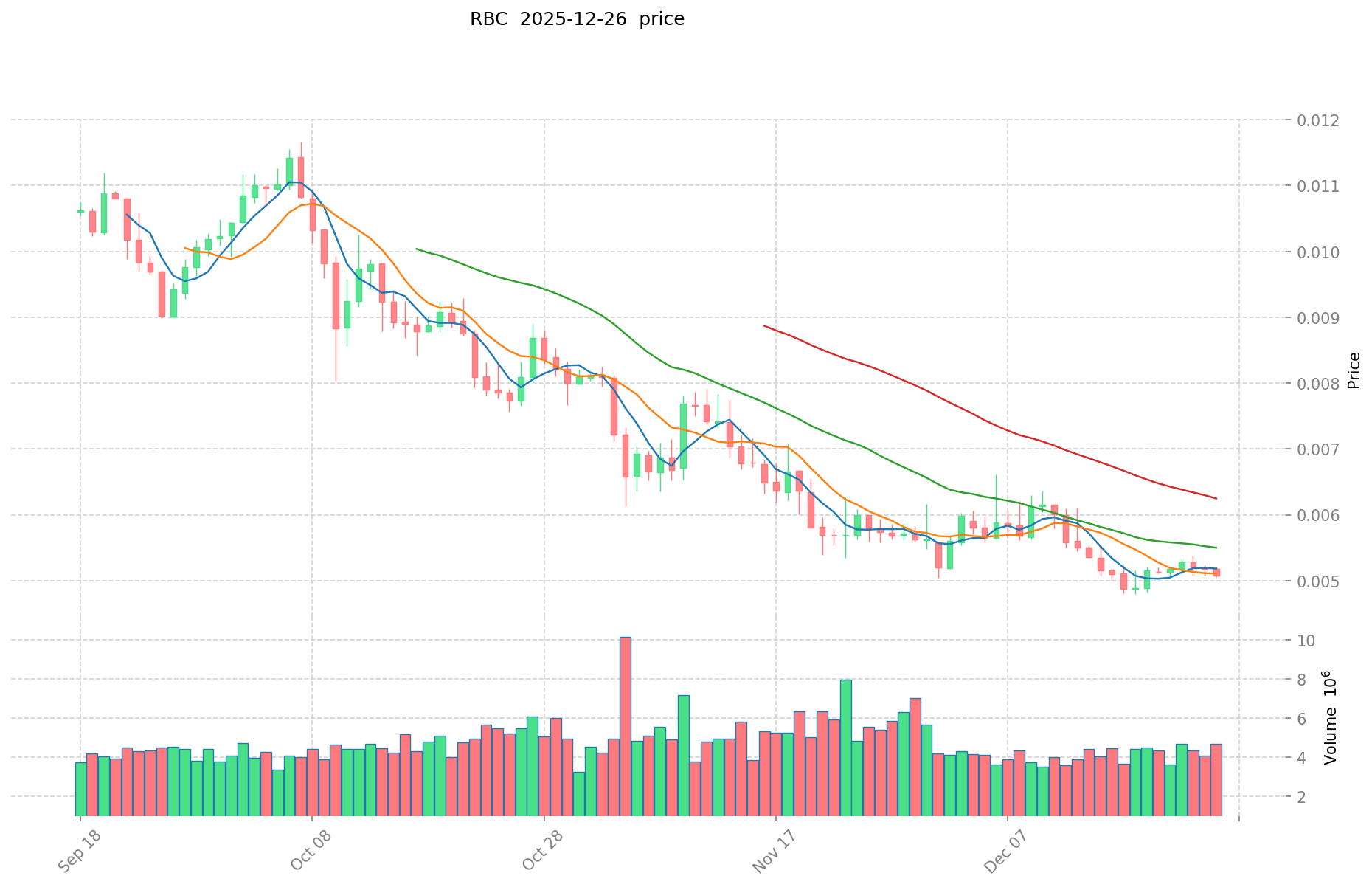
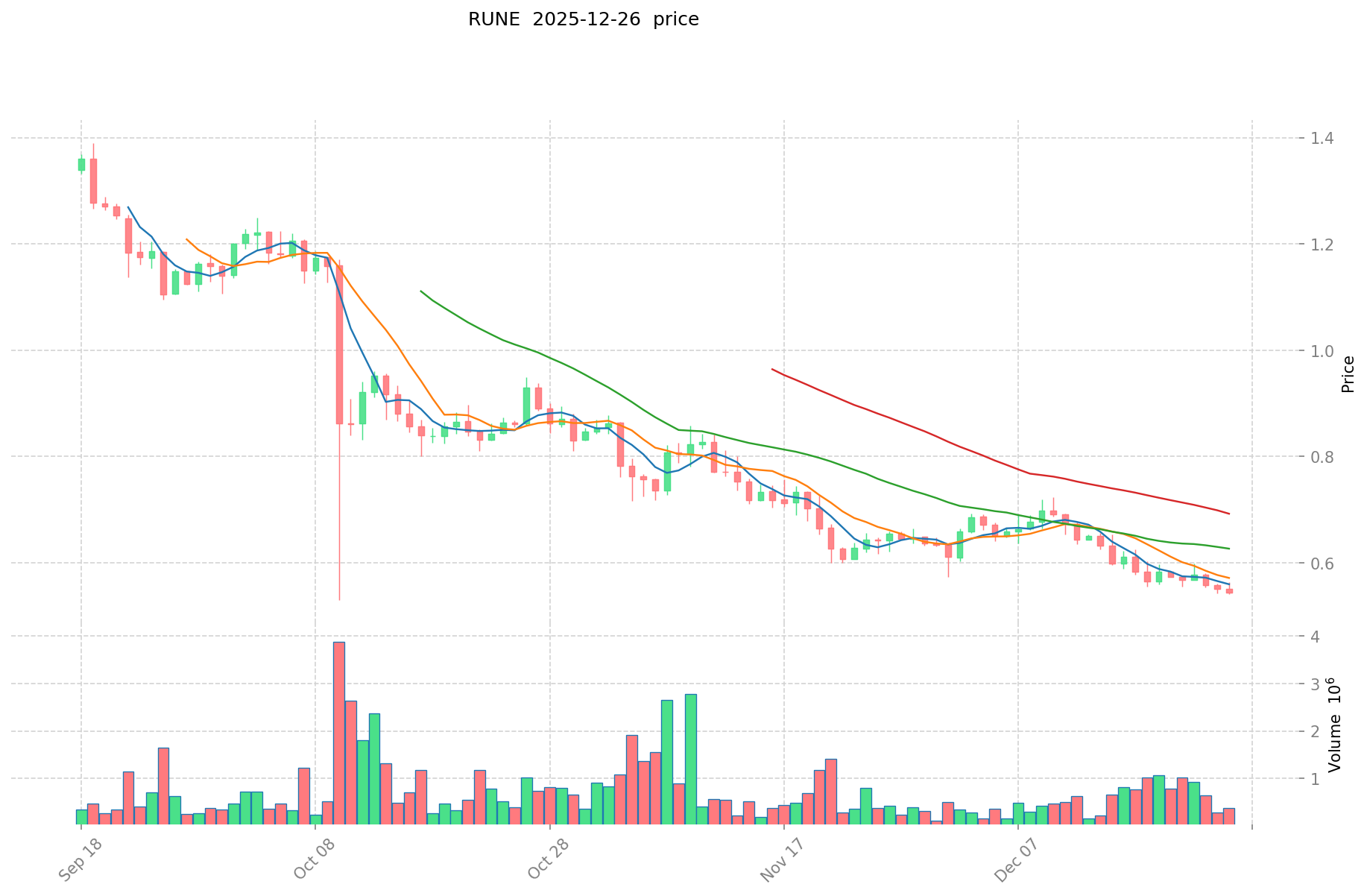
Rubic (RBC) and THORChain (RUNE) Historical Price Trends
- February 6, 2021: RBC reached its all-time high of $0.793213, driven by early DeFi platform enthusiasm and market expansion during the 2021 bull market.
- May 19, 2021: RUNE achieved its all-time high of $20.87, reflecting strong demand for multi-chain liquidity solutions during the peak of the altseason.
- December 23, 2022: RBC hit its all-time low of $0.00066293, reflecting the broader market downturn and crypto market contraction during the bear market phase.
- September 28, 2019: RUNE reached its all-time low of $0.00851264, representing the early-stage token price during THORChain's initial market entry.
- Comparative Analysis: Throughout the market cycle, RBC declined from its peak of $0.793213 to current levels, representing a 99.35% decline from ATH. In contrast, RUNE has experienced a more severe decline from $20.87 to current trading levels, representing approximately a 97.36% decline from its peak, indicating both assets have faced sustained downward pressure in the current market environment.
Current Market Status (December 27, 2025)
- RBC current price: $0.005133.
- RUNE current price: $0.5506.
- 24-hour trading volume: RBC $22,418.71 vs RUNE $229,813.59.
- Market sentiment index (Fear & Greed Index): 20 (Extreme Fear).
View real-time prices:
二、影响 RBC vs RUNE 投资价值的核心因素
供应机制对比(Tokenomics)
Based on the available reference materials, specific tokenomics data for RBC and RUNE is not provided in the source materials. This section cannot be completed without detailed information regarding their supply mechanisms, circulation models, and inflation schedules.
机构采用与市场应用
机构持仓
The reference materials do not contain specific information about institutional holdings or preferences between RBC and RUNE tokens.
企业采用
Reference materials indicate that stablecoins face regulatory barriers (KYC/AML compliance) in real-world commercial applications, rather than technical limitations. However, specific adoption data for RBC and RUNE in cross-border payments, settlement, or investment portfolios is not provided in the source materials.
国家政策
The reference materials mention that Russian Federal Savings Bank is collaborating with regulators to develop digital asset products, indicating growing institutional interest in cryptocurrencies. However, specific regulatory attitudes toward RBC and RUNE across different jurisdictions are not addressed in the available sources.
技术发展与生态建设
RBC 技术发展
No specific technical development information for RBC is provided in the reference materials.
RUNE 技术发展
No specific technical development information for RUNE is provided in the reference materials.
生态对比
The reference materials highlight various blockchain hackathons and development initiatives (Somnia Data Streams, GUI INU Ideathon, JAMHacks 9) demonstrating DeFi, AI, and social network applications across multiple ecosystems. However, detailed comparison of RBC and RUNE ecosystem development in DeFi, NFTs, payments, and smart contracts is not available in the source materials.
宏观经济与市场周期
通胀环境下的表现
The reference materials note that stablecoins serve as core value sources in traditional fiat payment systems, yet their scalability in real-world commerce is constrained primarily by regulatory (KYC/AML) rather than technical factors. Specific anti-inflationary attributes of RBC and RUNE are not discussed.
宏观货币政策
General discussion of macroeconomic indicators (interest rates, USD index) impacting cryptocurrency markets is present in the reference materials, but specific analysis of how these factors affect RBC and RUNE is not provided.
地缘政治因素
The reference materials do not provide specific analysis of geopolitical impacts on cross-border transaction demand for RBC and RUNE.
III. 2025-2030 Price Prediction: RBC vs RUNE
Short-term Prediction (2025)
- RBC: Conservative $0.00272–$0.00513 | Optimistic $0.00513–$0.00708
- RUNE: Conservative $0.29–$0.55 | Optimistic $0.55–$0.76
Mid-term Prediction (2026-2028)
- RBC may enter a consolidation phase with gradual growth, projected price range $0.0043–$0.0092
- RUNE may enter an expansion phase driven by ecosystem development, projected price range $0.56–$0.95
- Key drivers: institutional capital inflows, ETF adoption, ecosystem development
Long-term Prediction (2029-2030)
- RBC: Base scenario $0.0075–$0.0101 | Optimistic scenario $0.0101–$0.0130
- RUNE: Base scenario $0.75–$0.95 | Optimistic scenario $0.95–$1.20
View detailed price predictions for RBC and RUNE
RBC:
| 年份 |
预测最高价 |
预测平均价格 |
预测最低价 |
涨跌幅 |
| 2025 |
0.00708492 |
0.005134 |
0.00272102 |
0 |
| 2026 |
0.006720406 |
0.00610946 |
0.0043377166 |
19 |
| 2027 |
0.0070564263 |
0.006414933 |
0.00545269305 |
24 |
| 2028 |
0.0092278811205 |
0.00673567965 |
0.0053211869235 |
31 |
| 2029 |
0.010136861089267 |
0.00798178038525 |
0.007502873562135 |
55 |
| 2030 |
0.013045421861652 |
0.009059320737258 |
0.008606354700395 |
76 |
RUNE:
| 年份 |
预测最高价 |
预测平均价格 |
预测最低价 |
涨跌幅 |
| 2025 |
0.763944 |
0.5496 |
0.291288 |
0 |
| 2026 |
0.96545484 |
0.656772 |
0.56482392 |
19 |
| 2027 |
0.9895583724 |
0.81111342 |
0.4298901126 |
47 |
| 2028 |
0.954356049972 |
0.9003358962 |
0.702261999036 |
63 |
| 2029 |
0.95516635227858 |
0.927345973086 |
0.75115023819966 |
68 |
| 2030 |
1.195395326606508 |
0.94125616268229 |
0.64946675225078 |
71 |
IV. Investment Strategy Comparison: RBC vs RUNE
Long-term vs Short-term Investment Strategy
- RBC: Suitable for investors seeking early-stage DeFi platform exposure and those focusing on token creation and management ecosystem development
- RUNE: Suitable for investors pursuing multi-chain liquidity solutions and those valuing protocol-level cross-chain transaction capabilities
Risk Management and Asset Allocation
- Conservative investors: RBC 20% vs RUNE 80%
- Aggressive investors: RBC 40% vs RUNE 60%
- Hedging tools: Stablecoin allocation, options strategies, cross-asset diversification
V. Potential Risk Comparison
Market Risk
- RBC: Significant liquidity constraints reflected in 24-hour trading volume of $22,418.71, creating potential slippage risks for larger position entries
- RUNE: Higher trading volume ($229,813.59) provides better liquidity, though both assets face sustained downward pressure from historical peaks
Technical Risk
- RBC: Platform scalability across multiple chains, integration complexity with existing DeFi protocols
- RUNE: pBFT consensus mechanism reliability, sub-second block finality maintenance under network stress
Regulatory Risk
- Global regulatory policies toward DeFi platforms and cross-chain protocols remain uncertain, with both RBC and RUNE exposed to evolving KYC/AML compliance requirements and jurisdictional restrictions on token trading
VI. Conclusion: Which Is the Better Buy?
📌 Investment Value Summary:
- RBC Advantages: Early-stage DeFi platform positioning, lower absolute price point enabling higher token acquisition volume, vision for multi-chain P2P trading expansion
- RUNE Advantages: Higher trading liquidity, established multi-chain protocol with proven consensus mechanism, stronger 24-hour trading volume indicating broader market participation
✅ Investment Recommendations:
- Beginner investors: Focus on RUNE due to superior liquidity and established protocol infrastructure, while considering smaller RBC allocations for diversification exposure
- Experienced investors: Balance RBC early-stage ecosystem potential against RUNE's proven multi-chain capabilities through staged portfolio allocation
- Institutional investors: Prioritize RUNE's higher trading volume for position building, while monitoring RBC's platform development trajectory for future institutional-grade adoption
⚠️ Risk Disclaimer: The cryptocurrency market exhibits extreme volatility. Both RBC and RUNE have experienced 97-99% declines from historical peaks, and the current market sentiment index stands at 20 (Extreme Fear). This analysis does not constitute investment advice.
FAQ
RBC和RUNE分别是什么项目?各自的核心功能是什么?
RBC是Spark Protocol,核心功能为链上资本分配。RUNE是Rune Native Token,主要用于支持Rune网络的交易和治理功能。
RBC和RUNE在技术架构上有什么区别?
RBC用于控制通道和资源块管理,RUNE专注于数据传输。两者职责不同,RBC是资源配置方式,RUNE是数据流处理机制,在技术架构上承担不同功能。
RBC和RUNE的生态应用场景分别是什么?
RBC用于Rubicon平台的去中心化交易和治理机制,RUNE用于Thorchain网络的跨链交易和流动性提供,两者均支持各自生态的DeFi应用和智能合约生态。
RBC和RUNE的代币经济模型有什么差异?
RBC采用固定总量发行模式,由项目方中心化部署;RUNE通过挖矿获得,更具去中心化特征。RBC供应量确定,RUNE则依赖挖矿产出,两者通胀机制差异明显。
从投资角度看,RBC和RUNE哪个更值得关注?各自的风险是什么?
RBC和RUNE风险特征不同。RBC高杠杆风险较大,容易受市场剧烈波动影响;RUNE作为跨链资产,面临智能合约风险和市场流动性风险。选择应根据个人风险承受能力决定。
RBC和RUNE在市场流动性、交易对和交易所上线情况如何对比?
RUNE作为Thorchain生态代币,市场流动性较强,交易对丰富,早期上线多个主流平台。RBC的具体流动性和交易对情况需根据其具体项目背景确认,建议查看官方数据获取最新上线信息。
* The information is not intended to be and does not constitute financial advice or any other recommendation of any sort offered or endorsed by Gate.