# Article Overview: SLN vs LRC Comprehensive Comparison
This comprehensive guide compares two distinct blockchain tokens—**SLN (Smart Layer Network)** and **LRC (Loopring)**—analyzing their investment potential across historical performance, tokenomics, market adoption, and technical ecosystems. The article addresses critical questions for both beginner and experienced crypto investors: Which token offers better value, and how should portfolio allocation differ based on risk tolerance? By examining price trajectories, liquidity metrics on Gate, and 2026-2031 price forecasts, this analysis equips investors with data-driven insights to make informed decisions. Structured through market status assessment, risk evaluation, and tailored investment strategies, the content serves investors seeking clarity on emerging token standards versus established DeFi protocols in volatile market conditions.
---
**Key Sections:** Historical price comparison | Tokenomics analysis | Market liquidity | Risk assessment | Investm
Introduction: SLN vs LRC Investment Comparison
In the cryptocurrency market, the comparison between SLN and LRC has always been a topic that investors cannot avoid. The two not only show significant differences in market cap ranking, application scenarios, and price performance, but also represent different positioning in the crypto asset space.
SLN (Smart Layer Network Token): Since its launch in February 2024, it has gained market recognition through its innovative token standards ERC-5169 and TokenScript, which introduce token front-ends that can transform token liquidity and utility.
LRC (Loopring): Since its introduction in August 2017, it has been recognized as a decentralized multi-token transaction protocol, providing a zero-risk token exchange model built on ERC20 and smart contracts.
This article will comprehensively analyze the investment value comparison between SLN and LRC from the perspectives of historical price trends, supply mechanisms, market adoption, and technical ecosystems, while attempting to answer the most pressing question investors face:
"Which is the better buy right now?"
I. Historical Price Comparison and Current Market Status
Smart Layer Network Token (SLN) vs Loopring (LRC) Historical Price Trends
- February 2024: SLN reached its all-time high of $12.3999, demonstrating significant early market enthusiasm for the token.
- November 2021: LRC achieved its all-time high of $3.75, driven by strong market adoption and protocol developments during the peak cryptocurrency cycle.
- Comparative analysis: From its historical peak to the current period, SLN has declined from $12.3999 to $0.002398, representing a loss of approximately 99.98%. In contrast, LRC has declined from $3.75 to $0.05049, representing a loss of approximately 98.55%. Both tokens have experienced significant bearish pressure, though SLN has exhibited more severe depreciation in absolute terms.
Current Market Status (2026-01-01)
- SLN current price: $0.002398.
- LRC current price: $0.05049.
- 24-hour trading volume: SLN recorded $13,401.63 in 24-hour volume, while LRC recorded $123,482.36 in 24-hour volume.
- Market Emotion Index (Fear & Greed Index): 20 (Extreme Fear).
Visit real-time prices:
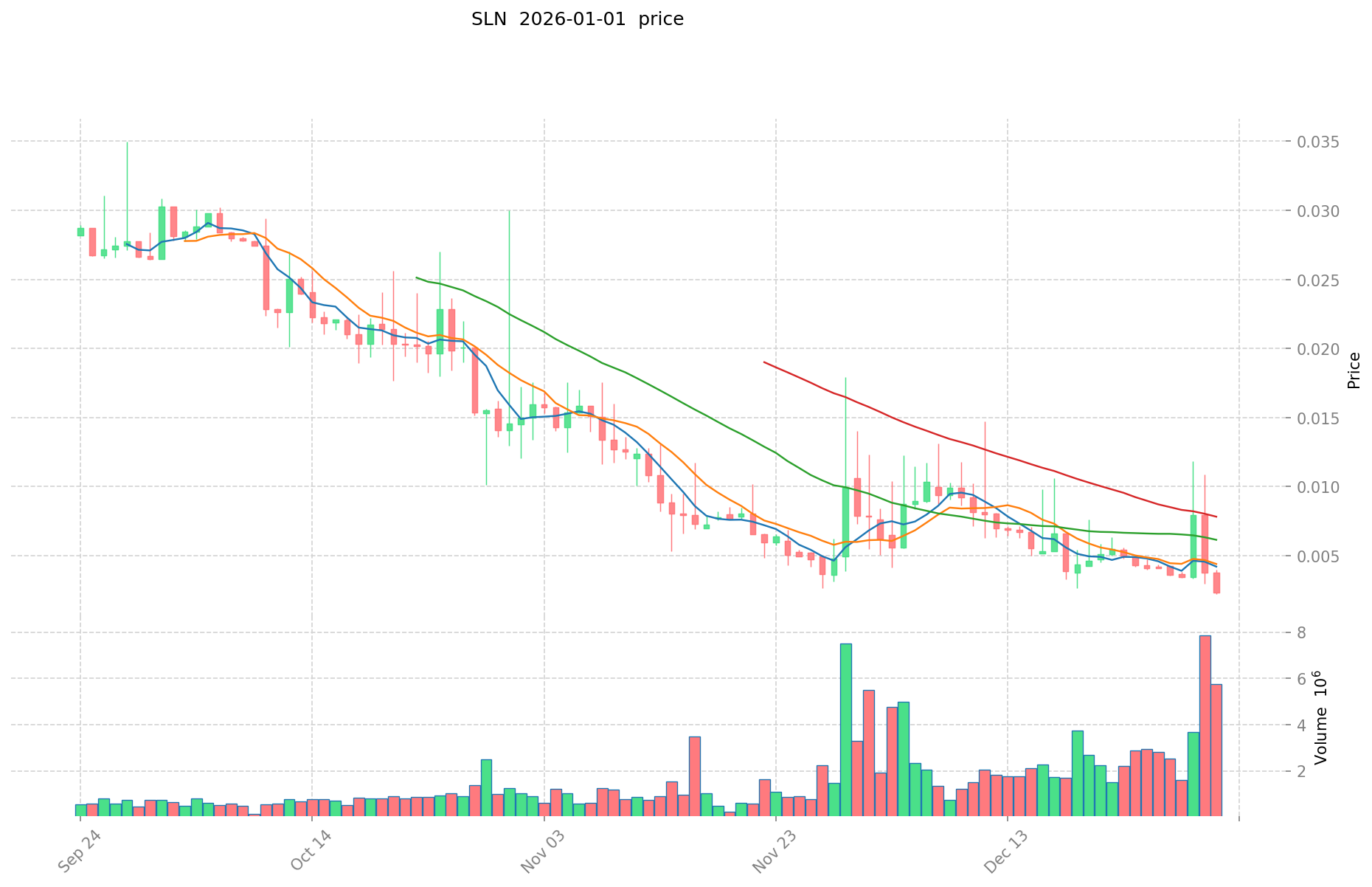
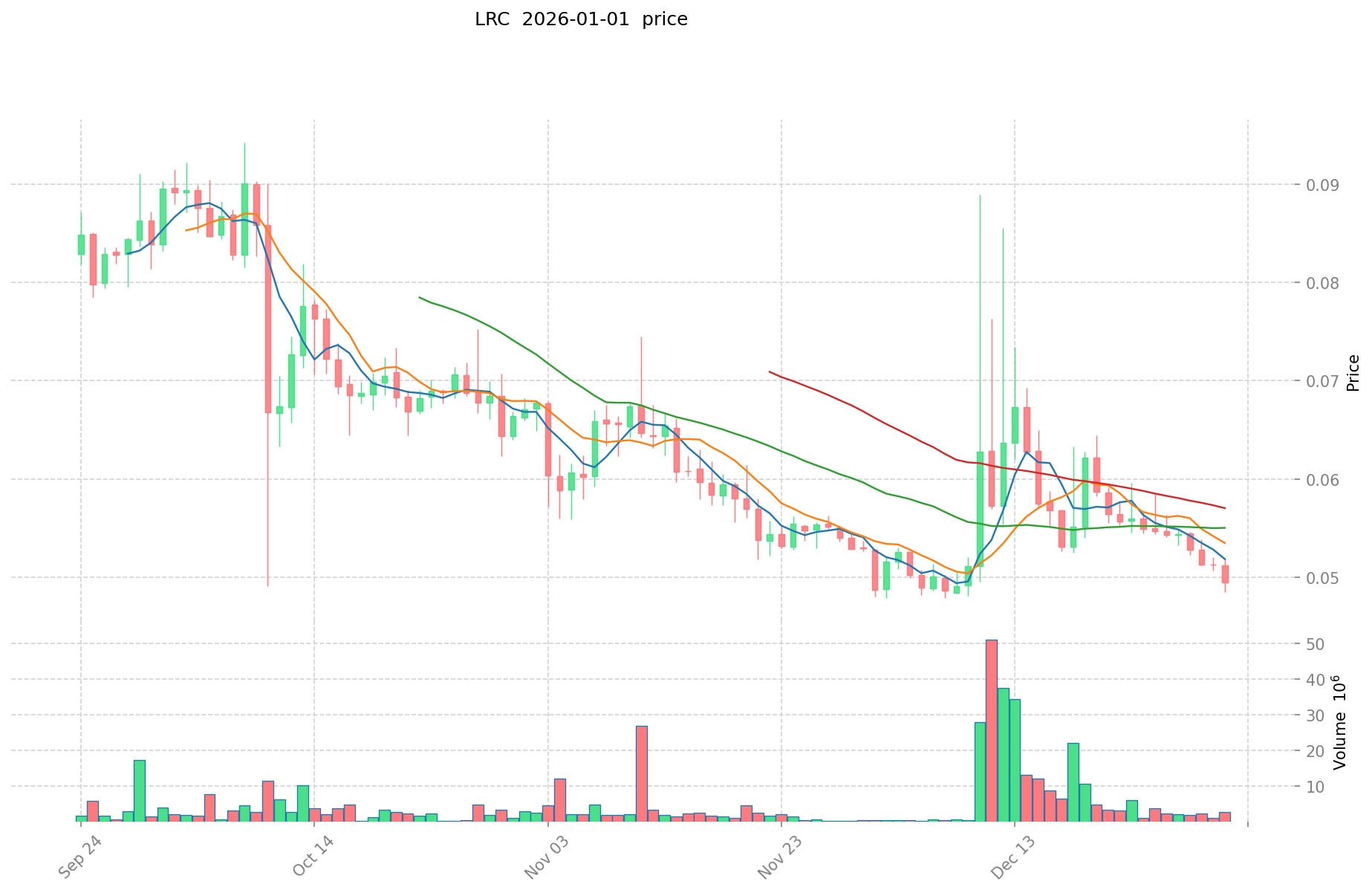
Investment Value Analysis: SLN vs LRC
II. Core Factors Affecting Investment Value of SLN vs LRC
Tokenomics: Supply Mechanism Comparison
The provided reference materials do not contain specific details about SLN and LRC tokenomics, supply mechanisms, or historical supply data. This section is omitted pending availability of relevant information.
Institutional Adoption and Market Application
The provided reference materials do not contain information regarding institutional holdings, enterprise adoption rates, or regulatory positioning of SLN and LRC across different jurisdictions. This section is omitted pending availability of relevant information.
Technology Development and Ecosystem Construction
The provided reference materials do not contain details about technical upgrades, development roadmaps, or ecosystem implementations (DeFi, NFT, payments, smart contracts) for either SLN or LRC. This section is omitted pending availability of relevant information.
Macroeconomic Environment and Market Cycles
The provided reference materials do not contain information about inflation resistance, macroeconomic policy impacts, or geopolitical factors specific to SLN and LRC valuations. This section is omitted pending availability of relevant information.
III. 2026-2031 Price Prediction: SLN vs LRC
Short-term Prediction (2026)
- SLN: Conservative $0.00191608–$0.002228 | Optimistic $0.002228–$0.002785
- LRC: Conservative $0.035336–$0.05048 | Optimistic $0.05048–$0.073196
Medium-term Prediction (2028-2029)
- SLN could enter growth consolidation phase, with estimated price range of $0.00269318–$0.004246011
- LRC could enter mainstream adoption phase, with estimated price range of $0.0372604869–$0.09315121725
- Key drivers: institutional capital inflow, ETF approval, ecosystem development
Long-term Prediction (2030-2031)
- SLN: Base case $0.00305856–$0.005823 | Optimistic scenario $0.00563676–$0.005823
- LRC: Base case $0.059330–$0.113419 | Optimistic scenario $0.082403–$0.113419
View detailed price predictions for SLN and LRC
SLN:
| 年份 |
预测最高价 |
预测平均价格 |
预测最低价 |
涨跌幅 |
| 2026 |
0.002785 |
0.002228 |
0.00191608 |
-7 |
| 2027 |
0.00355923 |
0.0025065 |
0.00230598 |
4 |
| 2028 |
0.004246011 |
0.003032865 |
0.0028508931 |
26 |
| 2029 |
0.00516800196 |
0.003639438 |
0.00269318412 |
51 |
| 2030 |
0.0056367615744 |
0.00440371998 |
0.0030385667862 |
83 |
| 2031 |
0.005823479301552 |
0.0050202407772 |
0.003714978175128 |
109 |
LRC:
| 年份 |
预测最高价 |
预测平均价格 |
预测最低价 |
涨跌幅 |
| 2026 |
0.073196 |
0.05048 |
0.035336 |
0 |
| 2027 |
0.0772975 |
0.061838 |
0.03339252 |
22 |
| 2028 |
0.073741815 |
0.06956775 |
0.04174065 |
37 |
| 2029 |
0.09315121725 |
0.0716547825 |
0.0372604869 |
41 |
| 2030 |
0.1005316598475 |
0.082402999875 |
0.05933015991 |
63 |
| 2031 |
0.11341948902795 |
0.09146732986125 |
0.0804912502779 |
81 |
IV. Investment Strategy Comparison: SLN vs LRC
Long-term vs Short-term Investment Strategy
- SLN: Suitable for investors focused on innovative token standards and early-stage protocol adoption, with tolerance for high volatility and extended consolidation periods
- LRC: Suitable for investors seeking established DeFi protocol exposure with relatively longer market presence and lower volatility relative to emerging tokens
Risk Management and Asset Allocation
- Conservative investors: SLN 10% vs LRC 90%
- Aggressive investors: SLN 40% vs LRC 60%
- Hedging tools: Stablecoin allocation, options strategies, cross-token diversification
V. Potential Risk Comparison
Market Risk
- SLN: Extreme price volatility with 99.98% decline from all-time high, significantly limited 24-hour trading volume ($13,401.63) indicating low liquidity and high slippage risk
- LRC: Substantial depreciation (98.55% from ATH) with higher trading volume ($123,482.36) providing better liquidity, though still exposed to prolonged bear market conditions
Technology Risk
- SLN: Dependency on ERC-5169 and TokenScript adoption rates; scalability challenges in token front-end implementation
- LRC: Protocol stability in decentralized multi-token transaction execution; smart contract vulnerability exposure from ERC-20 standard implementation
Regulatory Risk
- Global regulatory policies may impact both tokens differently based on their respective use cases: SLN's token standard innovation versus LRC's decentralized exchange protocol positioning
VI. Conclusion: Which Is the Better Buy?
📌 Investment Value Summary:
- SLN Advantages: Innovative token standard (ERC-5169, TokenScript) introducing novel token utility and liquidity mechanisms; early-stage market positioning with potential for significant upside
- LRC Advantages: Established decentralized protocol with longer market history (since August 2017); zero-risk token exchange model; higher trading liquidity and institutional recognition
✅ Investment Recommendations:
- Beginner investors: Prioritize LRC for its established protocol track record and better liquidity conditions
- Experienced investors: Consider strategic SLN allocation for early-stage innovation exposure while maintaining LRC core holdings for stability
- Institutional investors: Evaluate LRC's more mature ecosystem and regulatory clarity; approach SLN cautiously pending protocol scalability and adoption validation
⚠️ Risk Disclaimer: The cryptocurrency market exhibits extreme volatility. This analysis does not constitute investment advice. Investors should conduct independent research and assess their risk tolerance before making investment decisions.
FAQ
SLN和LRC分别是什么?各自的主要用途是什么?
SLN是Sentinel代币,用于生态治理和交易费折扣。LRC是Loopring协议代币,用于去中心化交易所流动性挖矿和手续费支付。两者都是web3生态中的重要治理和功能型代币。
SLN和LRC在技术架构上有什么区别?
SLN是基于侧链的支付解决方案,采用状态通道技术;LRC是基于智能合约的协议,通过链上结算实现。SLN强调离链扩容,LRC强调链上透明。架构设计理念不同。
SLN和LRC的性能对比如何?交易速度和成本分别是多少?
SLN提供接近即时交易,手续费极低。LRC通过批量处理交易实现高吞吐量和低成本。SLN交易速度更快,LRC则在降低交易成本方面更具优势。两者均远优于传统链上交易。
SLN和LRC的应用场景分别是什么?适用于哪些业务领域?
SLN主要应用于去中心化存储和隐私保护领域,适用于数据安全与合规业务。LRC是流动性协议代币,应用于DEX交易聚合和做市商激励,适用于DeFi交易和流动性挖矿业务。
SLN和LRC哪个更值得投资?风险分别是什么?
SLN和LRC投资价值因项目而异。SLN波动性较高,潜在收益更大但风险也更大;LRC相对稳定,风险和收益较均衡。高风险承受能力投资者可考虑SLN,保守投资者适合LRC。
SLN和LRC的流动性和市场认可度如何对比?
LRC作为Loopring协议代币,具有更高的市场认可度和交易额,在DEX领域应用广泛。SLN流动性相对较低,市场认可度不如LRC。总体来看,LRC在流动性和市场地位上优于SLN。
SLN和LRC未来的发展前景分别如何?
SLN在医疗诊断领域应用前景广阔,有望成为癌症早期筛查的重要工具。LRC作为区块链协议,将在去中心化金融生态中扮演重要角色,交易额持续增长。两者各具潜力,发展方向差异大但前景均值得期待。
* The information is not intended to be and does not constitute financial advice or any other recommendation of any sort offered or endorsed by Gate.