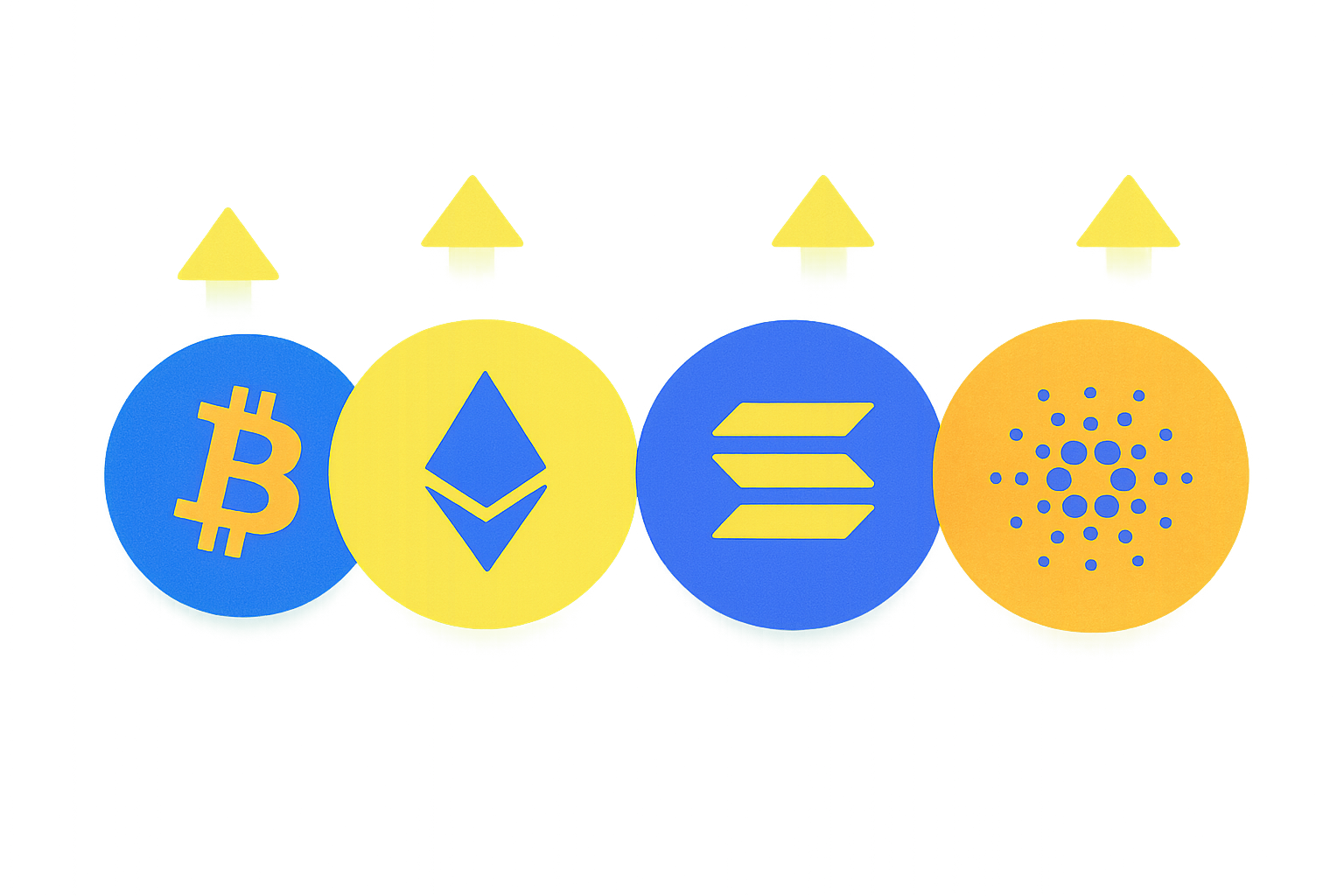
This article analyzes the top cryptocurrencies to watch in 2025, focusing on their potential for significant growth and relevance in digital finance. It discusses the evolving landscape shaped by institutional adoption, regulatory advancements, and technological innovations. Key topics include Bitcoin's store-of-value status, Ethereum's decentralized applications, Solana's high-speed network, Cardano's research-driven approach, and other promising altcoins. The article is suitable for investors seeking to understand the trajectory of digital assets and make informed investment decisions for diversified portfolios. Keywords: cryptocurrency investment, digital finance, Bitcoin, Ethereum, altcoins.
Top Cryptocurrencies to Watch in 2025: The Future of Digital Wealth
The cryptocurrency market in 2025 is evolving rapidly, fueled by groundbreaking innovations, regulatory clarity, and increasing institutional adoption. The days of crypto being a niche investment are long gone—major corporations, governments, and financial institutions are now deeply involved. If you're considering investing in digital assets, now is the time to pay attention to which bitcoins and cryptocurrencies are best to invest in.
Why Invest in Crypto Now?
The investment landscape for cryptocurrencies has fundamentally transformed. Mass adoption is no longer a distant dream but an emerging reality. Cryptocurrencies are being integrated into mainstream finance, with Fortune 500 companies and sovereign wealth funds recognizing their value as alternative assets. Additionally, many governments, including the United States, are moving towards clearer regulatory frameworks, making crypto a safer and more legitimate investment compared to previous years. This regulatory progress significantly reduces uncertainty and legal risks for investors. Furthermore, blockchain technology continues to improve at an accelerated pace, creating faster, more efficient networks that enhance transaction speeds and reduce operational costs. These three factors—mass adoption, regulatory progress, and technological breakthroughs—combine to create an unprecedented opportunity for investors seeking exposure to digital assets.
Bitcoin (BTC) – The Digital Gold
Bitcoin remains the most recognized and trusted cryptocurrency in the world, often referred to as "digital gold" due to its store-of-value characteristics. Government recognition has significantly reinforced Bitcoin's importance as a legitimate global asset. This institutional recognition has attracted major institutional investors and sovereign wealth funds, who are continuously increasing their Bitcoin holdings, thereby creating upward pressure on its price. The limited supply of Bitcoin, capped at 21 million coins, combined with increasing demand from institutional and retail investors, creates a compelling investment thesis. Bitcoin is widely considered among the best bitcoins to invest in for those seeking long-term value preservation. Analysts project that BTC could reach new all-time highs throughout 2025, driven by sustained demand and supply constraints.
Ethereum (ETH) – The Powerhouse of Decentralized Applications
Ethereum has revolutionized the cryptocurrency space through its smart contract capabilities, enabling an entire ecosystem of decentralized applications. The platform powers decentralized finance (DeFi) protocols, non-fungible tokens (NFTs), and increasingly sophisticated AI-powered applications. The successful implementation of Ethereum 2.0 has substantially transformed the network's performance characteristics. Transaction speeds have increased dramatically, while energy consumption has decreased significantly, making ETH more scalable and environmentally sustainable. These improvements have made Ethereum an increasingly attractive platform for developers and enterprises seeking to build blockchain-based solutions. Institutional adoption is expanding rapidly as traditional finance institutions recognize the value proposition of blockchain-based financial applications. Market analysts project that ETH could reach substantial valuations throughout 2025, fueled by institutional adoption and the expanding decentralized finance market.
Solana (SOL) – The High-Speed Contender
Solana has emerged as one of the fastest and most cost-effective blockchain networks available today. Its architecture enables thousands of transactions per second with minimal fees, creating an efficient ecosystem for decentralized applications. The Solana ecosystem boasts a thriving NFT marketplace and has established partnerships with major companies across various industries. These partnerships and the ecosystem's vibrancy position Solana as a formidable competitor in the smart contract platform space. Regulatory recognition and growing accessibility for institutional investors could trigger substantial price appreciation. Conservative projections estimate that SOL could experience significant growth throughout 2025, driven by high adoption rates and continued network improvements.
Cardano (ADA) – The Smart Investment for the Future
Cardano distinguishes itself through its research-driven development approach, emphasizing peer-reviewed academic research and rigorous testing before implementing major network upgrades. This methodical approach ensures long-term sustainability and reduces the risk of network failures. Cardano has successfully integrated smart contract functionality and is actively expanding into real-world applications, particularly in emerging markets where blockchain technology can address critical infrastructure challenges. The platform's commitment to solving practical problems while maintaining strong technical fundamentals makes it an attractive investment for those seeking long-term growth potential. Market analysts project that ADA could appreciate significantly as adoption increases and new institutional partnerships are announced.
XRP (XRP) – The Future of Cross-Border Payments
XRP's core technological advantage lies in its ability to facilitate instant, low-cost international transactions, addressing a critical pain point in global finance. Banks and financial institutions have recognized XRP's potential as a settlement mechanism for cross-border payments, preferring it over traditional correspondent banking systems that are slow and expensive. Recent regulatory developments have substantially improved the outlook for the token. Market participants anticipate that regulatory clarity will increase institutional adoption and potentially lead to expanded financial infrastructure integration in 2025. These developments position XRP as a significant asset for those seeking exposure to international payment solutions.
Polygon (MATIC) – Scaling Ethereum for Mass Adoption
Polygon is a layer-2 scaling solution designed to address Ethereum's scalability limitations by enabling faster and cheaper transactions while maintaining security through connection to the Ethereum mainnet. The platform reduces transaction costs significantly and increases throughput, making Ethereum-based applications practical for mass-market use. Polygon has established partnerships with technology giants and major companies seeking to leverage blockchain technology. These partnerships validate Polygon's technology and demonstrate real-world adoption beyond speculative use cases. As more projects integrate Polygon's technology to overcome Ethereum's scaling challenges, MATIC is positioned for substantial long-term success throughout 2025.
Chainlink (LINK) – The Oracle Connecting Blockchain to the Real World
Chainlink operates as a decentralized oracle network that enables smart contracts to securely access real-world data, external APIs, and payment systems. This critical infrastructure function makes Chainlink indispensable for the functionality of thousands of decentralized applications. As artificial intelligence-powered applications become increasingly prevalent within the blockchain ecosystem, Chainlink's role in providing reliable data feeds becomes even more crucial. The network's essential position in blockchain infrastructure and its growing adoption among major DeFi protocols position it for sustained growth as the industry continues to develop innovative applications.
Polkadot (DOT) – The Future of Blockchain Interoperability
Polkadot's core innovation lies in its ability to enable different blockchain networks to communicate and share information seamlessly. As the Web3 ecosystem evolves toward a multi-chain future where numerous specialized blockchains serve different purposes, interoperability becomes increasingly essential. Polkadot's architecture allows developers to build customized blockchains that can interact with the broader ecosystem. This unique value proposition attracts developers seeking to build scalable applications without sacrificing security or decentralization. As more developers build applications on Polkadot's network and interoperability becomes recognized as a key blockchain trend, DOT's value is expected to appreciate significantly.
Avalanche (AVAX) – The Fast and Scalable Ethereum Rival
Avalanche distinguishes itself through ultra-fast transaction speeds and minimal transaction fees, creating an attractive alternative platform for developers and enterprises. The network's innovative consensus mechanism enables rapid finality and high throughput while maintaining robust security properties. Institutional investors have demonstrated growing interest in AVAX as a platform for enterprise applications and institutional-grade DeFi solutions. This institutional adoption pattern suggests sustained demand for the network and its native token. The platform's technical superiority in speed and cost-efficiency, combined with increasing institutional interest, positions AVAX as a strong long-term investment for those evaluating which bitcoins and cryptocurrencies are best to invest in for diversification.
Stablecoins (USDT, USDC) – The Backbone of Digital Finance
Stablecoins such as USDT (Tether) and USDC (USD Coin) maintain a stable value pegged to the U.S. dollar, providing a crucial bridge between traditional finance and the cryptocurrency ecosystem. These assets serve essential functions including providing liquidity for crypto trading, enabling payments and remittances with reduced volatility, and serving as collateral in decentralized finance protocols. Stablecoins eliminate the price volatility that makes regular cryptocurrencies unsuitable for some practical applications, making them increasingly important for mainstream adoption. The stablecoin market has experienced exponential growth as financial institutions recognize their utility for efficient cross-border settlements and decentralized finance operations. Market data indicates that the total stablecoin market capitalization continues to expand, highlighting the growing importance of these assets within the broader cryptocurrency ecosystem.
Conclusion
The cryptocurrency market in 2025 stands at a pivotal juncture, with mainstream adoption accelerating, regulatory frameworks becoming increasingly clear, and technological breakthroughs enhancing the functionality and scalability of blockchain networks. When considering which bitcoins are best to invest in, diversifying your portfolio with high-potential cryptocurrencies aligned with your risk tolerance could lead to substantial returns. Long-term investors should focus on foundational assets like Bitcoin and Ethereum for sustained growth potential. Risk-tolerant investors might consider altcoins such as Cardano, Chainlink, and Polkadot for higher potential returns, accepting the associated volatility. Stablecoins provide a practical mechanism to hold cryptocurrency assets without exposure to price volatility. The future of finance is undeniably digital, and establishing positions in the cryptocurrency market aligned with your investment objectives remains prudent as the industry transitions from speculation to mainstream utilization.
FAQ
How much would I have if I invested $1000 in Bitcoin 5 years ago?
A $1,000 investment in Bitcoin 5 years ago would be worth over $10,620 today. Bitcoin's price has surged significantly, demonstrating its strong long-term growth potential in the cryptocurrency market.
Which cryptocurrency is best to invest now?
Bitcoin and Ethereum remain top choices for investors. Bitcoin leads in market dominance and transaction volume, while Ethereum offers versatile smart contract capabilities. Both show strong fundamentals for long-term growth potential.
How much is $100 Bitcoin worth right now?
As of today, $100 is worth approximately 0.0011 Bitcoin. The conversion rate fluctuates constantly based on market conditions. For the most current exchange rate, consult a reliable cryptocurrency data source.
* The information is not intended to be and does not constitute financial advice or any other recommendation of any sort offered or endorsed by Gate.