Historically, most crypto trading platforms were built with human traders in mind, offering features like trading charts, order panels, and asset management pages. However, with the rapid advancement of artificial intelligence, the market is seeing new demands: enabling AI systems to directly participate in market research and trading operations.
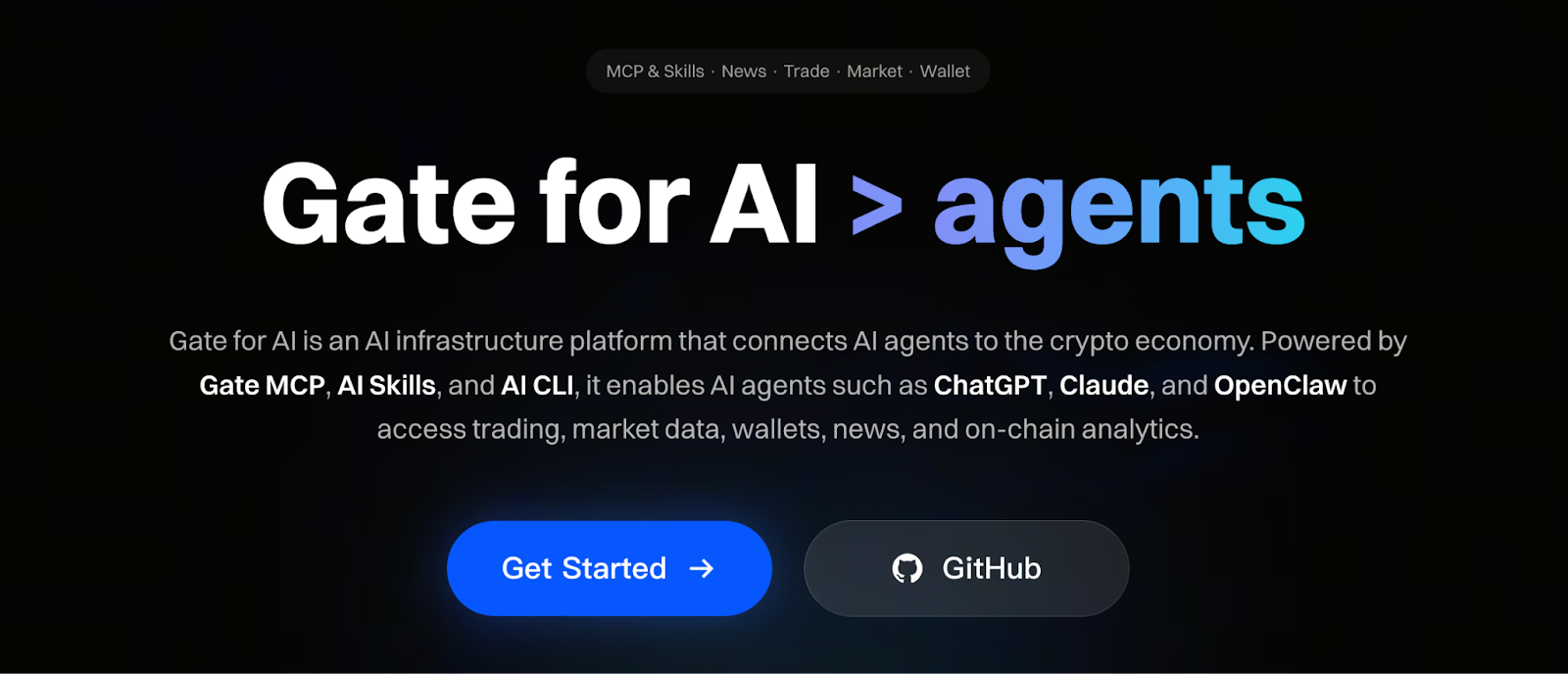
In response, Gate has introduced Gate for AI. This system goes beyond simply adding AI analysis tools—it reconstructs the exchange’s core capabilities into a technical framework accessible by AI agents. With a unified system design, AI can perform data analysis, strategy evaluation, and trade execution all on a single platform, creating a seamless and comprehensive trading workflow.
Five Core Capabilities for AI Trading Systems
Gate for AI is designed by integrating multiple capability modules, allowing AI to access diverse market data and trading functions simultaneously. These modules together form the foundation for AI-driven trading.
The first is centralized trading functionality. AI can directly connect to the platform’s spot markets, derivatives contracts, wealth management products, and new asset issuance mechanisms. In Gate’s mature matching and liquidity environment, AI can execute a range of strategies, including trend trading, arbitrage, and asset allocation.
The second is on-chain trading capability. Beyond centralized markets, Gate for AI enables AI to participate in decentralized trading scenarios. AI can perform swaps, on-chain perpetual trading, or meme token trading across different blockchains, tapping into on-chain liquidity and price differences.
Third is the wallet and signature management system. This system integrates wallet creation, private key management, and authorization signature mechanisms, enabling AI to conduct on-chain transactions and asset transfers securely under user authorization—laying a safe foundation for automated trading.
Fourth is the market information system. The platform continuously provides structured market news and real-time updates, allowing AI to quickly track market events and capital flows, and adjust strategies based on the latest information.
Finally, there’s the on-chain data query capability. Gate for AI connects to multiple on-chain data sources, enabling AI to analyze token development, address activity, and transaction history in depth—supporting more comprehensive market insights.
Skills Hub: Modular Trading Strategies
In addition to core trading capabilities, Gate for AI features the Skills Hub—a dedicated center for configuring AI trading strategies through modular components.
Within the Skills Hub, strategies are broken down into modules such as market scanning, price range analysis, arbitrage detection, and risk assessment. Users can build complete trading strategies simply by selecting and combining these modules—no coding required.
This design streamlines strategy configuration while maintaining high flexibility. AI can continuously monitor the market according to preset strategies and automatically execute trades or adjust positions when conditions are met.
For example, if abnormal funding rates or liquidation signals appear, AI can automatically analyze for arbitrage opportunities and, under authorized conditions, establish trading positions with integrated risk controls.
Additionally, users can interact with AI directly in natural language—such as asking whether a specific asset is suitable for opening a position. The system consolidates market conditions, liquidity, and risk data to generate analysis reports and provide trading recommendations.
Dual-Layer Technical Architecture: MCP and Skills
To balance system flexibility and strategic depth, Gate for AI adopts a dual-layer architecture: MCP and Skills.
MCP (Standardized Tool Interface) handles essential operations such as market data queries, account management, order execution, and on-chain data retrieval. This layer offers a unified API, enabling various AI systems to quickly integrate and leverage platform features.
Above MCP, the Skills layer delivers advanced strategic capabilities. It merges multiple data sources and analytical models into strategy modules, empowering AI to perform complex tasks like arbitrage analysis, risk assessment, and strategy generation.
This dual-layer structure ensures Gate for AI remains scalable while supporting sophisticated trading applications.
The Value of Native AI Trading Infrastructure
Gate for AI’s launch marks a shift in the role of trading platforms. Previously, exchanges served mainly as gateways for trading. In the AI era, platforms are evolving into technical infrastructures that AI can directly leverage.
By integrating trading capabilities, data resources, and strategy modules, AI agents can accelerate market research and strategy deployment. This architecture not only boosts trading efficiency but also enables more users to participate in intelligent trading. The modular design of Skills Hub further lowers technical barriers, empowering non-developers to use AI to build their own trading strategies.
Learn more about Gate for AI: https://www.gate.com/gate-for-ai
Conclusion
As AI continues to reshape the financial markets, crypto trading platforms are moving toward intelligent transformation. Gate for AI brings together trading functions, on-chain data, and strategy modules to establish a trading infrastructure that AI agents can access directly. Supported by five core capability modules, the Skills Hub strategy center, and the dual-layer MCP + Skills architecture, AI can manage the full process from market analysis to trade execution. This design not only drives trading efficiency but also paves new paths for the evolution of intelligent finance. As more strategy modules and features are introduced, AI applications in the crypto market will continue to expand—and Gate for AI will play a pivotal role in this transformation.







