Global Stock Markets Today: Volatility and Uncertainty
Global stock markets have recently faced significant volatility, driven by multiple factors and resulting in a marked increase in market fluctuations. In this complex environment, many investors are turning to the Gate Tokenized Stocks Section to access more flexible and innovative investment tools. Tokenized stocks allow investors to trade on global stock price movements without relying on traditional market infrastructure.
Market Advantages of the Gate Tokenized Stocks Section
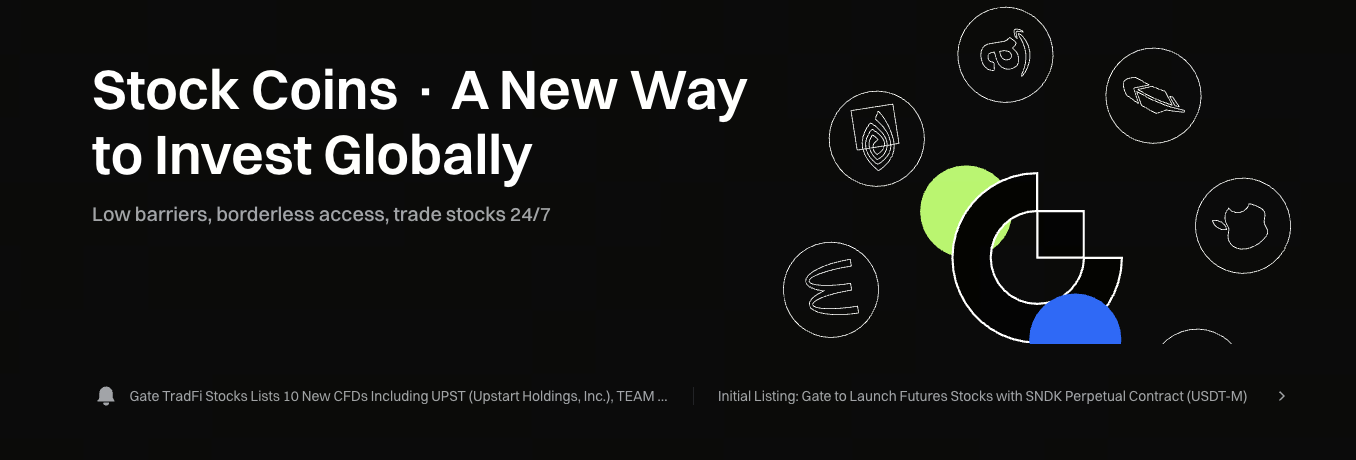 Image source: Gate Tokenized Stocks Section
1. Digital Assets Integrated with Traditional Stock Markets
Gate tokenized stocks are blockchain-based digital assets that mirror the price movements of traditional stocks in the digital marketplace through tokenization. This means investors can participate in global stock market gains and losses while leveraging the crypto market’s 24/7 trading capabilities to adjust strategies at any time.
2. Decentralized Trading Environment
Unlike traditional stock markets, trading Gate tokenized stocks does not require conventional brokers or financial institutions. All trades are executed via Smart Contracts, ensuring efficiency and transparency. This decentralized structure enhances fund security, reduces intermediary costs, and improves both liquidity and trading efficiency.
3. Low Entry Barriers and Global Access
Gate tokenized stocks feature low entry barriers, allowing investors to participate without substantial capital, and the platform is open to participants worldwide. Whether you’re an experienced institutional investor or a newcomer to tokenized stocks, Gate offers suitable investment opportunities.
How to Use Gate Tokenized Stocks to Navigate Market Volatility
1. Capturing Short-Term Price Movements
With heightened market volatility, investors can target short-term price swings to generate returns. For example, when macroeconomic data (such as CPI or PMI) triggers major market fluctuations, investors can quickly respond and pursue arbitrage opportunities with tokenized stocks.
The high liquidity and around-the-clock trading of tokenized stocks make these strategies easier to implement, enabling investors to adjust positions globally at any time and fully capitalize on price movements.
2. Sector Rotation Strategies
In volatile markets, different sectors may perform unevenly. For instance, when energy prices rise, energy-related tokenized stocks may outperform; conversely, in a rising interest rate environment, growth-oriented tokenized stocks may come under pressure. Investors can flexibly allocate across various tokenized stocks to take advantage of sector rotation opportunities.
3. Hedging and Risk Mitigation Strategies
During periods of market turbulence, investors often seek safe-haven assets. With tokenized stocks, investors can access tokens representing traditional safe-haven assets like gold or precious metals to hedge risks in other holdings. The low entry threshold also enables risk diversification with smaller capital allocations, reducing overall portfolio volatility.
4. Flexible Position Management
As market uncertainty grows, position management becomes even more important. Gate tokenized stocks allow investors to adjust their positions at any time, reducing dependence on individual stocks or sectors. The platform’s quick buy and sell mechanisms help investors respond rapidly in uncertain markets and avoid unnecessary losses from sharp swings.
Comparing Traditional Stocks and Tokenized Stocks
| Item |
Traditional Stock Market |
Gate Tokenized Stocks |
| Trading Hours |
Limited by exchange hours |
24/7 trading |
| Entry Barriers |
High (requires securities account) |
Low, no traditional account required |
| Trading Costs |
High (broker fees) |
Low (decentralized, no intermediary fees) |
| Investment Form |
Equity investment |
Participation in price movements, no shareholder rights |
| Market Environment |
Traditional securities market |
Crypto market, decentralized trading platform |
Risk Reminders and Investment Strategies
While Gate tokenized stocks offer flexible trading, they also carry certain risks. In volatile markets, investors should pay attention to the following:
1. Market Volatility Risk
Tokenized stock prices can be affected by both traditional stock markets and the crypto market. Investors need to closely monitor market sentiment and be prepared to respond to sudden changes.
2. Liquidity Risk
At times, tokenized stocks may experience lower market liquidity, resulting in wider bid-ask spreads and higher trading costs. Investors should focus on trading tokens with higher liquidity.
3. Compliance Risk
Crypto asset regulations vary by country and region. Investors must understand their local regulatory environment and comply with relevant laws and regulations.
4. Psychological Risk
Market volatility often brings emotional swings. Investors should remain rational and avoid making decisions driven by emotion.
Conclusion
As global stock market volatility and uncertainty increase, the Gate Tokenized Stocks Section provides investors with a flexible and convenient trading tool to capture opportunities in turbulent markets. With 24/7 trading, low entry barriers, and a decentralized structure, tokenized stocks are an ideal tool for managing market swings.
Nonetheless, investors should remain vigilant, invest rationally, and adjust strategies flexibly in response to market fluctuations. With disciplined position management and effective risk control, investors can pursue stable returns even in volatile market conditions.