Participants in the stock market and the crypto world are witnessing the onset of a chaotic era that has already begun.
Written by: shushu, Rhythm
Today’s financial market situation can be described as universally bleak; whether it’s the “taking medicine” meme or the “golden pit,” participants in the stock market and crypto world are witnessing the beginning of an already chaotic era.
Related Reading: “Global stock markets face the worst three-day performance in 50 years, can the crypto market hold up?”
The Federal Reserve hesitates to cut interest rates, and the market speculates that it has lost its ability to “support” the economy, while Trump tears apart market confidence with tariff negotiations, exacerbating external uncertainty. At the same time, the crypto market continues to decline under the dual pressure of technical and emotional factors, with several key support levels in jeopardy. This article explores multiple dimensions of macroeconomics, policy, market data, and technical analysis, summarizing traders’ observations on the current market for readers’ reference.
Macroeconomic Analysis
@AnnaEconomist
One of the reasons I believe there is still downside potential in this round of selling is the lack of possibility for a “Federal Reserve rescue” or “Trump rescue.” The following content mainly explains why a “Federal Reserve rescue” has become difficult to occur:
-
The premise of this market decline is the assumption that the Federal Reserve will cut interest rates five times this year. However, all FOMC members have stated that they need to see more “certainty” before any further rate cuts. Even by June, the Federal Reserve may not have enough “clear” inflation guidance. If companies continue to stockpile until June (which I indeed believe is the case), even if broader price increases eventually occur, they will only become apparent in the second half of the year. The Federal Reserve must wait for more definitive inflation signals.
-
The problem also lies in the Federal Reserve’s own expectations and judgments. If they continue to view the current situation as similar to 2022, worrying that inflation expectations may “de-anchor,” then even if the stock market falls another 20%, it will not shake their stance (as was the case in 2022). From the assessment of inflation risks in the Federal Reserve’s March meeting, they indeed still regard the current situation as another 2022.
-
The Fed will also refer to the inflation forecasts of major Wall Street investment banks. There are already several major banks predicting that core PCE will rise to 4%-5%. These forecasts will further discourage them from cutting interest rates.
-
The Federal Reserve places more importance on “hard data.” For instance, news about layoffs at DOGE may only be reflected in non-farm data by the end of the third quarter or the fourth quarter. However, the upward movement of inflation data is easier and faster to manifest. In other words, the Federal Reserve itself is a lagging regulator.
-
Powell cares about his “historical positioning”; he hopes to be seen as the new generation’s Volcker. At the same time, he is also cautiously maintaining the independence of the Federal Reserve, so he keeps his rhetoric neutral to avoid angering the White House. I say “trying” because if you listen closely, you will find that he is actually deliberately downplaying the hawkish stance within the FOMC and the Federal Reserve’s staff.
-
In the recessions of the 1970s and 1980s, nominal long-term interest rates did not bottom out until the economy bottomed out. In other cycles, interest rates tend to bottom earlier. The current macro environment is more like the '70s, '80s than other, milder recessions.
@Cato_CryptoM
-
The final version of Trump’s reciprocal tariffs is number 9, so before number 9, it is more of a negotiation period. At this time, it is too early to define the overall scope of this tariff and its impact on the economy, and we should not hastily define whether Trump will be impeached.
-
The core of Trump’s tariffs being high and aggressive is to have leverage and initiative at the negotiating table, so it doesn’t necessarily mean that he really has to raise tariffs this much to self-destruct or ruin his approval ratings.
-
Wounding the enemy a thousand while injuring oneself eight hundred does not harm Trump, nor MAGA, but rather the old American money from before, which is the dollar capital group. Therefore, they were in a hurry at the first moment, and then pushed for nationwide protests, using national righteousness to coerce Trump into compromise.
But who told you that Trump had to impose this tariff, and had to set it so high? If the purpose of the negotiations is achieved during this time, wouldn’t Trump suggest lowering the increase in tariffs? Isn’t that so?
From a God’s-eye perspective, if we look at it, Trump’s seemingly absurd and even hasty proposal of reciprocal tariffs has made the whole world think he is crazy or foolish. By doing so, he completes negotiations at the negotiation table, stimulating opponents to act and inciting public opinion to constrain himself, exposing all hidden enemies, and then announcing a reasonable reciprocal tariff policy on the 9th. Could this be a case of killing multiple birds with one stone?
Of course, this angle still needs to wait for the results on the 9th.
- Trump’s impact on the current market generally aligns with our expectations. During the previous election period, we mentioned that there would be a “period of adjustment” once Trump took office, and we are indeed experiencing that adjustment now.
But what exceeded our expectations was that no one expected the “pain” to be so strong, so strong that we thought he was crazy.
Of course, we criticize Trump now simply because we are victims of risk assets, and we are the injured party in Trump’s “revolution.” However, if we change our perspective, those who understand history should know that the revolutions and reforms that have occurred in various countries historically have always needed to go through a period of pain. Moreover, these revolutions and reforms, in their initial stages, were often misunderstood and faced the coercion of the “national righteousness” brought about by the protests and rallies of that time.
What we see in historical results is only the memory of the success of the revolution, not the pain they went through. I think what Trump is doing now is similar.
Many people believe that Trump is going to crash the economy, but if we look at it from a different perspective, even if Trump is currently causing a recession, if the economy quickly recovers after the recession and shows enough vitality, then who cares about the pain in the present?
History is always written by the victors, and right now Trump clearly has not won, so do not rush to conclusions.
Of course, we originally thought that Trump was going to perform a “major surgery” on America, but it turned out to be a “bone scraping therapy,” so the pain is too intense. Of course, if we find that after a year he has successfully extended America’s life by 50 years, by then everyone will probably be shouting about how “great” Trump is.
- Regarding the pressure on inflation caused by tariffs, Powell has previously stated that we need to see whether the inflation transmission from tariffs results in a one-time price increase on goods. If it does, then inflation may not be so terrifying, as short-term surges in prices could lead people to abandon consumption or seek alternatives.
Indeed, if this is the case, then inflation may have a weak short-term rebound, but it will lead to a weakening of the demand side, resulting in a slowdown in economic growth, with the greatest possibility of stagflation occurring, and the next step of stagflation is economic recession.
For the Federal Reserve, policies must necessarily be lagging, after all, they cannot exceed the speed of economic operation, and adjustments must be based on the discovery of economic issues. However, our Mr. Powell’s expectation management can be proactive, and if stagflation really occurs, the market will anticipate a recession. At that time, Mr. Powell can once again leverage his title as a master of expectation management to adjust market confidence, thus intervening at a critical moment, preventing the economy from truly falling into recession, and further demonstrating the independence of the Federal Reserve.
Of course, tariffs bring inflation, and the worst outcome is a monthly increase in inflation, which would directly lead to a rise in long-term inflation expectations, representing the most pessimistic scenario. Hopefully, it won’t be like that at that time.
- As for the decline in Trump’s approval rating due to tariffs, this is an inevitable short-term reaction, and there is even a possibility of impeachment, but I believe the probability is low.
Many of Trump’s current actions make me feel like a high-stakes gamble, and once he wins the bet, his approval ratings will naturally rise. The “defecting” Republican members will also return, and impeachment may just be a short-term danger signal, which may not necessarily lead to the actual impeachment process.
If you lose the bet, it naturally becomes a mess. Even if you’re impeached, who can turn the tide? Facing this mess, don’t expect the Democrats to step in and take the blame, right? I estimate that at this stage, even the Democrats wouldn’t want to take over, after all, a hot potato is feared to be hard to handle.
So, we can only wait to see if Lady Luck is on Trump’s side.
Negotiations are still ongoing among all parties, so before the 9th, we can only discuss from multiple angles. Perhaps while our discussions are heating up, the negotiations on the other side have concluded, with tariffs reduced more than expected, leading to a harmonious atmosphere for everyone?
@Phyrex_Ni
BTC fell 5.5%, ETH fell over 10%.
There is no clear negative news, and the trading volume is not high; it doesn’t resemble institutional selling, but rather looks like short-term risk aversion.
It may be a release of expectations regarding Monday’s countermeasures on tariffs in Europe and the U.S. There hasn’t been significant panic on-chain, and the structure hasn’t been damaged; more of the selling is from the inventory within exchanges.
If US stock futures continue to weaken tonight, the Asian market may follow suit in panic, but as long as there is no economic recession, I believe 70K is still a reasonable support.
In this round, I will continue to buy the dip, but with a small position + caution. I will make additional investment decisions after the tariffs are implemented and the GDP data is released.
When the market drops without reason, it is actually the most worth paying attention to.
Technical Analysis
@chetangurjar642
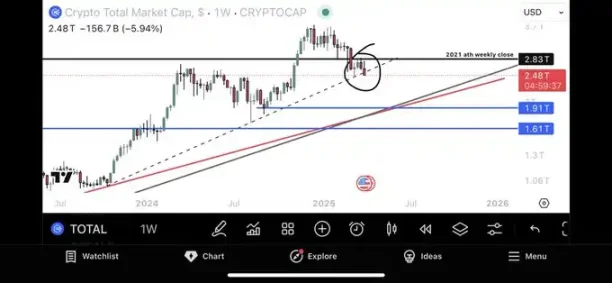
Latest trend update on the total market capitalization of cryptocurrencies:
It has currently broken below the dashed trend line on the weekly chart. If this break is confirmed, the next reasonable support level is at $1.91 trillion.
There is the intersection of the red bull market trend line and the long-term trend line (both are diagonal supports).
Of course, it is also possible that it will further drop to the position of 1.61 trillion dollars (it may just be a spike, but to be honest, it’s uncertain). If it really reaches this level, the level of pain in the market will be unimaginable, so please make sure to prepare in advance… By the way, if this situation occurs, the possible bottom time point would be in April.
I have started to place some bottom-fishing orders for altcoins at a range well below the current price. In addition, there are still nearly 5 hours left until the close of this K-line, so I am still watching.
Let’s take it one step at a time.
@biupa
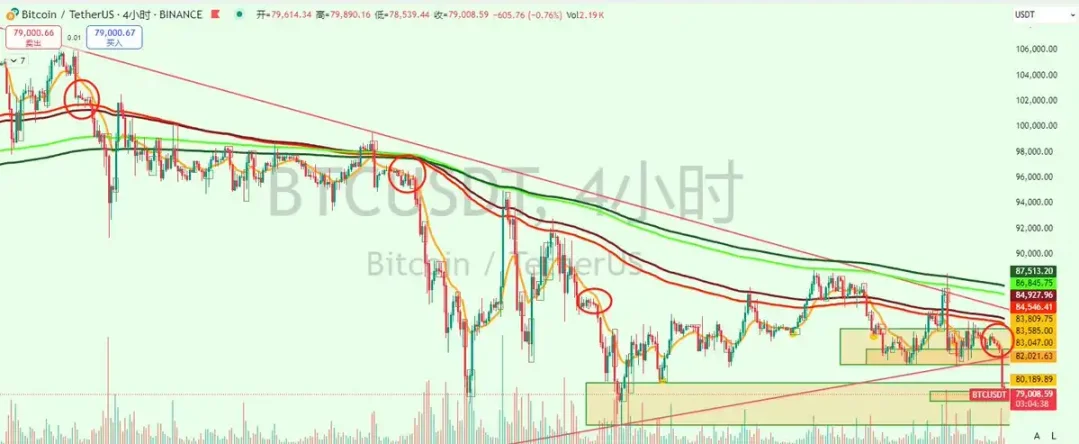
In fact, this weekend is no different from the previous few weekends, nor is it different from the weekend of February 3rd; it’s just the same with Saturday and Sunday experiencing a gradual decline, and a small drop on Sunday night leading to a large crash, which continues until the decline stops on Monday afternoon to evening.
@YSI_crypto
A slow rebound in a downtrend will only lead to more severe declines later.
66-72k, who agrees? Who disagrees?
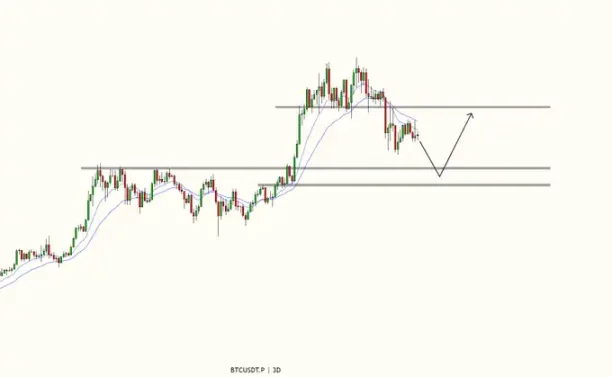
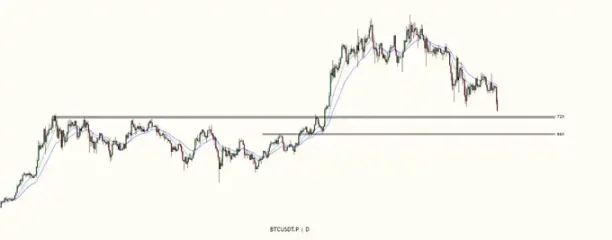
I have been holding a bearish outlook recently. Two days ago, I mentioned that the 72K-66K level is approaching, and I will observe the rebound situation at that time to decide whether to enter a long position.
@market_beggar
Black Monday: BTC rebounds
ETH fell below 1600, and both the Taiwan and Japan stock markets triggered circuit breaker mechanisms. We witnessed history once again.
I know that such a drop is hard for most people’s psychology. This article will focus on BTC and directly整理出 the important positions that have been repeatedly mentioned from the perspective of on-chain data analysis for your reference.
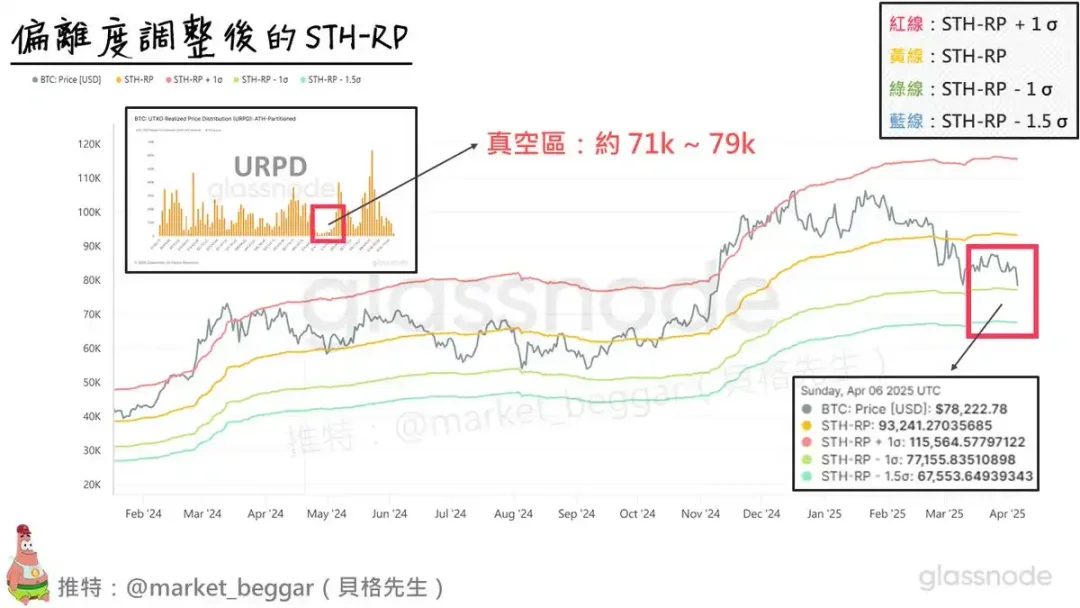
First is the “Deviation Adjusted STH-RP” model, currently:
Green line = 77,156
Blue line = 67,554
And 71 K ~ 79 K is still a relative vacuum area for URPD, so from the perspective of on-chain data, individuals are more inclined to wait for positions below 71 K.
Due to the downward trend at a large level, I view any long positions as “counter-trend operations.” I’m not sure how many readers can understand what I mean, but this is the direction of least resistance in the market.
I know that most people prefer to try to operate on trends, but contrarian trading is indeed one of the most common mistakes made by retail investors, and this is also a loss I suffered a few years ago when I was a novice. I hope everyone can learn from this.
Trading is the process of “cognitive monetization”; when the market difficulty clearly increases, “not acting” is also a form of action.
There is no need to chase every small-level fluctuation; the smaller the level, the more the price movement resembles Brownian motion. Focus on the big trend, hold your striking zone, and leave the rest to patience and discipline.
The smoke of chaos in 2025 has already risen, and you and I are witnesses to history.


