Original | Odaily Odaily Daily (@OdailyChina)
Author | Asher(**@Asher_ 0210 )
Yesterday, Kraken took the lead in supporting xStocks, allowing users to trade 60 tokenized US stocks on the platform; Bybit quickly followed suit, launching popular US stocks such as AAPL, TSLA, and NVDA; Robinhood also announced that it would support US stock trading on the blockchain and plans to launch its own public chain. In a moment, crypto and US stocks have achieved a two-way rush at the product level.
The contrast between this lively atmosphere and the quietness of the Meme is truly striking. Recently, the Meme can be said to have no heat on new projects, old projects are inactive, and even the few communities that used to casually chat about the market are almost devoid of discussion. Every day when I open the community, it feels like I’ve entered a retirement channel. Gradually, I’ve completely laid back and embraced a state of doing nothing.
Just as I was getting used to a Zen lifestyle - I stumbled upon the US stock segment launched on GMGN.
At first, I thought I was seeing things, but when I clicked in, CRCL, AAPL, TSLA, AMZN, NVDA all appeared neatly in the market list (they just had an x suffix added). I even visited GMGN’s official Twitter and found that on-chain US stock trading was really live, supported by xStocks, allowing users to purchase major popular US stocks with SOL in one click. Familiar interface, unfamiliar trading pairs, in that moment, I suddenly had an illusion: I had become a “traditional” trader.
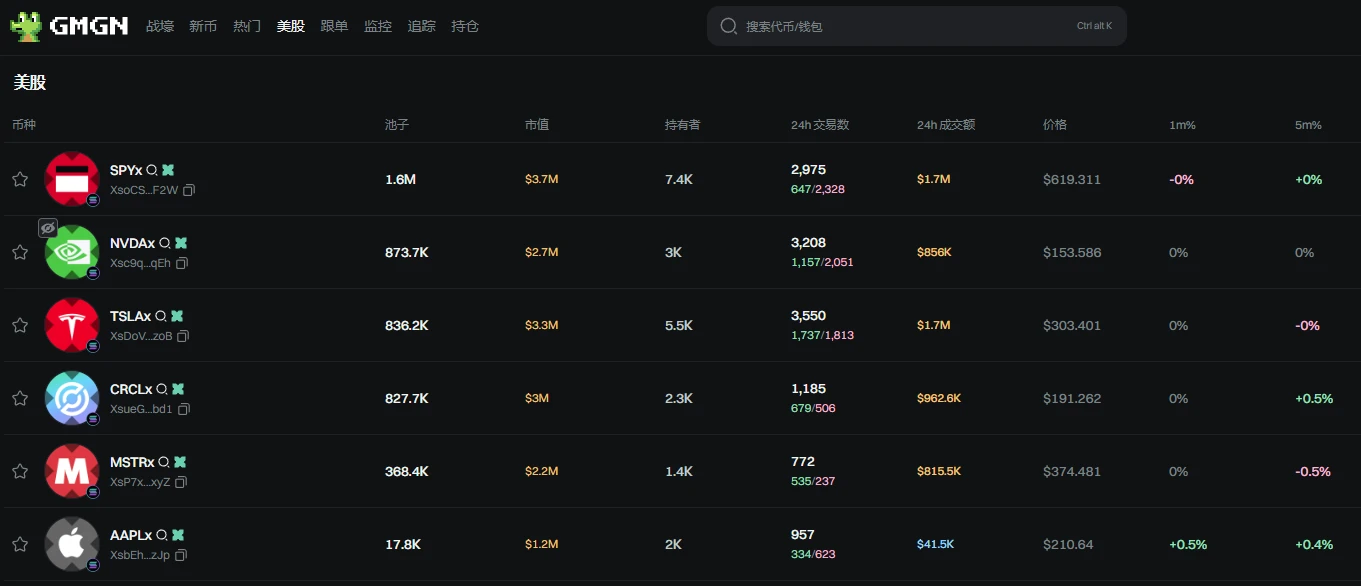
GMGN US Stock Trading Sector
To be honest, when I saw those 60+ tokenized US stocks on GMGN, I was a bit excited. The previous news about BTC and ETH launching ETFs did stir my emotions, but ultimately, it felt a bit distant for someone like me, a retail investor on the blockchain. This time is different; I can directly buy AAPL and sell TSLA on GMGN using my wallet, while keeping an eye on NVDA’s price fluctuations during meals—who would have thought just a few days ago that I could have this feeling of ‘trading US stocks on-chain’ without a US stock account?
I even started to fantasize:
- The SOL in my wallet is no longer just virtual currency, but my ticket in and out of Wall Street;
- Every on-chain buy and sell transaction is like knocking on a secret door to Nasdaq;
- No longer have to worry about not having any projects to participate in when there are no土狗 market trends on the chain;
- In the future, chatting with friends will no longer be “Can this local dog still be bought?” but rather “What do you think of Nvidia’s earnings report tonight?”
But soon, I also calmed down. After all, trading still requires attention to detail. After experiencing it all, the filter of U.S. stock traders began to shatter everywhere. The biggest problem is liquidity. Currently, there are 10 U.S. stock trading pairs on GMGN that have user participation, but only 5 U.S. stock trading pairs have liquidity pools exceeding $100,000, among which the best liquidity is SPYx (S&P 500 Index), with a token market cap of less than $4 million and a liquidity pool of only $1.6 million.
Embrace new things, after all, this is just the beginning stage. On-chain trading of US stocks technically bypasses the cumbersome processes of traditional brokers, breaking down thresholds such as KYC, account restrictions, and T+1 settlement. As long as you have an on-chain wallet, you can participate in trading directly. In addition, regarding the issue of liquidity, it can actually be gradually improved by providing liquidity rewards for tokenized US stocks, airdrop incentives, and so on. After all, compared to those purely on-chain dog tokens before, the price fluctuations of US stocks are relatively stable, making it less likely to experience significant volatility. If rewards are in place, liquidity can easily continue to strengthen.
Therefore, my current strategy is to set alerts for several US stocks on TradingView and GMGN. If the on-chain price falls below the actual stock price by more than 3 points due to liquidity issues, I will start to buy in small amounts, in batches. Additionally, I am closely monitoring the trading hours of US stocks and major events, such as earnings releases or macroeconomic data announcements, as these moments often exacerbate the price disparity fluctuations between the on-chain and US stock markets due to liquidity and other reasons, creating more short-term opportunities.
Overall, this strategy based on early warning and small batch buying allows me to participate in arbitrage opportunities in on-chain US stock trading, while effectively avoiding potential risks brought by liquidity, it can be considered a robust and suitable operating method for the current market environment.
No matter what, I am no longer a stinky P rookie. I am an on-chain US stock trader.
Disclaimer: The information on this page may come from third parties and does not represent the views or opinions of Gate. The content displayed on this page is for reference only and does not constitute any financial, investment, or legal advice. Gate does not guarantee the accuracy or completeness of the information and shall not be liable for any losses arising from the use of this information. Virtual asset investments carry high risks and are subject to significant price volatility. You may lose all of your invested principal. Please fully understand the relevant risks and make prudent decisions based on your own financial situation and risk tolerance. For details, please refer to
Disclaimer.


