This is a path different from Strategy.
Written by: Prathik Desai
Compiled by: Luffy, Foresight News
In 2020, Strategy Company (then known as MicroStrategy) began replacing Bitcoin with debt and stock. Originally a company selling enterprise software, it transformed under the leadership of co-founder and chairman Michael Saylor, injecting company funds into Bitcoin and becoming the largest publicly traded holder of Bitcoin.
Five years later, Strategy Company is still selling software, but the contribution of operations to the company’s overall gross profit has been steadily declining. In 2024, the operational gross profit decreased to about 15% compared to 2023; in the first quarter of 2025, that figure decreased by 10% compared to the same period last year. By 2025, Strategy’s model has been replicated, adapted, and simplified, paving the way for over a hundred publicly listed entities to hold Bitcoin.
This model is very simple: issue low-cost debt collateralized by enterprises, buy Bitcoin, and after its appreciation, issue more debt to buy more Bitcoin - forming a self-reinforcing cycle, turning the corporate treasury into a leveraged cryptocurrency fund. Maturing debt is repaid by issuing new shares, diluting existing shareholders’ equity. However, the appreciation of Bitcoin holdings boosts the stock price, offsetting the impact of equity dilution.
Most companies following in the footsteps of Strategy already have established businesses, and they hope to generate returns on their balance sheets through Bitcoin as an appreciating asset.
Strategy was once entirely an enterprise analytics and business intelligence platform; while the 15th largest publicly listed Bitcoin holder Semler Scientific was purely a health technology company; recently gaining attention, GameStop, which was previously a well-known retailer of games and electronics, only recently ventured into building a Bitcoin treasury.
Nowadays, a new wave of companies is eager to enjoy the benefits of Bitcoin, yet they do not want to bear the burden of establishing a physical business. They have no customers, no profit model, and no operational roadmap. They only need a balance sheet filled with Bitcoin, and a shortcut to quickly enter the public market. Thus, Special Purpose Acquisition Companies (SPACs, or reverse mergers) have emerged.
These Bitcoin asset SPACs, such as ReserveOne, ProCap (backed by Anthony Pompliano), and Twenty One Capital (supported by Tether, Cantor Fitzgerald, and SoftBank), are launching simple packaging solutions. Their proposition is clear: to raise hundreds of millions of dollars, buy Bitcoin in bulk, and provide public market investors with a stock code to track it all. That’s it; that’s the entire business.
The approach of these new entrants is completely opposite to that of Strategy: first accumulate Bitcoin, then consider the business part. This model is more akin to a hedge fund rather than a corporation.
However, many companies are still lining up to choose the SPAC route. Why is that?
A SPAC is a pre-funded shell company that raises funds from investors (usually a group of private investors), goes public on a stock exchange, and then merges with a private company. It is often described as a shortcut to an IPO. In the cryptocurrency space, it is a way for entities heavily invested in Bitcoin to go public quickly, avoiding adverse market sentiment or regulatory shifts; speed is key.
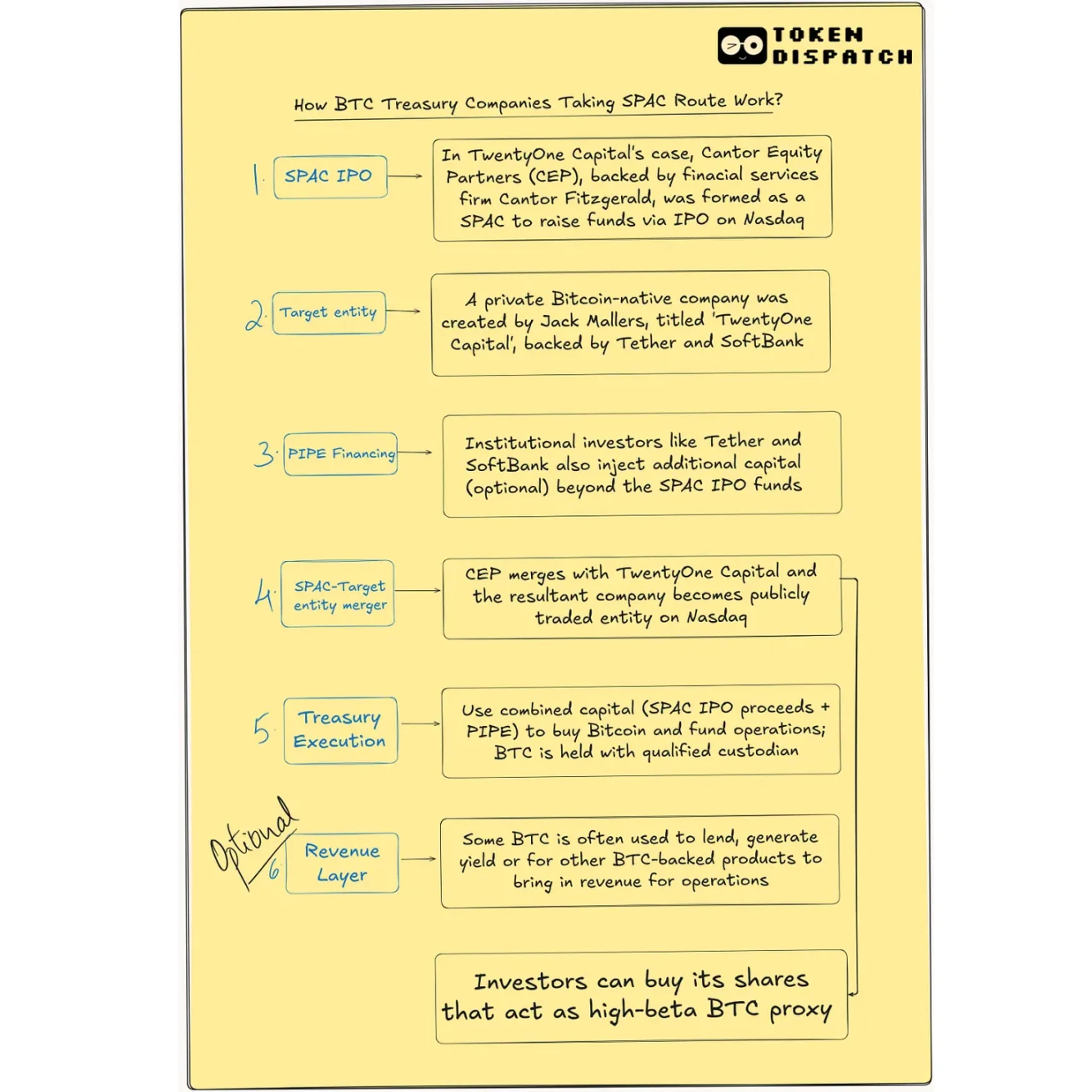
Although this “speed advantage” is often illusory. SPAC promises to complete the listing in 4-6 months, while an IPO takes 12-18 months, but in reality, the regulatory review for cryptocurrency companies takes longer. For example, Circle’s attempt to go public via SPAC failed, and it later succeeded through a traditional IPO.
But SPACs still have their advantages.
They allow these companies to paint bold visions, such as “reaching a Bitcoin holding of 1 billion dollars by the end of the year,” without immediately undergoing the stringent scrutiny of the traditional IPO process. They can bring in post-IPO private investments (PIPE) from heavyweight firms like Jane Street or Galaxy, negotiate valuations in advance, package them as shell companies compliant with SEC regulations, while avoiding the label of “investment fund.”
The SPAC approach simply makes it easier for companies to market their strategies to stakeholders and investors, as there is nothing else to promote besides Bitcoin.
Do you remember the scene when Meta and Microsoft considered incorporating Bitcoin into their treasury? They faced overwhelming opposition.

For public investors, SPACs seem to provide pure exposure to Bitcoin without the need to directly engage with cryptocurrencies, much like purchasing a gold ETF.
However, SPACs also face the issue of retail investor acceptance, as they tend to prefer gaining exposure to Bitcoin through more popular channels, such as Exchange-Traded Funds (ETFs). The 2025 Institutional Investor Digital Asset Survey shows that 60% of investors prefer to access cryptocurrencies through registered investment vehicles like ETFs.
Nevertheless, the demand still exists. Because this model contains leverage potential.
The strategy of buying Bitcoin didn’t stop there; instead, it continuously issued convertible notes (likely through the redemption of new shares). This approach helped this former business intelligence platform to become a Bitcoin “turbocharger”: during the rise of Bitcoin, its stock price increased more than Bitcoin itself. This blueprint is still in the minds of investors: a Bitcoin company based on SPAC can replicate this acceleration model — buy Bitcoin, issue more stock or debt to buy more Bitcoin, and repeat.
When a new Bitcoin company announces it has secured $1 billion in institutional PIPE investment, it inherently conveys credibility, signaling to the market that large funds are paying attention. Think about how much credibility Twenty One Capital gained from the support of heavyweight companies like Cantor Fitzgerald, Tether, and SoftBank.
SPAC allows founders to achieve this goal in the early stages of a company’s lifecycle without needing to first build a product that generates revenue. This early institutional recognition helps to gain attention, capital, and momentum for growth, while reducing the potential obstacles from investors that publicly listed companies may face.
For many founders, the appeal of the SPAC route lies in its flexibility. Unlike an IPO, which has very strict requirements regarding the timing of information disclosure and pricing, a SPAC offers greater control over narrative, forecasting, and valuation negotiations. Founders can tell forward-looking stories, develop capital plans, retain equity, and avoid the endless financing cycle typically associated with the traditional “venture capital → IPO” path.
This packaging itself is very attractive. An initial public offering (IPO) is a well-known language: stock codes can be traded by hedge funds, added to retail platforms, and tracked by ETFs. It serves as a bridge connecting the native concepts of cryptocurrency and traditional market infrastructure. For many investors, this packaging is more important than the underlying mechanisms: if it looks like a stock and trades like a stock, it can be integrated into existing portfolios.
If SPACs can be established and listed without any existing business, how will they operate? Where does the revenue come from?
SPAC also allows for structural creativity. A company can raise $500 million, invest $300 million in Bitcoin, and use the remaining funds to explore revenue strategies, launch financial products, or acquire other crypto enterprises that can generate income. This hybrid model is difficult to achieve under ETFs or other models, as those models have stricter rules and more rigid authorizations.
Twenty One Capital is exploring structured capital management. Its Bitcoin reserves exceed 30,000 coins, with part of it allocated to low-risk on-chain yield strategies. The company merged with a SPAC supported by Cantor Fitzgerald and raised over $585 million through PIPE and convertible bonds for purchasing more Bitcoin. Its roadmap includes building Bitcoin-native lending models, capital market instruments, and even creating Bitcoin-related media content and promotional campaigns.
Nakamoto Holdings, founded by David Bailey of Bitcoin Magazine, has taken a different path to achieve similar goals. It merged with a publicly listed medical company, KindlyMD, to build a Bitcoin treasury strategy. This transaction secured $510 million in PIPE and $200 million in convertible note financing, making it one of the largest crypto-related financings. It aims to securitize Bitcoin exposure into stocks, bonds, and hybrid instruments, allowing it to be traded on major stock exchanges.
Pompliano’s ProCap Financial plans to provide financial services based on the Bitcoin treasury, including crypto lending, staking infrastructure, and products that enable institutions to gain Bitcoin returns.
ReserveOne takes a more diversified approach. While Bitcoin remains the core of its portfolio, it plans to hold a basket of assets including Ethereum, Solana, and others, leveraging these assets for institutional-grade staking, derivatives, and over-the-counter lending.
With the support of companies like Galaxy and Kraken, ReserveOne positions itself as a crypto-native BlackRock, combining passive exposure with active yield generation. Theoretically, its income comes from lending fees, staking rewards, and the interest rate spread between managing short-term and long-term cryptocurrency asset bets.
Even if the entity has found a sustainable source of income, the label of “public company” will still bring paperwork and challenges.
The operations after the merger highlight the necessity of a sustainable revenue model. Fund management, custody, compliance, and auditing become crucial, especially when the only product is a highly volatile asset. Unlike ETF issuers, many SPAC-supported companies are built from scratch, custody may be outsourced, control may be weak, and risks can accumulate rapidly without notice.
In addition, there are governance issues. Many SPAC sponsors retain special rights, such as enhanced voting power, board seats, and liquidity windows, but they often lack expertise in cryptocurrency. When Bitcoin prices plummet or regulations tighten, experts are needed to steer the ship. When the market is rising, no one pays attention; but when it falls, problems become apparent.
So, how should retail investors respond?
Some people may be attracted by the upward potential, thinking that a small bet on a certain Bitcoin SPAC could replicate the prosperity of Strategy. However, they will also face multiple risks, such as equity dilution, volatility, redemption, and an untested management team. Others may prefer the simplicity of a spot Bitcoin ETF or even to hold Bitcoin directly.
Because when you buy Bitcoin stocks listed through a SPAC, you are not directly holding Bitcoin; instead, you are purchasing a plan where someone else has bought Bitcoin for you, hoping that they will succeed. This hope comes at a cost, and during a bull market, that cost seems worth paying.
However, you still need to understand what you are actually purchasing and how much.


