Author: Steven Ehrlich Source: unchainedcrypto Translation: Shan Ouba, Golden Finance
The emergence of stablecoins stems from the inability of cryptocurrencies (especially Bitcoin) to maintain price stability. For many years, they have been regarded as the “blood” that supports the operation of the blockchain by major public chains.
But now, stablecoins have gained regulatory backing from Washington, while public chains have not. Moreover, they seem no longer satisfied with merely being accessories to blockchain projects that are still searching for product-market fit.
The stablecoin blockchain is coming. Why should the two giants feel nervous?
With the passage of the GENIUS Act, stablecoins will usher in a new round of explosion— and the main issuers’ current goal is to operate their own Layer 1 public chain, rather than just relying on other chains. If they succeed, it means that someone will be eliminated.
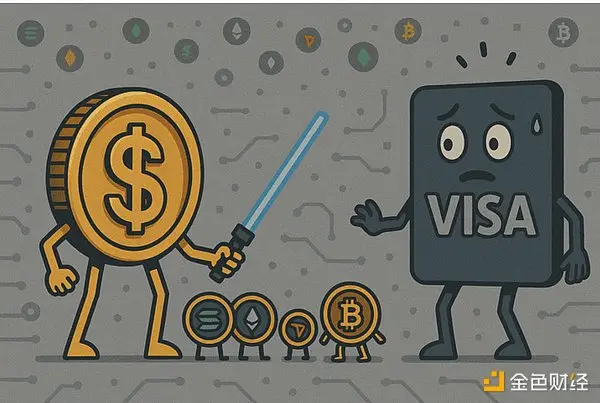
Although the existence of stablecoins was not anticipated around the 15 years since the birth of Bitcoin, it has proven to be a godsend for the entire industry. People quickly realized that Bitcoin and other assets such as Ethereum, Solana, and XRP could not replace the US dollar at all—because their price fluctuations are too severe.
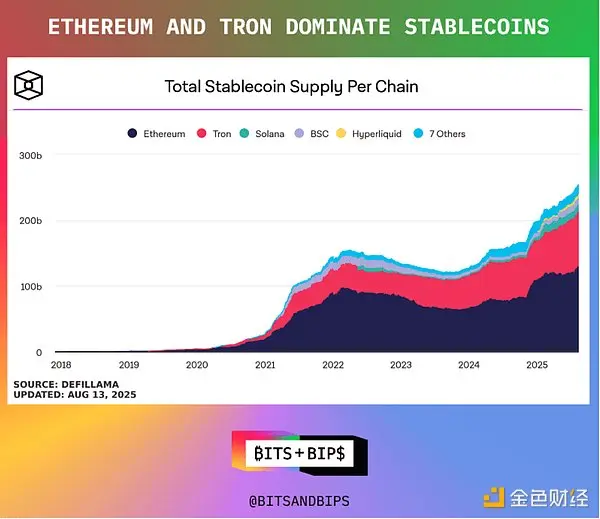
Stablecoins have become the perfect solution. They operate on the tracks of public chains while maintaining a price parity with the anchored asset (usually the US dollar). Their market capitalization has expanded from less than $1 million in 2017 to today’s $271 billion, spanning multiple public chains (mainly Ethereum and Tron), and becoming the core liquidity engine for spot trading, DeFi markets, and payments. The two largest stablecoins by market cap are Tether (USDT) and USD Coin (USDC), with market caps of $164.85 billion and $65.22 billion, respectively.
However, these issuers seem no longer satisfied with “riding the tracks of other public chains.” They want to become the true engine driving blockchain payments. The team behind Tether has invested in multiple blockchains focused on stablecoins (Plasma and Stable), and payment giant Stripe also appears to be developing its own blockchain. On Tuesday, the main issuer of USDC, Circle Financial (CRCL), announced the Arc project—a dedicated Layer 1 public chain born for payments.
Driven by the passage of the GENIUS Act in July 2025, stablecoins are on the brink of a breakout. Currently, the total supply of stablecoins is $271 billion, which accounts for about 1.2% of the $22.02 trillion M2 money supply. U.S. Treasury Secretary Scott Bessent has stated that if the relevant infrastructure is improved, the market value of stablecoins could grow to $3.7 trillion by the end of this century.
Circle CEO Jeremy Allaire pointed out candidly that the current blockchain system is far from sufficient to support the demands of modern payment systems:
“We are at a critical turning point where stablecoins are widely accepted by the mainstream financial system, and companies are competing to build on this infrastructure. However, so far, there is actually no blockchain infrastructure that can meet the most demanding needs of large financial institutions and enterprises.”
However, for Arc or other similar blockchains to succeed, they must capture market share from existing players. Next, we will look at where the opportunities lie and who might be the first to bear the brunt.
Current Shortcomings of Public Chains
Ethereum
Regardless of which mainstream public chain you choose, you will find areas for improvement in stablecoins and payment applications.
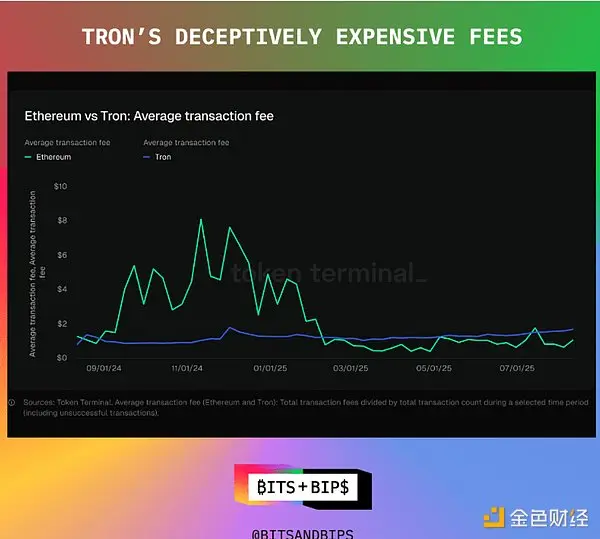
Ethereum is the second largest blockchain after Bitcoin, with a market value of $563.7 billion, but it is still too slow and too expensive for large-scale payment scenarios. According to Token Terminal data, the average transaction fee on Ethereum is currently $1.05. At first glance, this seems comparable to the fees of card networks, but there are a few points to note: limited throughput, the Ethereum network can only process about 20 transactions per second. During peak times, fees can fluctuate dramatically. Unfriendly payment method, all transaction fees must be paid in ETH, which requires users to hold an additional reserve of ETH, and its price is itself highly volatile.
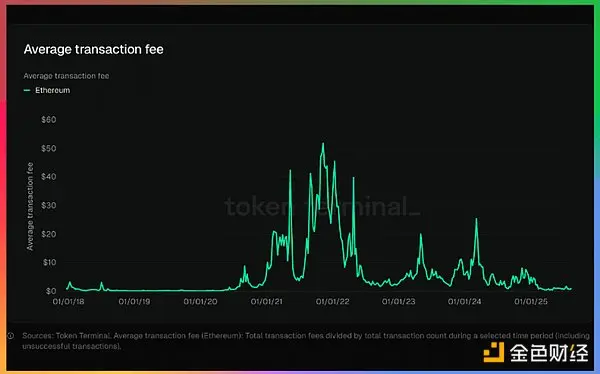
In the first half of 2021, the average transaction fee was close to $20 per transaction, reaching over $50 in May. This level of volatility is completely unacceptable for high-frequency low-value payment businesses.
This does not mean that Ethereum has no place in payments. On the contrary, it is likely to focus on high-value, low-frequency payment scenarios. As Grayscale Investments Research Director Zach Pandl stated in an interview in February this year: “Ethereum remains the leading chain in terms of total locked value and economic security, making it a natural platform for institutional finance.”
Base
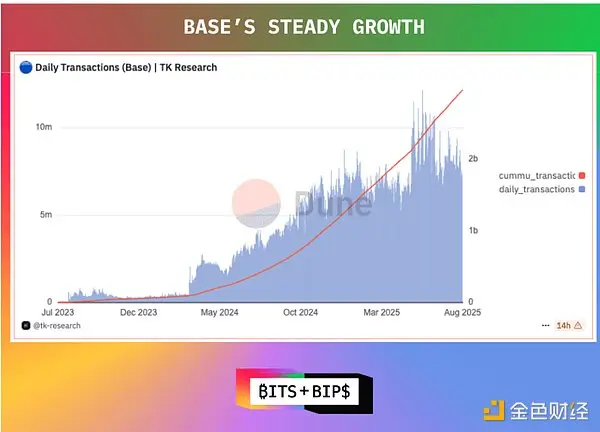
The issues with Ethereum have long been known, which is why many industry analysts are turning their attention to Layer 2 networks (L2), such as Base, hoping it can combine the “speed and low cost of card networks” with the “economic security of Ethereum.” Coinbase and Circle are actually close partners and are working to promote the application of USDC on Base.
On Base, transaction fees typically only cost a few cents. However, many L2 networks, including Base, are still in the experimental stage. Although the network is growing rapidly in terms of developer and market attention, its high centralization remains a concern—because currently Coinbase is the only sequencer operator. In L2 networks, the role of a sequencer is similar to that of L1 validators or miners.
This vulnerability was fully exposed in early August. At that time, Base was down for 33 minutes due to a sorter malfunction. If there had been multiple sorters available at the time, the network might have continued to operate normally like Bitcoin or Ethereum, even if the main miners or stakers went offline.
Tron
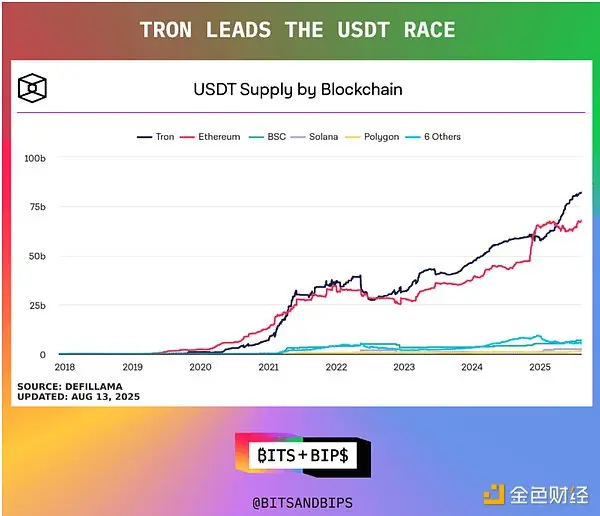
Finally, it has to be mentioned that Tron (波场), this blockchain with a market value of $36.2 billion, was founded by Chinese entrepreneur Justin Sun. Although Ethereum receives more attention in the Western world, Tron absolutely dominates in terms of the USDT custody scale, carrying $81.89 billion of USDT.
Tron has long been known as a “low-cost public chain,” which is particularly important for users in emerging markets. As YellowCard CEO Chris Maurice mentioned in the profile of Sun Yuchen I wrote for Forbes in March this year:
“You should know that these countries are among the most cost-sensitive markets in the world. In some places, people might spend 8 hours to save a few dollars. Therefore, the difference between 50 dollars and a few cents is very significant.”
But Tron is actually not as cheap as the outside world imagines. Its average transaction fee is $1.70, which is even higher than Ethereum.
Moreover, the fees charged by Tron for USDT transactions are dozens of times higher than sending the native token TRX. The average fee for sending one TRX is about 0.39 USD, while the average fee for sending one USDT can reach as high as 4.83 USD.
Perhaps this is why Maurice believes that “stable chains” like Arc could become potential competitors to Tron:
“I believe these players have ample capital to drive their chain and infrastructure, and their goal is to control payment rails, not just issue tokens. This is a very smart strategy, and they also have enough resources to succeed, which poses a significant threat to Tron.”
Visa, this blue and white giant whale
Considering the various limitations of existing public chains in payments, emerging stable chains will almost inevitably compete for market share—although they may still maintain a “friendly” facade in public. An anonymous industry analyst pointed out:
“These new public chains are undoubtedly competing with existing L1s.”
But their real target is the existing traditional giants, such as card networks.
Circle CFO Jeremy Fox-Geen said during the earnings call on Tuesday:
“Visa processes over $10 trillion annually in C2B (consumer to merchant) and B2B (business to business) payment rails.”
The analyst added that if Circle can capture 10% of the transaction volume from Visa, it would represent an extremely large market opportunity. He also mentioned that JPMorgan Chase has a total daily amount in fund flows and settlements that “exceeds $10 trillion.”
Circle seems to be adopting a dual strategy of cooperation and competition. On one hand, the company allows customers to use USDC for settlement. According to the company’s report, as of April 30, 2025, Circle has completed $225 million in USDC settlement transactions.
However, in terms of Visa’s overall scale, this figure is just a drop in the bucket. The impact on Circle’s revenue is also limited, as its revenue structure heavily relies on reserve income. In the second quarter, Circle’s reserve income from USDC collateral assets (invested in cash-like instruments) was 634 million dollars, while income from subscription and service businesses (including fees for processing USDC transactions and cross-chain transfers) was only 24 million dollars.
Looking ahead, Circle hopes to achieve a balance between these two sources of income. This could become increasingly critical as President Trump plans to replace Federal Reserve Chairman Jerome Powell and may push for a 300 basis point cut in the federal funds rate. Circle’s reserve yield in the second quarter was 4.1%, and if interest rates decline, this model may be impacted.
Therefore, Circle has clearly decided to bet on Arc - a foundational layer blockchain designed specifically for payments.
Allaire stated that financial institutions and regulators are looking for definitive finality in settlements, which Arc will achieve through Circle-audited professional validators and a new consensus mechanism. Arc will also provide configurable privacy controls, including optional confidentiality transfer features that are crucial for real-world business and financial applications, while also supporting regulatory compliance. Most importantly, users on Arc do not need to use volatile L1 tokens to pay transaction fees.


