Author: YQ
Compiled by: Tim, PANews
In my previous three analyses of the 1011 crypto settlement wave, I have dissected issues such as oracle failures, infrastructure collapses, and potential coordinated attacks. Today, I will focus on perhaps the most critical yet overlooked dimension: how market makers, who were supposed to maintain market stability, became the main drivers of an unprecedented liquidity vacuum, ultimately turning a controllable pullback into a $19 billion disaster.
Understanding Market Makers: Theory and Reality
Before examining the 1011 crash, it is necessary to understand the basic functions of market makers. In traditional financial markets, a market maker is a financial instrument that provides continuous quotes, acting as an intermediary between the buying price and the selling price, profiting from the spread while also playing an important role in maintaining market liquidity.
The theoretical role of market makers includes:
- Continuous Price Discovery: Maintaining Two-Way Quotes that Reflect Fair Market Value
- Liquidity provision: Ensuring that traders can buy or sell at any time without causing significant price impact.
- Volatility smoothing: Absorbing temporary supply and demand imbalances
- Market Efficiency: Maintaining uniform pricing through cross-platform arbitrage spreads.
In the cryptocurrency market, the operation model of market makers is similar, but they face unique challenges:
- 24/7 market, never closes
- Fragmentation of liquidity across hundreds and thousands of exchanges
- Extreme volatility compared to traditional assets
- Limited regulation and obligations
- Technical infrastructure requirements for high-frequency trading
Under normal market conditions, this system operates quite well. Market makers earn a slim profit by providing necessary liquidity. However, the events that occurred on October 10 and 11 indicate the dire situation the market can fall into when incentives and accountability diverge.
Timeline of Liquidity Disappearance
The precise withdrawal actions of market makers during the 1011 crash indicate that this was a coordinated operation rather than panic. Here is a detailed timeline of how liquidity evaporated:
At 4:00 Beijing time: News of Trump announcing a 100% tariff on Chinese imported goods swept across social media. Bitcoin subsequently dropped from $122,000. Although market makers maintained their positions, they began to widen the bid-ask spread, which is a standard defensive behavior in the market.
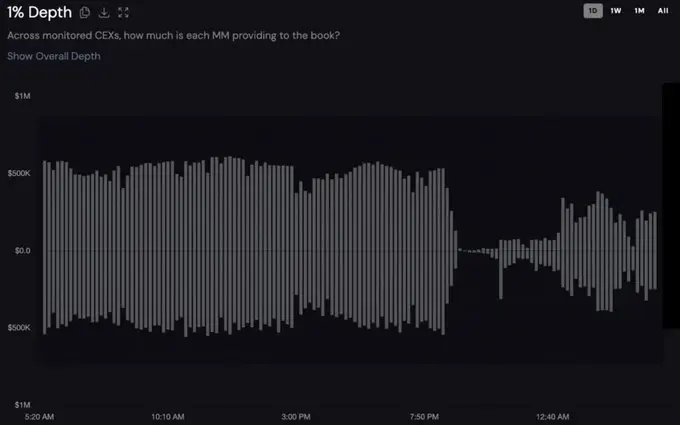
Binance Unnamed Token_0 1% Depth Chart for the Past 24 Hours. Buy orders are below the X-axis, and sell orders are above. Data source: Coinwatch.
At 4:40 PM Beijing time: Real-time tracking data shows that a catastrophic liquidity withdrawal has begun. The market depth of a certain mainstream token has plummeted from $1.2 million.
5:00 AM Beijing time: A critical turning point. As the US market opens, the macro environment deteriorates sharply. Institutional participants withdraw liquidity, spreads widen significantly, and the order book depth drops abruptly. It is at this moment that market makers shift from defensive positions to a complete withdrawal.
At 5:20 Beijing time: The market has plunged into extreme chaos. Almost all tokens are hitting bottom in the global liquidation wave. The market depth of tracked tokens has plummeted to $27,000—liquidity has dropped by 98%. After liquidity providers pulled back the $108,000 defense line, some altcoins fell by as much as about 80%.
At 5:35 Beijing time: As the most intense selling wave approaches its end, market makers begin to cautiously return to the market. In just 35 minutes, the depth of buy and sell orders on mainstream centralized exchanges has recovered to over 90% of pre-event levels, but at this point, the market has already suffered the maximum impact.
The timeline above reveals three key points:
- Market makers have a warning time of 20-40 minutes before completely withdrawing funds.
- Multiple institutions are withdrawing funds simultaneously.
- Liquidity only recovers after favorable re-entry points occur.
After the insurance fund becomes invalid: ADL continuous and large-scale triggering
When market makers withdraw, liquidation orders flood the order book, and the exchange will activate the last line of defense: Automatic Deductions (ADL). To thoroughly understand the complete context of the October turmoil, this mechanism is crucial.
How does automatic position reduction (ADL) work in centralized exchanges?
ADL is the third and final level in the liquidation hierarchy.
Level 1 - Order Book Liquidation Mechanism: When the position falls below the maintenance margin requirement, the exchange will execute forced liquidation through the order book. If the liquidation price is better than the bankruptcy price (i.e., the price at which the margin goes to zero), the remaining funds will be injected into the insurance fund.
Level 2 - Insurance Fund: When there is insufficient liquidity in the order book, this fund will bear the losses. Funds accumulated through forced liquidation profits during normal times can serve as a buffer mechanism for bad debts.
Level 3 - Automatic Reducing Position: When the insurance fund cannot cover the losses, the exchange will forcibly liquidate the profitable positions in the opposite direction.
Automatic Liquidation Ranking System
Binance's automatic position reduction mechanism uses a sophisticated ranking calculation formula:
ADL ranking score = Position profit and loss percentage × Effective leverage
Among them:
- Position P&L Percentage = Unrealized Profit / Absolute Value of Position Notional
- Effective Leverage = Absolute Value of Position Notional Value / ( Account Balance - Unrealized Loss + Unrealized Profit )
Bybit's approach is similar, but it adds extra security measures: the platform displays the user's percentile ranking through five indicator lights.
- Tier 5 = Top 20% (Automatic reduction of positions with the highest priority)
- Tier 4 = 20%-40%
- Tier 3 = 40%-60%
- Second tier = 60%-80%
- Tier 1 = Last 20% (Automatic reduction of position with lowest priority)
The cruel irony is that the top traders with the highest profitability and leverage usage are often the first to face forced liquidation.
October ADL Storm
From October 10 to 11, the scale of ADL coverage is unprecedented:
- Hyperliquid: Cross-margin ADL activated for the first time in over two years, affecting more than 1000 wallets.
- Binance: Large-scale launch of ADL
- Bybit Report: Over 50,000 short positions liquidated, totaling $1.1 billion
- BitMEX: This is an exceptional case, as it has a large insurance fund, and only 15 contracts are subject to ADL.
The correlation with the timing of market makers' withdrawal is indeed conclusive. From 05:00 to 05:20, as the liquidity in the order book was exhausted, liquidation orders could not be completed normally, resulting in the rapid depletion of the insurance fund, which in turn triggered the automatic position reduction mechanism.
Case Study: Cascading Risks
Think about what happens in a typical hedged portfolio during this critical 35 minutes.
At 5 o'clock Beijing time, the position of a certain trader:
- Long BTC: $5 million, 3x leverage
- Short DOGE: $500,000, 15x leverage (hedge is in profit)
- Long ETH: $1,000,000, 5x leverage
5:10 PM Beijing time: Market makers withdraw. DOGE crashes sharply, with significant profits from short positions. However, due to high leverage and profits, an automatic position reduction mechanism was triggered.
Beijing time 5:15: Forced liquidation of Dogecoin short positions through the automatic deleveraging mechanism, the portfolio has now lost its hedge protection.
Beijing time 5:20: Due to the lack of hedging, long positions in Bitcoin and Ethereum were liquidated in succession, ultimately leading to the total collapse of the entire investment portfolio.
This pattern has played out thousands of times. Seasoned traders with sophisticated positions watch as their profitable hedged positions are forcibly liquidated due to the ADL mechanism, leaving them with unhedged risk exposure, ultimately leading to liquidation.
Reasons for market maker's negligence: incentive issues
The simultaneous withdrawal of liquidity reveals a fundamental structural issue. Market makers face multiple possibilities of exiting the market:
1. Asymmetric Risk and Return
During extreme market volatility, the potential losses from maintaining quotes far exceed the spread earnings. When market makers provide quotes with a depth of $1 million, they can earn $10,000 in spread earnings under normal market conditions, but they may face a loss of $500,000 in a chain reaction.
2. Information Advantage
Market makers can see the total order flow and position situation. When they detect a severe bullish bias (87% of positions are long), they can foresee the direction of a market crash. Since they anticipate that a sell-off tsunami is about to come, why still provide buy quotes?
3. No legal risk
Unlike traditional exchanges where designated market makers are required to bear regulatory obligations, crypto market makers can withdraw freely. Even during market crises, they will not face any penalty mechanisms.
4. Arbitrage Opportunities
The data from the market crash shows that market makers who withdrew their quotes have turned to engage in inter-exchange arbitrage. Due to the price difference exceeding $300 among different trading platforms, the arbitrage profits far exceed those from market-making activities.
The Death Spiral of the Market
The interaction between market maker withdrawals and ADL has created a devastating death spiral.
- Initial shock (Trump's tariff announcement) triggers sell-off
- Market makers avoid cascading risks
- An order book without orders cannot be settled.
- The insurance fund is rapidly depleted due to the absorption of bad debts.
- ADL mechanism activated, forcibly liquidate profitable positions
- Traders who are automatically liquidated are forced to rebalance their positions, thereby exacerbating selling pressure.
- Trigger more liquidations, return to step three
This cycle continues until the leveraged positions essentially disappear. Data shows that the total open contracts in the market decreased by about 50% in just a few hours.
The unsettling truth about market structure
The market crash from October 10 to 11 was primarily not due to excessive leverage or regulatory failures, but rather rooted in the incentive misalignment within the market structure. When the parties responsible for maintaining market order benefit more from chaos than from stable returns, chaos becomes inevitable.
The timeline data shows that market makers have not fallen into panic. They synchronized their exit at the best time to minimize their own losses while creating maximum space for subsequent opportunities. This rational behavior under the current incentive structure has, however, led to irrational outcomes for the entire market.
Rebuilding trust through responsibility
The liquidity crisis in October 2025 exposed a fatal flaw in the cryptocurrency market: when the market most needed involuntary liquidity supply, the voluntary supply mechanism failed precisely at that moment. The $19 billion in liquidations not only caught over-leveraged traders off guard but also revealed the structural contradictions of the market maker system, where liquidity providers enjoy privileges without bearing corresponding responsibilities. This crisis is the inevitable result of that.
The road ahead requires acknowledgment that a purely laissez-faire market mechanism is unworkable during times of stress. Just as traditional markets have developed norms such as circuit breakers, position limits, and market maker obligations from disorderly trading, the crypto market must also implement similar safeguards.
Technical solutions are already in place:
- A progressive obligation system that links benefits to responsibilities
- The size of the insurance fund should match the actual risks, rather than being based on optimistic forecasts.
- ADL mechanism with “fuses” to prevent cascading risks
- Real-time transparency of market maker behavior
What is currently missing is the willingness to implement these measures. As long as cryptocurrency exchanges continue to prioritize maximizing short-term fees over long-term stability, these so-called “unprecedented” events will continue to occur with a sad regularity.
The 1.6 million accounts that were liquidated between October 10 and 11 paid the price for this structural flaw. The question is whether the industry will learn from this disaster or wait for the next batch of traders to repeat the same mistakes. When a crisis strikes, the market makers they rely on will vanish in an instant, leaving behind a chain of liquidations and forcibly closed profitable positions.


