In this uncertain world — from geopolitical tensions to breakthroughs in artificial intelligence — imagine a market where you can bet directly on the future. This is not casino-style gambling, but a highly complex system that uses collective intelligence to remarkably predict the future with precision. Welcome to the prediction market, the “crystal ball” of modern society.
By 2025, these platforms are no longer niche experiments but have rapidly expanded into a phenomenon worth billions of dollars, where finance, technology, and human intuition intertwine. Taking the 2024 U.S. election as an example, Polymarket's trading volume during the election exceeded 1 billion dollars, with predictive accuracy far surpassing traditional polls. Now, in 2025, this market is expected to set new highs, with a nominal trading volume projected to reach 30 billion dollars, achieving a 40% annual growth compared to 16.3 billion dollars in 2024.
Predicting the future is not a new concept that only emerged in 2025. From the stock market pricing corporate prospects to insurance quantifying risks, human society has always been putting a price on the future. The prediction market simply takes this logic to the extreme: breaking down future events into contracts and allowing market prices to reflect the probabilities of their occurrence. The real change occurs in 2025: on-chain transparent settlement, global no-threshold participation, the parallel development of social entry points and compliant platforms, transforming the prediction market from a niche interest into a track that capital, media, and institutions can no longer ignore.
01|Understanding Mechanisms: Principles and Types
What is a prediction market?
A prediction market (also known as an information market, event derivative, etc.) is a trading platform that allows participants to bet on the “yes/no” or multiple options regarding a future event. After the contract expires, if the option you bought “occurs,” you will receive a fixed return (usually $1 per contract unit); otherwise, you will lose your stake.
The core of the transaction is: Contract Price = The probability of the event being considered to occur — — The market continuously adjusts this probability through buying and selling activities.

Type and Modeling Mechanism
Prediction markets can have various schools of thought in their architecture, and different designs determine their performance and limitations:

On the other hand, contract types are not always as simple as “binary (yes/no)”: some contracts may have multiple options, while others may be scalar (numerical range) types. The clearer and more verifiable the design of the contract, the more trust and liquidity support it can gain from users.
Information Aggregation vs Operational Risk
The core value of the prediction market lies in the “aggregation of wisdom”: each trader places bets based on their own information and judgment, thus the market price reflects the combined opinions of the crowd. However, this also introduces operational risks: manipulation by large players, bubbles, market deviations, or opinion exhaustion (i.e., most people reading similar information) can distort prices.
02|2025 Three Main Lines: Compliance Landing, Social Embedding, Exchange-ification
2.1 Compliance Onshore: Kalshi Connects Regulation and Distribution
- After a long tug-of-war with regulators, the U.S. regulated election-related prediction contracts were released by the court, showcasing a compliance model effect; subsequently, Kalshi further integrated with Robinhood, directly embedding the prediction gateways for NFL and college football into mainstream brokerage apps, significantly expanding the reach.
- For a broader audience, “betting on real events like buying options” has become an understandable product paradigm, allowing prediction markets to move from the crypto-native sphere into a larger financial distribution network. At the same time, the narrative of federal regulation + cash settlement reinforces the mindset of “safe and trustworthy.”
2.2 Decentralized Breakthrough: The Scale and Influence of Polymarket
- Growth Rate and Scale: During the 2024 election window, Polymarket's trading volume surged from $62 million in May to $2.1 billion in October (+3268%), and it continued to maintain monthly activity at the billion-dollar level in 2025.
- Attention and Citation: Mainstream media (CNN, Bloomberg, etc.) live quotes odds data, traditional public opinion and on-chain data begin to “dual-track comparison”.
- Niche: Currently, about 90% of the funds are concentrated at both ends of Polymarket and Kalshi (decentralized/centralized bipolar), with the valuations and moats of leading platforms rising rapidly.
2.3 Social Embedding and Experience Upgrade: From “Jump” to “Bet in Place”
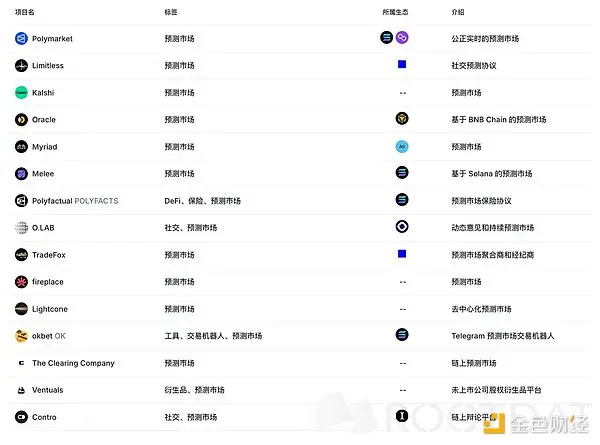
- Content is the entry point: Myriad, Flipr, etc. embed betting options directly into news feeds and social conversations (browse/discuss → place a bet with one click → return to discussion), reducing friction from “information to transaction” to a minimum.
- Exchange penetration: Solana's Drift adds a BET prediction module to its derivatives terminal; TryLimitless on Base reshapes the order matching experience with on-chain CLOB (Central Limit Order Book); meanwhile, Hyperliquid proposes Event Perpetuals, addressing the liquidity and slippage issues of binary markets with a design of “continuous trading and one-time settlement at expiration.”
Summary: Compliance and distribution attract incremental users, on-chain innovation enhances efficiency and playability, the “content - transaction - settlement” link is compressed, and the prediction market evolves from a single application form to a product matrix with multiple entry points.
03|Popular Application Scenarios
- Sports Prediction: NFL and the new season events drive a new wave of enthusiasm, with contracts covering match results, player data, and even real-time events, often achieving a prediction accuracy higher than that of experts.
- Crypto and DeFi: Enterprises and investors hedge against regulation and macro risks with prediction markets, while RWA tokenization brings stocks and real estate onto on-chain predictions, and privacy technologies like FHE enhance compliance.
- AI Empowerment: AI models enter the market as virtual traders, learning and predicting in real-time, and even providing automated betting services.
- National Security: U.S. intelligence agencies are studying the incorporation of prediction markets into threat analysis, with topics such as the South China Sea situation and sanction policies becoming reference signal sources.
04|Main Prediction Market Platforms
- Polymarket: The decentralized leader, expected to surpass $35 billion in total trading volume in 2025.
- Kalshi: A compliant representative connecting Robinhood, focusing on elections, macro, and financial events.
- PredictIt: An academic background platform known for political predictions, but with a low betting limit.
- Emerging players: TryLimitless (base chain) optimizes trading with CLOB, Talus Labs explores AI-driven prediction, and Noasight is a prediction market on the Sui chain, with active ecological innovation.
05|Product and Mechanism Design: From AMM to CLOB, and then to Information Perpetuity
- AMM binary pool: suitable for quickly creating and long-tail markets, but it is prone to price jumps and liquidity drying up as settlement approaches.
- CLOB (On-chain Limit Order Book): Friendly to market making and high-frequency trading, the depth and price discovery are closer to traditional exchange logic. TryLimitless uses CLOB to handle multiple outcomes/multi-leg positions, locking in profits and losses in advance, making the experience more like “event options.”
- Event Perps: Introduces a continuous trading curve, settling with a one-time anchoring of 0/1, during which high-frequency feed prices are not required, turning “news and probability” into a time series that can be longed or shorted; this approach aims to accommodate larger-scale speculation and hedging needs.
- Oracles and Arbitration: The credibility of the results recorded is fundamental. The mainstream on-chain solutions often use third-party oracles + dispute arbitration, but the transparency of the boundaries and processes of arbitration directly determines the platform's credibility (see §05 Risks).
06 | Participation and Monetization: From “Betting on Direction” to “Making Strategies”
If you only see the prediction market as “betting on who wins”, that's just the basics. The real play is to view it as a synthetic options and information exchange, establishing systematic strategies around “pricing discrepancies - information lag - structural incentives.”
- Cross-platform arbitrage: When the implied probabilities of the same event are inconsistent across CEX/compliant platforms/on-chain platforms, buy low and sell high to achieve risk-free expectations; can be semi-automated with API.
- Become an AMM LP: Earn fees in high-demand markets, hedge directional exposure with a “delta neutral” position, and capture liquidity premium.
- Bayesian updating vs market lag: establish an “event - probability” updating model, adjust positions ahead of the public's actions, and capitalize on the time difference between information and execution.
- Odds - Asset Linkage: Use prediction odds to guide on-chain/centralized derivatives (such as trading linked to BTC/ETH perpetual contracts) to position before the “announcement.”
- Combos and Conditional Orders (Parlays / Multi-Leg): Link the correlations between “Preliminary Election - General Election” and “Data Release - Asset Trends” to create a path-dependent risk/reward structure.
Risk control tips: Use simplified Kelly or fixed ratio for budget allocation; single market should not exceed 1-3% of total funds; prioritize locking in profits close to settlement instead of “betting on the outcome.”
07|Confronting the Dark Side: Oracles, Manipulation, Regulation, and Ethics
Oracle and adjudication disputes
On-chain settlement heavily relies on the “external truth” provided by the oracle. Over the past year, there have been disputes in the interpretation of results and decision-making processes in certain markets with extremely large capital volumes: for instance, differences in understanding of news wording/judgment criteria have led to determinations that contradict the intuition of most participants, resulting in millions to over a hundred million dollars in market outcomes, with users accusing a bias towards “large position holders.” Such events directly erode the platform's trustworthiness and compel upgrades to the predictability of rules and transparency of the appeal process.
Manipulation and “Reflexivity”
Prediction markets may shape events in reverse: when market outcomes affect public opinion and behavior, large funds influence narratives and affect information sources, thereby impacting judgments and prices. Design solutions include: multi-source oracles, delayed settlement windows, clear/machine-verifiable condition descriptions, and redesigning incentives and penalties for adjudicators.
Regulatory and Regional Differences
The centralized compliance path and the decentralized freedom path will coexist in the long term. Regulated cash settlement platforms offer stronger compliance and consumer protection, while decentralized platforms excel in global reach, censorship resistance, and innovation speed. The two sides will complement each other, jointly raising the industry's ceiling.
Ethical dilemmas arise in betting on wars and disaster-related events, causing social controversies.
08|From “Applications” to “Infrastructure”: Where Are We Heading?
- Distribution Layer: Deep integration of compliant platforms and brokerage apps, combined with social/content native entry points, transforming predictions from a “destination” into “on-the-way actions.”
- Matching Layer: CLOB and information permanence elevate the event trading experience and capacity to “exchange-level”, accommodating greater leverage, more complex combinations, and a wider range of topics.
- Ecological Layer: Capital and liquidity are highly concentrated towards the leading bipolar (Polymarket×Kalshi), while various front-end, robotics, data indices, and market-making tools emerge like mushrooms after rain, evolving the industry from “single-point platform competition” to a “multi-role collaborative network.”
Conclusion
Prediction markets are not a万能的水晶球, but they can price uncertainty and aggregate dispersed information into probabilities. They serve as a risk hedging tool for investors, a decision-making aid for institutions, and a “probability window” for the public to glimpse the future.
In the future, the path of the prediction market is becoming clearer:
- Compliance and decentralization go hand in hand: integrating into the mainstream financial system while maintaining on-chain innovation.
- Integration of AI and Automation: AI trading agents and data models join the market to improve efficiency and accuracy.
- Social distribution: From news to social applications embedding betting entry points, making prediction markets the default module.
- Infrastructure: Expanding from entertainment and elections to economic data, corporate strategy, energy, and healthcare.
In 2025, prediction markets are no longer a niche experiment, but have taken center stage in finance and crypto. The next question is: will you choose to stand on the sidelines, or bet on the future?
Disclaimer: The information on this page may come from third parties and does not represent the views or opinions of Gate. The content displayed on this page is for reference only and does not constitute any financial, investment, or legal advice. Gate does not guarantee the accuracy or completeness of the information and shall not be liable for any losses arising from the use of this information. Virtual asset investments carry high risks and are subject to significant price volatility. You may lose all of your invested principal. Please fully understand the relevant risks and make prudent decisions based on your own financial situation and risk tolerance. For details, please refer to
Disclaimer.


