The U.S. Office of the Comptroller of the Currency (OCC) issued a landmark interpretive letter confirming that national banks can legally act as riskless principals in cryptocurrency transactions — meaning they can facilitate customer crypto buys and sells without ever taking the digital assets onto their own balance sheets. This long-awaited clarification effectively green-lights America’s largest banks to offer regulated brokerage-style crypto trading services under existing banking law, dramatically narrowing the gap between traditional finance and blockchain markets.
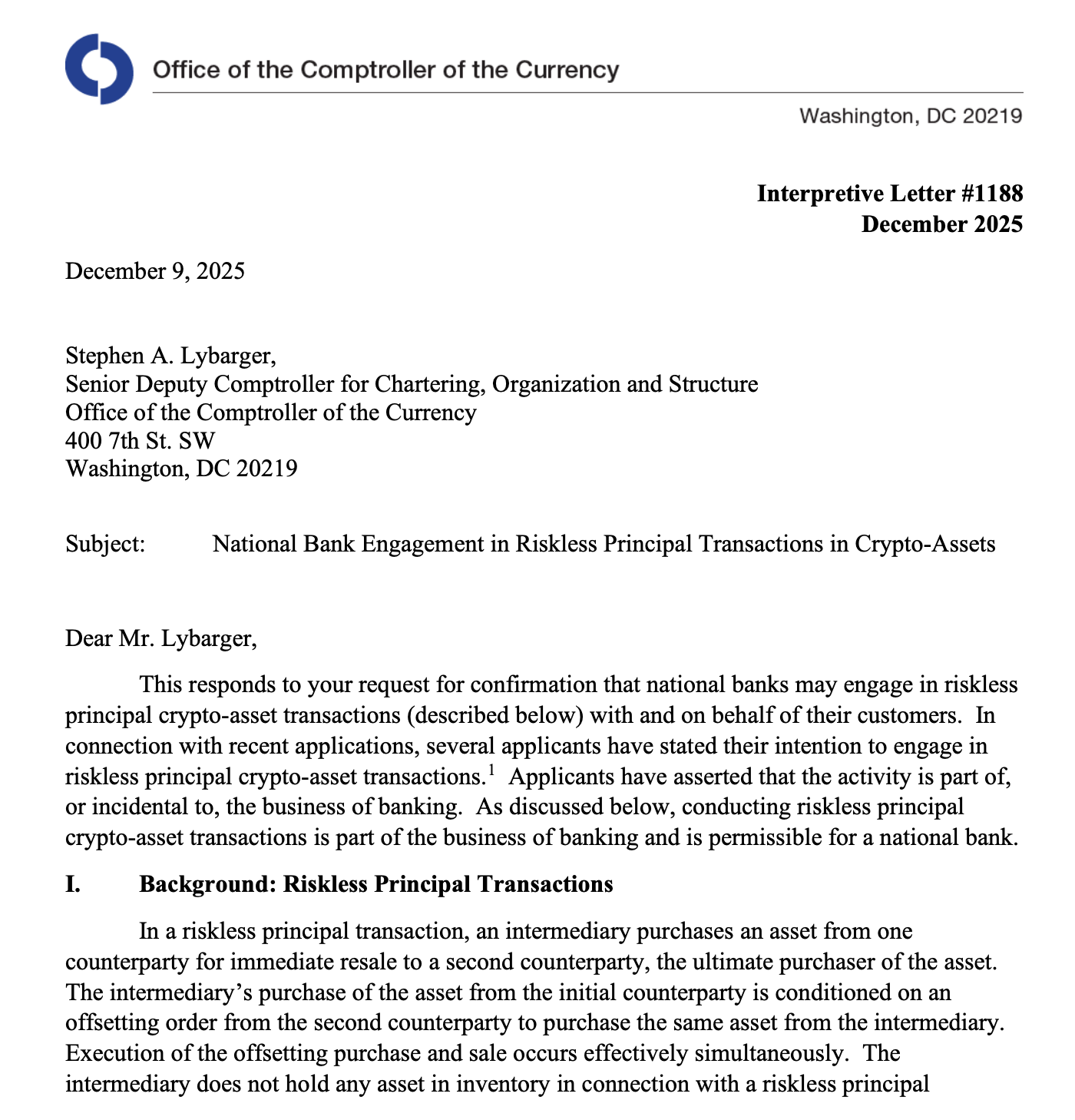
(Sources: US OCC)
What “Riskless Principal” Actually Means for Crypto
In traditional securities, a bank acting as riskless principal:
- Receives a customer order to buy 10 BTC
- Simultaneously executes an offsetting purchase from a liquidity provider
- Instantly delivers the BTC to the customer at an agreed markup
The bank never owns the asset, never exposes its capital to price risk, and earns only a small spread or fee. The OCC has now explicitly extended this decades-old model to Bitcoin, Ether, and other cryptocurrencies.
Key points from the letter:
- No balance-sheet custody of crypto is required
- Banks do not need new chartering or special crypto licenses
- Activity falls squarely within the longstanding “business of banking”
- Banks must still comply with AML/KYC, cybersecurity, and fair-banking rules
Why This Is a Game-Changer for U.S. Crypto Adoption
- Major banks can now compete directly with Coinbase, Kraken, and Robinhood on price, trust, and integration with existing checking/savings accounts.
- Customers get FDIC-insured banking relationships while trading crypto through the same trusted brand.
- Eliminates the biggest regulatory uncertainty that had kept most large banks on the sidelines since the 2022–2023 crypto winter.
- Creates a regulated on-ramp/off-ramp layer that dramatically improves liquidity and price stability for Bitcoin and altcoins.
Industry reaction has been immediate:
- Bank of America, Wells Fargo, and JPMorgan are reportedly accelerating internal crypto-trading pilots
- Regional banks have already begun filing updated compliance frameworks with the OCC
- Coinbase and other exchanges saw brief share dips on the news as competition intensifies
How This Fits Perfectly with 2025’s Regulatory Tailwinds
The OCC guidance lands alongside:
- SEC’s closure of multiple RWA and stablecoin investigations without action
- CFTC’s new digital-asset collateral pilot
- Incoming pro-crypto leadership under Chair Paul Atkins and the GENIUS Act framework
Together, these moves are creating the clearest U.S. regulatory runway for digital assets since 2021.
What Happens Next
- Expect the first major national banks to roll out crypto brokerage in Q1–Q2 2026
- Likely bundled with existing mobile apps (“Buy Bitcoin” button next to Apple Stock)
- Stablecoin and tokenized Treasury integrations will follow quickly
- Significant downward pressure on retail exchange fees as banks compete on spreads
The OCC’s December 2025 interpretive letter is the quiet regulatory bombshell the industry has waited years for: U.S. national banks are now officially allowed to bring cryptocurrency trading to Main Street — safely, legally, and at scale.
For banks and customers watching this space, the path is now open. Monitor official OCC announcements and your bank’s app updates in the coming months. As always, trade only through federally regulated institutions and maintain strong personal wallet security for any self-custodied assets.
Disclaimer: The information on this page may come from third parties and does not represent the views or opinions of Gate. The content displayed on this page is for reference only and does not constitute any financial, investment, or legal advice. Gate does not guarantee the accuracy or completeness of the information and shall not be liable for any losses arising from the use of this information. Virtual asset investments carry high risks and are subject to significant price volatility. You may lose all of your invested principal. Please fully understand the relevant risks and make prudent decisions based on your own financial situation and risk tolerance. For details, please refer to
Disclaimer.


