Aave Decentralized Autonomous Organization (DAO) and Aave Labs have clashed fiercely over the issue of fee distribution related to the CoW Swap integration. DAO members revealed that the fees generated from crypto asset swaps via CoW Swap flow into a private address controlled by Aave Labs, rather than the Aave DAO treasury, resulting in Ethereum losses of approximately $200,000 weekly and up to $10 million annually.
Controversy Over $10 Million Annual Fee Flow
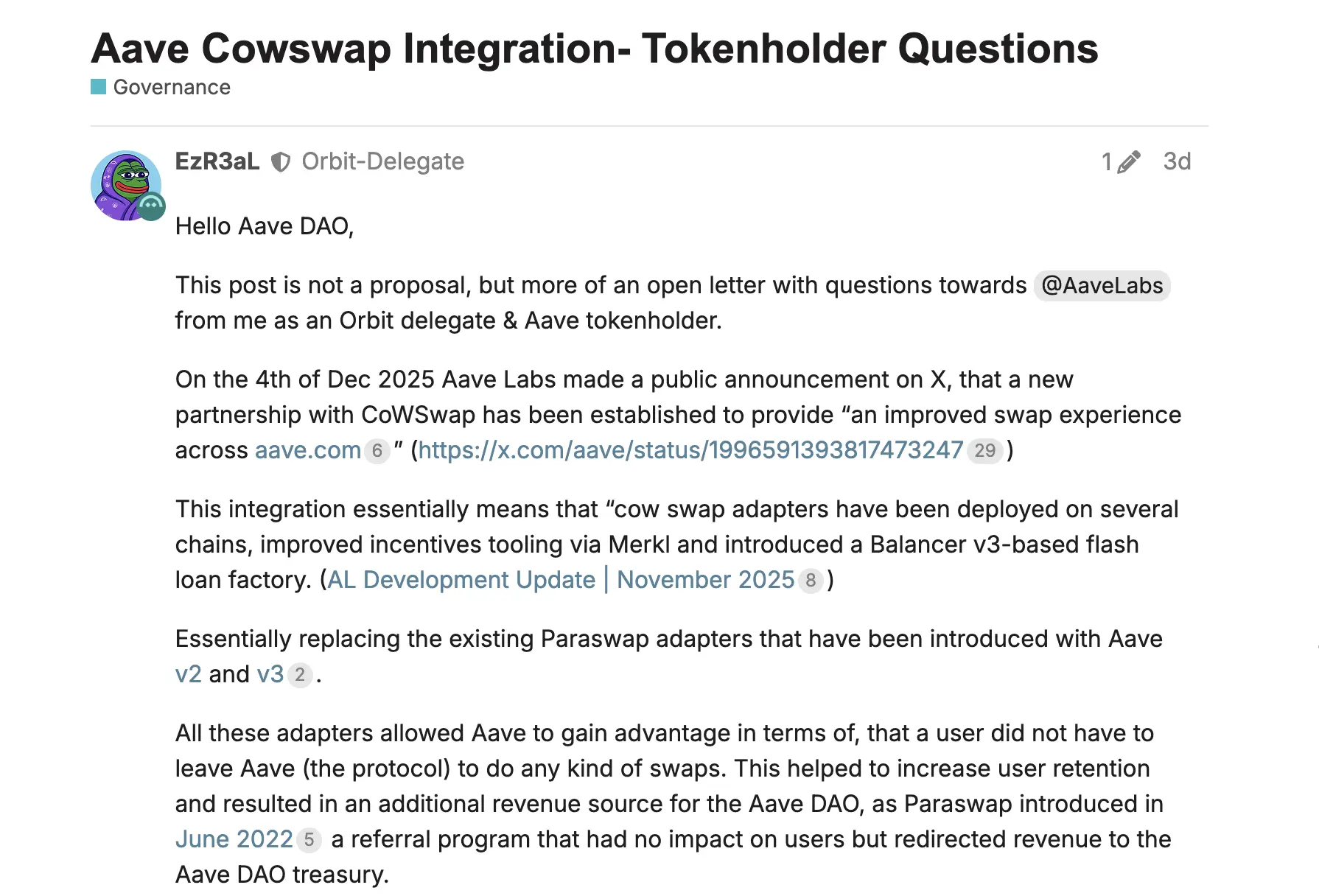
The storm in the Aave governance forum was ignited by pseudonymous member EzR3aL. In a post on the governance forum, he pointed out that after announcing the recent integration with decentralized exchange aggregator CoW Swap, the generated fees did not flow into the Aave DAO treasury but were instead transferred to a private address controlled by Aave Labs. This discovery shocked the community, as Aave DAO members had believed all protocol revenue belonged to the community.
EzR3aL raised several pointed questions: Why was the DAO not consulted prior to fee routing? Why do these fees not belong to the DAO? He emphasized: “Another entity (not Aave DAO) receives at least $200,000 worth of ETH weekly.” He also added that this implies the DAO is potentially losing up to $10 million in annual revenue. This figure represents a significant income stream for any DeFi protocol.
The core of the fee dispute lies in the ambiguity of authority boundaries. Aave Labs responded that the front-end components of the website and application interface have always been within Aave Labs’ legitimate responsibilities, and protocol-level changes—such as interest rate policies and smart contract code approvals—have always been managed by the DAO. Aave Labs also claimed it is the “funding entity” for the adapter development, which is just a few lines of code enabling swaps and other integrations.
However, this response did little to ease tensions. Some Aave DAO members stated that DAO funded the original adapter development, and thus income generated from the integration should flow back to the DAO. This exposes a fundamental issue: when a DAO funds development but a company executes it, how should the profits be attributed?
Power Struggle Between Centralized Company and Decentralized Organization
Marc Zeller, founder of the platform Aave-Chan Initiative, which serves the Aave governance community, issued more severe criticism. He stated that transferring all fees to Aave Labs is “extremely concerning” and accused: “Aave Labs, to achieve profit, has shifted Aave’s user base to competitors. This is unacceptable.”
Zeller’s critique highlights the core issue: does Aave Labs, as a profit-driven company, truly align with the interests of the Aave DAO as a decentralized organization? CoW Swap is an independent decentralized exchange aggregator. When Aave users utilize CoW Swap through integrated interfaces, should the fees be considered front-end service revenue (belonging to Aave Labs) or protocol revenue (belonging to the DAO)?
This kind of ambiguity is easily resolved in traditional corporate governance, where clear power divisions exist between the board and shareholders. But within a DAO structure, the relationship between development companies and the community organization is fraught with gray areas. Aave Labs claims that the front-end is their responsibility, so revenues generated from it should belong to them. But DAO members argue that the Aave brand and user base are built collaboratively by the community, and any income derived from utilizing these resources should belong to the community.
Three Major Dilemmas Revealed by the Aave Fee Dispute
Ambiguous Boundaries of Responsibilities and Rights: Difficult to clearly delineate protocol-level (DAO) versus front-end (company) responsibilities in practice
Structured Conflict of Interest: The goals of profit-seeking development firms and non-profit DAO are inherently conflicting, lacking formal mechanisms for resolution
Transparency Implementation Challenges: DAO members only discover fund flows when fee disputes erupt, indicating failure of oversight mechanisms
Crypto media outlets have contacted Aave Labs but as of press time have not received a response. This silence further fuels community dissatisfaction.
Structural Challenges of DAO Governance Models
This conflict highlights the complexity of operating a DAO. DAO represents a new governance and organizational model, offering advantages such as decentralized decision-making, transparent on-chain governance, and community ownership. However, the Aave incident exposes its own unique challenges.
The greatest challenge is balancing execution efficiency with decentralization. As a professional development team, Aave Labs can respond quickly to market demands, develop new features, and integrate new protocols. But this efficiency comes at the cost of reduced decentralization. When Aave Labs unilaterally decides on fee routing without consulting the DAO, it indeed accelerates execution but also erodes DAO’s decision-making authority.
Another challenge is incentive mechanism design. As a profit-oriented entity, Aave Labs needs revenue to sustain operations and motivate staff. But if all protocol revenues go to the DAO, how does Aave Labs get compensated? The current dispute shows that front-end fees are considered by Aave Labs as their revenue source, but this default arrangement has never been formally approved by DAO voting.
Future solutions may require more explicit contracts. Some DAO members suggest that formal proposals should clearly define Aave Labs’ responsibilities and revenue sharing ratios, turning implicit rules into explicit agreements. This not only avoids similar disputes but also provides a reference template for other DAOs.
Disclaimer: The information on this page may come from third parties and does not represent the views or opinions of Gate. The content displayed on this page is for reference only and does not constitute any financial, investment, or legal advice. Gate does not guarantee the accuracy or completeness of the information and shall not be liable for any losses arising from the use of this information. Virtual asset investments carry high risks and are subject to significant price volatility. You may lose all of your invested principal. Please fully understand the relevant risks and make prudent decisions based on your own financial situation and risk tolerance. For details, please refer to
Disclaimer.


