

Trade
Trading Type
Spot
Trade crypto freely
Pre-Market
Trade new tokens before they are officially listed
Margin
Magnify your profit with leverage
Convert & Block Trading
0 Fees
Trade any size with no fees and no slippage
Alpha
Points
Get promising tokens in streamlined on-chain trading
Leveraged Tokens
Get exposure to leveraged positions simply
Futures
Futures
Hundreds of contracts settled in USDT or BTC
Options
HOT
Trade European-style vanilla options
Unified Account
Maximize your capital efficiency
Demo Trading
Futures Kickoff
Get prepared for your futures trading
Futures Events
Participate in events to win generous rewards
Demo Trading
Use virtual funds to experience risk-free trading
Earn
Launch
CandyDrop
Collect candies to earn airdrops
Launchpool
Quick staking, earn potential new tokens
HODLer Airdrop
Hold GT and get massive airdrops for free
Launchpad
Be early to the next big token project
Alpha Points
NEW
Trade on-chain assets and enjoy airdrop rewards!
Futures Points
NEW
Earn futures points and claim airdrop rewards
Investment
Simple Earn
Earn interests with idle tokens
Auto-Invest
Auto-invest on a regular basis
Dual Investment
Buy low and sell high to take profits from price fluctuations
Soft Staking
Earn rewards with flexible staking
Crypto Loan
0 Fees
Pledge one crypto to borrow another
Lending Center
One-stop lending hub
VIP Wealth Hub
Customized wealth management empowers your assets growth
Private Wealth Management
Customized asset management to grow your digital assets
Quant Fund
Top asset management team helps you profit without hassle
Staking
Stake cryptos to earn in PoS products
Smart Leverage
NEW
No forced liquidation before maturity, worry-free leveraged gains
GUSD Minting
Use USDT/USDC to mint GUSD for treasury-level yields


More
Promotions
Activity Center
Join activities and win big cash prizes and exclusive merch
Referral
20 USDT
Earn 40% commission or up to 500 USDT rewards
Announcements
Announcements of new listings, activities, upgrades, etc
Gate Blog
Crypto industry articles
VIP Services
Huge fee discounts
Proof of Reserves
Gate promises 100% proof of reserves

Year-end final sprint? Strategy spends 108 million to buy again, with a total Bitcoin holding of 672,497 coins
36m ago
【Madman on Trends】The market has become extremely quiet, and a trend reversal will occur very soon.
44m ago
Trending Topics
View More14.24K Popularity
23.75K Popularity
40.27K Popularity
84.34K Popularity
3.11K Popularity
Hot Gate Fun
View More- MC:$3.55KHolders:10.00%
- MC:$3.55KHolders:10.00%
- MC:$3.57KHolders:10.00%
- MC:$3.57KHolders:10.00%
- MC:$3.57KHolders:10.00%





Pin
PANews 2025 Annual Public Chain Data Review: "Naked Swimming" Moment, Who Is Growing Against the Trend?
Author: Frank, PANews
2025 is a year of great drama and a watershed for the public chain track in the crypto world. If 2024 was a “carnival night” where various new public chains competed fiercely with high airdrop expectations and grand narratives, then 2025 is the “wake-up call” after the carnival. As the tide recedes and liquidity tightens, the true data hidden behind the surface of prosperity begins to surface. We see a “clash of two worlds”: on one side, the widespread halving of secondary market prices and a significant slowdown in TVL growth; on the other side, an inverse surge in on-chain fee revenue and DEX trading volume. This stark contrast reveals a brutal truth: the market no longer buys into simple “narratives,” and funds are concentrating into leading protocols with the ability to generate revenue and meet real needs. The PANews data team comprehensively analyzed the core data of 26 mainstream public chains in 2025. From TVL, token prices, fee income, activity levels to investment and financing, we attempt to restore the “bubble squeezing” process experienced by the public chain market this year through these cold numbers, and to identify those true winners who can still build solid moats in the winter. (Data sources: TVL, stablecoins, financing, and fee data from Defillama; daily active users and daily transaction volume from Artemis and on-chain info; token prices and market caps from Coingecko. Data period: January 1 to December 16, 2025.) The state of TVL: a cliff-like slowdown, DeFi experiencing “deleveraging” pain Looking at the most important indicator of public chain prosperity, TVL, this year’s top public chains saw slight growth overall but with a slowdown. PANews’s statistics show that the total TVL of 26 major public chains grew by 5.89% this year, with 5 new chains entering the list from zero initial data. Additionally, only 11 chains achieved positive growth, accounting for about 42%. In comparison, in 2024, the 22 mainstream chains’ annual TVL growth was 119%, with a growth rate of 78%. The slowdown in TVL growth also reflects the overall coldness of the crypto market. But this doesn’t mean 2025 was entirely dull. Looking at the entire industry, the network’s TVL reached $168 billion in October, a 45% increase from $115.7 billion at the start of the year. However, after October, due to a market crash, the overall TVL shrank sharply. Part of this was due to the decline in the prices of base tokens of various chains, and part was due to market risk aversion leading many funds to withdraw from DeFi systems. Among the top ten chains, Hyperliquid clearly emerged as the winner in 2025, with a 299% increase in TVL this year, compared to single-digit growth of other chains. Solana, on the other hand, was the biggest disappointment, with only 0.8% growth. As the MEME coin market cooled, this giant chain seems to be facing a crisis. Additionally, among the 26 chains analyzed, Flare’s growth rate exceeded 582%, making it the fastest-growing chain. OP Mainnet’s TVL, however, declined by 63.6%, making it the most severely affected.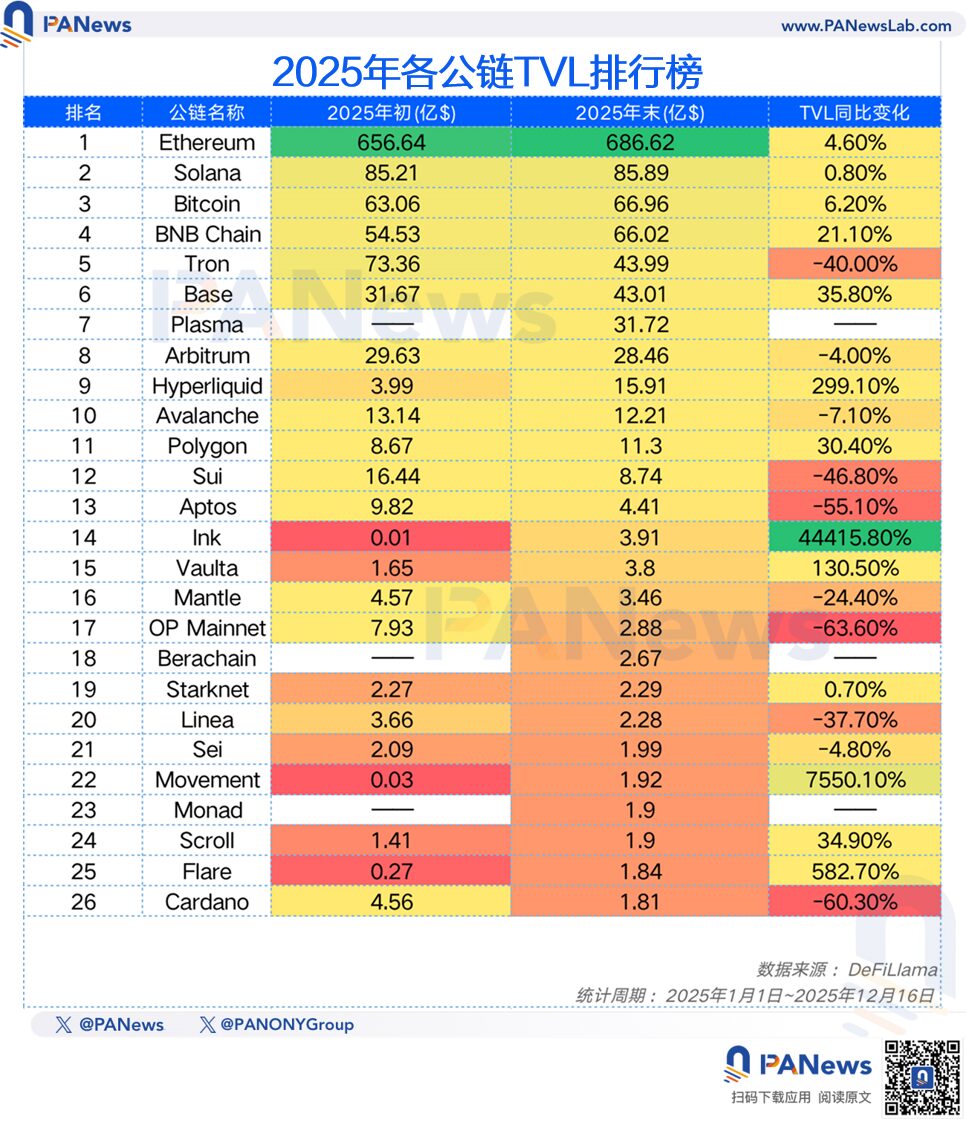 Average token prices halved, market no longer supports new chains
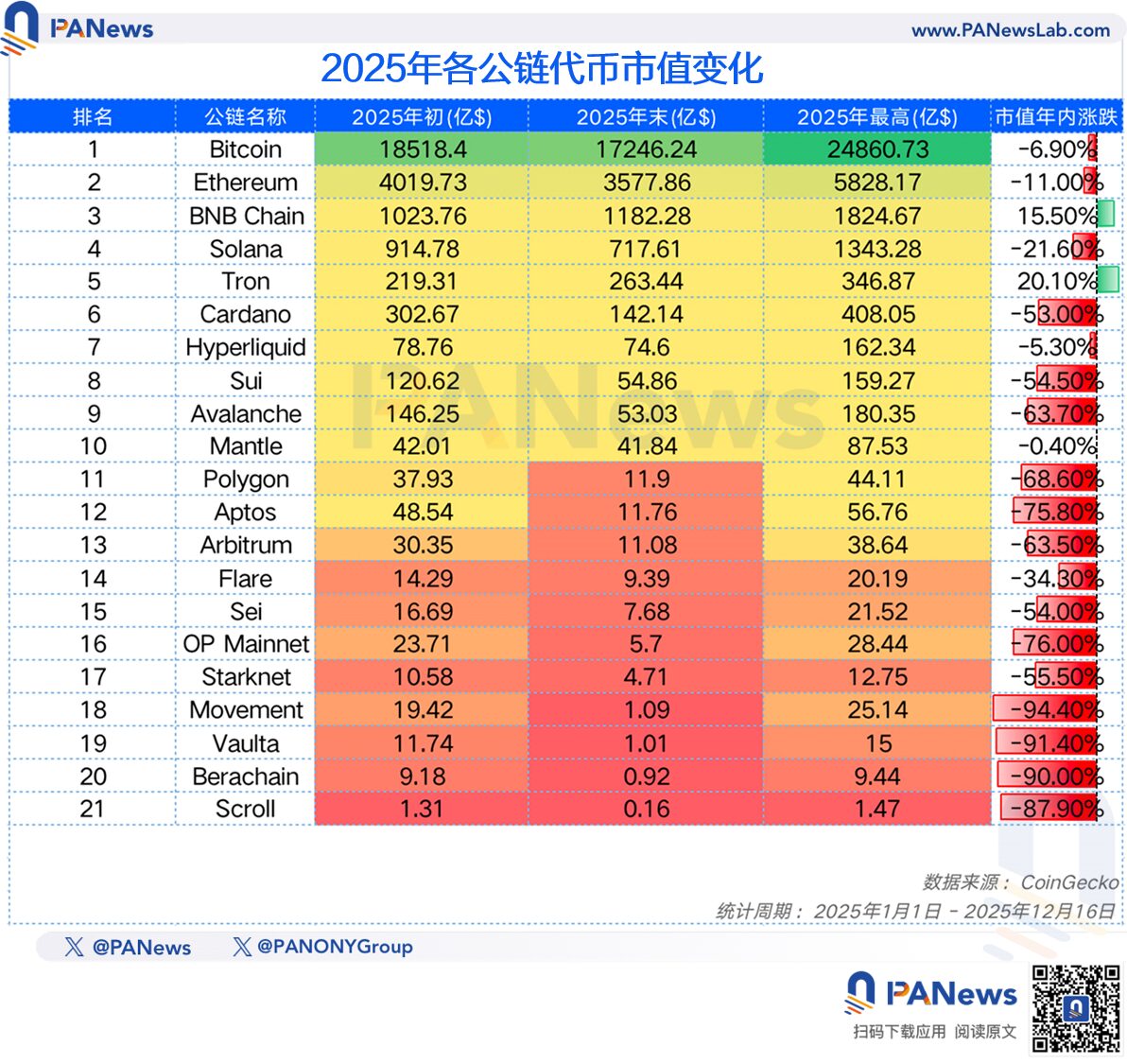
In terms of prices, the performance of these mainstream chains this year was also underwhelming. Compared to their prices at the start of the year, the tokens of these 26 chains fell by an average of 50%. Notably, Movement tokens dropped 95%, Berachain tokens fell 92%, and Scroll tokens declined 91%. These new chains failed to gain market recognition.
Among the analyzed chains, only BNB Chain (up 22%), Hyperliquid (up 14.2%), Tron (up 9.3%), and Mantle (up 3%) saw price increases this year; the rest experienced declines.
Average token prices halved, market no longer supports new chains
In terms of prices, the performance of these mainstream chains this year was also underwhelming. Compared to their prices at the start of the year, the tokens of these 26 chains fell by an average of 50%. Notably, Movement tokens dropped 95%, Berachain tokens fell 92%, and Scroll tokens declined 91%. These new chains failed to gain market recognition.
Among the analyzed chains, only BNB Chain (up 22%), Hyperliquid (up 14.2%), Tron (up 9.3%), and Mantle (up 3%) saw price increases this year; the rest experienced declines.
 However, the changes behind TVL and price data are mainly influenced by liquidity shifts in the crypto market. Analyzing the development indicators of the ecosystems presents a different picture.
Protocol revenue surges, public chains move toward a new “self-sustaining” phase
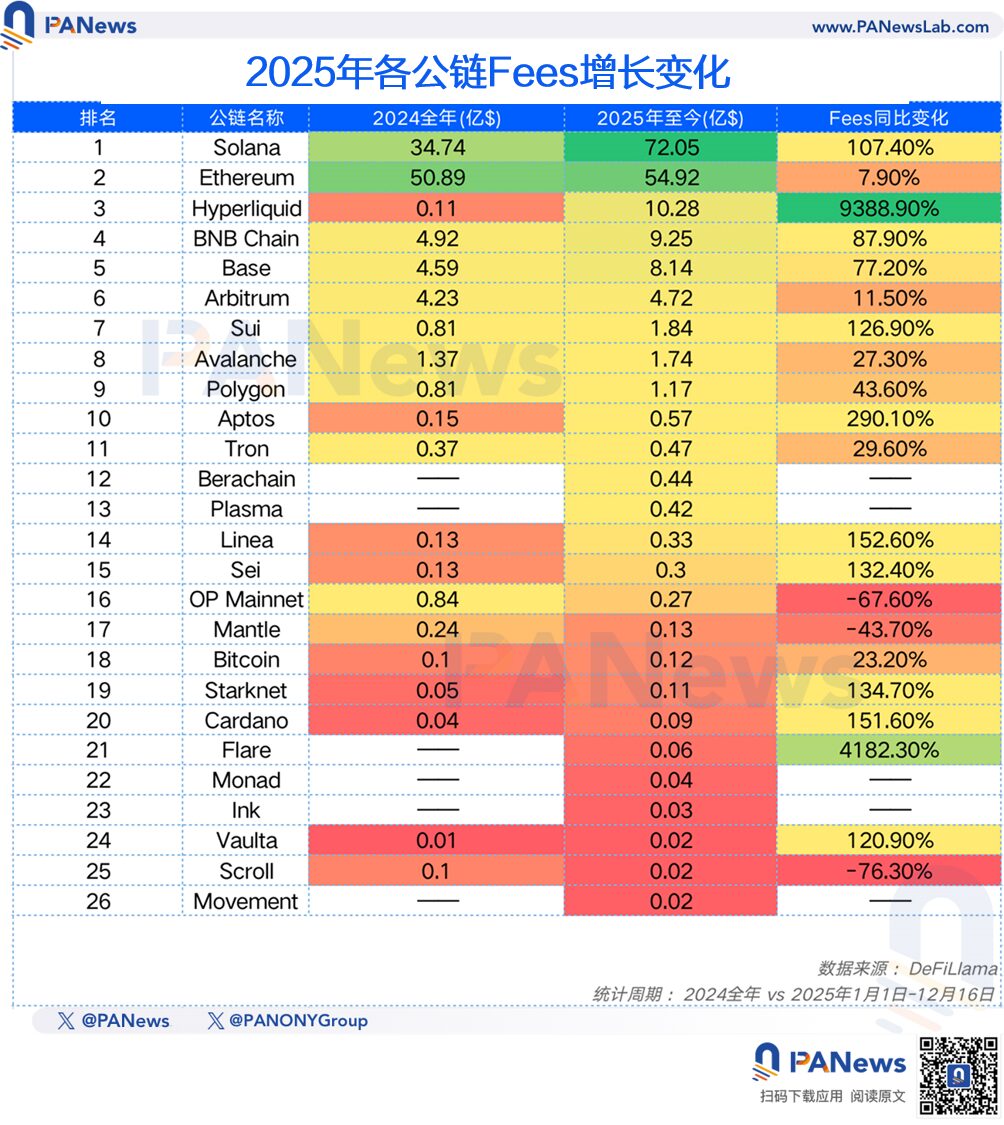
Regarding on-chain fee generation, these chains collectively generated $10.4 billion in fees in 2024, which increased to $16.75 billion in 2025, a total growth of 60%. Moreover, except for OP Mainnet, Mantle, and Scroll, which saw fee declines, all other chains experienced growth in 2025.
The largest increase in fees was seen in Hyperliquid (9388.9%), mainly because it launched at the end of 2024 with a small initial base. Solana’s fees grew by 107%, BNB Chain by 77%, Sui by 126%, and Aptos by 290%. It can be said that the revenue-generating capacity of mainstream chains greatly improved in 2025.
However, the changes behind TVL and price data are mainly influenced by liquidity shifts in the crypto market. Analyzing the development indicators of the ecosystems presents a different picture.
Protocol revenue surges, public chains move toward a new “self-sustaining” phase
Regarding on-chain fee generation, these chains collectively generated $10.4 billion in fees in 2024, which increased to $16.75 billion in 2025, a total growth of 60%. Moreover, except for OP Mainnet, Mantle, and Scroll, which saw fee declines, all other chains experienced growth in 2025.
The largest increase in fees was seen in Hyperliquid (9388.9%), mainly because it launched at the end of 2024 with a small initial base. Solana’s fees grew by 107%, BNB Chain by 77%, Sui by 126%, and Aptos by 290%. It can be said that the revenue-generating capacity of mainstream chains greatly improved in 2025.
 In addition, the transaction volume on DEXs across various chains also grew by 88% overall, with an average increase of 163%. Notably, Solana surpassed Ethereum with a transaction volume of $1.52 trillion, ranking the highest among chains, while BNB Chain followed closely with $697.2 billion, making it very likely to overtake Ethereum in 2026.
Hyperliquid remains the fastest-growing, with a 1217.00% increase in DEX trading volume for the year, and Flare ranks second with an 880% increase.
In addition, the transaction volume on DEXs across various chains also grew by 88% overall, with an average increase of 163%. Notably, Solana surpassed Ethereum with a transaction volume of $1.52 trillion, ranking the highest among chains, while BNB Chain followed closely with $697.2 billion, making it very likely to overtake Ethereum in 2026.
Hyperliquid remains the fastest-growing, with a 1217.00% increase in DEX trading volume for the year, and Flare ranks second with an 880% increase.
 When “airdrop hunters” disperse, retaining new public chain users becomes difficult
In terms of daily active users, the data shows mixed feelings.
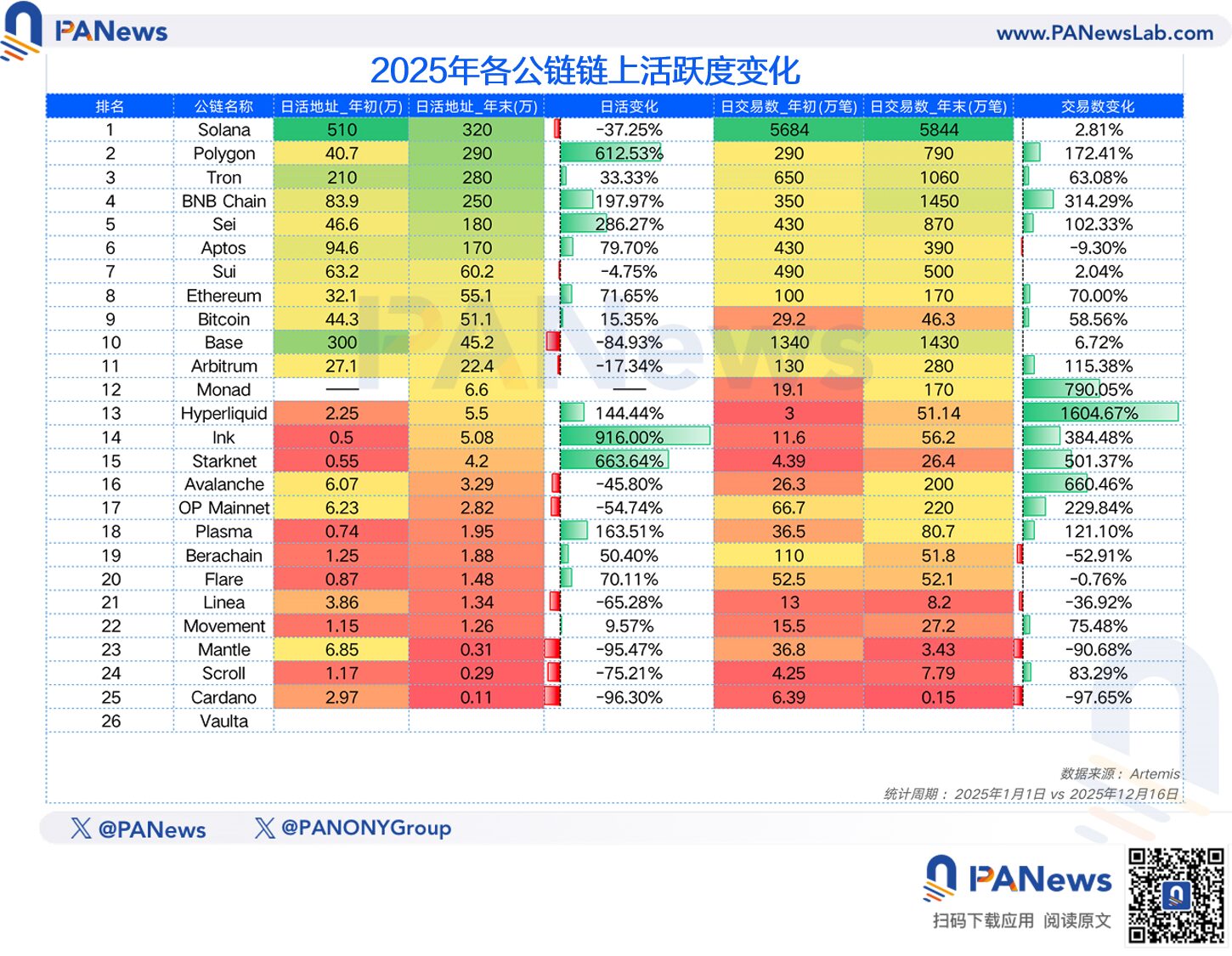
Overall, the number of daily active addresses across these chains increased from 14.86 million to 17.6 million, an 18% increase. Achieving such a result in a sluggish market is a relatively positive signal.
However, chains like Solana, Base, and Sui—once considered the most active among retail users—showed varying degrees of decline, with Base’s daily active users dropping 84.9% from the start of the year, and Solana down 37%. Recently, Polygon’s daily active addresses experienced exponential growth, reaching 2.9 million on December 19, a 612% increase from the start of the year. Additionally, chains like BNB Chain, Sei, and Aptos also saw significant growth in daily active users.
Furthermore, in terms of daily transaction counts, these chains saw an overall 33% increase by the end of the year compared to the start. BNB Chain’s data was particularly impressive, rising from 3.5 million to 14.5 million transactions, demonstrating strong scale and growth. Solana still leads with 58.44 million transactions, but with only a 2.8% increase for the year, showing signs of fatigue.
When “airdrop hunters” disperse, retaining new public chain users becomes difficult
In terms of daily active users, the data shows mixed feelings.
Overall, the number of daily active addresses across these chains increased from 14.86 million to 17.6 million, an 18% increase. Achieving such a result in a sluggish market is a relatively positive signal.
However, chains like Solana, Base, and Sui—once considered the most active among retail users—showed varying degrees of decline, with Base’s daily active users dropping 84.9% from the start of the year, and Solana down 37%. Recently, Polygon’s daily active addresses experienced exponential growth, reaching 2.9 million on December 19, a 612% increase from the start of the year. Additionally, chains like BNB Chain, Sei, and Aptos also saw significant growth in daily active users.
Furthermore, in terms of daily transaction counts, these chains saw an overall 33% increase by the end of the year compared to the start. BNB Chain’s data was particularly impressive, rising from 3.5 million to 14.5 million transactions, demonstrating strong scale and growth. Solana still leads with 58.44 million transactions, but with only a 2.8% increase for the year, showing signs of fatigue.
 Stablecoins become the only “bullish” sector in 2025
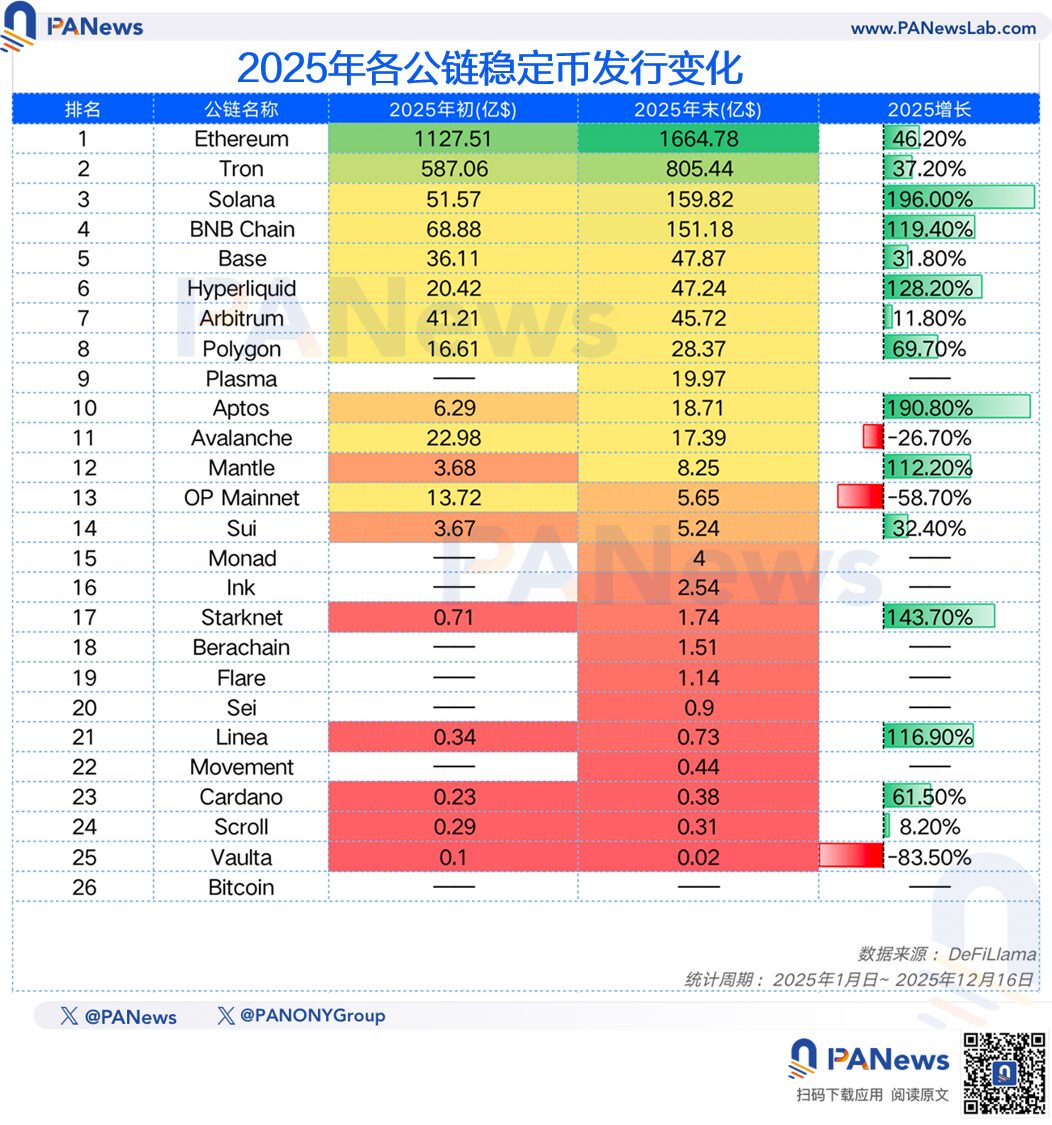
The stablecoin market in 2025 experienced a full-blown explosion, which is also reflected in public chain data. Compared to 2024, most chains saw significant growth in stablecoin market caps, with Solana leading with a 196% increase, making it the chain with the largest stablecoin growth. Ethereum and Tron, as the top two chains for stablecoins, maintained annual growth of 46% and 37%, respectively. Additionally, some active chains this year, like BNB Chain and Hyperliquid, also achieved substantial growth in stablecoins.
Stablecoins become the only “bullish” sector in 2025
The stablecoin market in 2025 experienced a full-blown explosion, which is also reflected in public chain data. Compared to 2024, most chains saw significant growth in stablecoin market caps, with Solana leading with a 196% increase, making it the chain with the largest stablecoin growth. Ethereum and Tron, as the top two chains for stablecoins, maintained annual growth of 46% and 37%, respectively. Additionally, some active chains this year, like BNB Chain and Hyperliquid, also achieved substantial growth in stablecoins.
 Ecosystem Financing: Polygon wins with star projects, Ethereum and Solana remain hot
Another noteworthy data dimension is financing. In 2025, the crypto industry set a new record with 6,710 financing events, categorized by chain. The data shows that the number of financing events dropped sharply from 640 to 293, but the total amount increased from $350 million to $667 million, with the average per deal rising from $5.57 million to $22.79 million. This indicates that, in the current market, it is more difficult for small and medium-sized teams to secure funding, while capital is more willing to invest heavily in star projects.
In terms of chain categories, Polygon raised the most with $2.24 billion, followed by Ethereum with $1.57 billion and Solana with $1.34 billion. However, Polygon’s leading position is mainly due to Polymarket’s massive $2 billion+ funding. Looking at the number of financing events, most occurred within the Ethereum, Solana, Bitcoin, and Base ecosystems.
Ecosystem Financing: Polygon wins with star projects, Ethereum and Solana remain hot
Another noteworthy data dimension is financing. In 2025, the crypto industry set a new record with 6,710 financing events, categorized by chain. The data shows that the number of financing events dropped sharply from 640 to 293, but the total amount increased from $350 million to $667 million, with the average per deal rising from $5.57 million to $22.79 million. This indicates that, in the current market, it is more difficult for small and medium-sized teams to secure funding, while capital is more willing to invest heavily in star projects.
In terms of chain categories, Polygon raised the most with $2.24 billion, followed by Ethereum with $1.57 billion and Solana with $1.34 billion. However, Polygon’s leading position is mainly due to Polymarket’s massive $2 billion+ funding. Looking at the number of financing events, most occurred within the Ethereum, Solana, Bitcoin, and Base ecosystems.
 Below is an analysis of several key public chains that market focuses on:
Ethereum: The boat has passed the mountain, fundamentals recover while token prices stagnate in a “dislocation period”
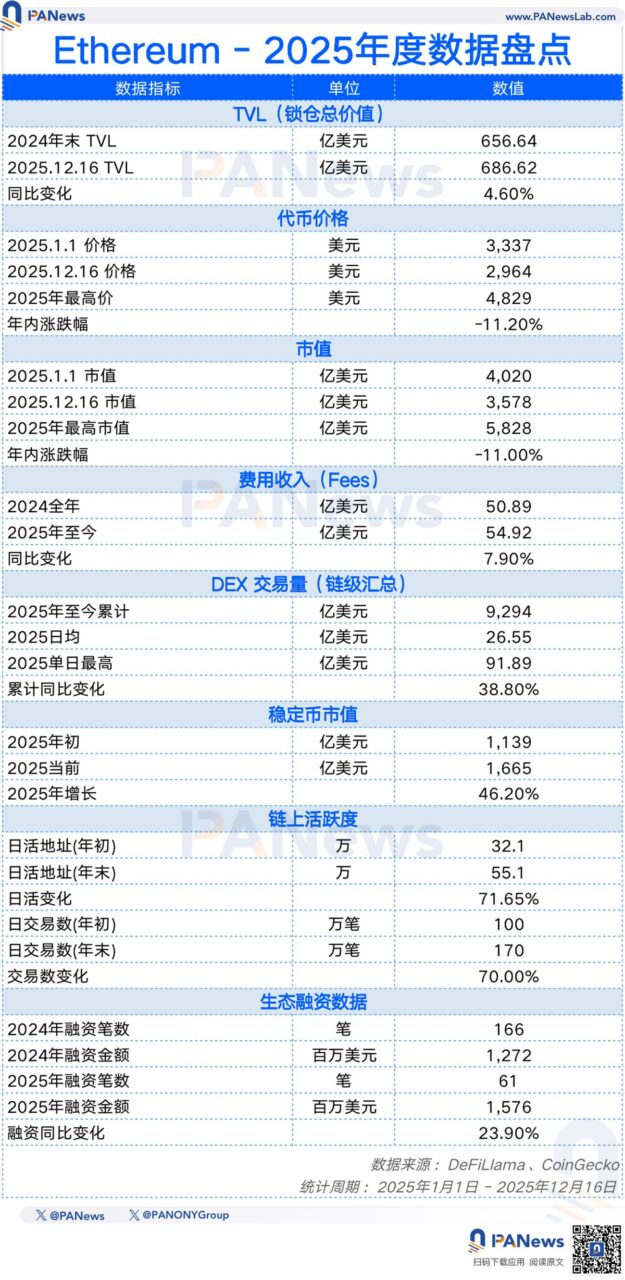
As the leading public chain, Ethereum’s development in 2025 can be described as “the boat has passed the mountain.” After experiencing ecosystem stagnation caused by severe L2 fragmentation in 2024, and market prices hovering without significant movement, Ethereum’s ecosystem data actually showed good growth in 2025, especially in DEX trading volume (up 38.8%), stablecoin market cap (up 46%), and on-chain active addresses (up 71%). Additionally, in ecosystem financing events and amounts, Ethereum still leads most chains. These data points indicate that Ethereum’s mainnet ecosystem experienced a revival in 2025.
However, in terms of price and TVL, the market’s overall correction still kept them stagnant. Compared to other chains, Ethereum’s token price demonstrated relatively stronger resilience.
Below is an analysis of several key public chains that market focuses on:
Ethereum: The boat has passed the mountain, fundamentals recover while token prices stagnate in a “dislocation period”
As the leading public chain, Ethereum’s development in 2025 can be described as “the boat has passed the mountain.” After experiencing ecosystem stagnation caused by severe L2 fragmentation in 2024, and market prices hovering without significant movement, Ethereum’s ecosystem data actually showed good growth in 2025, especially in DEX trading volume (up 38.8%), stablecoin market cap (up 46%), and on-chain active addresses (up 71%). Additionally, in ecosystem financing events and amounts, Ethereum still leads most chains. These data points indicate that Ethereum’s mainnet ecosystem experienced a revival in 2025.
However, in terms of price and TVL, the market’s overall correction still kept them stagnant. Compared to other chains, Ethereum’s token price demonstrated relatively stronger resilience.
 Solana: Success and failure both MEME, the fragility revealed after the bubble burst
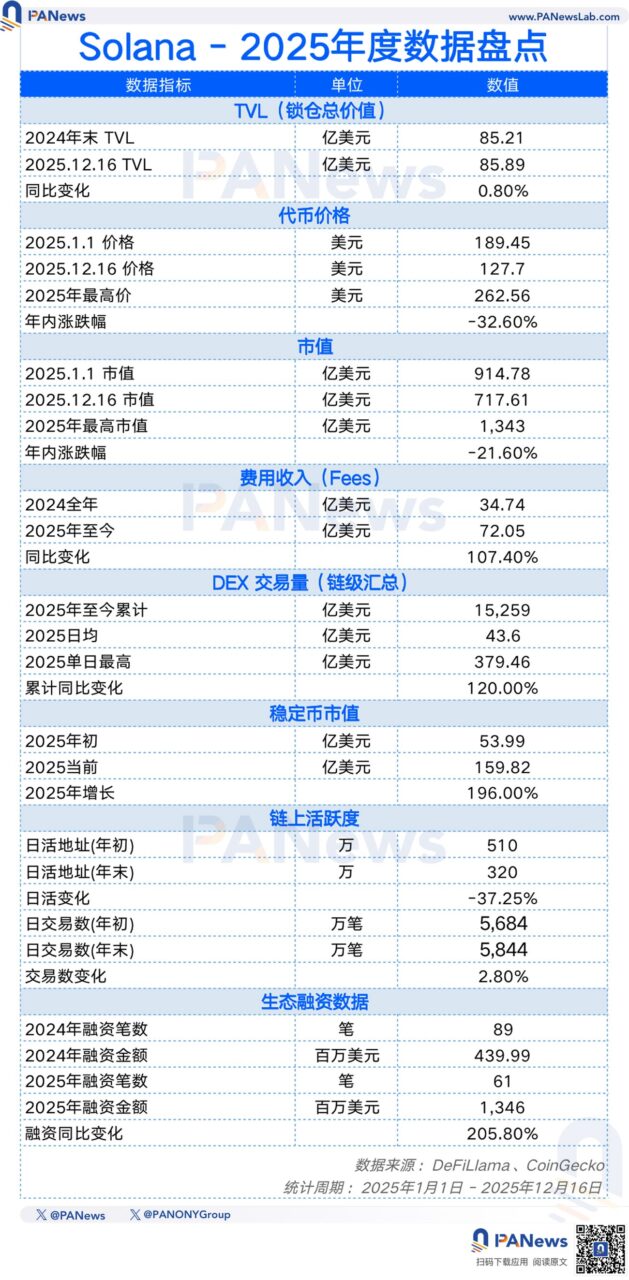
Compared to 2024, Solana in 2025 shows a different state: the fragility of its ecosystem exposed after the rollercoaster. After the MEME market peaked early and then declined, Solana failed to generate further narratives, while various launch platforms continued to compete within the MEME coin track. Although fees captured and DEX trading volume increased significantly this year, token prices, active users at year-end, and transaction counts all declined sharply. This also indicates that the market is voting with its feet—Solana’s bubble of prosperity seems to have burst.
Solana: Success and failure both MEME, the fragility revealed after the bubble burst
Compared to 2024, Solana in 2025 shows a different state: the fragility of its ecosystem exposed after the rollercoaster. After the MEME market peaked early and then declined, Solana failed to generate further narratives, while various launch platforms continued to compete within the MEME coin track. Although fees captured and DEX trading volume increased significantly this year, token prices, active users at year-end, and transaction counts all declined sharply. This also indicates that the market is voting with its feet—Solana’s bubble of prosperity seems to have burst.
 BNB Chain: From defense to full offense, the “Hexagon Warrior” with comprehensive growth
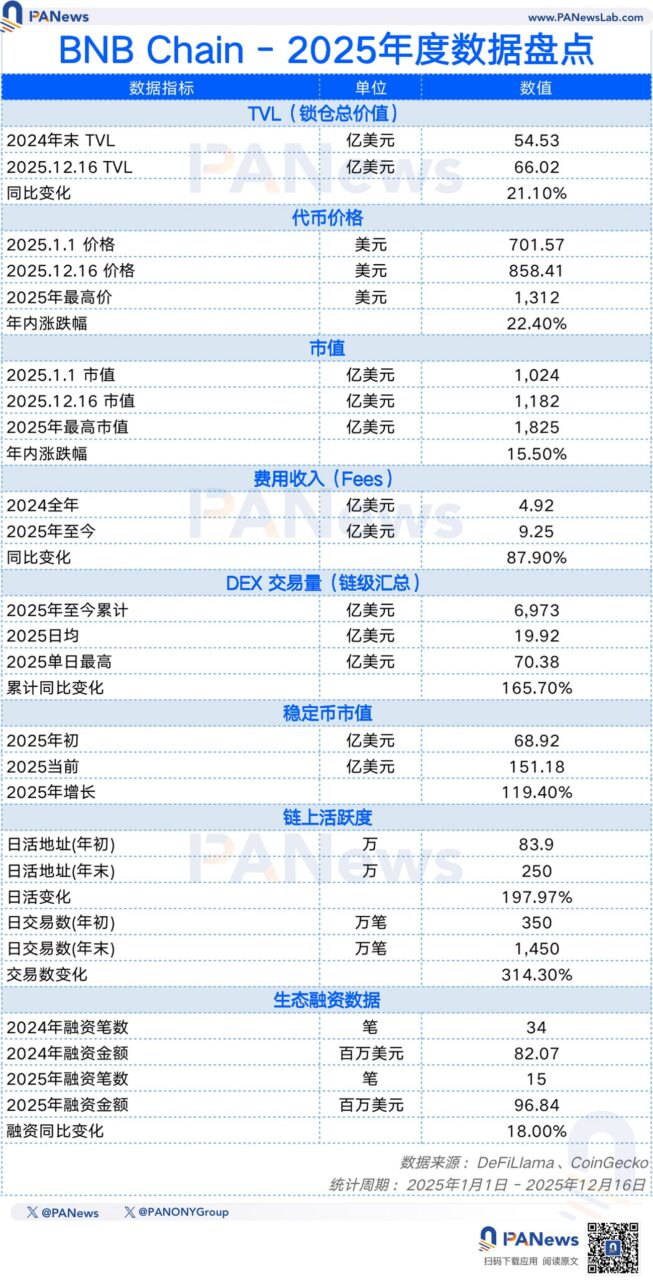
BNB Chain experienced a full breakout in 2025, with positive growth across all data dimensions. Especially in fee revenue, DEX trading volume, stablecoin market cap, and on-chain activity, most grew more than double. Such performance is rare in the context of a sluggish public chain market.
Of course, this success is closely related to Binance. From CZ and other executives actively participating in marketing, to launching Binance Alpha as a “must-do” for retail investors, and new derivatives exchanges like Aster targeting Hyperliquid, BNB Chain’s counterattack in 2024 has turned into a full-scale offensive. This aggressive push makes BNB Chain a formidable opponent that all other chains cannot ignore.
BNB Chain: From defense to full offense, the “Hexagon Warrior” with comprehensive growth
BNB Chain experienced a full breakout in 2025, with positive growth across all data dimensions. Especially in fee revenue, DEX trading volume, stablecoin market cap, and on-chain activity, most grew more than double. Such performance is rare in the context of a sluggish public chain market.
Of course, this success is closely related to Binance. From CZ and other executives actively participating in marketing, to launching Binance Alpha as a “must-do” for retail investors, and new derivatives exchanges like Aster targeting Hyperliquid, BNB Chain’s counterattack in 2024 has turned into a full-scale offensive. This aggressive push makes BNB Chain a formidable opponent that all other chains cannot ignore.
 Hyperliquid: The biggest dark horse of the year, teaching the industry a lesson with “real revenue”
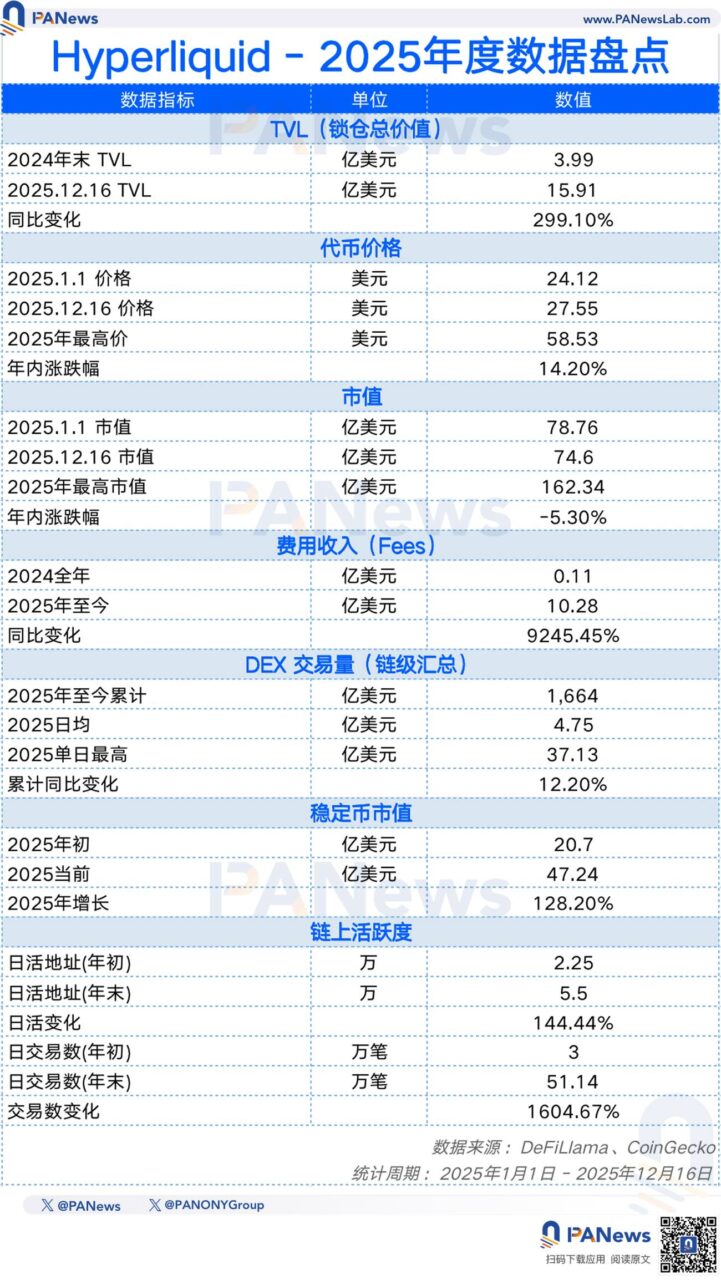
Similar to BNB Chain, Hyperliquid also shined brightly in 2025. Aside from a slight decline in market cap (-5.3%) from the start of the year, all other data showed positive growth, with several metrics recording the largest increases among all chains.
In 2025, Hyperliquid ranked ninth in total TVL, third in fee revenue, sixth in DEX trading volume, and fifth in stablecoin market cap. Based on these rankings, Hyperliquid has become a truly mainstream public chain. As a newcomer to the market, achieving such results is highly successful. Moreover, it is one of the few chains in 2025 that can sustain its ecosystem through genuine revenue without relying on inflation incentives.
However, Hyperliquid recently faced strong competitors, with products like Aster and Lighter approaching its trading volume. Unknowingly, Hyperliquid, which was a challenger last year, may have to shift to a defensive stance in 2026.
Hyperliquid: The biggest dark horse of the year, teaching the industry a lesson with “real revenue”
Similar to BNB Chain, Hyperliquid also shined brightly in 2025. Aside from a slight decline in market cap (-5.3%) from the start of the year, all other data showed positive growth, with several metrics recording the largest increases among all chains.
In 2025, Hyperliquid ranked ninth in total TVL, third in fee revenue, sixth in DEX trading volume, and fifth in stablecoin market cap. Based on these rankings, Hyperliquid has become a truly mainstream public chain. As a newcomer to the market, achieving such results is highly successful. Moreover, it is one of the few chains in 2025 that can sustain its ecosystem through genuine revenue without relying on inflation incentives.
However, Hyperliquid recently faced strong competitors, with products like Aster and Lighter approaching its trading volume. Unknowingly, Hyperliquid, which was a challenger last year, may have to shift to a defensive stance in 2026.
 Sui: Unlocking the “deep squat” under pressure, awaiting rebirth after the bubble bursts
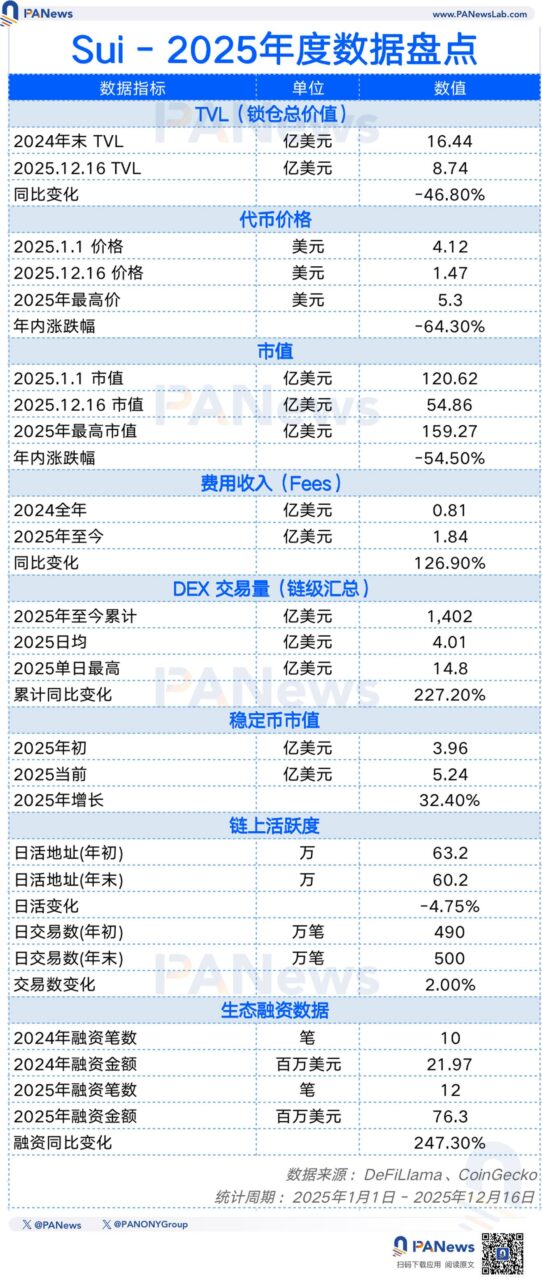
As a rising chain that in 2024 aggressively chased Solana and was highly anticipated by the market, Sui remained relatively quiet in 2025. Data shows that Sui’s token price fell by 64%, and TVL dropped 46.8%, reflecting market pressure. This was mainly due to Sui entering a “mass unlock period” in 2025, with large amounts of early investor and team tokens entering the market, combined with overall market cooling, putting downward pressure on prices.
Meanwhile, ecosystem activity, in terms of daily active users and daily transaction counts, remained nearly flat compared to the start of the year, indicating the root of Sui’s silence: lack of new narratives, and failure to fully explode in the MEME market. However, based on the growth in financing amounts and DEX trading volume, the capital market has not completely abandoned Sui. 2026 may be a year of rebuilding after the bubble bursts.
Sui: Unlocking the “deep squat” under pressure, awaiting rebirth after the bubble bursts
As a rising chain that in 2024 aggressively chased Solana and was highly anticipated by the market, Sui remained relatively quiet in 2025. Data shows that Sui’s token price fell by 64%, and TVL dropped 46.8%, reflecting market pressure. This was mainly due to Sui entering a “mass unlock period” in 2025, with large amounts of early investor and team tokens entering the market, combined with overall market cooling, putting downward pressure on prices.
Meanwhile, ecosystem activity, in terms of daily active users and daily transaction counts, remained nearly flat compared to the start of the year, indicating the root of Sui’s silence: lack of new narratives, and failure to fully explode in the MEME market. However, based on the growth in financing amounts and DEX trading volume, the capital market has not completely abandoned Sui. 2026 may be a year of rebuilding after the bubble bursts.
 Tron: The ultimate pragmatist, the “cash flow king” deep in the payments track
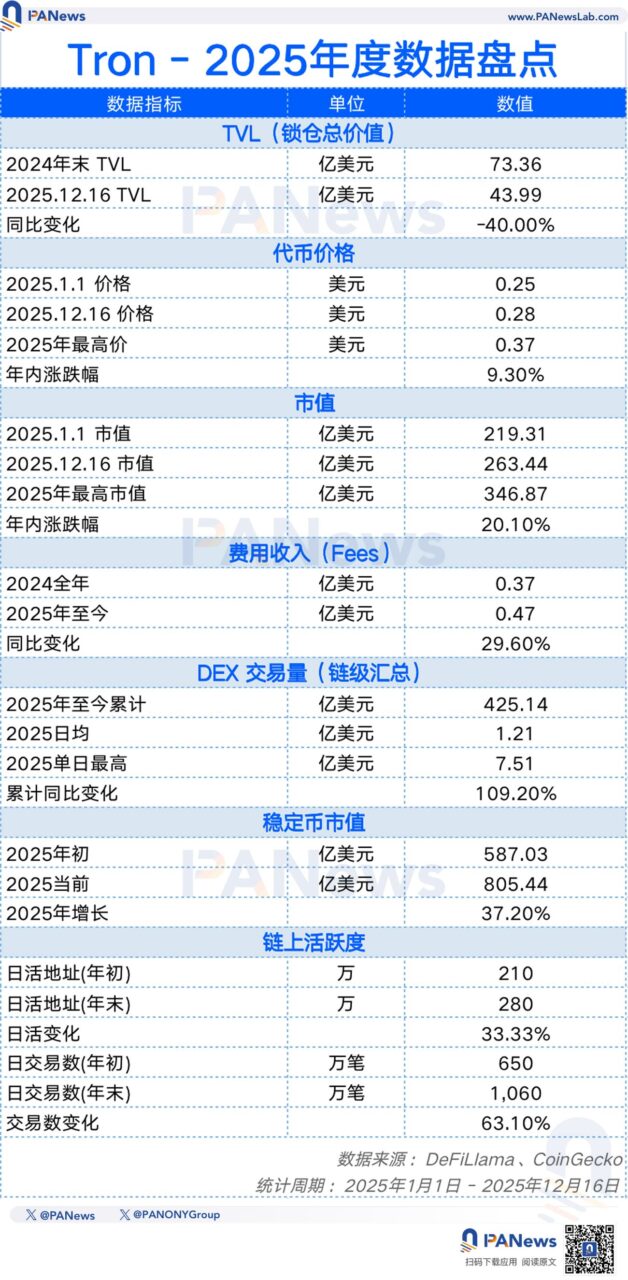
In 2025, Tron’s development set another narrative for the public chain market: leveraging the stability of stablecoins to continue “quietly making money.” Although TVL and token prices declined by about half, Tron’s reliance on the stablecoin market’s stability still generated $184 million in on-chain fees (up 126.9%) and expanded DEX trading volume by 224%. For Tron, rather than chasing hot topics and creating new narratives, it’s better to focus on solid fundamentals like global stablecoin settlement. This pragmatic approach has made it a public chain with stable cash flow and strong user stickiness.
Tron: The ultimate pragmatist, the “cash flow king” deep in the payments track
In 2025, Tron’s development set another narrative for the public chain market: leveraging the stability of stablecoins to continue “quietly making money.” Although TVL and token prices declined by about half, Tron’s reliance on the stablecoin market’s stability still generated $184 million in on-chain fees (up 126.9%) and expanded DEX trading volume by 224%. For Tron, rather than chasing hot topics and creating new narratives, it’s better to focus on solid fundamentals like global stablecoin settlement. This pragmatic approach has made it a public chain with stable cash flow and strong user stickiness.
 Looking back at the public chain landscape of 2025, it’s not just an annual report but a reflection of the diverse states of public chain development.
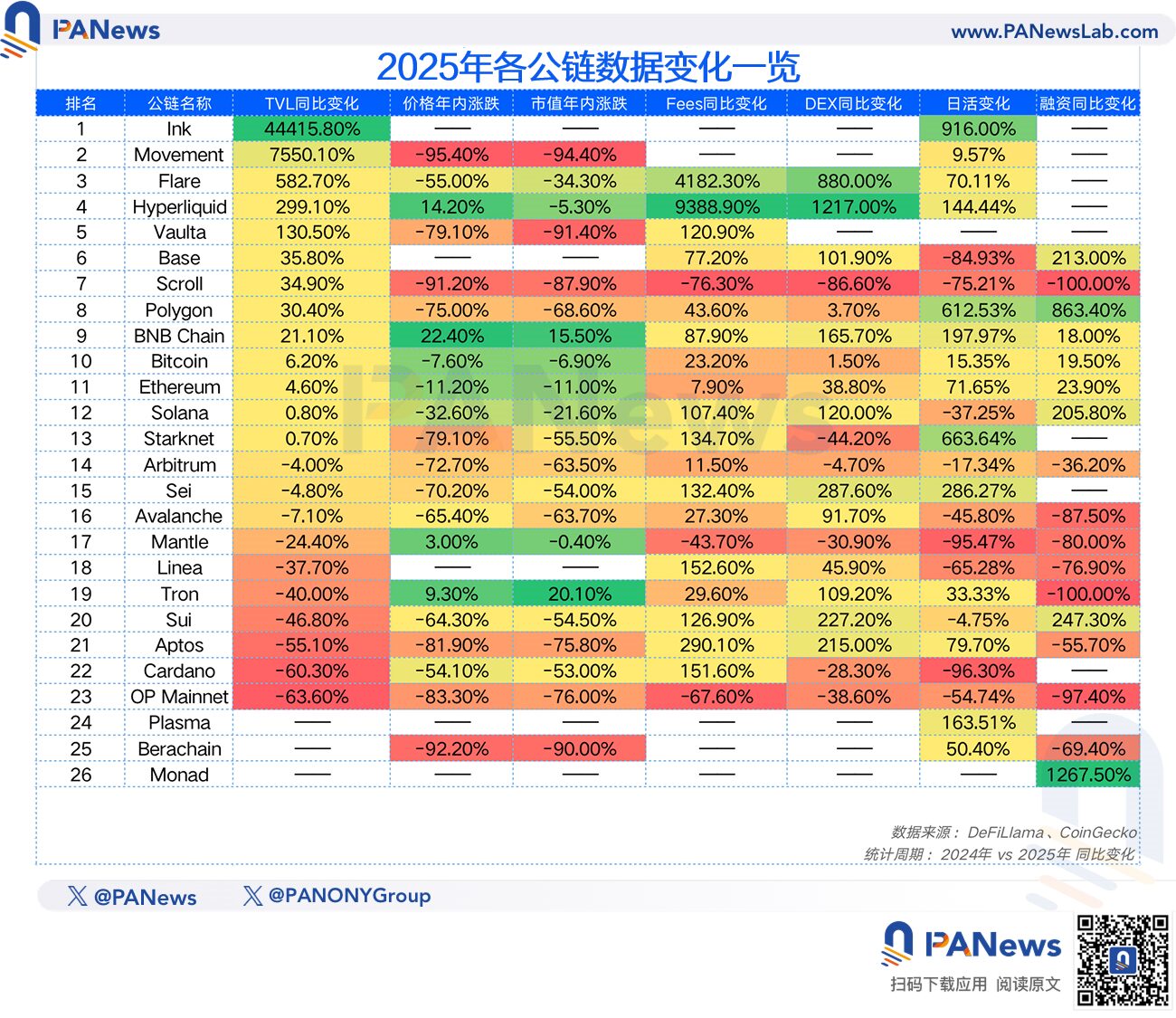 The clear red and black list of data tells us: the era of “thousands of horses racing” in the public chain track has ended, replaced by brutal “stock competition” and “oligopoly” trends. Whether it’s Solana’s traffic anxiety after the MEME craze, Sui’s price pain under token unlocks, or the disastrous market debut of new chains like Movement and Scroll, all prove that the false prosperity maintained by VC funding and PUA tactics is no longer sustainable.
However, amid the widespread decline, we can see the evolution of industry resilience. BNB Chain’s explosive ecosystem growth, Hyperliquid’s reliance on genuine revenue, and Tron’s pragmatic focus on payments collectively point to the survival rules for 2026: survive, not by storytelling, but by making money; not by volume manipulation, but by real users.
The cold winter of 2025 may be biting, but it has successfully squeezed out the bubbles attached to public chains for years. Looking forward to 2026, we have reason to believe that on a cleaner, more pragmatic foundation, public chains will no longer be just gambling casinos but will truly become the global infrastructure for large-scale value exchange.
The clear red and black list of data tells us: the era of “thousands of horses racing” in the public chain track has ended, replaced by brutal “stock competition” and “oligopoly” trends. Whether it’s Solana’s traffic anxiety after the MEME craze, Sui’s price pain under token unlocks, or the disastrous market debut of new chains like Movement and Scroll, all prove that the false prosperity maintained by VC funding and PUA tactics is no longer sustainable.
However, amid the widespread decline, we can see the evolution of industry resilience. BNB Chain’s explosive ecosystem growth, Hyperliquid’s reliance on genuine revenue, and Tron’s pragmatic focus on payments collectively point to the survival rules for 2026: survive, not by storytelling, but by making money; not by volume manipulation, but by real users.
The cold winter of 2025 may be biting, but it has successfully squeezed out the bubbles attached to public chains for years. Looking forward to 2026, we have reason to believe that on a cleaner, more pragmatic foundation, public chains will no longer be just gambling casinos but will truly become the global infrastructure for large-scale value exchange.