Bitcoin is trading near $87,255, down 0.33% intraday, with a 24-hour trading volume reaching $47.7 billion. The three major U.S. stock indices closed lower, with the S&P 500 down 0.35%, weighed down by weakness in the technology sector. Silver surged past $80 overnight before plunging, falling over 6% intraday, with profit-taking in precious metals impacting the crypto market. On Tuesday, the Federal Reserve’s December meeting minutes will be released, as investors seek clues for 2026 policy.
S&P Hits New Highs Before Tech Stocks Take Profits
U.S. stocks declined on Monday, mainly due to a pullback in the tech sector. Previously, the S&P 500 reached a record high of 6,945.77 points last Monday, indicating profit-taking at year-end highs. AI-related trading cooled, with Nvidia’s stock dropping over 1%, retracing some of last week’s gains of over 5%. Tech stocks like Palantir, Meta, and Oracle also saw declines to varying degrees.
This profit-taking behavior directly explains why Bitcoin fell today. The correlation between cryptocurrencies and tech stocks has been strengthening throughout 2024 and 2025, especially when institutional investors allocate to both asset classes simultaneously, with risk appetite shifts often reflecting in tandem. When the Nasdaq drops 0.50%, Bitcoin’s weakness aligns with this correlation logic.
Chris Larkin, head of trading and investing at Morgan Stanley’s E-Trade, said that in a relatively light economic data schedule this week, internal market momentum could be the main driver. He noted that if U.S. stocks aim for a double-digit rally to “close high,” the tech sector may still need to bear the primary push. This suggests that tech sector weakness could persist, exerting ongoing pressure on Bitcoin.
From a broader perspective, 2025 has been a stellar year for Wall Street: the S&P 500 has risen over 17%, the Dow Jones about 14%, and the Nasdaq over 21%. Such strong gains have accumulated substantial profit-taking, and year-end cashing out is normal market behavior. Currently, the market is in the “Christmas rally” window, with historical data since 1950 showing the S&P 500 typically gains over 1% during the last five trading days of the year and the first two trading days of the new year. However, this year’s situation might differ slightly, as excessive gains could trigger a correction.
Silver’s Flash Crash Below $80 Shakes Confidence in Safe-Haven Assets
The intense volatility in silver at the end of 2025 provides an emotional explanation for Bitcoin’s decline today. On Monday, silver futures briefly surged past $80 per ounce to a record high overnight but then quickly retreated, with a maximum intraday pullback of 15%. Jeff Kilburg, CEO of KKM Financial, believes this correction was mainly driven by profit-taking and year-end “tax-loss harvesting” trades. Despite the volatility, silver has still gained over 140% this year.
Silver’s sharp swings have a ripple effect on the crypto market. Both are viewed as alternative assets and inflation hedges, with similar investor sentiment. When silver experiences a historic retracement, Bitcoin investors also worry about similar scenarios, leading to reduced holdings. More importantly, silver and gold both came under pressure on Monday, with gold falling about 4.6% intraday. The broad correction in precious metals reflects a systemic cooling of market risk appetite.
Kilburg predicts silver could rise to $90–$100 per ounce in 2026, viewing this as “more of a reset, a breather,” but he emphasizes that the silver market faces dual pressures from “supply issues” and “demand issues.” This short-term volatility, alongside long-term bullish logic, also applies to the Bitcoin market.
Symmetrical Triangle Narrowing Indicates Imminent Direction Choice
(Source: Trading View)
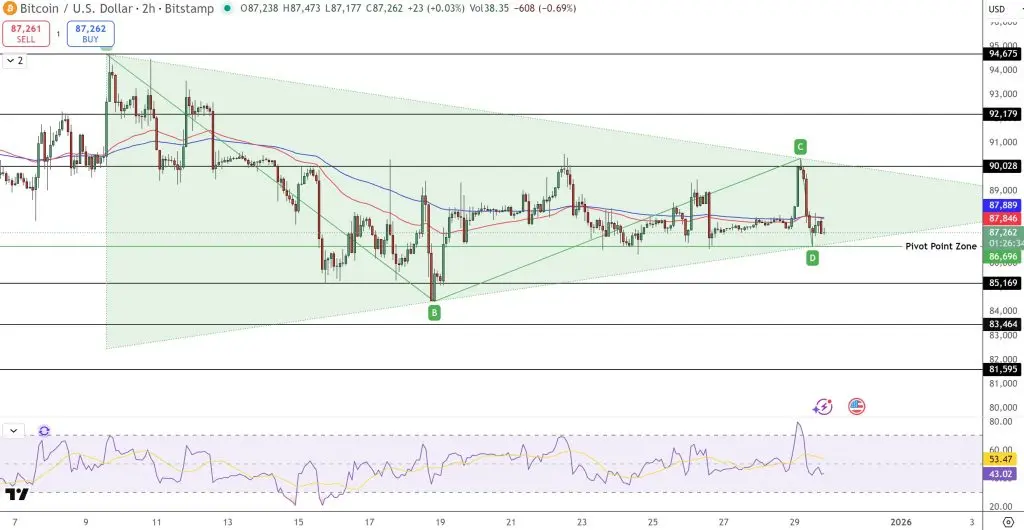
On the technical side, Bitcoin on the 2-hour chart shows a clear symmetrical triangle pattern, a classic formation often signaling a significant directional move. The price continues to follow an upward-sloping descending trendline, with buyers consistently entering around the $86,700 to $87,000 zone, which acts as technical support.
Structurally, Bitcoin continues to make higher lows and higher highs, indicating the overall uptrend remains intact. The 50-day and 100-day moving averages are clustered around $87,800 to $88,000, reflecting a supply-demand balance. The price has not yet convincingly broken below these moving averages, suggesting sellers lack confidence. Recent candlestick patterns show many spinning tops and dojis, with longer lower shadows, indicating market willingness to buy on dips.
Momentum indicators support a consolidation phase. The RSI has fallen back to around 50, retreating from recent highs but not entering bearish territory, with no clear bearish divergence. Volatility continues to narrow, a common feature of mature triangle formations. A confirmed breakout above the resistance near $90,200 could lead to a gradual rise toward $92,200, then $94,500–$95,000.
In a bearish scenario, a decisive break below $86,500 might see a drop toward $85,200, but current structure does not favor this outcome. Bitcoin’s market cap is $1.74 trillion, circulating supply just below 19.97 million coins, and a robust 24-hour trading volume of $47.7 billion indicates this consolidation is a buildup phase rather than distribution.
The Federal Reserve meeting minutes released at 2 p.m. Eastern Time on Tuesday will be a key catalyst. Paul Hickey, co-founder of Bespoke Investment Group, said investors should prepare for uncertainties in 2026, as “unexpected events can happen at any time.” Ahead of the minutes, the market may remain cautious, which explains the short-term logic behind Bitcoin’s decline today.
Disclaimer: The information on this page may come from third parties and does not represent the views or opinions of Gate. The content displayed on this page is for reference only and does not constitute any financial, investment, or legal advice. Gate does not guarantee the accuracy or completeness of the information and shall not be liable for any losses arising from the use of this information. Virtual asset investments carry high risks and are subject to significant price volatility. You may lose all of your invested principal. Please fully understand the relevant risks and make prudent decisions based on your own financial situation and risk tolerance. For details, please refer to
Disclaimer.


