The proposal in California to impose a 5% tax on billionaires’ wealth has faced fierce opposition from cryptocurrency executives and tech giants. They argue that this will trigger an outflow of entrepreneurs and capital flight.
It is reported that the controversial 2026 Billionaire Tax Act proposal aims to levy a one-time 5% wealth tax on individuals and entities with a net worth exceeding $1 billion. The bill is intended to provide funding for healthcare systems and state assistance programs at a time when federal funding cuts are imminent.
Since the proposed wealth tax targets unrealized gains, some billionaires may need to sell stocks or parts of their businesses to raise funds to pay the tax. The tax can be paid in a lump sum or in installments over five years with interest.
The Last Straw That Breaks Silicon Valley!
Cryptocurrency executives and tech giants warn that this could lead to a large-scale outflow of capital and talent from the state. The measure, called the 2026 Billionaire Tax Act, is scheduled for a vote in November 2026. It targets unrealized gains on assets such as stocks and digital currencies, which may force asset holders to sell assets to pay taxes.
 The proposal was submitted in November 2025 under the name “25-0024A1 Initiative” to California’s Attorney General and will apply to individuals residing in the state as of January 1, 2026, taxing all forms of personal wealth, including tangible and intangible assets.
Supported by the SEIU United Healthcare Workers West, the bill is expected to generate up to $100 billion in revenue. Supporters say that in the face of potential federal funding reductions, this money will be used to strengthen the state’s healthcare system, childcare, housing, and education.
Taxpayers can choose to pay in a lump sum or in five annual installments with interest. Critics argue that this structure effectively taxes “phantom profits” on unrealized holdings, which could disproportionately impact volatile industries like cryptocurrency.
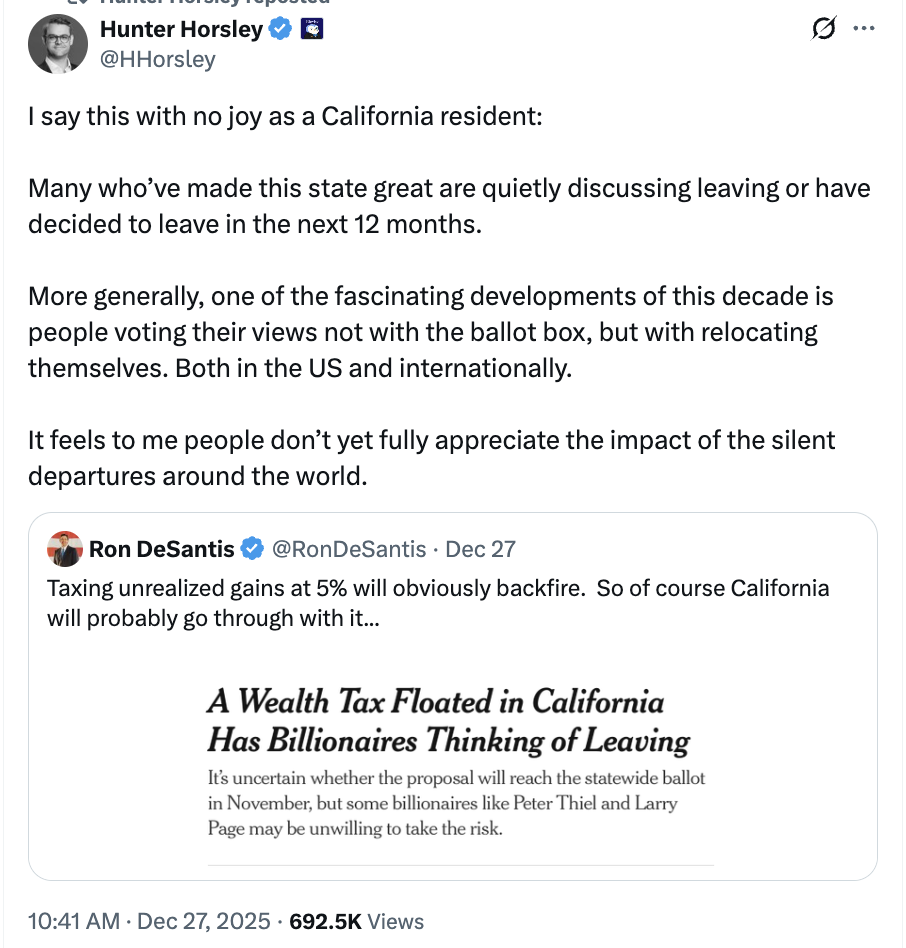
Leaders in the crypto space have publicly opposed the measure, viewing it as a threat to innovation and economic growth. Hunter Horsley, CEO of Bitwise Asset Management, pointed out that a recent report by California’s State Auditor uncovered billions of dollars in unrecorded or unjustified expenditures, urging lawmakers to address fiscal waste. Horsley stated, “Politicians have long forgotten their duty to serve.”
Jesse Powell, co-founder of cryptocurrency exchange Kraken, called this “the last straw,” predicting that billionaires will take their spending, philanthropy, and jobs elsewhere along with their wealth.
The proposal was submitted in November 2025 under the name “25-0024A1 Initiative” to California’s Attorney General and will apply to individuals residing in the state as of January 1, 2026, taxing all forms of personal wealth, including tangible and intangible assets.
Supported by the SEIU United Healthcare Workers West, the bill is expected to generate up to $100 billion in revenue. Supporters say that in the face of potential federal funding reductions, this money will be used to strengthen the state’s healthcare system, childcare, housing, and education.
Taxpayers can choose to pay in a lump sum or in five annual installments with interest. Critics argue that this structure effectively taxes “phantom profits” on unrealized holdings, which could disproportionately impact volatile industries like cryptocurrency.
Leaders in the crypto space have publicly opposed the measure, viewing it as a threat to innovation and economic growth. Hunter Horsley, CEO of Bitwise Asset Management, pointed out that a recent report by California’s State Auditor uncovered billions of dollars in unrecorded or unjustified expenditures, urging lawmakers to address fiscal waste. Horsley stated, “Politicians have long forgotten their duty to serve.”
Jesse Powell, co-founder of cryptocurrency exchange Kraken, called this “the last straw,” predicting that billionaires will take their spending, philanthropy, and jobs elsewhere along with their wealth.
A 5% tax on unrealized gains and assets that have already been paid is about the most retarded thing I’ve ever heard. I promise you this will be the final straw. Billionaires will take with them all of their spending, hobbies, philanthropy and jobs. Solve the waste/fraud issue. https://t.co/DKcNWni2kB
— Jesse Powell (@jespow) December 28, 2025
Nic Carter, founding partner of Castle Island Ventures, questioned the analysis of capital mobility in the proposal, noting that a one-time wealth tax often signals future taxation and comparing it to “sovereign default.” He cited Norway’s experience, where similar taxes led more than half of the top 400 taxpayers to leave, resulting in lower-than-expected revenue. Fredrik Haga, co-founder of Dune, said this made the country “poorer and worse off.”
Warning of a Possible ‘Innovation Death Spiral’
Discussions on X platform amplified these concerns, with users warning of a potential “innovation death spiral,” leading tech hubs to relocate to other states like Wyoming or overseas to places like Singapore.
Opposition is not limited to the crypto sector. Insiders reveal that tech giants like PayPal co-founder Peter Thiel and Larry Page, co-founder of Alphabet (Google’s parent company), are reportedly preparing contingency plans to leave California if the bill passes. This echoes broader warnings from Silicon Valley.
Peter Thiel is leaving California if we pass a 1% tax on billionaires for 5 years to pay for healthcare for the working class facing steep Medicaid cuts.
I echo what FDR said with sarcasm of economic royalists when they threatened to leave, “I will miss them very much.” https://t.co/5N8FxBqJww
— Ro Khanna (@RoKhanna) December 27, 2025
One of the main supporters of the proposal is Democratic Congressman Ro Khanna from California’s 17th district, who is friendly toward cryptocurrency. He defended the tax through a series of X posts, stating that the revenue will be used to improve childcare, housing, and education, which in turn will benefit American innovation. Khanna argued that investing in human capital will promote long-term innovation and emphasized its benefits for education and housing. The initiative originated from a legal professor at the University of Missouri, designed to address wealth inequality under California’s budget pressures.
Economists have mixed views on the potential consequences. While wealth taxes elsewhere (such as Norway, which reduced the scope after capital flight) face challenges, supporters point out that California’s unique venture capital and startup ecosystem is resilient.
However, critics highlight practical obstacles, such as valuing illiquid assets (like private stocks or art), liquidity issues, and underreported enforcement fines of 20-40%. The California Legislative Analyst’s Office (LAO) states that revenue is “very difficult to predict” and warns that billionaire outflows could cost the state billions annually in ongoing income, capital gains, property taxes, and sales taxes—far exceeding one-time gains. Even raising $100 billion would only cover one year’s expenses and wouldn’t solve the structural deficit or the projected $30 billion annual federal loss.
A Pillsbury Law analysis calls it the “billion-dollar problem,” noting that the broad scope of the tax could trap cryptocurrency reserves (treasuries) and other illiquid assets, exacerbating volatility in an industry still recovering from the 2022 market crash. As one X post summarized: “Crypto capital may vote with its feet,” highlighting concerns over offshore migration.
Disclaimer: The information on this page may come from third parties and does not represent the views or opinions of Gate. The content displayed on this page is for reference only and does not constitute any financial, investment, or legal advice. Gate does not guarantee the accuracy or completeness of the information and shall not be liable for any losses arising from the use of this information. Virtual asset investments carry high risks and are subject to significant price volatility. You may lose all of your invested principal. Please fully understand the relevant risks and make prudent decisions based on your own financial situation and risk tolerance. For details, please refer to
Disclaimer.


