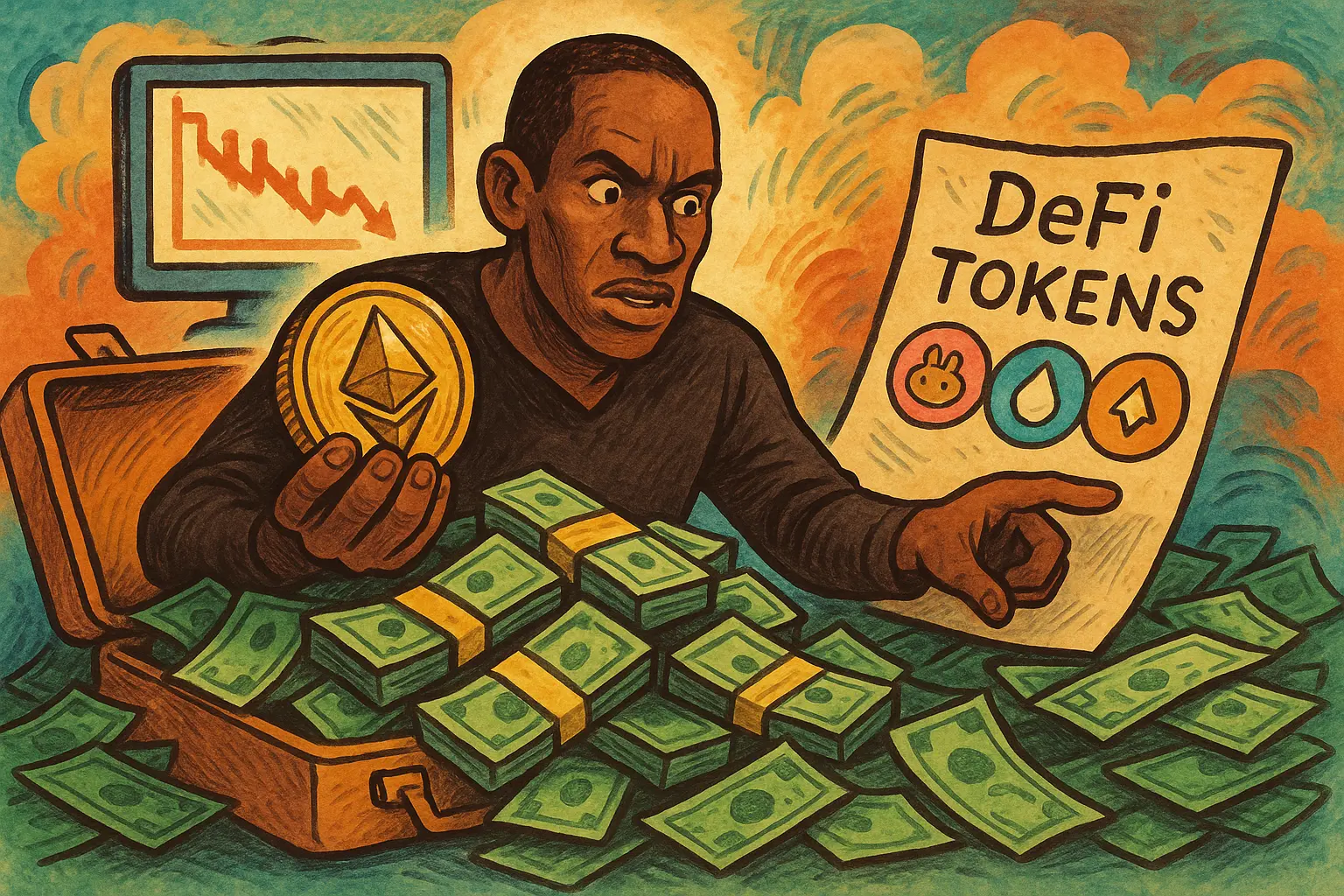
Legendary trader Arthur Hayes sold 1,871 ETH (worth $5.53 million) within two weeks, reallocating funds into DeFi tokens such as PENDLE, LDO, ENA, and ETHFI. PENDLE accounts for 48.9% of his portfolio. Hayes believes that the crypto market liquidity has bottomed out in November, and improvements in fiat liquidity will benefit DeFi tokens beyond ETH.
Liquidity Bottoming Theory Drives Strategic Shift
In a statement released on December 31, Arthur Hayes explicitly pointed out that liquidity in the crypto market may have bottomed in November and is gradually recovering. This judgment is the core logic behind his large-scale portfolio adjustment. He believes that when liquidity recovers from its trough, market capital flows tend to follow the “risk ladder” principle: first into stablecoins and Bitcoin, then spilling over into Ethereum, and finally igniting the DeFi and altcoin markets.
However, Hayes’s move bypassed the traditional capital flow path. He chose to shift directly from ETH to DeFi tokens at the moment liquidity just bottomed out. This contrarian operation hints at his unique assessment of the DeFi space: current DeFi token valuations are excessively undervalued by the market, and the improvement in fiat liquidity will first benefit these mispriced assets.
From a timing perspective, Hayes’s actions began in mid-December, coinciding with the Federal Reserve’s third rate cut and significant redemptions from Bitcoin ETFs. The market generally expects the Fed to pause rate hikes in 2026, which would further tighten liquidity expectations. But Hayes’s judgment is the opposite: he believes the worst is over, and the liquidity environment will gradually improve.
This contrarian approach is not his first. In March 2020, during the COVID-19 crash, Hayes made large Bitcoin purchases; in May 2021, during the market frenzy, he reduced his holdings early. These actions demonstrate his precise grasp of macro liquidity cycles. His recent shift from ETH to DeFi tokens may be another bold bet based on the same logic.
In-Depth Analysis of PENDLE-led Portfolio
According to on-chain data disclosed by Lookonchain, Arthur Hayes completed a thorough portfolio restructuring within two weeks. He sold 1,871 ETH worth $5.53 million and allocated funds into four DeFi tokens: 961,113 PENDLE (worth $1.75 million), 2.3 million LDO (worth $1.29 million), 6.05 million ENA (worth $1.24 million), and 491,401 ETHFI (worth $343,000).
PENDLE emerged as the biggest winner in this adjustment, receiving the highest capital allocation and accounting for 48.9% of Hayes’s overall portfolio. This highly concentrated holding indicates Hayes’s strong confidence in PENDLE compared to other DeFi protocols. PENDLE is a yield tokenization protocol that allows users to monetize future yields or trade yield derivatives. In 2024, PENDLE has gained widespread attention for its unique yield splitting mechanism.
LDO is the governance token of Lido Finance, the largest Ethereum staking protocol, controlling over 30% of the ETH staked market share. Hayes allocated $1.29 million to LDO, indicating his bullish outlook on the long-term development of Ethereum staking economics, despite reducing his ETH holdings.
ENA and ETHFI represent innovations in stablecoin issuance and liquidity re-staking tracks, respectively. ENA is the governance token of Ethena, which issues the synthetic dollar USDe. ETHFI is the token of Ether.fi, focusing on liquidity re-staking services. These allocations show Hayes’s optimism for financial innovation within the Ethereum ecosystem rather than the underlying assets themselves.
Arthur Hayes DeFi Portfolio Structure
Core Holdings (PENDLE 48.9%)
· Leading yield tokenization protocol
· 961,113 tokens, valued at $1.75 million
· Bullish on yield derivatives market explosion
Staking Economy (LDO)
· Ethereum staking leader
· 2.3 million tokens, valued at $1.29 million
· Controls over 30% of ETH staking market
Stablecoin Innovation (ENA)
· Issuer of synthetic dollar USDe
· 6.05 million tokens, valued at $1.24 million
· Hedging against fiat liquidity volatility
Re-staking Track (ETHFI)
· Liquidity re-staking service provider
· 491,401 tokens, valued at $343,000
· Capturing ETH staking yield stacking
Fiat Liquidity Improvement Amplifies DeFi
Hayes’s core bullish thesis on DeFi tokens hinges on a macro judgment: that improvements in fiat liquidity will benefit DeFi tokens more than ETH. This logic can be broken down into three layers. The first is the lag effect of liquidity transmission: when central banks release liquidity, capital first flows into traditional financial markets, then into cryptocurrencies, and finally spills over into DeFi. This lag creates a value trough, and current DeFi token valuations have not yet reflected the upcoming liquidity improvements.
The second layer is leverage amplification: DeFi protocols’ revenue and user growth are highly sensitive to liquidity conditions. When markets are flush with capital, total value locked (TVL) and trading volumes in DeFi protocols grow exponentially, directly impacting governance token values. In contrast, ETH’s growth as an underlying asset tends to be more linear and stable.
The third layer is valuation repair potential: DeFi tokens like PENDLE and LDO experienced severe declines in 2024, with many retracing over 60% from their highs. Hayes believes these declines have overly priced in pessimism, and as liquidity improves, valuation recovery potential will far exceed that of ETH.
However, this logic also carries risks. If liquidity does not improve as expected, or if capital continues to chase Bitcoin and meme coins instead of DeFi, Hayes’s bets could result in losses. Additionally, smart contract risks, regulatory uncertainties, and increasing competition in DeFi could weaken investment returns.
Hedging ETH Weakness with DeFi Opportunities
Hayes’s decision to sell ETH has sparked debate in the market. ETH price currently hovers below $3,000, down 38% from its peak of $4,878 in 2021. This is not Hayes’s first ETH sale; CoinGape previously reported that he transferred 682 ETH worth $2 million to Binance and exchanged for PENDLE.
His bearish stance on ETH may be based on several considerations. First, Ethereum is gradually losing its edge in the competition with high-performance chains like Solana. Solana’s low fees and high throughput have attracted many DeFi and NFT projects, while Ethereum’s Layer 2 scaling solutions, though addressing some issues, have also dispersed ETH’s value capture.
Second, after transitioning from proof-of-work to proof-of-stake, ETH’s narrative shifted from “digital oil” to “bond-like asset.” While this reduces energy consumption, it also weakens ETH’s scarcity narrative. When market capital chases high-risk, high-reward assets, ETH’s bond-like properties become a disadvantage.
Third, Hayes may believe that ETH’s valuation already fully reflects its role as the base asset of DeFi, while DeFi protocol tokens are severely undervalued. By selling ETH to buy PENDLE and other tokens, he is essentially engaging in a relative value trade: selling a reasonably valued underlying asset and buying undervalued application-layer assets.


