
Pi coin forecast by Grok editing predicts reaching $0.50 in 2026 (up 140%), with amplified trading volume creating a bullish visual that sparks discussion. Supporters are optimistic about user base growth, while skeptics question the lack of applications and liquidity. Achieving the target requires exchange listings, clear regulations, and ecological implementation, but complex IOU trading and ecological delays weaken confidence.
Grok Chart Manipulation Event: Visual Deception or Market Expectation?
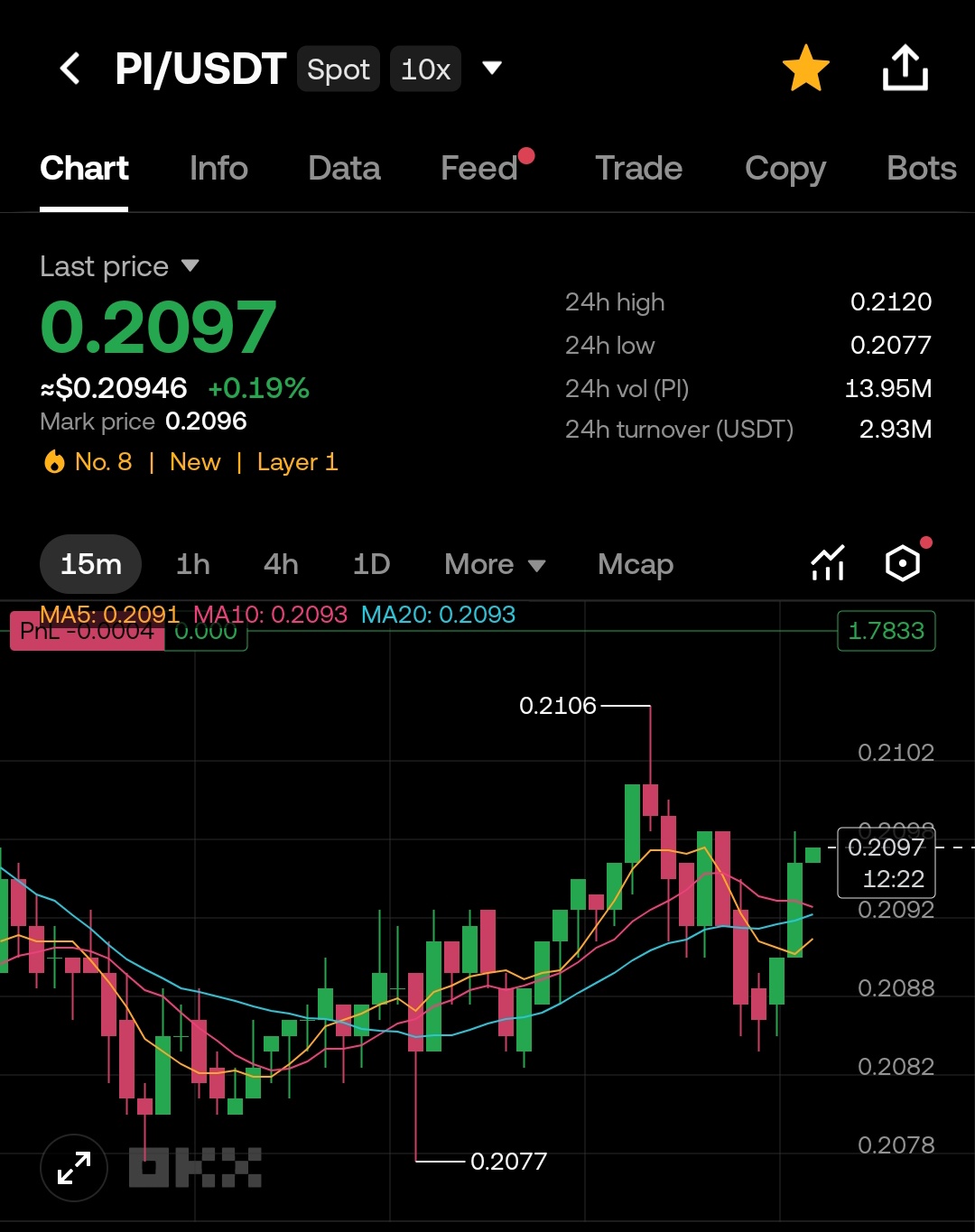
This controversy started with a viral post where users requested Grok to modify the Pi coin price chart. The editing techniques are simple: enlarging volume bars, stretching candlestick ranges, adjusting timeline ratios, visually creating the illusion that the price is about to explode. Originally steady price fluctuations appear as a poised rocket after editing.
This chart quickly spread within the Pi coin community, with many users viewing it as a bullish signal. But the key issue is: Grok, as an AI tool, only follows user instructions to edit graphics, without any price analysis or prediction. It neither examines on-chain data nor assesses market fundamentals; it’s purely visual manipulation. Equating AI image editing with price prediction is a classic cognitive bias.
However, the power of visual deception should not be underestimated. Human brains react to charts intuitively much faster than rational analysis. A chart that “looks strong” can influence emotions and decisions. In crypto communities, this visual-based FOMO (Fear of Missing Out) effect is especially intense. Many novice investors lack technical analysis skills and are easily misled by the chart’s appearance.
The post did not claim definitive conclusions but used “if” scenarios to spark discussion. Yet, during dissemination, such hypothetical assumptions are often overlooked, and charts are treated as “predictions” or even “insider info.” This is a typical pattern in social media: original context is stripped away, content simplified into eye-catching headlines, eventually leading to factually detached fanaticism.
140% Increase Requires Three Major Catalysts to Occur Simultaneously
Numerically, Pi needs to rise from the current $0.21 to $0.50, a 140% increase. While such a jump is not impossible in crypto markets, it requires strong catalysts. Based on comprehensive market analysis, reaching this goal depends on three simultaneous conditions.
First is accelerated listing on mainstream exchanges. Currently, Pi trading is mainly on small exchanges and OTC markets, with severe liquidity shortages. IOU trading offers early trading avenues but adds complexity. True price discovery requires listings on major platforms like Binance and Coinbase, which have strict listing procedures involving compliance checks and technical assessments. If Pi can successfully list on 2 to 3 top exchanges by 2026, liquidity will grow exponentially.
Second is regulatory clarity. Pi’s distribution model (via mobile mining) faces regulatory uncertainty in multiple jurisdictions. Some countries consider it an unregistered security; others question its KYC process. If Pi Network can obtain regulatory approval or exemptions in major markets like the US and EU, the biggest uncertainties will be eliminated, attracting institutional capital.
Third is real-world application deployment. Currently, Pi’s use cases are extremely limited, mainly small-scale social experiments. To support a $0.50 valuation, genuine commercial applications must generate sustained demand. This includes integration with e-commerce platforms, cross-border payment scenarios, and DeFi protocols. Crypto history shows tokens without practical applications tend to lose value eventually.
Three Essential Conditions to Reach $0.50
Exchange Listing: Initiate new CEX listing campaigns to solve liquidity issues
Regulatory Approval: Obtain clear legal status in the US, EU to eliminate compliance risks
Application Deployment: Generate real demand through e-commerce payments, cross-border remittances, DeFi, etc.
The Huge Gap Between Conservative Predictions and Fanatical Expectations
Contrasting with the community’s optimistic sentiment, professional institutions are much more conservative. Most aggregate forecasts suggest Pi’s price volatility in 2026 will be modest, with an average annual price between $0.17 and $0.22. These predictions are based on current market structure, liquidity levels, and adoption rates, without assuming any major breakthroughs.
The logic behind conservative forecasts is that Pi is still in early transition from a closed ecosystem to an open market. Its large user base (claimed over 50 million) has not yet translated into real market demand. Many users hold Pi not for investment or utility but because “mining costs are zero.” Once mainnet fully opens and free trading is allowed, massive sell pressure could offset any upward momentum.
Crypto market cycles also offer reference. The last bull run indeed brought unprecedented gains to utility tokens, but those projects had clear value capture mechanisms—Chainlink with oracle services, Uniswap with fee sharing, Aave with lending markets. In contrast, Pi’s economic model remains unclear; how tokens capture ecosystem value has yet to be demonstrated.
Delays in ecosystem development are weakening short-term confidence. Pi Network has repeatedly postponed mainnet launch timelines—from an initial promise of 2019 to a delay until 2026—without full realization. Each delay erodes community trust and reduces external investor interest. In a competitive crypto landscape, missing the right timing often means falling permanently behind.
Community Size Is a Double-Edged Sword, Not a Panacea
Pi supporters often cite its large user base as a key argument. Over 50 million registered users are impressive, but the value of this number is questionable. First, registered users are not necessarily active or paying users. Second, these users were acquired at zero cost (just download the app and click daily), implying very low loyalty. When more attractive “free mining” projects emerge, users can easily switch.
More critically, user scale alone does not generate value; only when users pay for services or contribute data does economic value emerge. Facebook’s valuation is built on ad revenue, Uber on commission. What is Pi Network’s business model? Who pays whom for what? These fundamental questions remain unanswered.
In some cases, community size can even be a negative factor. When 50 million users try to sell their “free” Pi simultaneously, who absorbs this selling pressure? Unless external demand of comparable scale floods in, prices will collapse. That’s why many analysts believe the first day of mainnet opening might be the peak rather than the start of value growth.
Disclaimer: The information on this page may come from third parties and does not represent the views or opinions of Gate. The content displayed on this page is for reference only and does not constitute any financial, investment, or legal advice. Gate does not guarantee the accuracy or completeness of the information and shall not be liable for any losses arising from the use of this information. Virtual asset investments carry high risks and are subject to significant price volatility. You may lose all of your invested principal. Please fully understand the relevant risks and make prudent decisions based on your own financial situation and risk tolerance. For details, please refer to
Disclaimer.


