Author: @BlazingKevin_ , Researcher at Movemaker
1 Research Summary
Figure Technology Solutions (hereafter “Figure”) is at the forefront of transforming the financial services industry, aiming to reshape traditional lending and capital markets through blockchain technology. As a vertically integrated fintech company, Figure is not only the largest non-bank originator of home equity lines of credit (HELOC) in the US but also a key infrastructure provider in the real-world asset (RWA) tokenization space. As of December 2025, Figure has successfully completed an IPO, with a market cap stable between $7.5 billion and $9 billion.
The core argument of this report is that Figure represents the third phase of fintech development: from “online” (like Rocket Mortgage) to “platformization” (like SoFi), and now to “on-chain.” Leveraging its Provenance Blockchain, a public chain built on Cosmos SDK, Figure has effectively addressed the most challenging “middle and back-office efficiency” issues in traditional finance. By directly minting, registering, and trading assets (such as mortgages and ownership records) on-chain, Figure has reduced loan origination and securitization costs by over 100 basis points and shortened processing times from the traditional 30-45 days to under 5 days.
2025 marks a pivotal year for Figure. The company not only achieved GAAP profitability, with Q3 net profit approaching $90 million, but also completed a strategic merger with Figure Markets, re-integrating its lending business with its digital asset trading platform. This move creates a closed-loop ecosystem: consumers can mortgage their homes for funds, which are issued in interest-bearing stablecoins ($YLDS), and can directly invest on Figure Markets or re-pledge via the Democratized Prime protocol. The integration of “asset side” and “funding side” demonstrates the ultimate vision of the RWA track.
This report will analyze Figure’s Q3 financials and evaluate whether its “blockchain-native” strategy, based on recent updates to revenue sources and business models, constitutes a true moat, as well as its long-term investment value amid an increasingly crowded RWA sector.
2 Business Segments and Product Lines
After completing the merger with Figure Markets in July 2025, Figure’s business architecture has become more integrated and vertically aligned. Its core competitiveness lies in digitizing the entire asset lifecycle (origination, registration, trading, financing, settlement) via Provenance blockchain. **Based on this, we have summarized four core business models: RWA asset origination and distribution, capital guarantees and securitization, DeFi financing and lending, and interest-bearing stablecoins and payment settlement.** The diagram below connects these four business areas, attempting to clarify Figure’s complete commercial model.
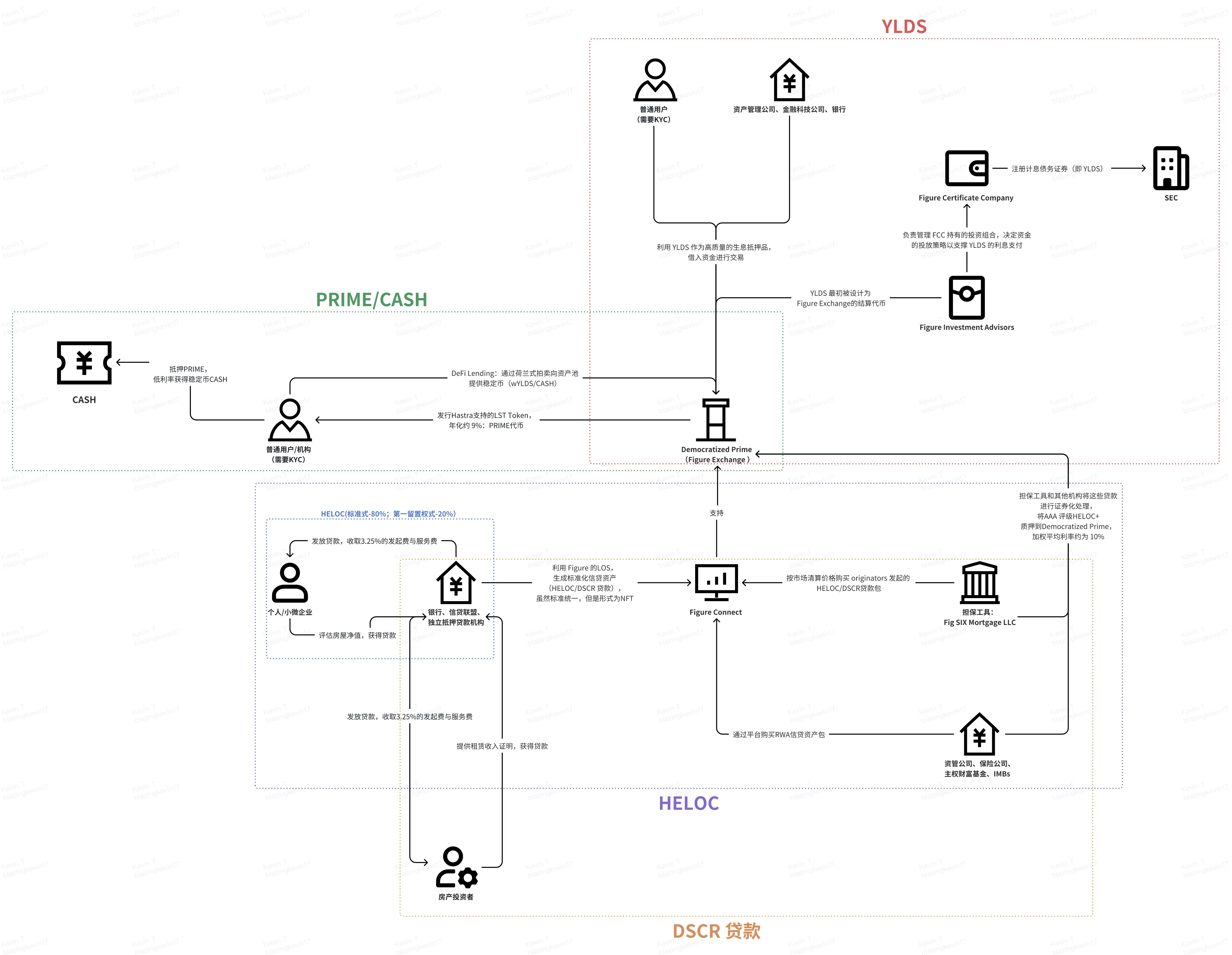
2.1 RWA Asset Origination and Distribution
2.1.1 HELOC
This is Figure’s “bread and butter,” aimed at solving pain points in traditional credit markets, such as manual operations, reliance on paper, and high costs (industry average $11,230). Focusing on HELOC, notably, Q3 saw a significant surge in DSCR loan transaction volume. Let’s start with HELOC, which is Figure’s flagship product.
Product Mechanism and User Experience: Traditional banks typically require 30 to 45 days for HELOC approval, involving cumbersome offline assessments and notarizations. Figure uses automated valuation models (AVM) and immutable records on blockchain to achieve an “approval in 5 minutes, disbursement in 5 days” experience. This speed directly addresses market pain points, especially in high-interest environments, where homeowners prefer HELOCs for liquidity rather than selling their homes, thus avoiding losing their low-interest mortgage.
Market Position: Since inception, Figure has originated over $19 billion in loans, becoming the largest non-bank HELOC originator in the US. Its market share among non-bank institutions is dominant.
HELOC+: This is the highest-tier premium loan pool within the protocol. Its underlying collateral consists of HELOC assets originated by Figure and partners, tokenized on Provenance chain, with credit quality comparable to assets rated AAA by S&P.
From another perspective, the stakeholders and their motivations involved in the HELOC business—from origination to securitization—are as follows:
- Borrowers (individuals/small micro enterprises):
◦ Apply for home equity credit (HELOC) or small business loans (SMB) via Figure’s fully digital process.
◦ Authorize system to automatically verify income, assets (AVM), and credit score, enabling “5-minute approval, 5-day disbursement.”
- Origination Partners (banks, credit unions, independent mortgage brokers):
◦ Use Figure’s white-label loan origination system (LOS) to produce standardized credit assets according to uniform underwriting standards.
◦ Pay Figure a technology processing fee based on transaction volume.
◦ Place produced loan pools on Figure Connect marketplace for bidding or sell based on forward commitments, enabling rapid capital turnover without long-term balance sheet occupation.
- Figure Connect Platform (matchmaker):
◦ Convert credit assets into “digital twin” tokens on Provenance chain, ensuring ownership, composition, and performance history are unique and tamper-proof.
◦ Match originating banks with capital market buyers (institutions), providing real-time, atomic on-chain settlement.
- Institutional Buyers (asset managers, insurers, sovereign wealth funds):
◦ Purchase homogeneous credit pools with AAA potential, gaining transparent, data-rich credit exposure.
◦ Enjoy settlement speeds several times faster than traditional secondary markets (from monthly to daily/second-level).
2.1.2 First Lien HELOC
In Figure’s business model, cash-out refinancing is being reshaped through its innovative “First Lien HELOC.” This business grew rapidly, with transaction volume nearly tripling in H1 2025. Next, we clarify the core differences between cash-out refinancing and HELOC.
In traditional finance and Figure’s blockchain-native credit model, both are means for homeowners to extract home equity, but differ significantly in loan nature, lien priority, and capital market performance.
1. Loan Nature and Credit Structure: Beginning and Cycle
- HELOC: Under legal and regulatory frameworks (e.g., TILA), HELOC is defined as “open-end credit.” Its key feature is that homeowners can repeatedly draw and repay funds within a specified draw period (usually 2-5 years). Figure’s HELOC product allows borrowers to make multiple withdrawals as needed without incurring additional upfront costs or payoff costs.
- Cash-out Refinance: Typically a “closed-end credit.” Homeowners apply for a new larger loan to pay off the existing mortgage, receiving the remaining cash difference in a lump sum. It is not a revolving line but a one-time debt restructuring.
2. Lien Priority Differences
- HELOC: Usually as a “second lien.” It is an additional debt above the existing first mortgage. In liquidation, it ranks behind the first mortgage, thus higher risk.
- Refinance Business: Always involves a “first lien.” Since it replaces the old loan with a new one, the new lender obtains the primary lien on the property. The “First Lien HELOC” product, which has grown fastest in recent years, is essentially a substitute for traditional cash-out refinancing.
3. Efficiency and Cost Differences in Figure’s Model
According to Figure’s data, blockchain technology enables dramatic cost reductions:
- Cost Comparison: Processing a first lien refinance (a refinancing substitute) costs only $1,000, compared to industry average of $12,000. For traditional HELOC, average production cost is just $730, far below the mortgage industry average of $11,230.
- Disbursement Time: Whether refinancing or HELOC, approval via Figure’s automated LOS typically takes 5 minutes, with median disbursement in 10 days, versus about 42 days industry-wide.
4. Capital Market and Securitization Logic
- HELOC Securitization: Figure has issued multiple asset-backed securities (ABS) backed by HELOCs, with senior tranches repeatedly rated AAA by S&P and Moody’s. Since HELOCs are often second liens, rating agencies assume higher default loss rates than first lien assets.
- Refinance (First Lien) Performance: As it holds the first lien, its assets are more attractive in capital markets, with more favorable risk pricing. Figure’s first lien business volume grew nearly 3x in Q3 2025.
Why are more US homeowners choosing First Lien HELOCs, and what benefits do they gain?
◦ Extreme cost savings: Figure’s first lien production cost is about $1,000, versus industry average of $12,000, saving significant payoff costs.
◦ Time efficiency: Approval in 5 minutes, median disbursement reduced from 42 days to 10 days.
◦ Flexibility: Lower interest rates than personal loans, with the ability to re-access home equity in the future.
From Q3 financials:
In Q3 2025, Figure’s consumer credit market total transaction volume reached $2.5 billion, up 70% YoY.
First Lien HELOC performance:
◦ Q3 2025: Volume accounts for 17% of total consumer credit. Estimated transaction amount around $425 million. This is a 650 basis point increase from 10.5% in the same period 2024.
◦ First half 2025: Share of total originations was 15%, with transaction volume approximately $480 million.
◦ Growth rate: Exponential, with Q3 2025 volume nearly tripling YoY.
Open/standard HELOC ( is usually a second lien):
◦ Since HELOCs constitute 99% of total, most are second or third liens.
◦ Despite rapid growth of first lien, Figure’s balance sheet as of September 30, 2025, shows 80% of HELOC assets are still non-first lien (second or third liens).
2.1.3 DSCR Loans
Designed for real estate investors. This product does not consider borrower’s personal income but approves based on property’s rental income (DSCR).
DSCR loans are a core expansion of Figure’s successful model in HELOC into broader consumer credit assets.
In Q3 2025, including DSCR loans, new product categories contributed over $80 million in volume, showing strong growth.
Stakeholder structure, behavior patterns, and profit-sharing logic are highly aligned with HELOC, but with a focus on investment property cash flows.
From stakeholder profiles, besides borrowers, the roles and motivations are similar to HELOC.
| Metric Dimension |
Core Data / Indicator |
Market Significance |
| Growth Momentum |
Q2 (0.02%) → Q3 >$8,000万( |
Explosive growth: Though low in Q2, transaction volume surged in Q3 driven by DSCR and crypto-backed loans. |
| Single Loan Metrics |
Average balance: $174,000 Loan cap: $1 million |
Precise targeting: Fits main financing range for single-family rental (SFR) investors. |
| Market Potential )TAM( |
> $20 billion/year )securitization scale( |
Replacement of existing assets: DSCR is core to US Non-QM market; Figure aims to solve issues of “low transparency, long cycles” via blockchain. |
| System Support )LOS( |
> $16 billion |
Horizontal expansion: Leverages automated system (LOS) proven in HELOC, enabling rapid scaling of DSCR products. |
| Core Competitive Advantage |
75% RWA private credit market share |
Industry pricing power: With dominant market share, Figure is establishing “real-time, atomic settlement” as the standard in DSCR niche. |
DSCR borrowers mainly finance rental properties. Borrowers submit applications via Figure or partners’ portals. DSCR loans require, besides standard credit assessment, proof of rental income (e.g., lease agreements) to calculate debt service coverage ratio.
The core logic of DSCR loans is “substituting trust with facts (data).” Similar to HELOC, it converts highly illiquid real estate debt into standardized, homogeneous tokens on-chain, achieving Pareto optimization on the asset and funding sides: borrowers get funds, institutions reduce friction, and ordinary DeFi users—previously on the periphery—become beneficiaries of these high-quality RWAs.
)# 2.2 Capital Guarantee and Securitization
To enhance market liquidity and serve as “last buyer,” Figure has established strategic partnerships with top investment institutions.
- Sixth Street (strategic joint venture):
◦ Provides $200 million equity capital to the joint venture Fig SIX Mortgage LLC.
- Fig SIX Mortgage LLC (guarantor vehicle):
The jointly established Fig SIX Mortgage LLC is defined within the Figure ecosystem as a key “guarantor vehicle,” with a $200 million recourse equity commitment from Sixth Street.
Operationally, Fig SIX acts as a “permanent buyer” on the Figure Connect electronic trading platform. This mechanism alleviates asset distribution concerns for banks, credit unions, and independent mortgage brokers, ensuring their blockchain-native assets can be executed with certainty and priced competitively. This “always-present” bid process effectively transforms fragmented, opaque private credit transactions into a standardized market with efficient price discovery.
In securitization structuring, Fig SIX’s risk hedging is prominent. It actively retains and holds residual or “first-loss” tranches during securitization transactions, making it the “first absorber” of credit risk, bearing losses first if HELOC loans default, thus protecting upper-tier creditors.
2.3 DeFi Financing and Lending
This model democratizes capital flow by removing traditional prime brokers and warehouse financing intermediaries.
Typically banks or lenders, they deposit tokenized credit assets (e.g., HELOC pools) or crypto assets into smart contracts as collateral. This allows institutions to access real-time liquidity from their RWAs at lower costs than traditional warehouse lines.
The protocol uses hourly Dutch auctions to determine liquidation rates. Borrowers set a maximum acceptable rate, while lenders bid for target yields; all funds are then charged at a unified market clearing rate. This mechanism ensures instant price discovery and fairness, with rates dynamically adjusting within a 1% to 30% range.
Figure has successfully “fragmented” the previously exclusive private credit market, enabling ordinary DeFi users to participate with as little as $100.
By mid-2025, lenders earned nearly 9% annualized yield through this protocol, significantly higher than returns on YLDS stablecoins or traditional money market funds. This attractiveness has prompted Figure to expand the model to Layer 1 ecosystems like Solana and Sui, introducing PRIME tokens for liquidity staking, further amplifying RWA yield leverage.
- Democratized Prime Protocol:
To ensure lender funds’ safety, Democratized Prime has established a robust, code-based risk management system.
+ **Asset Confirmation:** Uses **DART technology** to achieve perfect collateral rights, ensuring lenders have indisputable legal and technical recourse over underlying RWAs.
+ **Liquidation Logic:** The protocol monitors LTV in real-time. When LTV hits 90%, smart contracts automatically trigger on-chain liquidation, auctioning the credit assets via weekly **BWIC**. Proceeds are used to repay principal first. If market liquidity is insufficient, interest rates automatically spike to 30%, forcing borrowers to deleverage or attract new capital.
2.4 Interest-Bearing Stablecoins and Payment Settlement
Figure leverages its SEC-registered compliant status to bring traditional money market yields onto the on-chain payment system.
- Figure Certificate Company ###FCC( (Issuer):
Unlike most offshore-based stablecoins, the core advantage of ) lies in its transparent legal identity.
FCC’s role: Registered as an investment company under the 1940 Investment Company Act, FCC issues face value certificates, which are represented digitally by $YLDS .
Underlying asset backing: Fully collateralized by a high-quality, low-risk asset portfolio (mainly US Treasuries and securities held by prime money market funds). This structure ensures stability and regulatory traceability, enabling it to serve as institutional-grade interest-bearing collateral.
- YLDS Holders (mainly institutional):
$YLDS provides a Pareto improvement between traditional finance and DeFi for holders.
+ **Yield model:** Holders earn approximately **SOFR (Secured Overnight Financing Rate) minus 50 basis points**. In high-interest macro environments, this makes $YLDS  a superior asset compared to non-interest-bearing stablecoins.
+ **Payments and settlement:** Supports 24/7 on-chain P2P transfers, and as the default settlement currency on Figure Exchange, assets can be exchanged within seconds. For example, users can directly buy Bitcoin with $YLDS , with automatic underlying rate hedging and clearing.
- Figure Payments Corporation ($YLDS FPC$YLDS ):
Due to regulatory restrictions, FCC cannot directly hold common crypto assets like USDC or USDT. Figure introduced Figure Payments Corporation $YLDS FPC( as a key funding channel.
+ **Mirror order mechanism:** When users buy crypto assets with ) on exchanges, FPC runs mirror order processes in the background. The system matches $YLDS  holders with USDC-holding counterparties via FPC’s liquidity pools, bridging compliant securities tokens and public crypto markets.
+ **Ecosystem scale:** This compliant architecture saw significant growth in 2025, with balances rising from about $4 million in Q2 to nearly **$100 million** in November, expanding to Layer 1 ecosystems like Solana and Sui.
$YLDS 3 Q3 Revenue Breakdown
![]###https://img-cdn.gateio.im/webp-social/moments-9d839f081a9376969913aec98134eb08.webp(
Figure’s performance this quarter is remarkable, with total net revenue reaching $156.37 million and net profit hitting $90 million. Such a nearly 57% net profit margin is rare among traditional financial institutions, demonstrating the efficiency gains from blockchain infrastructure in traditional lending. Behind this profitability is a highly diversified and complementary revenue structure, mainly from loan sales, technology fees, origination, and ongoing service fees and interest.
Loan sales net income, the largest revenue driver, contributed $63.561 million, showcasing Figure’s strong asset liquidity in secondary markets. Full loan sales accounted for $51.72 million, transferring ownership, risk, and cash flows of HELOCs to institutional buyers, enabling rapid capital recovery. Notably, securitized loan income of $8.266 million was generated by injecting standardized loans into special purpose entities (SPEs) and issuing bonds from AAA to B- ratings. Figure’s ability to help these securities achieve AAA ratings from agencies like S&P and Moody’s relies heavily on data integrity from its LOS system and traceability via Provenance blockchain, providing unprecedented transparency for institutional investors.
Technology and ecosystem fees contributed $35.691 million this quarter, the core differentiator from typical financial firms. Of this, $15.548 million came from technology service fees, and $16.248 million from ecosystem fees, essentially a “market access” or “matchmaking” premium. By leveraging blockchain to shorten traditional multi-month settlement cycles to days or seconds, Figure’s real-time settlement capability is a key asset attracting ecosystem partners. Standardized underwriting and documentation transform non-standard loans into highly homogeneous, tradable digital assets, marking Figure’s transition from a loan originator to a financial infrastructure provider.
Front-end loan origination fees reached $21.415 million, including direct service fees, disbursement charges, and loan discount income. The explosive growth of this revenue is driven by its highly automated workflow. Figure has eliminated inefficiencies of traditional finance by connecting borrower bank accounts for automatic income verification, using AVM instead of on-site property appraisals. Coupled with digital lien matching, automated title searches, and remote notarization, it greatly reduces customer acquisition costs and enhances user experience. All loan data, after anonymization, are stored as hashes on Provenance blockchain, ensuring assets have immutable credit attributes from inception.
In addition to “fast buy and sell” revenue, Figure demonstrates strong asset management capabilities. Interest income totaled $17.864 million, derived from core HELOC portfolios, digital asset-backed personal loans, and about 5% retained risk in securitizations. The company also manages cash flow efficiently through YLDS stablecoin interest and cash equivalents, sharing long-term value appreciation of high-quality assets.
Service assets and fee income reflect the “long tail” of Figure’s profit model. This quarter, net service asset income was $9.332 million, representing fair value of retained servicing rights after loan sales. Although valuation assumptions cause some fluctuation, the cash flows are real. Service fees and other income totaled $8.502 million, mainly from managing loan portfolios for banks, insurers, or securitization trusts, including monthly payments, account maintenance, and investor reporting. The weighted average service fee rate remained around 30 basis points (0.30%), providing stable recurring revenue.
Finally, Figure’s investment activities also show its role as a deep participant in crypto. Other income this quarter was $6.2 million, mainly from minority equity stakes in unconsolidated entities. Notably, its holdings in the Domestic Solana Fund, which owns SOL tokens acquired via FTX bankruptcy auctions, and profits from joint ventures like Fig SIX with Sixth Street and Reflow, form a comprehensive financial ecosystem covering credit, investment banking, and compliance consulting.
In summary, Figure’s Q3 financials not only show strong numbers but also prove that blockchain is more than a gimmick in finance—it’s a productivity tool that reduces costs, shortens settlement cycles, and enhances asset ratings. By hashing and certifying underlying loans, and batch transferring ownership of asset pools on Provenance, Figure has established a full-chain digital standard from origination, automated review, real-time settlement, to post-service. This model improves traditional finance efficiency and paves the way for broader on-chain RWAs in the future.
) About Movemaker
Movemaker is the first official community organization authorized by the Aptos Foundation, initiated jointly by Ankaa and BlockBooster. It focuses on promoting the construction and development of the Aptos ecosystem in the Chinese-speaking community. As the official representative of Aptos in the Chinese region, Movemaker aims to connect developers, users, capital, and numerous ecosystem partners to build a diverse, open, and prosperous Aptos ecosystem.
Disclaimer:
This article/blog is for reference only, representing the author’s personal views and not the stance of Movemaker. It does not intend to provide: ###i( investment advice or recommendations; )ii( offers or solicitations to buy, sell, or hold digital assets; or )iii( financial, accounting, legal, or tax advice. Holding digital assets, including stablecoins and NFTs, involves high risk, with significant price volatility and potential devaluation. You should carefully consider whether trading or holding digital assets suits your financial situation. For specific questions, consult your legal, tax, or investment advisors. The information provided herein (including market data and statistics, if any) is for general reference only. While reasonable efforts have been made in preparing these data and charts, the author is not responsible for any factual errors or omissions.


