On January 19, Bitcoin plummeted to $92,600, down 5.5% from its peak. The core reasons for the sharp decline include OG whales selling 2,500 BTC for a profit of $265 million, the postponement of the CLARITY Act review triggering regulatory uncertainty, and technical retracement at high levels resulting in a triple negative impact.
Ancient whale sells $265 million after 12 years, exerting pressure on the market
(Source: CryptoQuant)
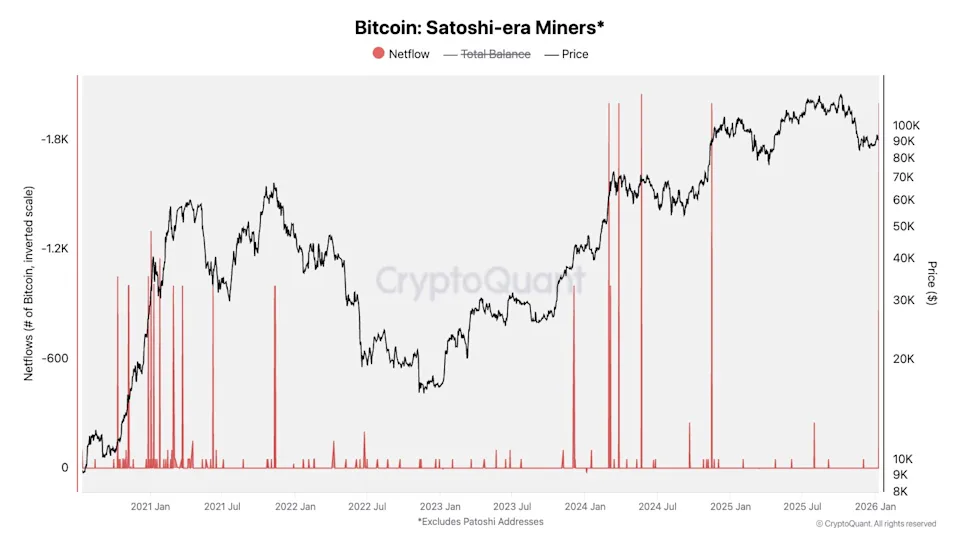
The key trigger for Bitcoin’s sharp decline today stems from a 12-year dormant OG whale re-entering the market to sell. According to Lookonchain, a Bitcoin wallet named “5K BTC OG” has begun selling its holdings. These Bitcoins were originally purchased in 2012 at an average price of $332 each. The wallet initially held 5,000 BTC and has now sold 2,500 BTC, with an average sale price of $106,164 per BTC, realizing a profit of approximately $265 million.
The selling pattern shows a high degree of systematicity and planning. The OG transfers 250-500 BTC per transaction, dispersing funds through at least 10 Binance trades over the past five months. In the most recent activity, another 500 BTC was transferred to Binance, worth $47.77 million. This marks the latest in a series of recent withdrawals by this 12-year Bitcoin holder, with total profits now exceeding $500 million, making it one of the most profitable HODL-to-exit patterns in Bitcoin history.
The wallet still holds 2,500 BTC, worth about $237.5 million, which could be the next batch of Bitcoin entering the market. Given that Bitcoin’s price is slightly below $100,000, such a large-scale sell-off (from a long-term holder) could further depress an already resistant market. While long-term holders celebrate their “diamond hands,” many traders are uneasy, as these cryptocurrencies, dormant since the early days of Satoshi, are now active and highly liquid.
From a market psychology perspective, the OG whale’s selling behavior has a strong demonstrative effect. When a 12-year holder with over 31,000% profit chooses to exit, it sends a signal to the market: even the most steadfast believers see current prices as attractive for selling. This psychological impact far exceeds the actual supply and demand effects of the sell-off and may trigger other large investors to follow suit.
CLARITY Act postponement sparks regulatory uncertainty
The second major factor behind Bitcoin’s decline today is the deadlock in key legislation of the US cryptocurrency regulatory framework. On January 15, the Senate Banking Committee delayed the review of the “Crypto Market Structure Clarity Act” (CLARITY Act). Officials stated that further negotiations with industry stakeholders are needed, casting a shadow over the regulatory certainty that was expected to be imminent.
The largest compliant US crypto exchanges do not support the latest draft, citing “too many issues,” including restrictions on tokenized stock operations and rules on exchanges paying rewards to stablecoin holders. Brian Armstrong, CEO of Coinbase, told Fox News: “In my view, an industry (banking) controlling regulators through bans on competition is extremely unfair.” This public criticism has stirred political controversy. Reporter Eleanor Tretter noted that the company’s stance angered the Trump administration, with the White House threatening to withdraw support for the bill unless Coinbase resumes negotiations.
Although Armstrong later issued a statement denying rumors, asserting that the government is not considering abandoning the CLARITY Act, this controversy has exposed the complex game behind the bill’s progress. Trump’s crypto policy advisor, David Sachs, urged the industry to use this delay “to resolve any remaining disagreements,” adding that “market structure legislation is closer than ever to completion.” However, the shift from “about to pass” to “further negotiations needed” is enough to turn market sentiment from optimistic to cautious.
Three major impacts of the CLARITY Act delay on the market
Regulatory certainty postponed: The clear regulatory framework expected to be implemented in Q1 2026 now has an uncertain timeline.
Institutional funds cautious: Many traditional financial institutions are waiting for regulatory clarity before large-scale entry; the delay means capital inflows are postponed.
Political risks rising: The public disagreement between the largest compliant US crypto exchange and the White House shows that even under the Trump administration, crypto regulation faces internal power struggles.
Regulatory uncertainty has always been one of the biggest enemies of the crypto market. The 2021 Chinese ban on crypto trading and mining, and the 2023 SEC lawsuit against the largest compliant US crypto exchange, both triggered intense market volatility. The current delay of the CLARITY Act, while not directly negative regulation, creates enough uncertainty to cause some institutional investors to hold back, reducing new buying.
Technical retracement and market sentiment shift
(Source: TradingView)
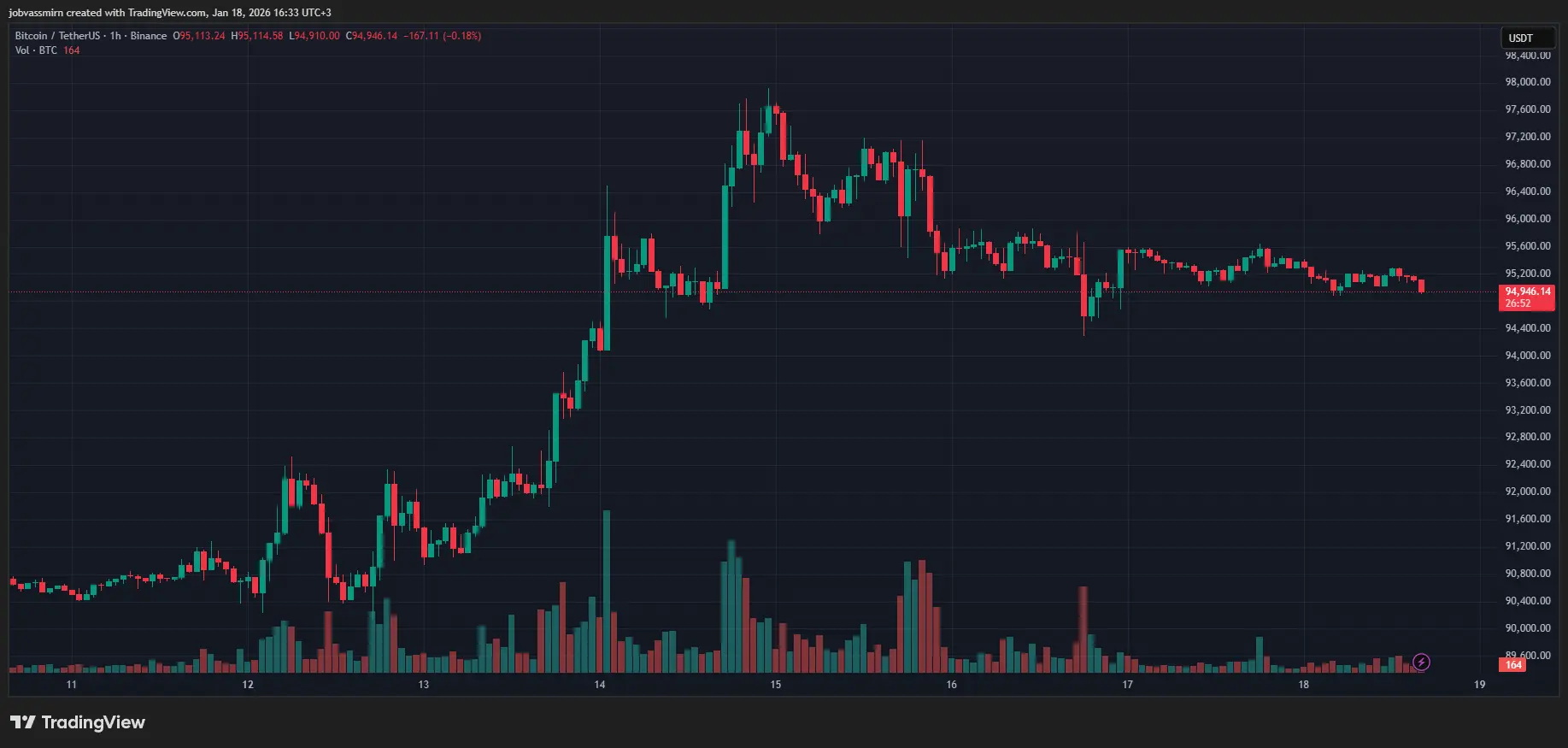
From a technical perspective, why did Bitcoin crash today? The local peak at $98,000 reached last Wednesday is a key resistance level. The past week has been generally positive for Bitcoin and the broader crypto market, with the rally starting last Monday when the digital gold price rebounded from around $90,000. On Tuesday last week, the price broke above $95,000 for the first time since November 2025.
However, after reaching a slightly lower local peak below $98,000 on Wednesday, Bitcoin entered a minor correction, falling back to around $95,000, and further declined to $92,600 on January 19 at the start of this week. This correction pattern is known in technical analysis as a “bull market correction” or “healthy retracement,” but when the retracement exceeds 5% and is accompanied by significant negative news, it can evolve into a deeper adjustment.
QCP Capital analysts previously stated that Bitcoin has long lagged behind gold and stocks, but breaking through the $95,000 resistance—its highest since November last year—changed this dynamic. They believe current prices already reflect macroeconomic risks such as developments in Venezuela and Iran, and US tariff policies. However, the new variables of OG whale selling and CLARITY Act postponement have not been fully priced in.
Market sentiment indicators also show warning signals. The crypto fear and greed index surged from 29 to 50 within a week, indicating “greed” sentiment for the first time, but then quickly retreated. This rapid shift in sentiment often foreshadows increased short-term volatility. Although crypto ETF fund flows have stabilized, with Bitcoin spot funds absorbing $1.42 billion, the daily inflow rate has slowed.
Looking at the price structure, $95,000 is a key resistance turned support level since November last year. Falling below it shifts psychological support to the $90,000 round number. The current price of $92,600 is in this danger zone; if it cannot quickly recover above $95,000, it may trigger further technical sell-offs, with targets at $90,000 or even lower support at $85,000.
Short-term outlook and key support levels to watch
The reason for Bitcoin’s sharp decline today is now clear: systemic sell-off by OG whales, postponement of the CLARITY Act, and technical retracement at high levels—these three factors combined. In the short term, the market will closely monitor: whether the remaining 2,500 BTC from OG whales continues to be sold, progress in CLARITY Act negotiations, and whether the $90,000 key support can hold.
If the $90,000 support fails, the next major support is around $85,000, the starting point of the November 2025 rebound. Conversely, if it holds and rebounds, regaining above $95,000 could open the path to the psychological $100,000 mark. Investors should remain cautious, control leverage, and wait for a clear market direction before making decisions.


