
SkyBridge Capital founder Anthony Scaramucci criticizes the “CLARITY Act” for banning stablecoin yields, claiming this puts the US dollar at a disadvantage in competing with China’s digital renminbi. The People’s Bank of China has already allowed interest payments on digital renminbi, while US bank CEOs warn that stablecoin restrictions could lead to $6 trillion in deposit outflows. However, the crypto industry views the ban as a result of banking lobbying to protect their own interests.
Scaramucci sharply criticizes CLARITY Act for stifling stablecoin competitiveness
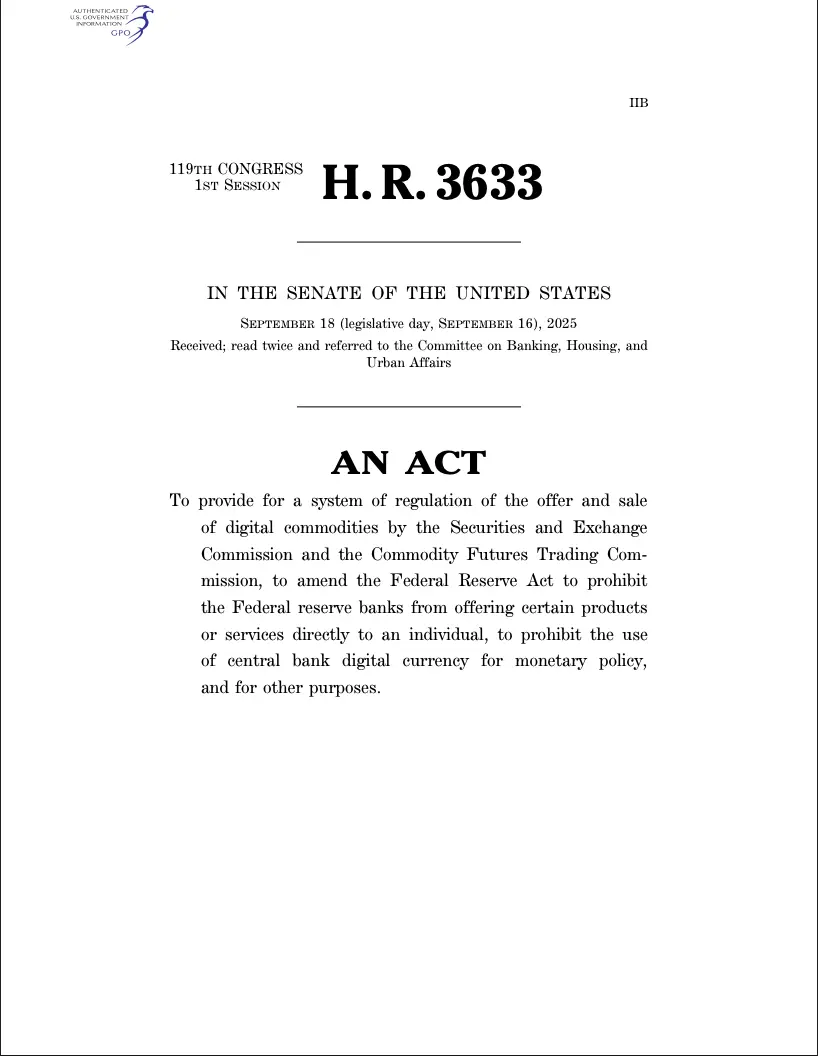
(Source: U.S. Congress)
“The entire system is collapsing,” Scaramucci said in response to the provisions in the “CLARITY Act” (U.S. cryptocurrency market structure framework) that prohibit crypto exchanges and service providers from offering stablecoin yields to customers. This clause has become a key obstacle in the competition between US dollar stablecoins and digital renminbi, sparking strong industry backlash.
Scaramucci pinpointed the core issue: “Banks don’t want stablecoin issuers to compete with them, so they block the distribution of yields. Meanwhile, China is issuing yield-bearing stablecoins, so which do you think emerging countries will choose—yield-bearing or non-yielding systems?” This rhetorical question reveals the underlying power struggle behind the stablecoin yield ban and its potential threat to the global dominance of the dollar.
The “CLARITY Act” expands the scope of the ban introduced in the “Genius Act”—which guides and establishes the U.S. stablecoin innovation framework—focused on regulating USD-backed stablecoins. Originally, the Genius Act only restricted stablecoin issuers from paying interest to holders, but the CLARITY Act further extends the ban to crypto exchanges and service providers, preventing even non-yielding stablecoins from offering interest on deposits through their business models.
Scaramucci views this comprehensive prohibition as disastrous. He believes that when emerging markets choose between digital renminbi and USD stablecoins, the yield-bearing digital renminbi will have an overwhelming advantage. This is not just a technical competition but a contest over global financial infrastructure standards. Once emerging markets adopt digital renminbi for cross-border payments and reserves, the US dollar’s hegemonic position could be fundamentally challenged.
Digital renminbi interest payments highlight US dollar disadvantages
The People’s Bank of China has allowed commercial banks to pay interest on digital renminbi deposits since January. This policy shift gives the digital renminbi a structural advantage over USD stablecoins in the competition. For holders, earning passive income on digital currency is clearly more attractive than non-yielding alternatives, especially in a global environment where interest rates remain relatively high.
The interest mechanism for digital renminbi is not just a technical upgrade but a key part of China’s strategy to internationalize the renminbi. By offering yields, the digital renminbi can attract not only individual users but also enterprises and financial institutions as a cross-border settlement tool. When a company operating along the “Belt and Road” can hold interest-earning digital renminbi, they are naturally inclined to use renminbi rather than dollars for transactions.
In contrast, under the restrictions of the CLARITY Act, USD stablecoins will lose this appeal. Currently, mainstream stablecoins like USDT and USDC do not offer yields themselves, but many DeFi protocols and centralized platforms provide yield opportunities through lending, liquidity mining, and other mechanisms. If the CLARITY Act is strictly enforced, these yield sources could be cut off, turning USD stablecoins into mere trading media rather than attractive stores of value.
From a competitive perspective, USD stablecoins under the CLARITY Act will be prohibited from offering yields via exchanges and service providers, making them purely transactional tools without passive income. Meanwhile, digital renminbi, with the central bank’s approval, allows commercial banks to pay interest, enabling it to serve both as a medium of exchange and a yield-generating asset. For emerging markets, USD stablecoins can only rely on dollar backing, whereas digital renminbi offers both yield and the appeal of China’s trade relationships.
The CEO of the largest compliant crypto exchange in the US, Brian Armstrong, issued a more direct warning: “I’m worried that in the US, we only see the trees and not the forest. The reward mechanisms for stablecoins won’t impact lending, but they will significantly affect the competitiveness of US stablecoins.” Armstrong argues that banning stablecoin yields won’t truly protect banks, as funds will still flow into other yield-bearing digital assets, just not denominated in dollars.
Banking industry’s $6 trillion panic and lobbying battle
During Wednesday’s earnings call, US bank CEO Brian Moynihan stated that stablecoins could lead to a $6 trillion outflow of bank deposits. This staggering figure reveals the deep fears within the traditional banking sector about the rise of stablecoins. Moynihan warned that deposit outflows from traditional banks could reduce their lending capacity, impacting overall financial system stability.
What does $6 trillion represent? It’s roughly one-third of total US bank deposits. If this prediction materializes, it would deal a catastrophic blow to the banking business model. Banks primarily earn interest by taking deposits and making loans. When large amounts of deposits flow into stablecoins, the pool of funds available for lending shrinks sharply, forcing banks to raise deposit rates to compete for capital, squeezing profit margins.
However, the crypto industry sees this panic as exaggerated. More importantly, they believe banks are using this fear to lobby for regulations unfavorable to stablecoins. Industry leaders like Armstrong argue that banning yield on stablecoins is a core pain point, designed to stifle competition and protect existing banking interests.
Three main arguments of banking lobbying and crypto industry rebuttals
Deposit outflow threat: Banks claim stablecoins cause large deposit withdrawals, threatening financial stability. Crypto advocates counter that stablecoins still require dollar reserves, which ultimately flow into government bonds or bank systems, just in different forms.
Interest rate competition argument: Banks argue stablecoin yields compete with bank deposit rates, undermining monetary policy transmission. Crypto industry responds that competition is fundamental to market economy; banks should improve services rather than seek regulatory protection.
Systemic risk warning: Banks warn that insufficient regulation of stablecoins could trigger systemic risks. Crypto advocates argue that stronger regulation, not bans on yields, is the proper approach—bans are a knee-jerk reaction.
From an economic-political perspective, this debate is fundamentally about the power struggle between traditional finance and emerging fintech. Banks wield significant lobbying power and political influence, shaping legislation to favor their interests. The stability coin yield ban in the CLARITY Act exemplifies this lobbying influence.
However, such short-sighted protectionism could backfire. If USD stablecoins lose competitiveness and market share globally, the damage will extend beyond crypto, weakening the dollar’s international standing. As emerging markets favor digital renminbi for yield considerations, the dollar’s role as a global reserve currency could be gradually eroded.
Strategic misstep in US dollar hegemony
Scaramucci points out a deeper strategic issue: in the context of US-China technological and financial competition, banning stablecoin yields may be a strategic mistake by the US. The dollar’s global dominance was built after the Bretton Woods system, relying on its leading role in international trade settlement, foreign exchange reserves, and commodity pricing. But this position is not guaranteed forever; it must adapt to technological and market changes.
In the digital currency era, the rules of monetary competition are being rewritten. Traditionally, a currency’s attractiveness depended on the issuing country’s economic strength, political stability, and financial market depth. Now, user experience, technological convenience, and yield potential are new dimensions of competition. If USD stablecoins lag behind digital renminbi in these areas, the dollar’s global position could face real challenges.
More critically, overly restrictive regulation may drive innovation and capital outflows. If the US imposes harsh rules on stablecoins, projects may relocate to jurisdictions like Singapore, Switzerland, or the UAE, which are actively competing to become global crypto financial hubs with more friendly regulation. Once USD stablecoin issuance and operations shift offshore, US control over this market diminishes significantly.
From a national security standpoint, maintaining the competitiveness of the dollar stablecoin aligns with US strategic interests. Stablecoins are an extension of dollar influence into the digital age; restricting yield features is akin to shooting oneself in the foot. As China promotes the internationalization of the digital renminbi and integrates it with the Belt and Road Initiative, the US needs more competitive digital dollar solutions rather than policies that protect short-term banking interests.


