Trump Threatens Tariffs on EU, Crypto Regulations Hit a Wall; Bitcoin Flash Crash Below $92,500, $750 Million Liquidated in 4 Hours, Market Focused on Volatility Before February 1 Tariff Implementation.
(Background: Why is Trump so determined to take Greenland? What secrets does this 80% ice-covered island really hold?)
(Additional context: Trump announced: a 10% tariff on Denmark and eight other European countries starting February, vowing to “take Greenland” and EU countries are forming a coalition to counter.)
Table of Contents
- Weekend Liquidity Vacuum Intensifies Downtrend
- Tariff Signals Boost Global Risk Aversion
- Regulatory Delays Worsen Market Conditions
- Technical Levels and Key Observation Points
On a weekend night when most Wall Street traders are on holiday and liquidity is thin, Bitcoin (Bitcoin) once again experienced a rapid plunge. On the evening of the 18th Eastern Time, influenced by President Trump’s statement that “if Denmark does not sell Greenland, the U.S. will impose a 10% tariff on eight NATO allies,” the cryptocurrency dropped sharply from $95,500 to $92,474 within four hours, triggering over $750 million in long contract liquidations. Under the shadow of geopolitical tensions and regulatory uncertainty, the market is reassessing risk assets.
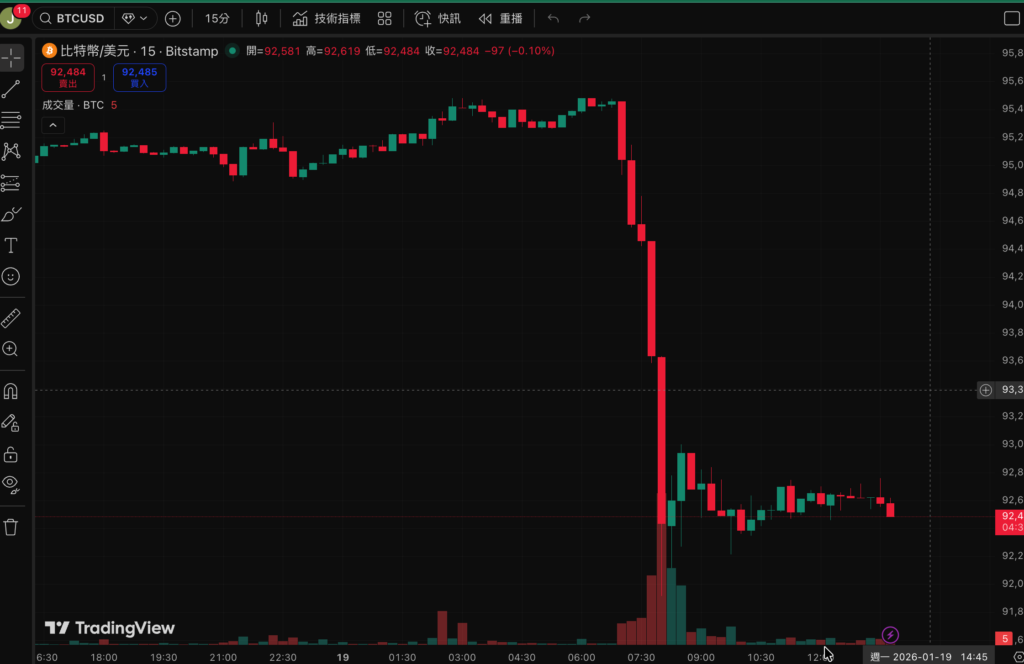
Weekend Liquidity Vacuum Intensifies Downtrend
Weekends are typically the thinnest trading periods, and prices tend to amplify fluctuations when lacking buying support. During this flash crash, most of the $750 million forced liquidations were from long positions betting on price increases. Mainstream tokens like Ether (Ether) and Solana also weakened simultaneously, indicating that risk aversion is not a single-point event but a systemic withdrawal from high-beta assets.
Tariff Signals Elevate Global Risk Sentiment
The trigger was President Trump’s ultimatum posted on Truth Social: if Denmark does not sell Greenland, the U.S. will start imposing a 10% tariff on NATO allies including the UK and Germany from February 1, 2026, with a potential increase to 25% mid-year if no agreement is reached. ABC News cited European officials saying this could push transatlantic relations into a “dangerous spiral downward.” Rising trade barriers mean global liquidity is under pressure, prompting investors to shift into traditional safe-haven assets like the dollar, with Bitcoin bearing the brunt.
Regulatory Delays Worsen Market Conditions
Geopolitical tensions are not the only pressure. The U.S. Senate Banking Committee previously indefinitely postponed hearings on the “Crypto Market Structure Bill,” weakening institutional expectations for regulatory clarity. BTC Markets analyst Rachael Lucas emphasized:
“The core reason for worsening market sentiment is the bill’s delayed progress, causing institutions to adopt a wait-and-see approach.”
Capital flows also support this view: in the last two months of 2025, net outflows from spot Bitcoin ETFs reached $4.4 billion, indicating that “smart money” has already reduced exposure, setting the stage for this sharp sell-off.
Technical Levels and Key Observation Points
As the price breaks below the 50-week moving average, Bitcoin’s medium-term upward trend faces testing. If tariff threats persist, some analysts expect the price to retest the $67,000 to $74,000 range. However, compared to past cycles, the market infrastructure is more mature now, and institutional exposure is more diversified, making a “new crypto winter” difficult to confirm at this stage.
In the short term, February 1 is a key date: if Trump’s tariff plan is officially implemented or if U.S.-Europe negotiations turn around, it could influence capital flows. Investors should monitor macro liquidity and regulatory developments to assess whether Bitcoin can maintain institutional confidence under these dual pressures.
The sell-off extending from Greenland to Wall Street again reminds the market that although Bitcoin is viewed as “digital gold,” its price remains deeply influenced by global liquidity and regulatory expectations. In the coming weeks, if uncertainties persist, high volatility may become the norm.
Disclaimer: The information on this page may come from third parties and does not represent the views or opinions of Gate. The content displayed on this page is for reference only and does not constitute any financial, investment, or legal advice. Gate does not guarantee the accuracy or completeness of the information and shall not be liable for any losses arising from the use of this information. Virtual asset investments carry high risks and are subject to significant price volatility. You may lose all of your invested principal. Please fully understand the relevant risks and make prudent decisions based on your own financial situation and risk tolerance. For details, please refer to
Disclaimer.


