According to data from SoSoValue, 11 US-listed spot Bitcoin ETF funds have recorded a net capital inflow of approximately $1.2 billion since the beginning of the month, marking a complete reversal from the capital outflows experienced in December.
This figure not only has positive implications for cash flow but also, upon deeper analysis of the data structure, sends a more optimistic signal: major investors are gradually abandoning traditional arbitrage strategies to directly bet on Bitcoin’s long-term bullish prospects.
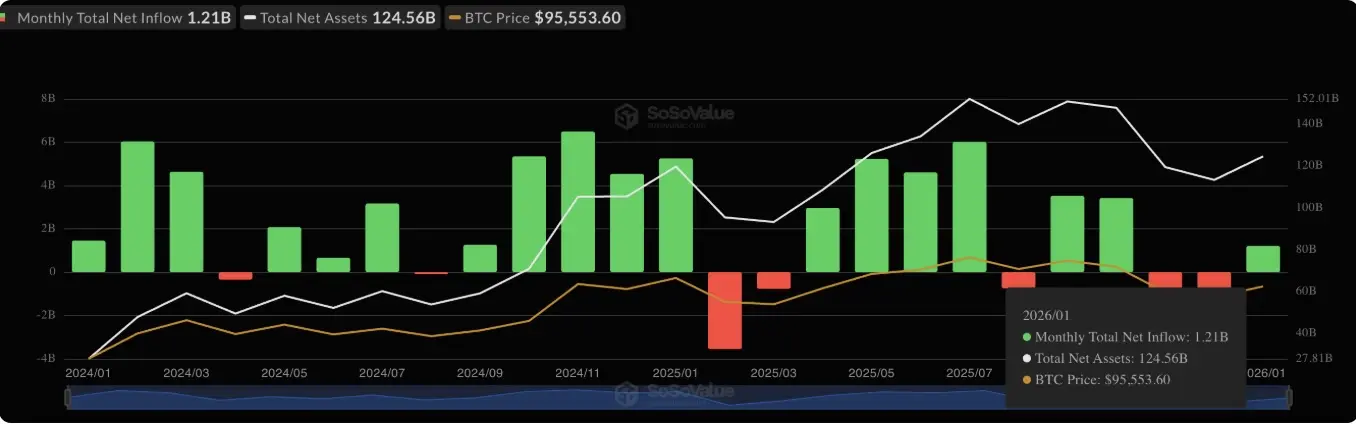 The capital flowing into Bitcoin ETFs this month reaches $1.2 billion (SoSoValue)## Arbitrage “cash-and-carry” gradually losing appeal
For a long time, institutional players favored the “cash-and-carry” arbitrage strategy—a low-risk, stable approach. This strategy exploits price discrepancies between the spot market and futures market.
Specifically, investors buy Bitcoin spot ETFs and simultaneously short Bitcoin futures contracts. The profit does not come from Bitcoin’s price appreciation but from the pre-locked price difference between the two markets.
However, recent data indicates that the new capital flowing into US Bitcoin spot ETFs no longer serves this strategy. The reason is that the price gap between the current spot market and the futures market has narrowed significantly, while capital costs and transaction expenses have increased, making arbitrage profits nearly unattractive.
Narrowing price gap, profits approaching zero
Although the Bitcoin spot ETF recorded a net capital inflow of $1.2 billion, the number of open standard and micro Bitcoin futures contracts on CME has surged by 33%, reaching 55,947 contracts.
Under normal conditions, the combination of ETF capital inflows and increasing open interest is usually associated with cash-and-carry trading. However, this time, it’s an exception.
According to analysts, the basis—the price difference between CME futures contracts and the ETF spot—has decreased to just enough to cover transaction and financing costs, and in many cases, does not generate actual profits.
This has almost eliminated the incentive to revert to arbitrage strategies.
Low volatility “shuts down” arbitrage opportunities
Another key factor is the significant decline in Bitcoin’s price volatility. Since the sharp correction from its all-time high last October, Bitcoin’s price has mainly fluctuated around $90,000.
Low volatility means fewer opportunities to create sufficiently large price discrepancies between spot and futures. According to Volmex’s BVIV index, Bitcoin’s 30-day implied volatility has dropped to around 40%, the lowest since October, indicating that expectations for sharp short-term swings are weakening markedly.
Capital “sticking” and a long-term outlook
This shift reflects a notable turning point in the market’s microstructure and carries positive implications for Bitcoin.
Capital continues to flow into Bitcoin spot ETFs but no longer with a short-term tactical focus. Instead, new investments tend to be more “sticky,” aiming for long-term holdings and benefiting from future price appreciation.
In a low-volatility environment, many institutions feel safer allocating capital to alternative assets like Bitcoin, especially as this asset has underperformed compared to precious metals and equities during the same period.
Institutional speculators return to futures market
Data from CME futures markets shows that the recent increase in open interest is mainly driven by non-commercial investors—large speculators—rather than hedge funds implementing arbitrage strategies.
The number of Bitcoin futures contracts held by this group has risen to over 22,000 contracts, reflecting a clear improvement in market sentiment and growth expectations.
Conversely, leveraged funds that typically short futures contracts for cash-and-carry trades are gradually reducing their short positions, indicating that arbitrage activity continues to contract.
Conclusion
Overall, the data suggests that capital is returning to Bitcoin, but in a very different manner than before. Instead of seeking small profits from price discrepancies, institutional investors are directly betting on Bitcoin’s long-term upward trend through managed futures markets and spot ETFs.
This represents a slow but steady flow of capital, which, in a low-volatility environment, could serve as a fundamental driver for Bitcoin’s next upward cycles in the medium and long term.
Vương Tiễn
Disclaimer: The information on this page may come from third parties and does not represent the views or opinions of Gate. The content displayed on this page is for reference only and does not constitute any financial, investment, or legal advice. Gate does not guarantee the accuracy or completeness of the information and shall not be liable for any losses arising from the use of this information. Virtual asset investments carry high risks and are subject to significant price volatility. You may lose all of your invested principal. Please fully understand the relevant risks and make prudent decisions based on your own financial situation and risk tolerance. For details, please refer to
Disclaimer.


