Pi App Studio introduces no-code payment integration, now live on the testnet. AI-guided steps support session-based payment modes such as game continuation. Creators can build applications in the Pi browser and set prices; earnings are limited to Test Pi and do not support mainnet transfers.
Pi App Studio Payment Integration Eliminates Technical Barriers
On January 21, 2026, Pi App Studio introduced built-in payment integration for newly created applications. This feature allows developers to add Pi coin-based payment functions to their app experience through guided prompts instead of coding. Key features of this update include: payment functions available on the testnet using Test Pi, payments valid only within a single active session, integration limited to newly created applications, accessible via the Pi browser rather than Pi Desktop.
This update does not enable cross-session persistent purchases; it focuses on session-level interactions such as continuing a game turn or unlocking features during gameplay. This design avoids complex state management and effectively controls testing on the testnet. From an ecosystem perspective, it reduces reliance on a few developers and enables more contributors to create utility-driven applications.
Prior to this update, even with a simplified developer SDK, integrating Pi 幣 payments still required developer tools and technical knowledge. For non-technical users, this process remained difficult. Pi App Studio now abstracts complex payment flows into AI-managed guided steps, allowing developers without programming skills to easily accept Pi payments, control pricing and deployment, track income, and manage their app monetization models.
This update shifts profit rights from developers to creators. Previously, payment integration required SDKs and technical skills, favoring developers’ profit models. Now, payments are real-time and no coding is needed, enabling creators to set monetization parameters easily. This aligns with Pi Network’s practicality-first approach, supporting more functional applications rather than speculative assets.
10 Steps to Fully Integrate Pi Coin Payment Functionality
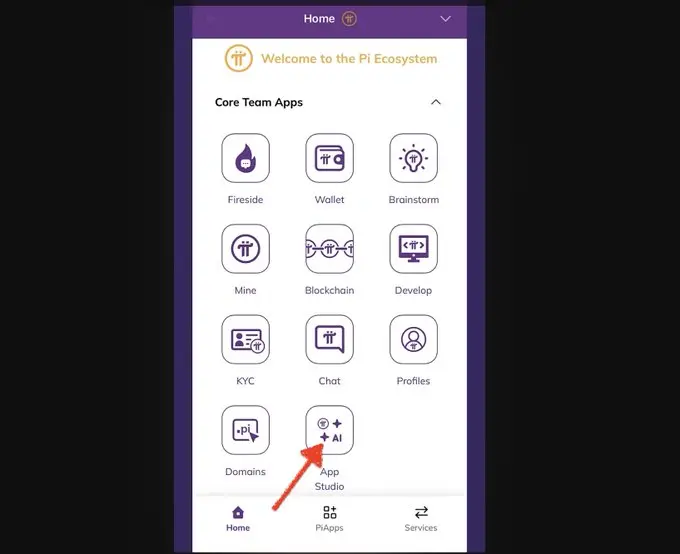
Step 1: Access Pi App Studio via Pi Browser. Open Pi Browser on your mobile device and navigate to Pi App Studio. Pi Desktop app does not support payment integration.
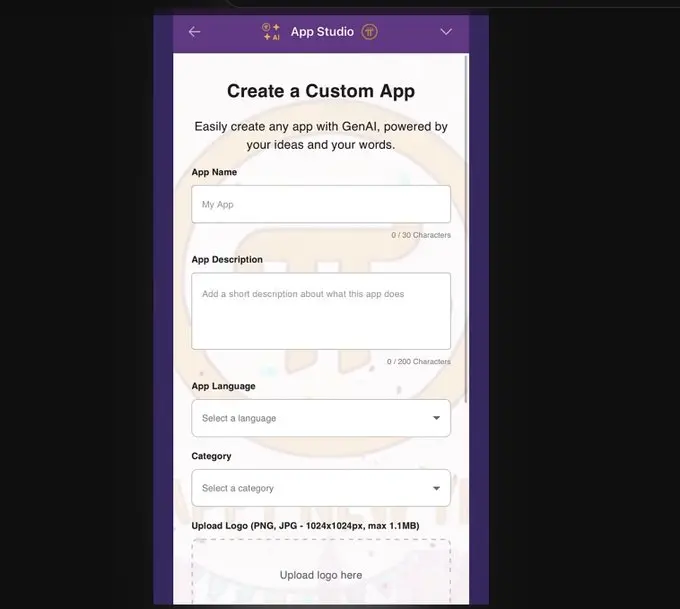
Step 2: Create a new custom application. Payment features can only be integrated into newly created applications; existing apps cannot retroactively add payment functions. During creation, select “Custom Application.”
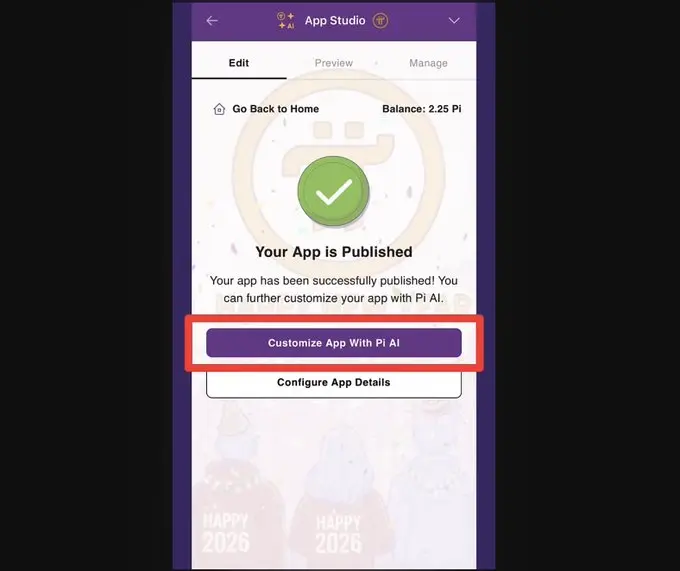
Step 3: Open Pi AI Custom Control Panel. After creating the app, choose “Use Pi AI Custom Application.” This opens an AI-driven editing interface to control app behavior and features.
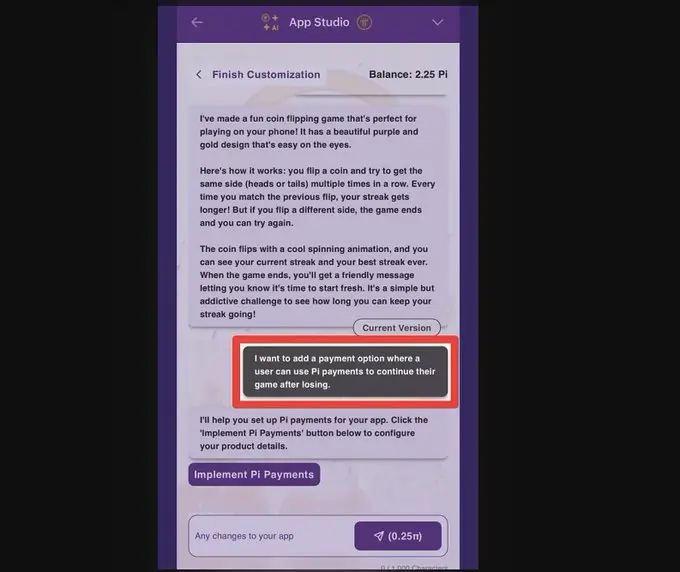
Step 4: Clearly mention Pi payment in prompts. Explicitly specify in your prompt that you want to add Pi coin payment functionality. The system will only initiate the payment workflow if “Pi Payment” is explicitly included. Example prompt: “Add Pi payment feature so users can continue the game after losing.”
Step 5: Select to implement Pi payment. When the prompt recognizes Pi payment, a “Implement Pi Payment” button will appear. Click to proceed.
Step 6: Create a Testnet Pi wallet. During setup, a new Testnet Pi wallet must be created; all user Test Pi payments will be sent to this wallet. Important rules include securely saving the private key, never revealing it, and creating the wallet as a mandatory step.
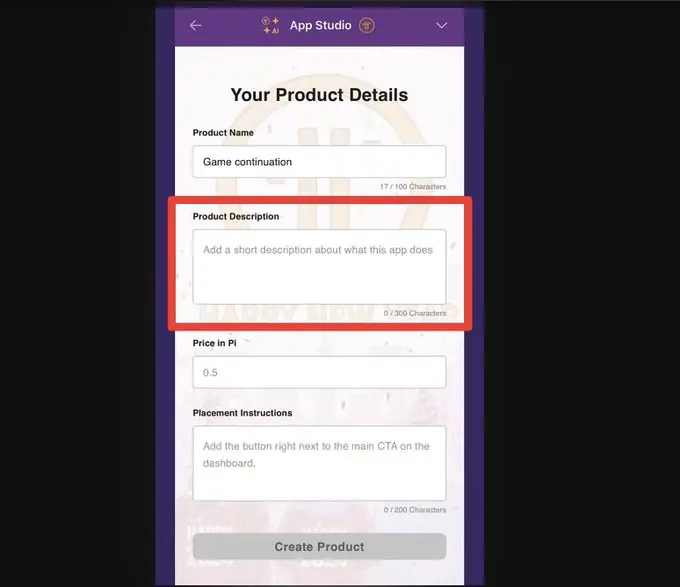
Step 7: Precisely define payment behavior. Accurately describe the specific function of the payment within your app, including what actions are performed after payment, when it appears, and how it affects the session. Example: “User pays Test Pi to continue the current game after losing, without resetting the score.”
Step 8: Set price in Pi. Define the amount of Pi to be paid per transaction; the amount remains fixed per transaction.
Step 9: Configure payment placement. Specify where the payment option appears in the user interface, e.g., after the game over screen.
Step 10: Publish and test. Save your setup; users can now interact with the payment feature using Test Pi. Income will be visible in the app’s income dashboard.
Session-Level Payment Logic in Coin Toss Game Demo
The official tutorial demonstrates a simple coin toss game showcasing session-based payment mode. The initial behavior involves the user tossing coins, attempting to match consecutive results, and losing the game. After integrating payment, upon failure, users can choose to pay with Test Pi to continue the same session, with scores retained. This illustrates how Pi coin payments can modify session logic without introducing persistent upgrades.
Session-based payment mode defines a session as an independent activity instance, such as a game round, a task attempt, or a single experience flow. Paid features allow users to modify or extend the session without resetting progress. After the session ends, the payment effect expires. This design avoids complex state management and effectively controls testing on the testnet.
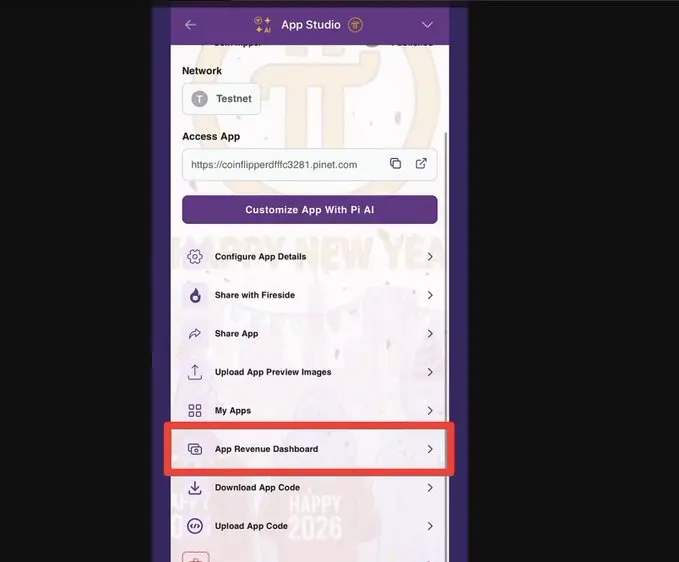
Creators can view Test Pi income via the App Studio revenue dashboard. Current limitations include income only from Test Pi, no mainnet transfers, and no withdrawal to external wallets. Wallet security remains the creator’s responsibility; Pi App Studio does not manage private keys. This clear division of responsibility ensures the platform provides tools without custodianship, and creators bear wallet security risks.
Pi App Studio’s payment integration offers developers a controllable, simplified way to add Pi coin-based payments during app activity. By limiting functionality to the testnet and session-level interactions, Pi Network prioritizes stability and experimentation over early profit realization. The system removes technical barriers while safeguarding wallet security and transparent payment flows. For creators, it provides a practical method to test monetization logic without coding.
Disclaimer: The information on this page may come from third parties and does not represent the views or opinions of Gate. The content displayed on this page is for reference only and does not constitute any financial, investment, or legal advice. Gate does not guarantee the accuracy or completeness of the information and shall not be liable for any losses arising from the use of this information. Virtual asset investments carry high risks and are subject to significant price volatility. You may lose all of your invested principal. Please fully understand the relevant risks and make prudent decisions based on your own financial situation and risk tolerance. For details, please refer to
Disclaimer.
Related Articles
Pi Network's rally stalls, CEX deposits surge indicating profit-taking
Pi Network (PI) surged over 25% in March, but CEX deposits skyrocketed to 3.91 million coins, indicating profit-taking pressure is accumulating. Social media buzz is increasing, and technical indicators are bullish, but the overall trend remains bearish. The resistance level is at $0.2396, and the support is at $0.1977. Large deposits suggest a possible local top, so caution is advised.
MarketWhisper1h ago
PI (Pi) increased by 7.62% over the past 24 hours
Gate News Report, March 11 — According to Gate Market Data, as of press time, PI (Pi) is trading at $0.23, up 7.62% in the past 24 hours, with a high of $0.24 and a low of $0.17. The current market capitalization is approximately $2.248 billion, an increase of $159 million from yesterday.
Pi Network is a blockchain community and developer platform dedicated to enabling users to mine Pi tokens easily on their phones through innovative technology. Centered around its groundbreaking technology, the network allows mining via mobile apps without consuming大量电力, making it the first digital currency that can be mined on a mobile device. Pi Network emphasizes decentralization, mobile-first design, and environmental friendliness, aiming to involve more users in the cryptocurrency ecosystem.
##
GateNews3h ago
Pi Network Explores AI Training With Over 421K Nodes in New Proof-of-Concept
Pi Network has over 421,000 Nodes, representing more than 1 million CPUs, that could support opt-in AI computing tasks.
In the OpenMind pilot, 7 Pi Node operators returned image-inference results within 4 seconds, including labels such as “bus” and “person”.
Pi Network is testing a new use f
CryptoNewsFlash18h ago
PI Token Maintains Bullish Trend as Anticipation for Pi Day Grows
PI token trades above $0.21 after rallying over 25% in the past 7 days as anticipation for the upcoming Pi Day on March 14 grows.
PiScan recorded 3 million PI deposits to exchanges in 24 hours, suggesting near-term profit taking which could reverse the bullish trend.
Pi Network’s PI token tr
CryptoNewsFlash18h ago
Pi Network Approaches Key Price Level — Breakout or Bull Trap Ahead?
Price Action: PI trades near $0.20 supply zone after short-term 5% rally.
Technical Signals: H4 chart bullish, but higher timeframe trends remain bearish.
Trading Strategy: Watch $0.1857 support and $0.216 resistance for breakout or bull trap confirmation.
Pi Network has shown
CryptoNewsLand19h ago
Pi Network announces that KYC validator rewards will be distributed by the end of March, with 17 million users having completed identity verification.
Pi Network announces that rewards will be distributed to KYC verifiers by the end of March 2026. These volunteers are responsible for verifying user identities to ensure network security. Currently, 17 million users have completed identity verification. Project updates include node upgrades and the possible launch of decentralized trading features, aiming to promote network development. The user base has already exceeded 50 million.
GateNews21h ago


