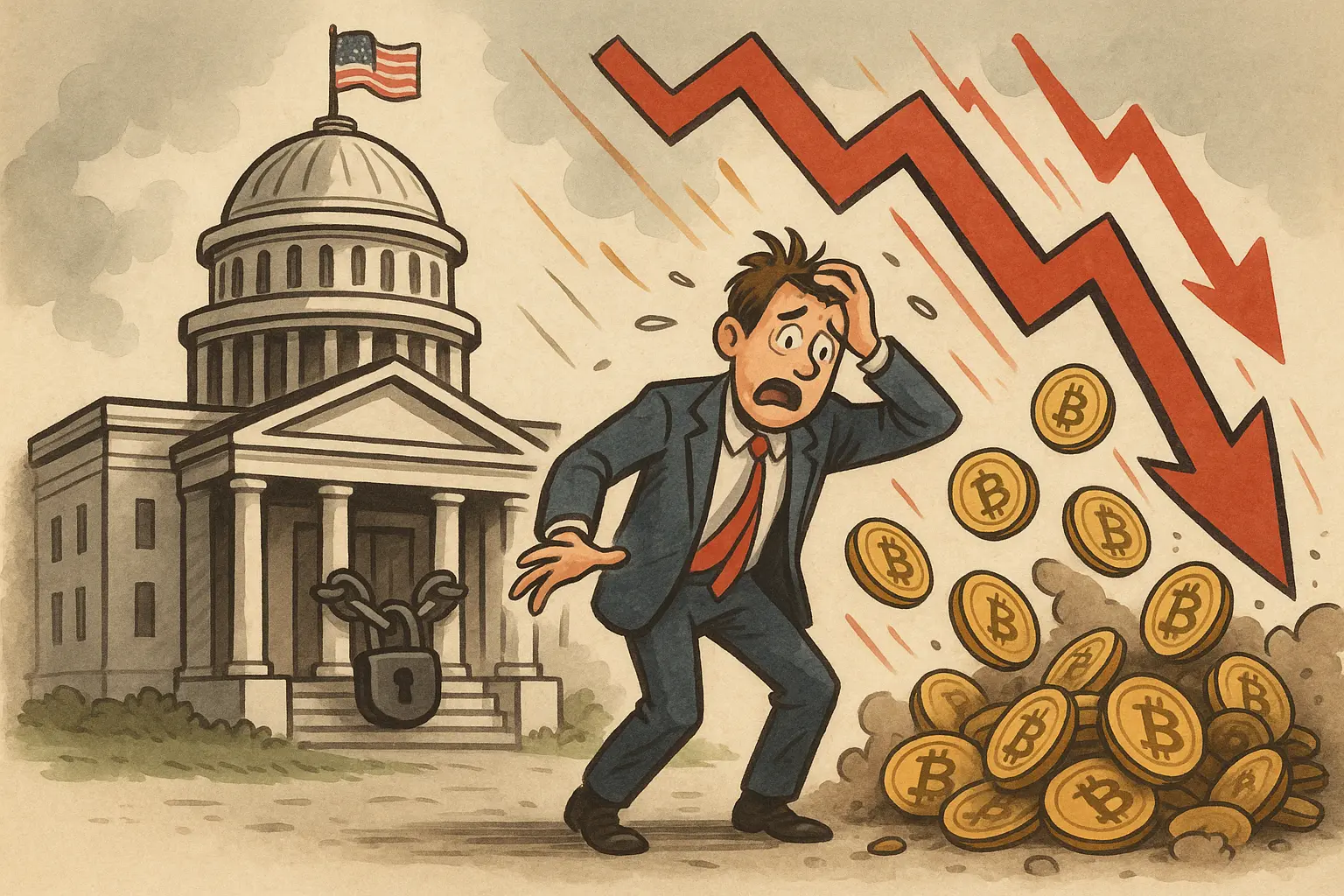
Polymarket shows the probability of a U.S. government shutdown at the end of the month surging from 9% to 73%, with the crypto market evaporating $30 billion over the weekend and over $600 million in long positions liquidated. The cause is that the continuing resolution only延至 January 30, with Democrats opposing DHS funding due to recent events. Background involves a $240 million Somali immigrant fraud case, possibly reaching $9 billion, with Trump deploying 2,000 agents for enforcement.
Only 2 Months After 43 Days of Shutdown, Another Deadlock
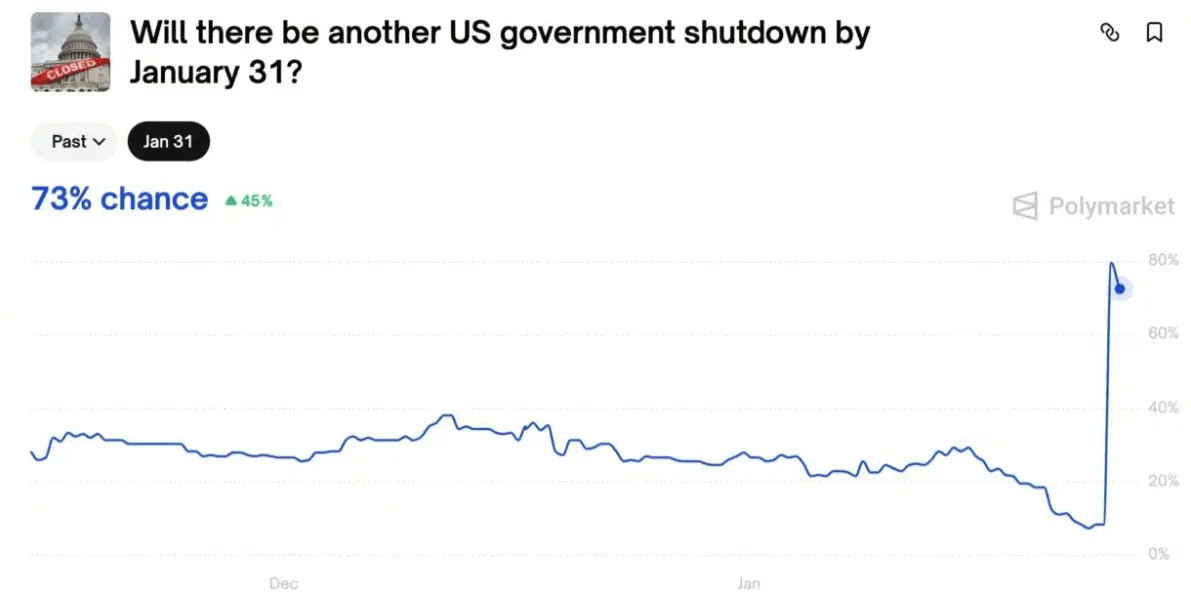
(Source: Polymarket)
According to Polymarket data, the probability of a U.S. government shutdown at the end of this month suddenly jumped from 9% to 79%! Due to the sudden occurrence on a weekend, the crypto market has already declined in anticipation. Notably, the record 43-day shutdown that began on October 1 last year ended on November 12, 2025, with a compromise bill. Just over two months after that agreement, why is there another shutdown?
This shutdown is caused by the fact that last year’s bill was only a “Continuing Resolution” (CR), which temporarily extends funding for most government agencies until January 30, 2026. Only a few departments (such as Agriculture, Veterans Affairs, and Congress itself) received full-year funding. Congress must pass a new, longer-term bill before January 30, or agencies without full funding will face another shutdown.
CRs are stopgap measures in U.S. government operations. When Congress cannot pass full appropriations before the start of the fiscal year, CRs are used to keep the government running temporarily. However, CRs merely delay the problem, pushing budget disputes into the future. The January 30 deadline has now arrived, and divisions on key issues remain unresolved.
The 43-day shutdown was one of the longest in U.S. history, causing significant economic and social impacts. Hundreds of thousands of federal employees worked unpaid or were furloughed, and government services were widely disrupted. The temporary bill was meant to give both sides more time to negotiate a long-term solution. But over two months have passed without substantial progress, and a new shutdown risk looms.
The 79% probability of shutdown is a highly predictive figure. As a decentralized prediction market, Polymarket’s odds reflect real capital betting. When the probability jumps from 9% to 79%, it indicates market participants believe a shutdown is almost inevitable. Such a sharp change often stems from a major event or news—in this case, Democrats suddenly opposing DHS funding over recent incidents on the weekend.
Causal Chain of Somali Fraud and ICE Shooting Citizens
The current shutdown is driven by Democrats’ refusal to approve DHS funding, citing recent incidents involving ICE agents shooting civilians. Trump has been fixated on the Somali immigrant fraud case in Minnesota, using it as a pretext to intensify local crackdowns on illegal immigration.
The Somali fraud scheme, involving over $240 million confirmed, with reports suggesting total losses could reach $9 billion, shocked the American public. Somali refugees and immigrants fraudulently obtained federal and state benefits through forged documents, false income and family reports. Investigations show some networks are highly professional, even teaching how to fill out applications and evade scrutiny.
Trump publicly condemned the Somali community, saying they should “get out of America,” and accused Minnesota officials of “inciting rebellion.” Using this as leverage, DHS increased enforcement actions against illegal immigrants, deploying about 2,000 ICE agents to Minneapolis. The initial targets were Somali individuals with final deportation orders.
However, these aggressive enforcement actions and subsequent ICE shootings of U.S. citizens have led Senate Democrats to oppose House appropriations that include DHS funding. ICE agents in Minneapolis conducted two enforcement operations, killing two U.S. citizens, sparking significant controversy domestically.
In the first incident, ICE agents clashed with a suspect during an arrest, shooting and killing a bystander. In the second, ICE mistakenly identified a U.S. citizen as an illegal immigrant and shot him during the chase. These events triggered protests, with civil rights groups accusing ICE of racial discrimination and excessive force.
Democrats demand accountability and reform for ICE, while Republicans want to push their border security agenda. This deadlock directly causes the current risk of a U.S. government shutdown. Senate Democrats refuse to pass full DHS funding unless Republicans agree to investigate and limit ICE enforcement actions. Republicans insist ICE’s actions are lawful and oppose restrictions.
Crypto Market Loses $30 Billion in a Single Day, Absurd Logic of the Selloff
Because Democrats suddenly opposed DHS funding over the weekend, the crypto market bore the brunt of this shock. Today, due to the risk of a U.S. government shutdown, the crypto market plummeted, liquidating over $600 million in longs in a single day, and wiping out more than $30 billion in market cap. So, the Somali fraud in Minnesota finally found a buyer in the crypto market today.
This cause-and-effect may seem absurd at first glance, but in today’s highly interconnected financial markets, it has internal logic. A U.S. government shutdown increases political uncertainty, reducing investor risk appetite. During risk-off sentiment, funds flow out of high-risk assets (like cryptocurrencies and tech stocks) into low-risk assets (like USD, U.S. Treasuries, gold). Therefore, the crypto market, unrelated directly to the shutdown, becomes one of the first asset classes to be sold off.
The $600 million long liquidation reflects severe losses among leveraged traders. These traders use margin to amplify positions; when prices fall to liquidation levels, positions are forcibly closed, causing further selling pressure. This chain of liquidations is common in crypto markets, often magnifying mild corrections into sharp crashes.
The $30 billion market cap loss accounts for about 1% of total crypto market value (assuming roughly $3 trillion total). While not extreme percentage-wise, the absolute amount is significant. Ultimately, this loss is borne by millions of global crypto investors, triggered by domestic U.S. politics and a fraud case. The absurdity of this “remote transmission” is the core message of the article’s title.
As for how U.S. stocks will react, we must wait until the opening on January 26. If stocks also fall sharply, crypto may face further selling pressure. If stocks remain relatively stable, crypto might rebound first, as its exaggerated reaction to political events is seen as a buying opportunity.
Disclaimer: The information on this page may come from third parties and does not represent the views or opinions of Gate. The content displayed on this page is for reference only and does not constitute any financial, investment, or legal advice. Gate does not guarantee the accuracy or completeness of the information and shall not be liable for any losses arising from the use of this information. Virtual asset investments carry high risks and are subject to significant price volatility. You may lose all of your invested principal. Please fully understand the relevant risks and make prudent decisions based on your own financial situation and risk tolerance. For details, please refer to
Disclaimer.


