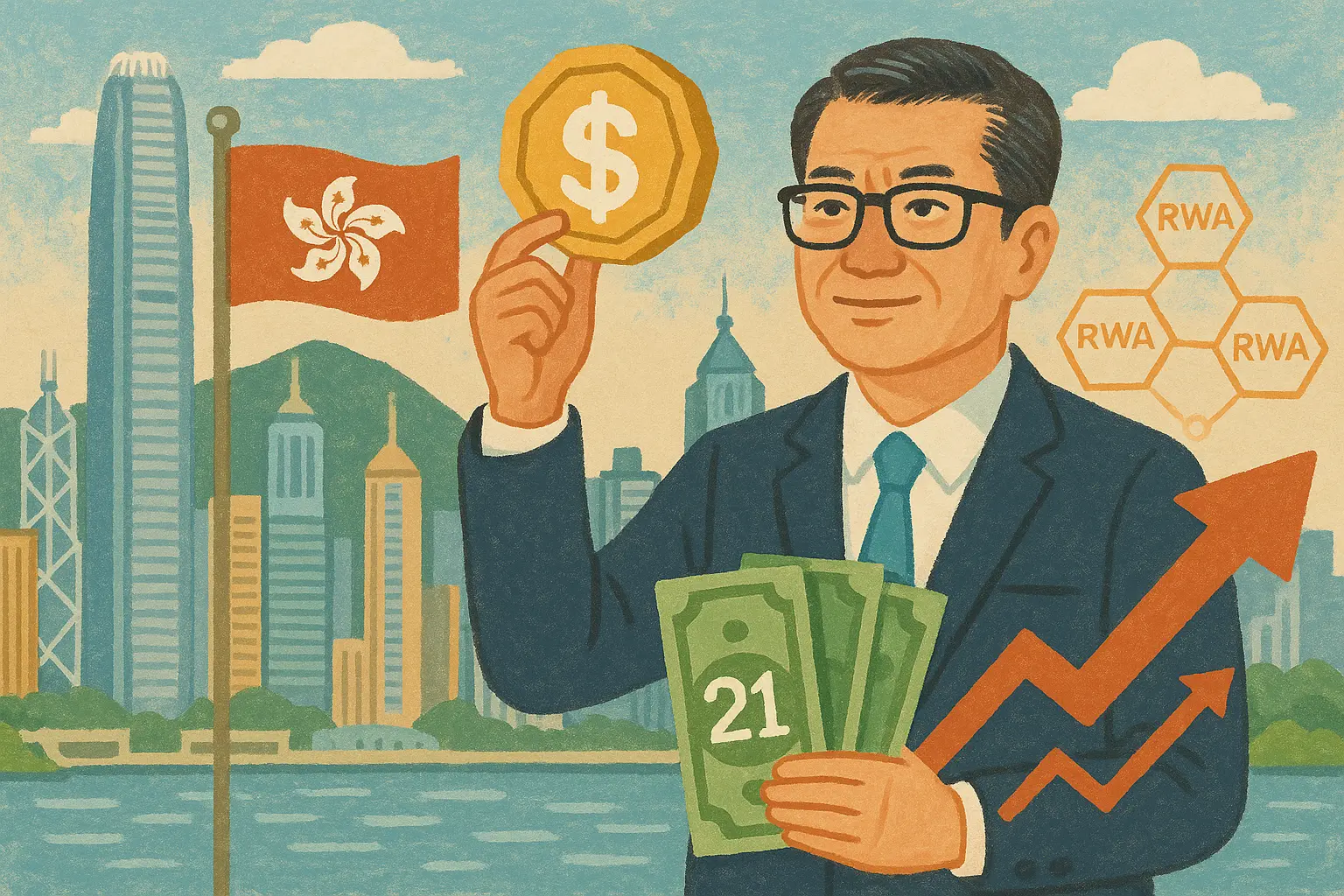
Hong Kong Financial Secretary Paul Chan Mo-po announced in Davos that the first batch of stablecoin licenses will be issued within the year. Hong Kong has already licensed 11 VASPs and successfully issued $2.1 billion in tokenized green bonds. The three-step strategy of “VASP licensing + stablecoin regulation + government demonstration” paves the way for the digitalization of trillions in assets.
Hong Kong Stablecoin Licenses to Launch Within the Year, Three-Step Strategy Takes Shape
On January 21, 2026, Hong Kong SAR Government Financial Secretary Paul Chan Mo-po announced in Switzerland at Davos to the global audience that Hong Kong expects to issue its first stablecoin-related licenses within the year, reaffirming the principle of “same activity, same risk, same regulation.” This statement is consistent with his public confirmation six months earlier in December 2024 of plans to introduce a stablecoin licensing regime this year, indicating that Hong Kong’s stablecoin licensing policy has entered a substantive implementation phase.
This upcoming policy is not an isolated move. In his Davos speech, Chan systematically outlined Hong Kong’s strategic blueprint for digital assets, built on three main pillars. The first pillar is establishing compliant trading venues; since 2023, Hong Kong has licensed 11 virtual asset trading platforms (VASPs), creating a clear compliant trading market. The second pillar is the stablecoin regulatory framework; the licenses to be issued will serve as compliant bridges connecting digital assets with the fiat currency world. The third pillar is government-led demonstration; Hong Kong has successfully issued three tranches of tokenized green bonds totaling about $2.1 billion (approximately HKD 27 billion), providing authoritative backing for blockchain applications in sovereign credit.
These three steps form a logically coherent closed loop: first, define a secure “arena” (VASP licenses); then, provide a stable “common token” (stablecoin licenses); finally, have the most credible entity “lead by example” (tokenized green bonds). As the global tokenization of real-world assets (RWA) sector explodes in 2024 but faces the common problem of “applauded but not popular,” Hong Kong’s integrated approach reveals its deeper intent: to transcend the role of a mere crypto trading hub, systematically enabling traditional financial assets worth trillions to enter the digital realm, building a government-backed, well-regulated “official road.”
The timing of Hong Kong’s stablecoin license rollout is noteworthy. Major global financial centers are diverging in their approach to stablecoin regulation. The US Congress is still debating legislation, the EU’s MiCA regulation has taken effect but details are yet to be clarified, while Singapore led the way in 2023 with its stablecoin regulatory framework. Hong Kong’s decision to issue licenses in early 2026 avoids the risk of premature regulation stifling innovation while establishing a first-mover advantage before the market matures. This “not too early, not too late” pacing reflects the strategic resolve of Hong Kong regulators.
$2.1 Billion Tokenized Green Bonds Set a Government Demonstration Benchmark
Hong Kong government’s issuance of three tranches of tokenized green bonds totaling $2.1 billion has significance far beyond financing. These bonds serve as a “model room,” providing a comprehensive template for subsequent tokenization of real estate, private credit, commodities, and other assets—covering technical solutions, legal structures, and regulatory approval. With real financial scale, they prove that blockchain technology is not only suitable for cryptocurrencies but can also underpin mainstream financial products backed by sovereign credit.
Issuing tokenized green bonds involves complex engineering. First, selecting blockchain infrastructure; Hong Kong chose enterprise-grade consortium chains over fully open public chains, balancing transparency and privacy needs. Second, developing smart contracts for functions like automatic interest payments and redemption at maturity, which require rigorous security audits. Third, integrating on-chain KYC/AML verification to ensure only qualified investors can participate. Lastly, interfacing with traditional custody and settlement systems (e.g., CMU) to enable seamless connection between digital tokens and traditional finance.
This proven technical, legal, and regulatory solution can be directly referenced or reused by subsequent institutions, greatly reducing trial-and-error costs. When investors see that even the most conservative government bonds can be issued, traded, and settled as tokens, acceptance of other asset classes will naturally increase. Leveraging the top-tier credit of the Hong Kong SAR government, this initiative provides strong market education and credibility for the entire “asset tokenization” concept.
While $2.1 billion is modest compared to the global bond market, it is a landmark in the tokenized asset space. Most private sector tokenization projects are in the tens of millions of dollars with limited liquidity. Hong Kong’s three issuances demonstrate continuity and replicability; this “serial” issuance approach is more instructive than one-off large-scale offerings, proving that tokenization is not a one-time experiment but a sustainable business model.
Dual-Drive RWA Infrastructure: Stablecoins and Green Bonds
In Hong Kong’s RWA infrastructure blueprint, stablecoin licenses and tokenized green bonds are not merely parallel tracks but mutually reinforcing components. They address “liquidity” and “credit” dimensions, respectively, unlocking the scale-up of RWA applications.
Stablecoins play a core role in solving the “pricing and settlement” challenge in RWA ecosystems. In traditional DeFi, highly volatile cryptocurrencies are unsuitable as stable valuation units for long-term assets. The emergence of compliant stablecoins provides a digital mirror of fiat currency value for RWAs. Whether for bond interest payments, asset share subscriptions/redemptions, or as collateral for refinancing, stablecoins can serve as efficient, programmable settlement tools.
Once Hong Kong issues stablecoin licenses, a regulated, transparent, reserve-backed “digital HKD” or other fiat-backed stablecoins will enter the market. This will significantly reduce operational complexity and FX risks for traditional institutions participating in RWA projects, clearing obstacles for large capital inflows. Unlike unregulated offshore stablecoins, Hong Kong’s issued stablecoins will be strictly regulated in reserve management, redemption mechanisms, and operational transparency, becoming a “regulatory capillary” connecting DeFi liquidity with the traditional fiat world.
More importantly, the combination of stablecoin licenses and tokenized bonds can spawn new financial scenarios. For example, interest on tokenized bonds could be paid per second and automatically transferred via smart contracts; bond shares could be fractionalized and pooled with stablecoins to create short-term liquidity pools; holding bond tokens as collateral could enable instant borrowing of stablecoins for liquidity management. These operations, difficult or inefficient in traditional finance, will become natural on compliant digital infrastructure.
Animoca Brands co-founder Yat Siu points out that future Web3 development will be driven by infrastructure, regulation, and genuine user adoption, with Hong Kong poised to become a key global hub. This judgment is based on Hong Kong’s simultaneous deployment of stablecoin and tokenized asset pathways, waiting for their intersection to spark innovation.
Regulatory Sandbox as an Innovation Incubator
In Hong Kong’s digital asset strategy, the “regulatory sandbox” is a frequently mentioned but deeply meaningful mechanism. It is more than a firewall isolating risks from mainstream markets; its deeper strategic purpose is to act as an active innovation incubator and policy regulator. Chan Mo-po emphasized the launch of the sandbox at Davos to encourage application innovation, recognizing its flexibility and foresight in “learning by doing, guiding from points to surface.”
The core function of the sandbox is to provide a real testing environment for fintech innovations that are ambiguous or unregulated under current frameworks. Companies can work closely with regulators within limited scope and small real user groups to explore risks and compliance boundaries of their business models. For RWAs, the sandbox is especially significant because these projects often span securities law, property law, contract law, and more, creating many unprecedented legal issues when combined with blockchain.
For example, do tokenized real estate shares represent ownership or profit rights? Do automated collateral liquidation smart contracts trigger licensing issues? Which jurisdiction’s laws apply to cross-border tokenized assets? Hong Kong’s sandbox aims to address these “no-man’s land” issues. Regulators can avoid pre-emptively drafting perfect rules that might stifle innovation, instead learning dynamically from concrete cases, understanding technology, assessing risks, and accumulating regulatory experience.
Within the sandbox, experiments can include linking bond interest payments with on-chain identity data for automatic tax reporting; using IoT sensor data to trigger insurance token claims; or establishing decentralized identity (DID) and verifiable credentials (VC) for compliant access to tokenized assets. The results of these experiments will ultimately inform and shape Hong Kong’s and international regulatory frameworks.
This approach demonstrates Hong Kong’s regulatory philosophy of agility: maintaining core safeguards (such as investor protection and financial stability) while encouraging exploration and trial-and-error. Such an environment is highly attractive to RWAs entrepreneurs and financial institutions seeking to break through existing paradigms within a compliant framework.
Challenges and Global Competition Facing Hong Kong’s Approach
Hong Kong’s initiatives are providing a valuable reference model for the world, especially Asia-Pacific, with a “clear regulation, technology-neutral, government-led” RWA development paradigm. However, while optimistic, it is necessary to remain realistic about the challenges ahead.
First, cross-border legal recognition remains difficult. Hong Kong law recognizes the validity of tokenized bonds, but this does not guarantee recognition elsewhere. Achieving truly global circulation of tokenized assets requires broad consensus on property rights, smart contract enforceability, and legal recognition across jurisdictions—an inherently long process.
Second, balancing innovation and regulation is an ongoing challenge. The Hong Kong Securities and Futures Professionals Association publicly opposed proposals to remove the “exemption threshold” for traditional asset managers investing in virtual assets, citing concerns over disproportionate compliance costs and discouragement of exploration by traditional institutions. Finding the optimal balance between investor protection and not overly constraining innovation tests regulatory wisdom.
Third, technological risks and new financial security issues persist. Blockchain technology is still evolving; vulnerabilities in smart contracts, private key management, and cross-chain communication pose risks. Tokenized assets may also introduce new forms of market manipulation, insider trading, and systemic risks, and current regulatory tools may not be fully effective.
Finally, international competition is fierce. Singapore, UAE, UK, and others are actively developing their digital asset and RWA frameworks, each with different regulatory architectures and incentives. Whether Hong Kong can maintain its institutional advantage, market vitality, and talent attraction will be a long-term, dynamic contest.
The issuance of stablecoin licenses marks a new phase in this competition. For market participants, Hong Kong’s story sends a clear signal: the era of debating “whether we can do” RWAs is over; the key question now is “how to leverage this increasingly mature infrastructure” to do so.


