
- The Ethereum Foundation has launched a new post-quantum (PQ) team, declaring PQ security a top strategic target for the network this year.
- Vitalik has warned that current cryptography will be breakable by quantum computers by 2030, although some like a16z have dismissed the threat.
The technology world is divided on how immediate a threat quantum computing is; some say it could be before the end of the decade, while others give it over 50 years. However, blockchain networks like IOTA and Aptos are working on post-quantum (PQ) security in advance, and the Ethereum Foundation has become the latest to launch a PQ initiative.
Justin Drake, a researcher with the Foundation, announced recently that it has launched a new PQ team led by Thomas Coratger, another researcher who has been at the Foundation for years. Coratger’s team will include the mind behind LeanVM, a proposed zero-knowledge virtual machine that accelerates scaling in post-quantum world.
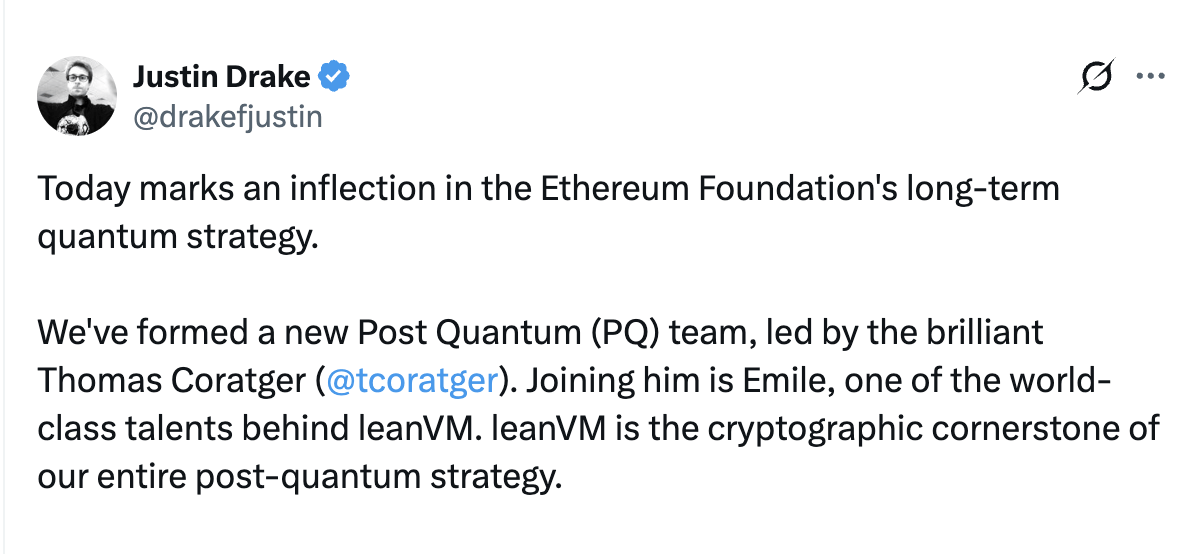
Image courtesy of Justin Drake on X.
While the Foundation is only now launching a dedicated team, Drake revealed that it has been at work since 2019, preparing for the rise of quantum computing. Founder Vitalik Buterin has been consistently calling on blockchain projects to speed up their pace as quantum computers are an existential threat. As we reported, he believes that they could break Ethereum and Bitcoin’s cryptographic techniques in four years.
To prepare for this future, researcher Antonio Sanso will begin a bi-weekly breakout call for all core developers starting next month. These calls will focus on “user-facing security, covering dedicated precompiles, account abstraction, and longer-term transaction signature aggregation with leanVM.”
Later this year, the Foundation will also host a PQ workshop, similar to the inaugural one, held last year in Cambridge. At the Ethereum conference in Cannes in March, there will also be a dedicated PQ day to discuss the latest developments.
Making Ethereum Post-Quantum Ready
The Foundation is also running multi-client PQ consensus development networks, which have brought together teams like Ream Labs and Zeam ETH, with the Foundation’s protocol coordinator Will Corcoran running the initiative.
As with any other development, education and awareness campaigns are vital to bringing more interested parties onboard. The Foundation has been working on a 6-part video series about its PQ strategy. It also joined the independent advisory board created by Coinbase last week.
To stimulate community engagement, the Foundation has announced a $1 million prize for the winners of its Poseidon challenge, which aims to strengthen the Poseidon hash function. It insists that despite the criticism, hash-based cryptography is still the way to go, although some like Cardano’s Charles Hoskinson have disagreed publicly. This is in addition to the existing $1 million Proximity Prize.
The new PQ team comes just as Optimism, a leading Layer 2 on Ethereum, unveiled its post-quantum roadmap. Optimism noted that if large-scale quantum computers arrive, “core cryptography in Ethereum and the Superchain could be at risk. Signatures and commitments are the foundation of the system. If those break, everything built on top is in trouble.”
While the entire tech world agrees that quantum computing is a systemic risk for crypto and finance, there’s major division on the timeline. Some like Vitalik believe it’s only a few years away. Others, like a16z Crypto, say these predictions are “frequently overstated.” The company, which has invested in almost every other major crypto project, says the cost of running these computers will be prohibitive, even if the technology itself matures faster than expected.
Ether trades at $2,900, dipping over** 1%** in the past day despite the trading volume skyrocketing by 240% to $32 billion.
Disclaimer: The information on this page may come from third parties and does not represent the views or opinions of Gate. The content displayed on this page is for reference only and does not constitute any financial, investment, or legal advice. Gate does not guarantee the accuracy or completeness of the information and shall not be liable for any losses arising from the use of this information. Virtual asset investments carry high risks and are subject to significant price volatility. You may lose all of your invested principal. Please fully understand the relevant risks and make prudent decisions based on your own financial situation and risk tolerance. For details, please refer to
Disclaimer.
Related Articles
Ethereum Activity at All-Time Highs Due to Mass Capitulation - U.Today
Ethereum's network shows high activity, surpassing 2021 metrics, but this surge is due to investors selling rather than genuine demand. Liquidity is declining as users withdraw capital to exchanges, signaling potential challenges ahead.
UToday47m ago
Mega Bank's Director Rui-bin Zhuang tests stablecoin remittances, but the costs of blockchain are misunderstood.
Mega Financial Holding Co. held a media briefing on the 10th. Chairman Dong Rui-bin revealed that to objectively compare the efficiency of bank and blockchain remittances, Mega Bank mobilized 17 countries worldwide and 25 overseas branches last year for testing. Branch staff opened accounts at local legal exchanges and used the virtual asset trading platform BitoPro to trade USDT stablecoins, transferring 50 USDT each time back to Taiwan, and compared this with traditional bank cross-border wire transfers.
The results showed that stablecoins do have advantages for small-scale cross-border remittances. However, for remittance amounts exceeding the equivalent of NT$200,000 (about $7,000 USD), banks remain more cost-competitive.
Mega Experiment: Banks Are More Cost-Effective for Transfers Over $7,000 USD
The test results indicated that in the scenario of "paying NT$ in Taiwan and receiving local currency at the destination," bank wire transfers generally arrive within about 2 hours, with a fee of approximately
ChainNewsAbmedia2h ago
ETH drops 1.07% in 15 minutes: whale fund concentration triggers short-term pullback
March 10, 2026, 18:00 to 18:15 (UTC), ETH's return within the 15-minute candlestick was -1.07%, with price fluctuations ranging from 2049.1 to 2073.15 USDT, an amplitude of 1.16%. During the same period, market trading volume significantly increased by over 32%, large on-chain fund flows occurred frequently, triggering short-term market sentiment fluctuations, rapidly increasing attention, and intensifying volatility risks.
The main driver of this abnormal movement is the concentrated sell-off by whale funds. On-chain data shows that within this time window, there were four large transfers exceeding 5000 ETH, all flowing to a major...
GateNews3h ago
Tom Lee’s BitMine Acquires 60,976 ETH, Holdings Now $10.3B
Bitmine Immersion Technologies reports total assets of $10.3 billion, including 4.53M ETH. With 3.04M ETH staked, it generates $174M annually at a 2.91% yield. The firm seeks to reach 5% of total ETH supply and is expanding its staking infrastructure.
CryptoFrontNews5h ago


