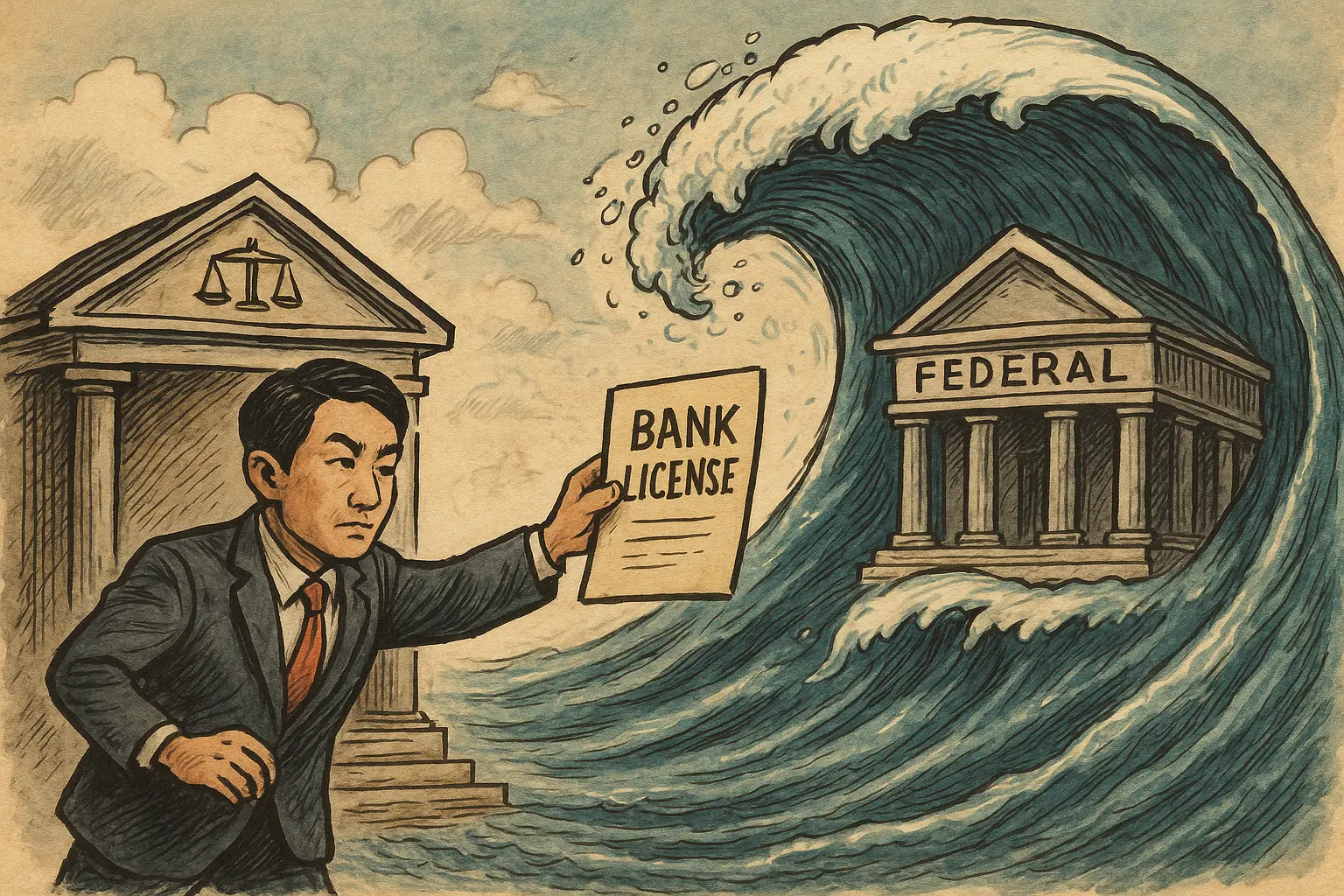
Nomura Securities’ subsidiary Laser Digital has applied for a national trust bank license with the OCC in the United States, enabling nationwide operations without state-by-state licensing. Laser Digital joins the ranks of applicants like Circle, Ripple, and BitGo, reflecting a trend of crypto companies expanding under the deregulatory environment of the Trump administration.
Strategic Value of Federal Trust Charter
Laser Digital’s application places it among an increasing number of crypto firms seeking federal trust bank status in the U.S… According to the Financial Times, the application has been submitted to the OCC, marking an important strategic shift for the crypto industry amid regulatory changes in the U.S…
The core advantage of a federal trust bank charter is “one approval, nationwide access.” Traditionally, crypto custody and trading services require separate Money Transmitter Licenses in each state, a process that takes years, is costly, and involves complex compliance. Regulatory standards vary greatly across states, with some requiring physical presence. This fragmented regulation severely limits the speed and operational efficiency of crypto firms’ expansion.
The federal trust charter fundamentally changes this. Once approved by the OCC, Laser Digital can offer custody, settlement, and crypto trading services across all 50 states without applying for individual state licenses. This “Federal Preemption” principle allows trust banks to operate under a unified federal standard, significantly reducing compliance costs and accelerating market entry. For a multinational financial institution like Nomura, this efficiency gain is especially critical.
However, the federal trust charter also comes with strict restrictions. Most notably, it prohibits the acceptance of retail deposits, meaning Laser Digital cannot offer checking or savings accounts like traditional commercial banks. This restriction is designed to isolate risks—if crypto operations encounter issues, retail depositors protected by FDIC insurance are not affected. Additionally, federal trust banks must maintain higher capital adequacy, undergo more frequent regulatory examinations, and comply with strict AML and KYC standards.
Sources indicate that Laser Digital also plans to offer spot crypto trading services. This means, beyond custody and settlement, the platform will allow institutional clients to buy and sell major cryptocurrencies like Bitcoin and Ethereum directly. This vertically integrated business model could position Laser Digital as a “one-stop” crypto service provider for institutional investors, similar to a prime broker role in traditional finance.
Regulatory Deregulation Window in Trump Era
Laser Digital’s timing is no coincidence; it is a strategic bet on changing U.S. policy environment. With Trump in office, U.S. crypto regulation has shifted direction. The “regulatory enforcement” approach championed by former SEC Chair Gary Gensler has been replaced by a “pro-innovation” stance, with federal agencies like the OCC actively approving crypto-related bank charters.
This policy shift is evident in data. In 2025, the OCC approved only two conditional crypto trust bank charters, but in the first month of 2026, five companies received preliminary approval. Industry expectations are that this approval pace will accelerate through 2026. Nomura’s decision to apply now is clearly to ride this “deregulation” wave.
From Nomura’s perspective, this is also a key part of its global crypto strategy. Nomura Securities established Laser Digital in 2021, initially focusing on Asia and Europe. However, the U.S., accounting for about 40% of global crypto trading volume, has always been a strategic priority. Previously, regulatory uncertainty and compliance costs in the U.S. led Nomura to adopt a wait-and-see approach. Now, with clearer policies, Nomura is committed to entering the U.S. market, marking a shift from a “regional player” to a “global crypto giant.”
Deeper motivation stems from competitive pressure. Traditional financial giants like Goldman Sachs and Morgan Stanley have gained early advantages in the U.S. crypto market, while native crypto firms like Coinbase and Kraken are actively applying for bank licenses. If Nomura does not establish a U.S. presence quickly, it risks losing competitiveness in the institutional crypto services market. The federal trust charter is an ideal tool for Nomura to “leapfrog” competitors.
Banking Race Among Six Major Players
Laser Digital is not alone. The U.S. Office of the Comptroller of the Currency (OCC) often grants conditional trust bank charters, requiring applicants to meet standards related to capital, governance, and compliance before final approval and operation. Several well-known crypto companies are at various stages of the application process.
Five Companies with OCC Conditional Approval
Circle: Issuer of USDC stablecoin, the second-largest stablecoin globally. The trust license aims to fully regulate stablecoin issuance, redemption, and reserve management under federal oversight.
Ripple: Behind XRP, focused on cross-border payment solutions. Trust bank status will enhance its compliance credibility among enterprise clients.
BitGo: Leading institutional-grade crypto custody provider managing over $60 billion in assets. The trust license will solidify its position as a “crypto bank.”
Fidelity Digital Assets: Fidelity’s crypto division serving over 200 institutional clients. The trust bank status will create synergy with its traditional financial services.
Paxos: Stablecoin and tokenization infrastructure provider, issuer of USDP and PAXG (tokenized gold). The trust license will make it a fully regulated digital asset bank.
Additionally, Trump-supported World Liberty Financial announced earlier this month that it is seeking a national trust license to support issuance and redemption of its USD1 stablecoin under federal regulation. If approved, this project, backed by the Trump family, would carry strong political symbolism and could further accelerate approval processes for other applications.
All these companies aim to shift their core operations from the “gray area” to the “white area”—moving from reliance on state-level licenses and self-regulation to strict federal banking regulation. While this increases compliance costs, it also brings higher market trust, lower legal risks, and better integration with traditional finance.
Stablecoin issuers and custodians increasingly adopt trust charter models to integrate issuance, settlement, and asset protection. This vertical integration trend reflects the crypto industry’s transition from “wild growth” to “institutionalization.” When stablecoin issuers are also federally regulated banks, their issued tokens will have a “bank deposit”-like credit backing, which is crucial for adoption by large enterprises and governments.
Deep Significance of Industry Structural Transformation
Laser Digital’s application for a federal trust license, along with similar moves by other crypto firms, signals a structural shift across the industry. This is not just a strategic decision by individual companies but a historic turning point of crypto moving from “anti-establishment” to “integrated into the establishment.”
From “decentralized ideals” to “regulated entities,” this transition has sparked intense debate within the community. Critics argue that crypto companies seeking bank licenses betray Bitcoin and Ethereum’s decentralization ethos, turning crypto into an extension of traditional finance. Supporters believe that only through regulatory cooperation can crypto truly mainstream and serve billions of ordinary users.
Practically speaking, the federal trust license is an essential step toward industry maturity. When institutional investors (pension funds, sovereign wealth funds, insurance companies) consider allocating to crypto assets, their primary concern is not “decentralization level” but “regulatory compliance” and “asset security.” A trust bank regulated by the OCC is far more trustworthy than a startup holding only a state license. This trust can translate into hundreds of billions of dollars in potential capital inflows.
For Laser Digital and Nomura, this application also has a broader vision: redefining the financial infrastructure for digital assets. If approved, Laser Digital could become the first Japanese financial institution branch offering “bank-grade crypto services,” providing a compliant bridge for cross-border crypto flows between Asia and the U.S. This “East-West connection” positioning is a unique advantage for Nomura, differentiating it from purely domestic U.S. players.


