XRP continues its rebound on Monday, with spot ETF experiencing its fifth consecutive day of net inflows, attracting $9,160,000 on January 27. Since its launch in November, total inflows have reached $1.25 billion, surpassing the SOL ETF’s $877 million. The Senate Agriculture Committee will review the “Market Structure Bill” on January 29, boosting legislative expectations. Short-term target is $2.5, medium-term target is $3.0.
XRP Spot ETF Records Five-Day Net Inflows
On January 27, the US XRP spot ETF market maintained strong momentum, achieving net capital inflows for the fifth consecutive trading day, indicating sustained institutional demand for XRP. According to SoSoValue data, the XRP spot ETF issuer reported a net inflow of $9,160,000, higher than the previous day’s $7,760,000, showing accelerating buying pressure.
Since the initial launch of Canary XRP ETF (XRPC) on November 14, the cumulative net inflow in the US XRP spot ETF market has reached $1.25 billion. This figure is significant in the crypto ETF space, as it exceeds the performance of the earlier launched SOL spot ETF market, which has only accumulated $877.7 million in net inflows since October, a gap of $372.3 million.
Comparison of Fund Flows: XRP ETF vs. Bitcoin ETF
XRP ETF Net Inflows: Five consecutive days, totaling $1.25 billion
Bitcoin ETF Net Outflows: Since November 14, cumulative outflows of $2.9 billion
Market Significance: Decoupling of XRP from Bitcoin, demonstrating independent demand momentum
Institutional Preference Shift: From Bitcoin allocations to XRP’s utility narrative
Notably, the strong performance of XRP ETF contrasts sharply with Bitcoin ETF. On January 27, the US Bitcoin spot ETF market experienced another outflow, and since November 14, Bitcoin ETF market has seen net outflows of $2.9 billion. This divergence suggests XRP may be decoupling from Bitcoin, establishing its own demand narrative.
Market analysts attribute XRP ETF’s robust demand to increased token utility. Unlike Bitcoin, mainly a store of value, XRP has practical applications in cross-border payments. As Ripple partners with more financial institutions, XRP’s utility is translating into institutional demand. This “utility premium” allows XRP ETFs to attract capital even as Bitcoin ETFs face selling pressure.
Five consecutive days of net inflows reflect a strategic shift among institutional investors. Continuous capital inflow in crypto ETFs often signals more stability than single large inflows, indicating sustained demand rather than speculative impulses. When institutions increase XRP exposure over multiple days, it usually reflects long-term fundamental confidence rather than short-term price movements.
Senate Review on January 29 as a Key Catalyst
The rescheduling of the “Market Structure Bill” review by the US Senate Agriculture Committee to January 29 is crucial for XRP’s short-term price trajectory. Previously delayed due to bad weather, the committee’s review is a key step toward passing legislation that could clarify the legal status of digital assets including XRP.
Amendments and committee votes are critical before the bill proceeds to a full Senate vote. If the Agriculture Committee approves the bill on January 29, focus will shift to the Banking Committee’s revisions and schedule. Market sentiment is optimistic that the Senate will ultimately pass the bill, supporting XRP’s price.
However, the legislative process faces hurdles. After Coinbase (COIN) withdrew support for the “Market Structure Bill,” the Banking Committee withdrew its draft and postponed the scheduled review on January 15. Coinbase CEO Brian Armstrong cited concerns that proposed amendments would eliminate stablecoin rewards and allow banks to ban competitors.
The core issue is the conflict of interest between banks and the crypto industry. US banks warn that if legislation permits stablecoin yields, given their higher deposit returns compared to US banks, there could be a capital outflow of up to $6 trillion. Such outflows would weaken banks’ lending capacity and net profit margins, impacting their record profits.
Recently, Andrew Scaramucci summarized how US banks are trying to block DeFi competition, stating: “The whole system is collapsing: banks don’t want to face competition from stablecoin issuers, so they block yields. Meanwhile, China is issuing yield-bearing stablecoins—do you think emerging countries will choose a yield-generating system or a non-yield one?”
Despite these obstacles, market remains optimistic about legislative progress. Recent price movements highlight XRP’s sensitivity to congressional regulatory developments. After the Banking Committee announced the January 15 review, XRP surged from $1.8103 on December 31 to a high of $2.4151 on January 6. However, due to delays in the Senate Banking and Agriculture Committee reviews, XRP dropped to a low of $1.8113 on January 25. Subsequently, optimism about the January 29 review pushed XRP back above $1.91.
Technical Targets at $2.5 but Need to Break Key Resistance
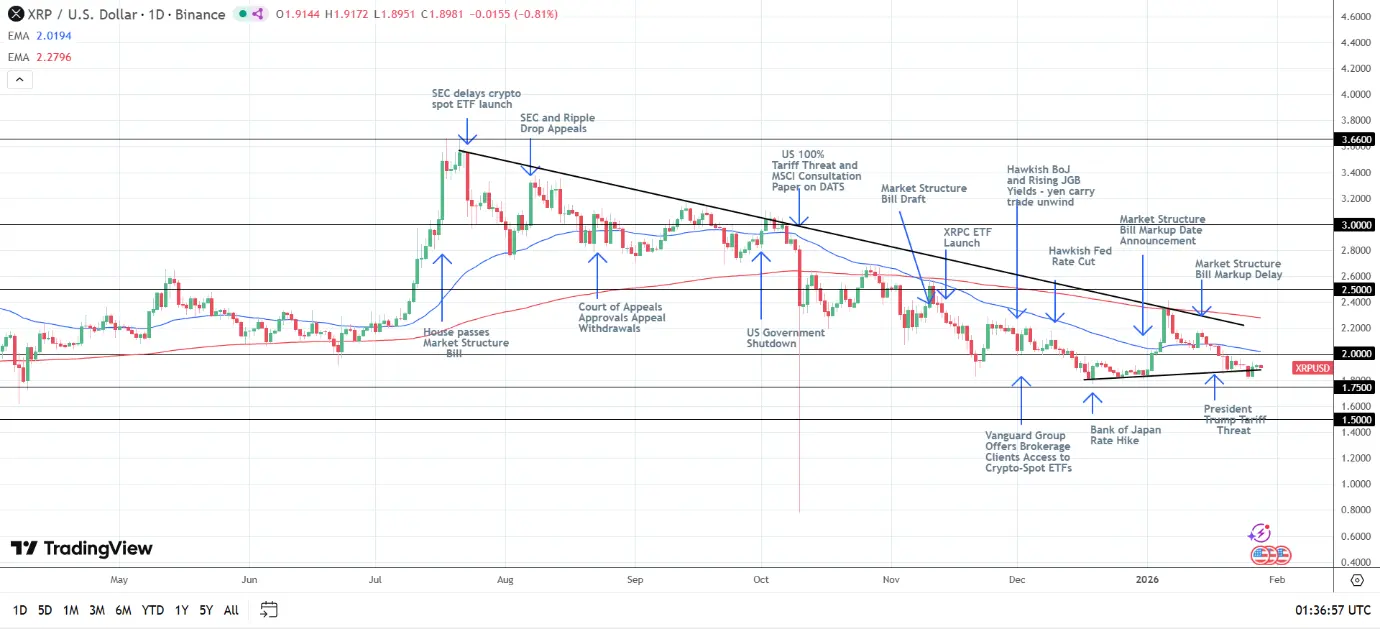
(Source: Trading View)
On January 27, XRP rose 0.50%, closing at $1.9136, after gaining 3.83% the previous day. Despite the gains, XRP remains below its 50-day and 200-day moving averages, indicating a bearish bias. However, positive fundamentals continue to offset technical weakness, reaffirming a bullish outlook.
Key technical levels to watch include: support at $1.85, $1.75, then $1.50; resistance at the 50-day moving average of $2.0194; 200-day moving average of $2.2796; and overhead resistance at $2.0, $2.5, $3.0, and $3.66.
On the daily chart, breaking above $2.0 will activate the 50-day moving average. Notably, sustained breakout above the 50-day MA would signal a short-term trend reversal. A bullish reversal could push bulls to challenge $2.2. Further, breaking $2.2 would pave the way to test the 200-day moving average. Continued breakthroughs of these averages would reinforce bullish medium- and short-term price targets.
The strong demand for XRP spot ETF again confirms a positive near-term outlook (1-4 weeks), with a target of $2.5. Additionally, market expectations that the Senate will pass the “Market Structure Bill” and the increasing utility of XRP also strengthen long-term bullish forecasts: mid-term (4-8 weeks) target at $3.0; long-term (8-12 weeks) target at $3.66.
Downside Risks and Central Bank Policy Variables
Despite the bullish outlook, some factors could challenge optimism. The Bank of Japan hints at multiple rate hikes to reach a higher neutral rate (possibly between 1.5%-2.5%). Higher neutral rates could narrow the US-Japan interest rate differential more than expected. A significant narrowing might trigger unwinding of yen carry trades, similar to mid-2024. Such unwinding would negate short-term bullish sentiment.
Additionally, Fed Chair Powell’s hawkish stance has diminished market expectations for rate cuts in the first half of 2026. Powell will hold a press conference on January 28, and his policy signals will be critical for XRP’s near-term price outlook. Support for rate cuts in 2026 and for Japan’s potential lowering of the neutral rate (possibly between 1%-1.25%) could boost XRP demand.
Further delays or partisan opposition to the “Market Structure Bill” also pose risks. If the Agriculture Committee fails to pass the bill on January 29, or if the Banking Committee continues to block it, market sentiment could turn sharply bearish. Ultimately, reports of net outflows from XRP spot ETF would be the most direct negative signal. These scenarios could pressure cryptocurrencies, causing XRP to fall below $1.85 and signaling a bearish trend reversal.


