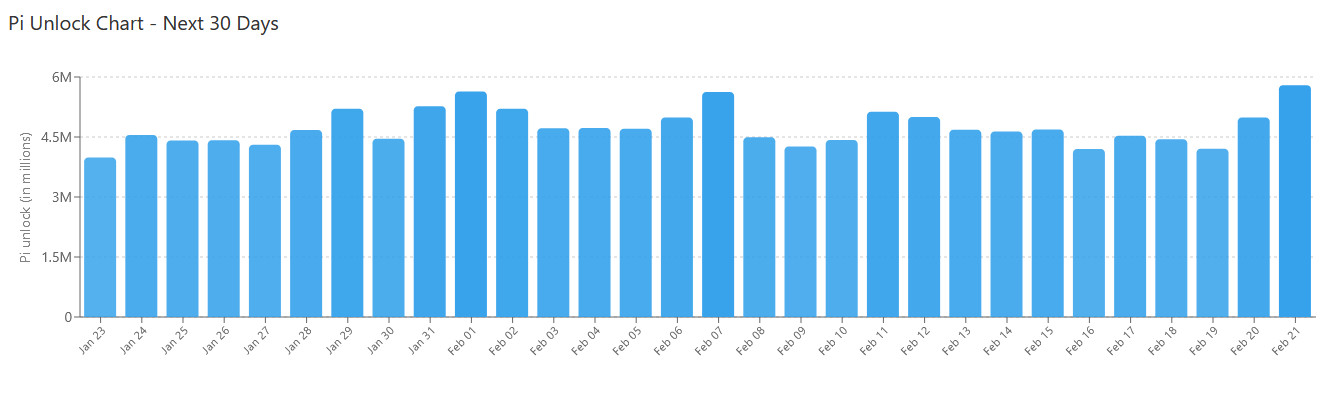
Pi coin drops to $0.17, approaching the all-time low of $0.1585. The January unlock of 134 million tokens (far exceeding December’s 8.7 million) is hard for the market to digest. RSI at 30.94 indicates oversold, MACD shows a bearish trend. Key support is at $0.13; breaking below could test $0.12. Despite having 215 applications in the ecosystem, short-term sentiment remains bearish.
134 Million Token Unlock Creates the Largest Annual Supply Shock
(Source: PiScan)
Pi coin completed its largest planned token unlock in January 2026, with 134 million PI entering circulation. This supply far exceeds what the market can absorb without triggering uncontrollable price declines, becoming a primary catalyst for Pi’s continued price drop. Compared to December’s smaller 8.7 million unlock, which was smoothly absorbed, the January unlock is over 15 times larger, posing a severe challenge to price stability.
From a supply and demand perspective, 134 million tokens at the current price of $0.17 represent a potential selling pressure of about $2.28 million. If holders of these unlocked tokens choose to cash out immediately and buying interest cannot keep up, prices will fall. More critically, these unlocked tokens often come from early teams, investors, or miners—whose cost basis is extremely low (possibly near zero)—giving them strong incentives to sell at any price.
This “unlock and dump” pattern is common in crypto markets. During the 2021 bull run, many projects saw their prices halved or even go to zero after large-scale unlocks. Pi’s situation is more complex because it has not yet been listed on mainstream exchanges; liquidity is mainly concentrated in OTC markets and small exchanges, which amplifies the price impact of the unlock due to insufficient liquidity.
In recent weeks, Pi’s price has been consolidating around $0.17, retreating to the lows of October 2025. The market seems to have pre-absorbed some of the unlock expectations, but once the 134 million tokens actually enter circulation, the actual selling pressure could be greater than anticipated. This period coincides with increasing economic uncertainty, as the Federal Reserve will hold its first FOMC meeting of the year on January 27-28, which could influence overall investor sentiment in the crypto space.
If the FOMC signals hawkishness (e.g., maintaining high interest rates or hinting at further hikes), risk assets will face greater pressure, and Pi, as a less liquid small-cap, could see steeper declines than major cryptocurrencies. Conversely, if the FOMC signals dovishness (e.g., easing or rate cuts), it could provide short-term momentum for crypto markets, but support for Pi will still depend on the actual scale of unlock selling pressure.
Technical Outlook Fully Bearish, $0.13 as the Last Defense
(Source: Trading View)
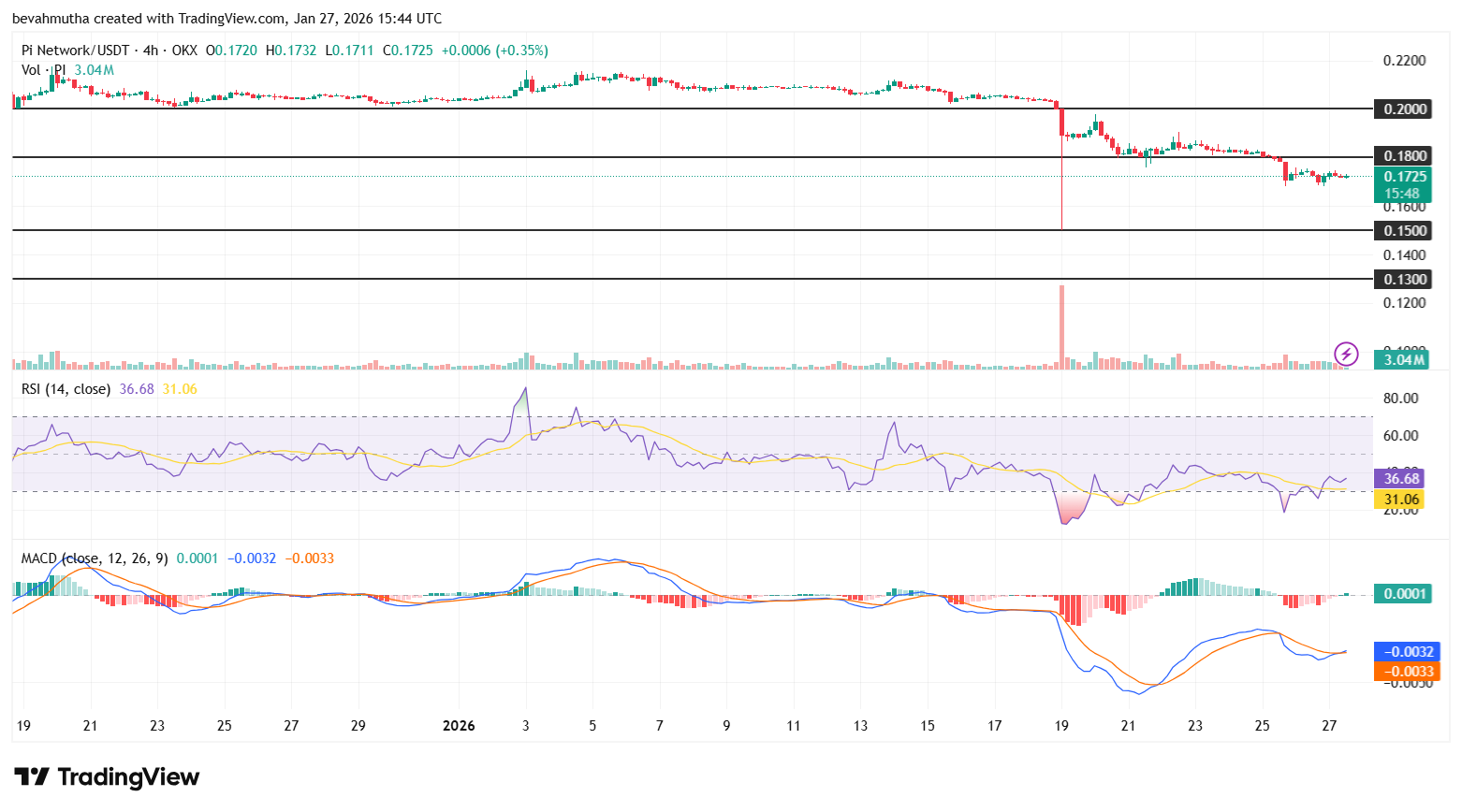
At press time, Pi 幣 price has fallen 2% in the past 24 hours, down to $0.1720. The Relative Strength Index (RSI) is at 30.94, indicating the coin is in oversold territory. The MACD remains bearish, with both MACD line and signal line below zero, and the histogram continuing negative, confirming ongoing downward momentum.
An RSI of 30.94 suggests Pi has entered a technically oversold zone, which could imply a rebound opportunity. However, oversold conditions do not guarantee an immediate reversal; in a strong downtrend, RSI can remain in oversold territory for extended periods or even decline further. During Bitcoin’s bear market in 2018, RSI stayed below 30 for months, with prices dropping from $6,000 to $3,200. Therefore, relying solely on RSI oversold signals to time a bottom is risky; it must be combined with other indicators and fundamental developments.
The MACD’s bearish structure is even clearer. Both MACD line and signal line are below zero, and their distance does not show signs of narrowing, indicating the downward momentum has not yet exhausted. Only when the MACD histogram turns positive and the fast line crosses above the slow line to form a golden cross can a trend reversal be confirmed. Currently, this reversal signal is still far off.
After breaking below $0.18, Pi is now struggling to stay above $0.16. The coin faces resistance around $0.18 and $0.20; further declines could test support levels at $0.15 and $0.13. If selling pressure persists, the next key level to watch is $0.12, which is below the previous low of $0.1585, setting a new record low.
Key Price Levels for Pi
Resistance levels: $0.18 (short-term), $0.20 (mid-term), $0.22 (breakout target)
Support levels: $0.15 (first line), $0.13 (critical support), $0.12 (new low)
Current price: $0.17 (weak zone between support and resistance)
Why is $0.13 so critical? This level has been tested multiple times as support in the past. Based on volume distribution, the $0.13–$0.15 range has significant historical trading activity. If it breaks below $0.13, it would mean all investors holding in this zone are trapped, potentially triggering panic selling and accelerating the decline toward $0.12 or lower.
Can 215 dApps Support the Price?
Despite immense selling pressure, the Pi ecosystem continues to focus on increasing demand. The team is working to enhance application utility to counteract the growing supply pressure. Currently, Pi has over 215 applications, with developer numbers steadily increasing. These dApps cover e-commerce, gaming, social, tools, and other categories, theoretically creating real usage demand for Pi.
However, the number of dApps does not directly translate into price support. The key is their actual activity and transaction volume. If most of these 215 dApps are inactive or have minimal daily users, they cannot generate enough Pi consumption to offset unlock selling pressure. The Pi Network team has not publicly disclosed detailed usage data for these dApps, making it difficult to assess the ecosystem’s true health.
Historically, ecosystem development tends to lag behind token price support. Ethereum accumulated many dApps from 2015 to 2017, but its price only surged during the 2017 ICO boom. Solana built its DeFi ecosystem in 2020-2021, with a price explosion in 2021. This lagging effect suggests that even if Pi’s ecosystem development is on the right track, short-term price stabilization is unlikely.
Pi also faces a fundamental challenge: it is not listed on major exchanges. The core team announced last year a strategic shift to prioritize ecosystem development over exchange listing. While this reflects a long-term focus, it also limits liquidity and price discovery efficiency. Currently, Pi is mainly traded OTC and on small exchanges, which have much lower depth than Binance or Coinbase, making prices more susceptible to manipulation by large orders.
If Pi’s future prospects cannot break above $0.18, it may retest $0.20 and strive toward $0.22. However, given the current technical and fundamental setup, such a rebound seems unlikely in the near term. Investors should remain cautious and closely monitor the support at $0.13.


