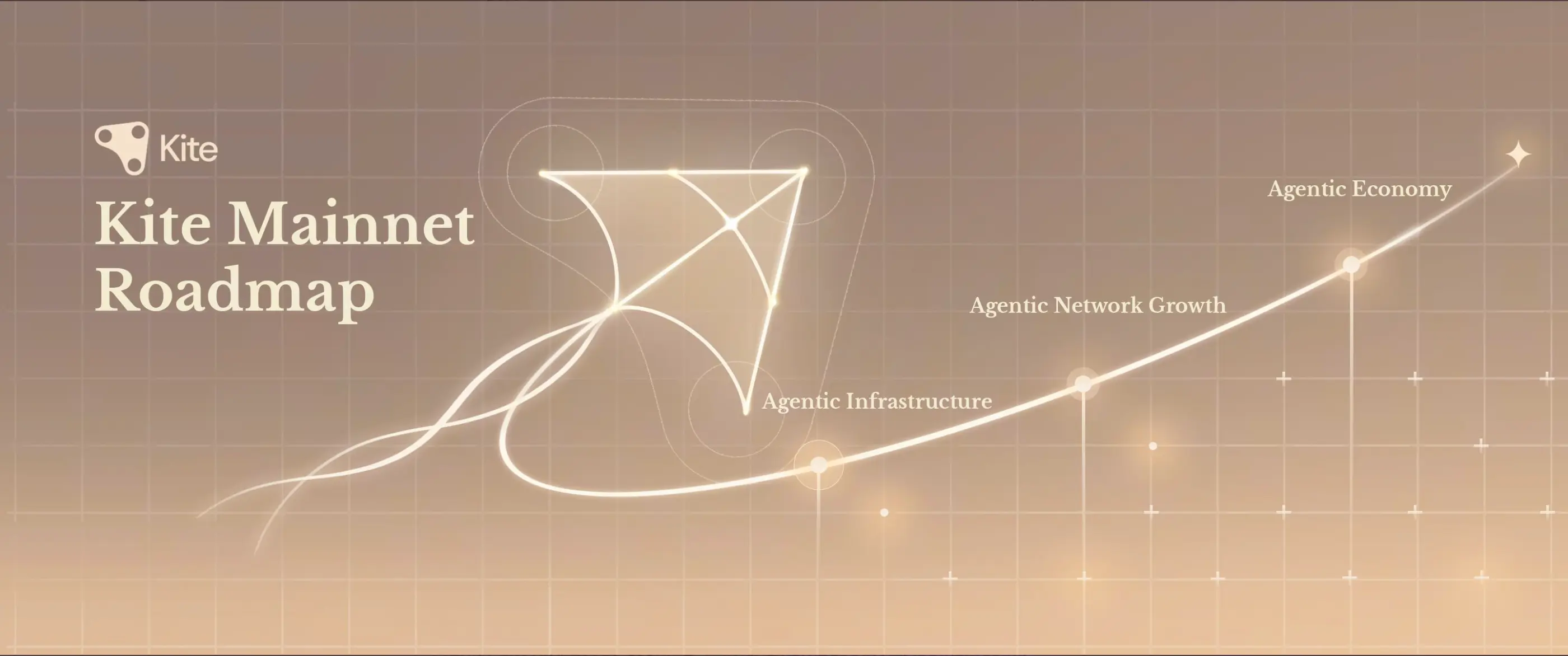
The Kite Network has officially unveiled its comprehensive mainnet roadmap, charting a decisive course to build the essential infrastructure for an economy run by autonomous AI agents.
Moving beyond conceptual frameworks, this roadmap details six strategic pillars designed to solve the core bottlenecks of identity, payment, and governance in a machine-driven world. Crucially, Kite positions itself as the native settlement layer for standards like Coinbase’s x402, enabling a seamless “pay-per-call” model for agent interactions. This article dives deep into Kite’s blueprint for Agentic Trust, Settlement, and Growth, analyzing its potential to transition the crypto narrative from human-centric DeFi to a scalable, trust-minimized autonomous economy. We examine the technical deliverables, market implications, and why this infrastructure could be the missing piece for mainstream AI agent adoption.
The Autonomous Economy Imperative: Why Crypto Needs Kite
The convergence of artificial intelligence and blockchain is no longer a futuristic fantasy; it is an immediate engineering challenge. As AI agents evolve from conversational chatbots to task-executing entities—booking flights, managing portfolios, or coordinating supply chains—they hit a fundamental wall: our current economic infrastructure is built for humans. Traditional payment systems like credit cards rely on “human-in-the-loop” authentication and dispute resolution, processes that are far too slow and ambiguous for machines operating at digital speeds. This creates a critical bottleneck, stifling the potential of a truly autonomous economy.
Enter projects like Kite, which are being built with a first-principles approach. The core thesis is simple yet profound: if AI agents are to become economic actors, they require a native financial layer. This layer must provide machine-readable identities, programmable governance, and instantaneous, auditable settlement. Kite’s mainnet roadmap, therefore, is not just another blockchain launch; it is a meticulous construction plan for the economic operating system of autonomous agents. By aligning with emerging internet payment standards like Coinbase’s x402 protocol, Kite aims to make payment a seamless, native part of any API call, removing friction and enabling micro-transactions at scale. This foundational work addresses the “who,” “how,” and “under what rules” of machine-to-machine commerce, positioning Kite at the forefront of a potentially trillion-dollar shift.
Deconstructing the Six Pillars: Kite’s Blueprint for an Agentic World
Kite’s strategy is articulated through six interconnected pillars, each addressing a critical failure point in today’s attempt to integrate AI with value transfer. This structured approach moves the project from vague ambition to verifiable execution.
Pillar 1: Agentic Trust – From Anonymity to Verifiable Identity
For autonomous agents to handle real-world value, trust must be engineered into the system, not assumed. The primary risk is ambiguity: an anonymous software process with access to funds and APIs is a systemic vulnerability. Kite’s Agentic Trust pillar tackles this by building a robust identity and governance framework.
At its heart is KitePass, a system for establishing verifiable, on-chain agent identities. This transforms agents from anonymous callers into accountable entities. When an agent makes a request, counterparties can cryptographically verify:** **Which agent is this? Who authorized it? What are its permission bounds? This identity becomes a composable object, enabling fine-grained, attributable actions across complex, long-running workflows.
On top of identity sits Programmable Governance. Instead of relying on manual reviews and post-hoc audits, Kite encodes authority, budgets, and risk constraints directly into executable, on-chain policies. These rules—dictating who can sign, what endpoints are accessible, and what spending limits apply—are enforced at the moment of execution. This shifts security from a retrospective “best practice” to a proactive, machine-enforceable guarantee, creating a foundation of trust that scales with the ecosystem.
Pillar 2: Agentic Settlement – The Rails for Machine-Native Payments
High-frequency agent interactions demand equally high-frequency, reliable settlement. Without it, systems devolve into unmanageable credit risk. Kite’s Agentic Settlement pillar is the financial plumbing that makes the autonomous economy liquid and accountable.
This involves creating a stablecoin-native payment rail optimized for near-zero gas fee settlements, ensuring the unit of account and transfer is both stable and verifiable. The roadmap emphasizes the development of “facilitators”—components that allow resource providers to set pricing rules and enable payers to complete transactions while generating auditable proof. Most critically, Kite is building end-to-end fiat on-ramp and off-ramp pathways. This closed loop is vital for real-world usability, allowing users and ecosystem participants to enter and exit the economy with minimal friction, bridging the gap between traditional finance and the agentic world.
The x402 Integration: A Strategic Masterstroke
A key differentiator for Kite is its native compatibility with Coinbase’s x402 protocol. x402 elegantly embeds payment requirements directly into HTTP API responses. If an AI agent calls a paywalled API, it receives a payment request; it can then fulfill this request and retry the call with cryptographic proof.
- Kite’s Role: Kite acts as the execution and settlement layer for this standard. It provides the standardized “payment intents” and final on-chain settlement, turning the x402 handshake into a finalized, irreversible transaction.
- The Impact: This creates a clean, universal “pay-per-call” model for the entire internet. For AI agents, it means seamless access to millions of monetized APIs without pre-funded accounts or complex billing agreements. This interoperability positions Kite not as a closed garden, but as the open settlement backbone for a broader agent economy.
Pillar 3: SmartDev Infra – Fueling Ecosystem Growth with Superior Tools
A blockchain is only as valuable as the ecosystem it supports. Kite’s SmartDev Infra pillar is a dedicated commitment to developer experience, ensuring builders can onboard, innovate, and debug with ease.
The deliverables are systematic: a zero-fee RPC gateway for reliable access, comprehensive documentation and operational guides to reduce hidden costs, and a suite of tooling for observability and debugging, including block explorers and monitoring APIs. This triad ensures that external teams can develop agent-native applications in a self-serve manner, with full visibility into transactions and contract interactions. This reduces dependency on Kite’s core team and accelerates the pace of ecosystem innovation, which is the ultimate metric for any infrastructure platform’s success.
Pillar 4: Agent Network Operations – Engineering Real Decentralization
Decentralization is operationalized through Kite’s Agent Network Operations pillar. It moves beyond ideology to deliver a participatory, secure, and scalable validator network.
The roadmap details the launch of audited staking contracts, user-friendly validator dashboards, and a Validator-as-a-Service (VaaS) program. The VaaS initiative is particularly strategic, lowering the technical barrier to becoming a network validator and ensuring decentralized participation from day one. By phasing in external validators and rigorously testing network performance, Kite is building a robust Proof-of-Stake foundation that guarantees long-term security and censorship resistance—a non-negotiable requirement for an economy handling significant value.
Pillar 5: AgenticFi – Liquidity and Access for the $KITE Ecosystem
A token without utility and liquidity is a ghost town currency. The AgenticFi pillar ensures the $KITE token is functional and liquid from the outset, weaving it into the fabric of the network.
This involves establishing cross-chain bridges for asset portability, securing fiat on-ramp partnerships for easy entry, and launching core DeFi primitives like decentralized exchanges (DEXs) and liquid staking derivatives (LSDs). A DEX provides immediate price discovery and deep liquidity for $KITE, while LSDs allow stakers to maintain liquidity, enabling their staked assets to be used in other DeFi strategies. This focus on “Day 1 liquidity” is a critical lesson learned from earlier blockchain launches; it ensures the economic flywheel can start spinning immediately, attracting users, developers, and capital in a synergistic loop.
Pillar 6: The Ecosystem Growth Engine – Sustainable Flywheel Mechanics
Growth must be engineered, not hoped for. Kite’s final pillar, the Ecosystem Growth Engine, is dedicated to building measurable, replicable momentum.
This is achieved through a transparent incentive framework tied to on-chain identity and behavior, making rewards explainable and auditable. Coupled with this is an active ecosystem program—hackathons, incubation batches, and partner integrations—designed to catalyze demonstrable use cases and sustain developer engagement. By binding growth mechanics directly to the core pillars of identity and settlement, Kite aims to convert short-term incentives into long-term, compounding network effects, where every new agent and developer adds tangible value to the entire system.
The Competitive Landscape: How Kite Stacks Up
Kite does not exist in a vacuum. It operates in a nascent but competitive space at the intersection of AI and crypto. Understanding its position requires a brief landscape analysis.
Direct and Indirect Competitors: Projects like Fetch.ai and SingularityNET focus on creating and hosting AI agent marketplaces, often with their own internal coordination mechanisms. Chainlink’s CCIP and Axelar provide generalized cross-chain messaging, which could be adapted for agent communication but lack native agent identity and payment layers. Ethereum L2s like Arbitrum or Optimism offer scalable execution but are general-purpose; they lack the specialized primitives Kite is building for autonomous agents.
Kite’s Strategic Edge: Kite’s differentiation is its singular focus on being the *economic settlement and trust layer*. Instead of building the agents themselves or a general-purpose blockchain, it provides the indispensable infrastructure** **forall agents. Its deep integration with standards like x402 gives it a potential first-mover advantage in standardizing agent-to-service payments. By being “agent-native” from the ground up, it could achieve a level of efficiency and security that retrofitted general-purpose chains cannot match.
The KITE Token: Utility, Mechanics, and Economic Design
At the center of Kite’s autonomous economy is its native token,** **$KITE. Its design is critical to aligning all network participants—users, developers, validators, and agents.
Core Utility Functions:
- Network Security & Governance: $KITE is the staking token for the Proof-of-Stake consensus mechanism. Validators stake $KITE to secure the network and earn rewards. Token holders can also delegate their stake and participate in governance votes to steer the protocol’s future.
- Settlement Gas Fees: While designed for efficiency, transactions on the Kite network require $KITE to pay gas fees. This creates a constant, utility-driven demand for the token as agentic activity grows.
- AgenticFi Collateral: $KITE will serve as a key collateral asset within the native DeFi ecosystem, including in lending protocols and as a liquidity pair in DEXs.
- Access & Incentives: Certain premium network services or governance rights may be gated by $KITE holdings. Furthermore, the ecosystem growth engine will use $KITE (or points redeemable for it) to incentivize desired behaviors like building high-quality agents or providing liquidity.
Tokenomics and Distribution: A sustainable token economy requires careful planning to avoid inflation-driven dilution or concentrated sell pressure. While the full tokenomics are detailed in Kite’s official documentation, a successful model typically involves allocations for ecosystem development, team (with long-term vesting), foundation treasury, and community incentives (like airdrops or liquidity mining). The phased release of these tokens, aligned with mainnet milestones and ecosystem growth, is crucial for long-term health.
Future Trajectory: From Roadmap to Reality
The published roadmap is a promise; the next 12-24 months are about delivery. Kite’s journey will likely unfold in distinct, overlapping phases.
Phase 1: Foundation & Launch (Next 6-12 months): This involves the core technical delivery: launching the mainnet with basic Agentic Trust (KitePass) and Settlement capabilities, onboarding the first external validators, and deploying initial DeFi primitives. Success here is measured by technical stability and the onboarding of early developer partners.
Phase 2: Ecosystem Activation (12-24 months): With core infrastructure live, the focus shifts to growth engine ignition. Expect to see major hackathons, grants for agent-building projects, and integrations with existing AI platforms and tools. The goal is to catalyze the first wave of compelling, revenue-generating “killer agent” use cases that demonstrate the network’s unique value.
Phase 3: Network Effects & Scale (24+ months): The ultimate test. Can Kite become the default settlement layer for a significant portion of autonomous agent transactions? This phase depends on achieving liquidity dominance for $KITE, fostering a rich ecosystem of composable agent services, and seeing organic adoption beyond incentivized programs. If successful, Kite transitions from a promising project to a critical piece of global digital infrastructure.
FAQ
1. What is the Kite Network?
The Kite Network is a blockchain platform specifically designed to be the economic infrastructure for an autonomous economy powered by AI agents. It provides essential services like verifiable agent identity, programmable governance, machine-native payment settlement, and tools for developers to build agentic applications.
2. What is the x402 protocol and how does Kite use it?
x402 is an open standard pioneered by Coinbase that integrates payment requirements directly into HTTP API responses. Kite builds native compatibility with x402, acting as its settlement layer. This allows AI agents to seamlessly pay for API services on a per-call basis, with Kite providing the final, on-chain proof of payment.
3. What is $KITE and what is it used for?
$KITE is the native utility token of the Kite Network. It is used to pay for transaction gas fees, secure the network through staking, participate in governance, and provide liquidity within the network’s DeFi ecosystem. Its demand is designed to grow in tandem with usage of the Kite Network by AI agents.
4. How is Kite different from other “AI + Crypto” projects?
Many projects focus on creating the AI agents themselves or are general-purpose blockchains. Kite’s unique focus is on being the specialized** economic layer for **all autonomous agents. It provides the trust, identity, and settlement infrastructure that agents need to interact and transact value reliably and at scale, regardless of who built them.
5. When will the Kite mainnet launch and how can developers get involved?
The mainnet launch is a phased process outlined in the published roadmap, unfolding over the next 1-2 years. Developers interested in building on Kite should monitor the official Kite channels for the release of testnets, developer documentation, and grant/ hackathon announcements. Early engagement typically offers the greatest opportunity for support and recognition.


