Bitcoin falls below $80,000, with ETF holders facing a paper loss of $7 billion. Over the weekend, it dropped to $74,609 and has now rebounded to $77,649. The average cost basis for ETFs is $90,200, representing a 15% loss, with 62% of capital inflows in loss. MicroStrategy’s cost basis is $76,020, with profits shrinking to $1.17 billion. If outflows continue, the next support level is $65,500.
Average ETF Loss of 15% Corresponds to $7 Billion Unrealized Loss
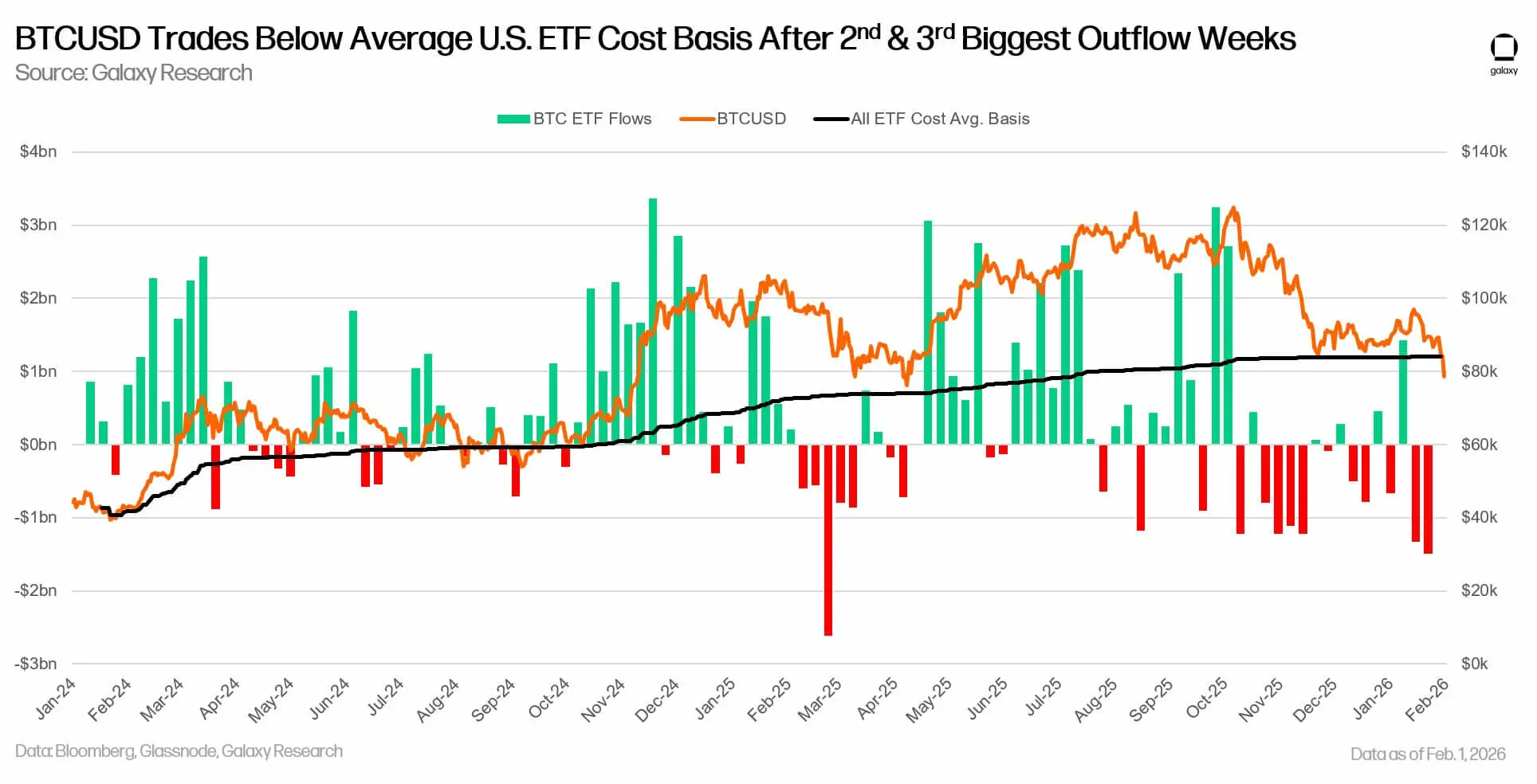
(Source: Jim Bianco)
Through on-chain analysis and capital flow tracking, the extent of losses is becoming increasingly clear. Jim Bianco of Bianco Research notes that currently, 12 spot Bitcoin ETFs hold about 1.29 million BTC, worth over $115 billion. These funds collectively hold approximately 6.5% of the circulating Bitcoin supply. If combined with MicroStrategy’s corporate holdings, ETF holdings account for 10% of all Bitcoin.
However, their entry points are vastly different. MicroStrategy has been buying Bitcoin since 2020, with an average purchase price of $76,020, and has unrealized profits of only $1.17 billion, far below the over $30 billion profit last October. The sharp decline in profits shows that even long-term holders are not immune to market volatility. While the $1.17 billion buffer seems large, relative to its total investment of $54.26 billion and holdings of 713,502 BTC, this buffer only accounts for 2.2%, making it extremely fragile.
In contrast, ETF investors entered later and paid higher prices. Bianco points out that the average purchase price of the 12 spot Bitcoin ETFs is about $90,200, roughly $13,000 (16%) above the current price. The weighted average purchase price across these ETFs is $85,360, implying an average loss of about $8,000. This equates to an unrealized loss of approximately $7 billion for these investors. Essentially, this will cause ordinary Bitcoin ETF buyers to incur losses.
James Check from CheckOnChain adds another nuance: if we assume the cost basis of capital inflows is the price at the day of inflow, then 62% of ETF capital inflows are now in loss. This proportion is astonishing, indicating that over 60% of ETF buyers are experiencing losses, and this widespread unrealized loss will have a profound impact on market sentiment.
This mechanism will alter behavior. Unlike self-managed investors who can tolerate significant volatility, ETF holders—including advisors and asset allocators—will rebalance according to preset portfolio rules. When ordinary holders are in loss, a rebound could trigger “liquidation selling”—investors selling during price recoveries to cut losses rather than waiting for full recovery. This behavior pattern will suppress the strength of rebounds.
Monthly Outflows of $2 Billion Correspond to Selling Pressure of 27,000 BTC per Month
Losses among Bitcoin ETF holders are also accompanied by a significant shift in capital flow direction. From November 2025 to January 2026, net outflows from the 12 spot Bitcoin ETFs totaled about $6.18 billion. This marks the longest monthly capital outflow period since these products launched in 2024. Notably, large daily redemptions often occur during the withdrawal process.
Data from SoSo Value shows that in the last two trading days of January, these products recorded over $1.3 billion in net redemptions, with only $6.3 million in small inflows over nine days of outflows. When capital outflows surge, the market absorbs supply over a shorter period, potentially increasing intraday volatility. In such cases, Bitcoin’s trading behavior often resembles that of high-beta macro assets, with volatility exceeding that of tech stocks.
Fundamentally, capital outflows signal a reversal in the fate of Bitcoin ETFs, which had previously been a stable demand source for this leading cryptocurrency. The future market question is about the basic supply and demand: if capital outflows persist, what will happen to Bitcoin’s price discovery?
If ETF markets continue to lose over $6 billion every three months, the implied monthly net outflow rate is about $2 billion. Assuming Bitcoin’s price is $75,000, this means other buyers need to absorb roughly 27,000 to 28,000 BTC each month. If prices fall, the same dollar outflow will correspond to more BTC, increasing the amount that must be absorbed elsewhere.
Compared to the issuance schedule after Bitcoin halving, this number is larger. The 2024 halving reduces block rewards to 3.125 BTC, with an average daily new supply of about 450 BTC, or roughly 13,500 BTC per month. Therefore, if ETF redemptions continue at recent speeds, each month’s outflow would be equivalent to about two months of new issuance. Unless other demand sources re-emerge, this supply-demand imbalance could impact market sentiment and further depress Bitcoin prices.
Supply-Demand Imbalance from ETF Capital Outflows
Monthly Outflow Rate: $20 billion (based on the past three months’ $61.8 billion)
Corresponding BTC Volume: 27,000–28,000 BTC (at $75,000 per BTC)
New Monthly Supply Post-Halving: 13,500 BTC
Supply-Demand Ratio: ETF outflows are equivalent to twice the monthly issuance, indicating severe imbalance
Retail-Driven ETF Redemptions Amplify Price-Driven Sell-offs
The relationship between ETF capital flows and price movements is statistically significant, and the composition of buyers helps explain this relationship. A report from K33 Research last year found that Bitcoin’s price remains closely correlated with ETF capital flows, with an R-squared of 0.80, accounting for about 80% of the variance in 30-day BTC returns. This high correlation suggests ETF capital flows can almost fully explain Bitcoin price changes.
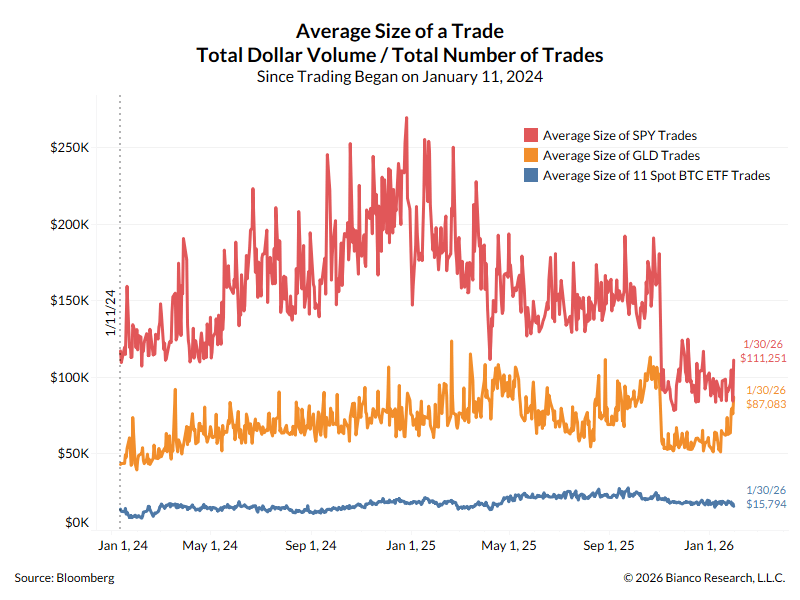
Bianco notes that average trading size can reflect who is driving these funds’ trading activity. The average trade size for SPDR S&P 500 ETF (SPY) is $111,300, for SPDR Gold ETF (GLD) is $87,000, while for Bitcoin ETFs it is only $15,800. He believes this trading pattern resembles retail investors rather than long-term institutional holdings.
If, as Bianco suggests, marginal ETF holders are more like retail investors, then capital flows may become more “price-driven.” Simply put: when prices fall, more investors may choose to exit, and this withdrawal manifests as redemptions. Redemptions force issuers to sell spot Bitcoin to meet cash withdrawals, which can push prices lower again, creating a negative feedback loop.
Considering this, analysis indicates that if buyers enter at around $75,000, that level could provide support. If Bitcoin’s price remains in this zone and capital flows stabilize, ETFs might shift again from being net sellers to marginal buyers. This would reduce mechanical oversupply and could suppress market volatility.
However, if capital outflows persist, Bitcoin could face significant resistance, further lowering its price. Joao Wedson, CEO of Alphractal, points out that in such a scenario, the next major support level is around $65,500. This target is about 16% below current levels and would wipe out MicroStrategy’s $1.17 billion buffer, putting it into a paper loss.
MicroStrategy’s $76,020 Cost Basis Becomes Market Lifeline
MicroStrategy’s average cost basis of $76,020 has become the most watched price level in the market. If Bitcoin continues to fall below this threshold, MicroStrategy will face a paper loss, potentially triggering a chain reaction. Although MicroStrategy’s holdings are uncollateralized and lack immediate liquidity risk, the paper loss could impair its ability to continue financing Bitcoin purchases. Investors may question the effectiveness of its Bitcoin strategy, and stock price pressure could make future equity financing for Bitcoin acquisitions more difficult.
The key market question is: who will be the buyers after ETF outflows? Monthly outflows of $2 billion correspond to selling pressure of 27,000–28,000 BTC, which is twice the monthly issuance. Unless MicroStrategy or other large institutional buyers significantly increase their purchases, this supply-demand imbalance will continue to depress prices. The current market is at a critical juncture—whether $75,000 can hold will determine the short-term trend.


