Losses at CrossCurve underline the high risk of cross-chain bridges during periods of rising crypto attacks.
CrossCurve halted user activity after an attack targeted its cross-chain bridge. The incident forced developers to investigate a smart contract flaw. Partner protocols and and security firms issued warnings as funds were traced on-chain.
User Interactions Halted as CrossCurve Examines Contract Weakness
CrossCurve confirmed on Sunday that its cross-chain bridge was targeted by attackers. The team linked the incident to a flaw in one of the bridge’s smart contracts. Users were asked to pause all activity while developers began reviewing the issue.
Because assets are held across multiple smart contracts, moving them between networks increases risk when a single component fails.
⚠️ URGENT Security Notice
Dear users,
Our bridge is currently under attack, involving the exploitation of a vulnerability in one of the smart contracts used.
Please pause all interactions with CrossCurve while the investigation is ongoing.
We appreciate your patience and… pic.twitter.com/yfo1KvWoDd
— CrossCurve (@crosscurvefi) February 1, 2026
Curve Finance addressed its community shortly after the incident. Users with exposure to CrossCurve pools were advised to reassess their positions and decide whether to withdraw voting support. The statement urged careful judgment when interacting with external protocols during unstable conditions.
Early checks found damage limited to the bridge, with no issues detected across other protocol components. Alerts went out quickly, while the team kept access paused and tracked the movement of stolen funds.
Protocol Calls for Asset Returns After On-Chain Review
After tracing on-chain activity, the team found that funds from the exploit had moved into 10 wallet addresses. CrossCurve said it could not confirm whether those wallets belonged to the attackers and saw no clear hostile behavior at that point. Even so, the protocol acknowledged that users lost funds due to the exploit.
In response, project officials appealed directly to recipients to return the assets. The team described the transfers as improper and asked for cooperation. To support recovery efforts, CrossCurve activated its SafeHarbor WhiteHat policy, offering a reward of up to 10% of recovered funds if the rest is returned.
Details included a direct contact email for coordination. An alternative option allows anonymous returns through a designated wallet address. The team said recovered funds would be returned to affected users after review.
Moreover, CrossCurve shared a contact email to help coordinate the return of funds. A separate wallet address was also provided for those who prefer to send assets back without revealing their identity. After verification, the team said it plans to distribute recovered funds to affected users.
Recent Breaches Expose Ongoing Risks in Decentralized Finance
Crypto attacks have increased across the industry, with the CrossCurve incident adding to a growing list of breaches. Security firm CertiK recorded nearly $400 million in losses in January 2026, with more than 40 major incidents reported.
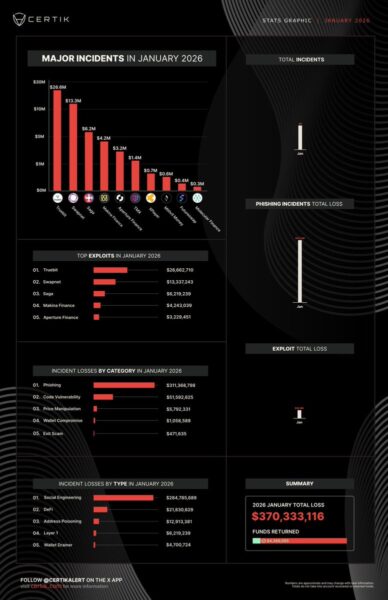
_Image Source: _X/CertiK
Cross-chain systems face a higher risk because they handle large amounts of funds and rely on complex structures. Recent incidents show how fast damage can spread once an exploit begins.
Other victims during the same period included Swapnet, which lost $13 million. Saga and Makina Finance reported losses of $6.2 million and $4.2 million. Step Finance also suffered a breach that drained several treasury and fee wallets, moving more than 261,000 SOL.
Losses across 2025 passed $1 billion, marking the worst year on record for crypto theft. The CrossCurve case adds another reminder of ongoing security gaps within decentralized finance.
Disclaimer: The information on this page may come from third parties and does not represent the views or opinions of Gate. The content displayed on this page is for reference only and does not constitute any financial, investment, or legal advice. Gate does not guarantee the accuracy or completeness of the information and shall not be liable for any losses arising from the use of this information. Virtual asset investments carry high risks and are subject to significant price volatility. You may lose all of your invested principal. Please fully understand the relevant risks and make prudent decisions based on your own financial situation and risk tolerance. For details, please refer to
Disclaimer.
Related Articles
Sillytuna Hackers Move Over $10M in Stolen Crypto Funds
The Sillytuna hackers have laundered over $10M in stolen funds, primarily using Bitcoin and DAI, through exchanges and mixers to obscure the origins. Despite these movements, they still hold $19M in stolen assets.
BlockChainReporter1h ago
Shiba Inu: Alert Issued as SHIB Participant Social Media Account Gets Hacked - U.Today
Ragnarshib warns the Shiba Inu community about a hacked account belonging to Vet Kusama, currently used by scammers to send fraudulent messages. Users are advised not to interact with the account or its links until it is recovered.
UToday3h ago
IoTeX Releases ioTube Security Incident Report: Actual Losses Approximately $4.4 Million, Pledges Full Compensation to Affected Users
IoTeX reports that the ioTube cross-chain bridge incident on March 6 resulted in approximately $4.4 million in losses. 99.5% of the stolen assets have been frozen, and the team has committed to fully compensate affected users. The mainnet has resumed operation, and the attacker’s address has been blacklisted. Meanwhile, efforts are underway to promote decentralized governance and security audits.
GateNews6h ago
Prince Group is laundering 10.7 billion NT dollars in Taiwan! Developing their own "OJBK Wallet" to connect with underground currency exchanges.
Taipei District Prosecutors Office is investigating the Cambodia "Prince Group" money laundering case, indicting 62 individuals and 13 companies. The involved amount of money laundering is 10.7 billion, and assets worth 5.5 billion have been seized. The group used USDT and their self-developed "OJBK Wallet" to conduct cross-border money laundering, conceal criminal proceeds, and withdraw cash in multiple countries.
区块客8h ago
HypurrFi reveals that early versions of Aave V3 had a rounding error vulnerability, and the addition of new lending markets for XAUT0 and UBTC has been suspended.
HyperEVM's custodial lending protocol HypurrFi disclosed that previous versions of Aave V3 had a "rounding error" vulnerability, allowing attackers to extract underlying tokens. HypurrFi guarantees the safety of user funds, has paused supply and borrowing operations in affected markets, and is working with relevant parties to address security issues.
GateNews9h ago
AI agents bypass Cloudflare protection, encrypting DeFi front-end security faces further tests
Recently, the autonomous AI agent OpenClaw successfully bypassed Cloudflare defenses using the Scrapling library, raising concerns about DeFi security. Although the tool can legally scrape content, the potential risks remind developers to establish multiple layers of defense and avoid over-reliance on traditional protection measures.
GateNews10h ago


