Sustained price pressure and weather-related outages reduced mining power, forcing a rare and large network adjustment.
Bitcoin’s mining network went through a major reset over the weekend after a steep fall in computing power. Slower block production over several weeks forced the system to make a rare and large adjustment. Experts cited market pressure and weather-related disruptions as the reasons for such a large move.
Bitcoin Network Responds to Sudden Loss of Computing Power
Bitcoin mining difficulty fell 11.16% on Saturday, dropping to 125.86 trillion at block height 935,424. Data from Mempool shows the adjustment came after average block times stretched to about 11.4 minutes, well above the network’s 10-minute target.
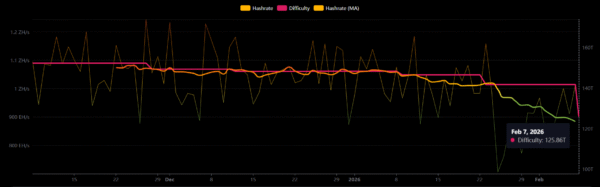 _Image Source: _Mempool
According to Bitcoin developer Mononaut, the adjustment represents the biggest difficulty drop since China forced miners to shut down operations in July 2021. Few adjustments of this size have ever occurred, placing the move among the ten largest declines in the network’s history.
Bitcoin just experienced an 11.16% drop in difficulty – the largest negative adjustment since the July 2021 china mining ban crash, and the 10th largest negative % adjustment of all time. https://t.co/AVUGsv8mlB pic.twitter.com/Fauykg0d3l
— mononaut (@mononautical) February 7, 2026
As many miners shut down their machines, the network’s computing power declined, causing blocks to be produced more slowly. Over the past month, about one-fifth of the network’s mining power disappeared, with much of that loss happening in just the past week.
Since China’s mining ban, Bitcoin has seen very few large difficulty drops. The largest prior incident occurred in June 2025, when extreme heat forced many miners to scale back operations. Another smaller difficulty cut occurred in early February 2025.
Price Slump and U.S. Weather Events Cut Bitcoin Mining Activity
Experts suggest the recent price weakness remain a factor behind the hashrate retreat. Bitcoin has dipped from its October peak of above $126,000, falling more than 45%.
Bitcoin prices came under pressure as government bond yields rose and investors pulled money from exchange-traded funds. Further, the broader shift away from risk assets also weighed on demand. Data from SoSoValue shows U.S. spot bitcoin ETFs becoming net sellers in 2026.
At the same time, a winter storm in the United States knocked a large share of mining power offline. At one point, as much as 40% of global hashrate was unavailable. Miners across several power regions reduced activity to ease stress on local grids and protect household electricity supply.
In contrast, lower mining difficulty offers short-term relief. With fewer machines online, miners still operating face less competition and can earn more per unit of computing power if prices remain stable.
Still, the OG coin is trading near $69,475 and price charts point to continued weakness across both short and long-term periods. This downside signals weak market confidence and limits the relief miners expect.
Disclaimer: The information on this page may come from third parties and does not represent the views or opinions of Gate. The content displayed on this page is for reference only and does not constitute any financial, investment, or legal advice. Gate does not guarantee the accuracy or completeness of the information and shall not be liable for any losses arising from the use of this information. Virtual asset investments carry high risks and are subject to significant price volatility. You may lose all of your invested principal. Please fully understand the relevant risks and make prudent decisions based on your own financial situation and risk tolerance. For details, please refer to
Disclaimer.
Related Articles
Nic Carter: The controversy over BIP-360 authorship is not important; focus should be on the quality of the proposal and quantum resistance goals
Castle Island Ventures Partner Nic Carter stated that the Bitcoin community should focus on the technical quality of the BIP-360 proposal rather than the author's identity. By eliminating the quantum vulnerability in Taproot addresses, it paves the way for Bitcoin's quantum resistance. As ECC risks become increasingly apparent, enhancing quantum resistance has become an important topic.
GateNews5m ago
Bitwise: Why is Bitcoin destined to reach one million dollars?
The author analyzes the potential of Bitcoin, believing it could reach $1,000,000 within the next ten years. By viewing Bitcoin as an emerging store of value asset and comparing it to the gold market, the article demonstrates the possibility of Bitcoin capturing a larger market share in the future. The author points out that the global store of value market is continuously expanding, and Bitcoin investments are gradually being accepted by institutions, but also warns of risks such as market stagnation and insufficient Bitcoin market share. Overall, the author maintains an optimistic outlook on Bitcoin's prospects.
PANews30m ago
Bitcoin spot ETF net inflow yesterday was $115 million, with BlackRock IBIT leading the charge.
On March 11, the total net inflow of Bitcoin spot ETFs reached $115 million, continuing for 3 days of net inflow. BlackRock ETF IBIT had the highest single-day net inflow at $115 million; Fidelity ETF FBTC had a net inflow of $15.3685 million. Grayscale ETF GBTC, on the other hand, experienced a net outflow of $15.9676 million. The current total net asset value of Bitcoin spot ETFs is $90.886 billion, with a total net inflow of $55.902 billion.
GateNews1h ago
Exodus Movement Releases Financial Report: FY2025 Revenue of $121.6 million, holding over 610 BTC as of the end of February
Exodus Movement releases FY2025 financial report, with revenue reaching $121.6 million, a new record high. The company holds over 610 Bitcoin and 1,840 Ethereum, and has fully repaid the $60 million debt financing obtained through Galaxy Digital.
GateNews2h ago


