


Crypto Payment Cards: $113 million in January transactions! An average of $4 million daily, turning investment into everyday spending

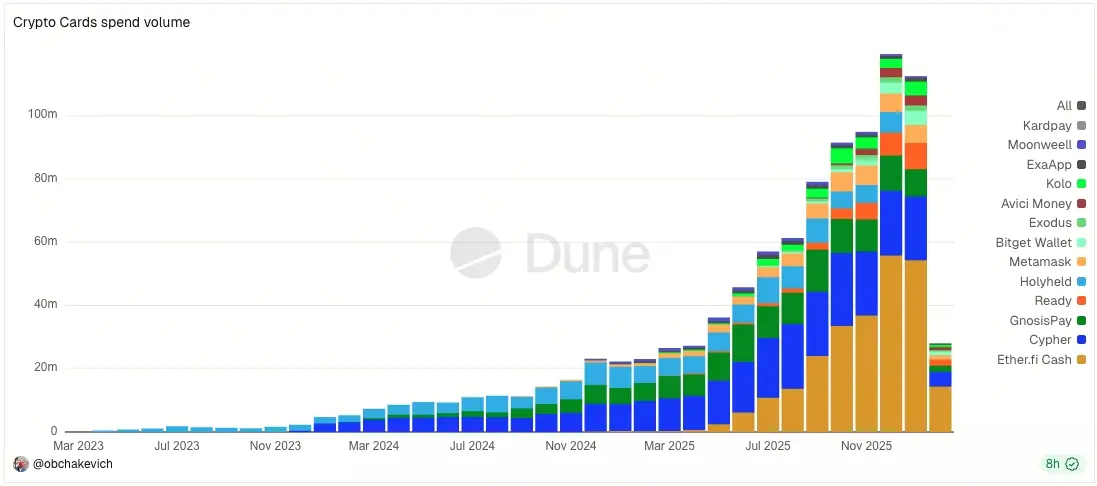
Crypto Payment Card: In January, transactions reached $113 million, a 5.8% decrease from December, ending a 12-month streak of continuous growth, with a stable daily average of 3.5 to 4 million dollars. During payment, cryptocurrencies are instantly converted into fiat currency, allowing merchants to receive fiat without needing to understand blockchain technology, thereby eliminating complexity and enabling global spending.
Market Signal: First Correction After 12 Months of Continuous Growth
(Source: Dune)
According to @obchakevich_'s data dashboard, in January 2026, crypto payment cards recorded a transaction volume of $113 million, representing a slight decline of about 5.8% compared to December 2025, ending a full year of uninterrupted growth. This slowdown warrants further analysis—is it seasonal adjustment or a sign of a trend reversal? January is typically a slow month for consumption, as consumers may reduce spending ahead of the Lunar New Year to prepare for the Spring Festival. The 5.8% decrease is relatively mild and could simply reflect normal seasonal fluctuations.
Currently, crypto payment cards have processed nearly $27.5 million in transactions this month, with an average daily volume of approximately $3.5 to $4 million. This daily stability is a more meaningful indicator. Although the total monthly volume has slightly declined, the daily transaction volume remains at a healthy level, indicating that the user base and usage habits have not fundamentally changed. An average of $3.5 to $4 million per day means thousands to tens of thousands of transactions occur daily, demonstrating that crypto payment cards have transitioned from experimental to everyday use.
A 12-month growth streak itself is an impressive achievement. From January to December 2025, the crypto payment card market experienced continuous expansion, a rare phenomenon in the crypto industry. Most crypto applications tend to have volatile growth patterns, with sharp rises and falls, but crypto payment cards show a steady, reliable adoption curve. This difference likely stems from crypto payment cards addressing genuine needs—namely, convenience for daily spending—rather than speculative trading.
Key Data on the Crypto Payment Card Market
- Total transaction volume in January: $113 million, down 5.8% from December
- Consecutive growth record: First correction after 12 months of continuous increase
- February progress: Approximately $27.5 million processed (as of data cutoff)
- Daily transaction volume: Stable at $3.5 to $4 million
If February can resume growth, the January correction will be viewed as a healthy adjustment. However, if February continues to decline, it may indicate market plateauing or emerging challenges. The overall decline in cryptocurrency prices could be a factor; as users’ crypto assets decrease in value, their willingness to spend diminishes accordingly. Additionally, new competitors entering the market might divert some transaction volume.
From Investment Asset to Daily Currency: A Paradigm Shift
Crypto cards enable users to spend digital assets just like traditional debit cards. Users no longer need to lock cryptocurrencies as investments; instead, they can use them for daily purchases—online, in physical stores, or anywhere that accepts bank cards. This shift is quietly transforming the flow of global capital. For a long time, cryptocurrencies have been mainly viewed as buy-and-hold assets. Using them felt complicated, slow, and disconnected from everyday life.
Crypto cards function very similarly to ordinary debit cards. The main difference is that they do not deduct funds directly from a bank account but from a linked crypto wallet. When making a purchase, cryptocurrencies are automatically and instantly exchanged into local fiat currency. From the merchant’s perspective, everything remains the same—they receive fiat currency as usual, with the conversion process handled automatically in the background. This seamless experience removes one of the biggest barriers to crypto payments: usability.
This real-time conversion mechanism is at the core of crypto payment cards. When users swipe their card, the system automatically calculates the amount of crypto needed for the purchase and completes the conversion and settlement within milliseconds. The entire process is transparent to both users and merchants; the only difference is that users are spending crypto assets instead of fiat deposits. Integration with Visa and Mastercard networks allows crypto payment cards to be used at millions of merchants worldwide without requiring any changes on the merchant’s side.
One of the greatest challenges of cryptocurrencies has always been their complexity. Managing private keys, switching between exchanges, and concerns about acceptance have made using crypto very inconvenient. Crypto cards simplify all of this. Users no longer need to worry about exchange rates or supported currencies—they can pay just like they normally do. This convenience is helping crypto move from a niche technology to mainstream daily use.
Financial Inclusion and the Revolution in Cross-Border Payments
Crypto cards also open doors for those who lack access to traditional banking services. In many regions, opening a bank account can be costly, time-consuming, or even impossible. Crypto wallets can be created quickly and linked to bank cards, enabling global spending. For freelancers, remote workers, and digital nomads, this flexibility is especially valuable—they can earn, hold, and spend across borders without relying entirely on traditional financial systems.
Approximately 1.7 billion adults worldwide are unbanked, yet most own mobile phones. Crypto payment cards provide a way to bypass traditional banking systems and directly connect to the global financial network. Users only need a crypto wallet and a virtual or physical crypto card to spend anywhere that accepts Visa or Mastercard globally. This financial inclusion is one of the most socially impactful contributions of crypto payment cards.
Cross-border payments are another major advantage. Traditional bank cards often incur high currency conversion fees and cross-border transaction fees—sometimes 3% to 5% of the transaction amount. Crypto payment cards typically have lower conversion costs because cryptocurrencies are inherently global and do not require multiple intermediaries. For frequent travelers or consumers, this cost savings is highly attractive.
Many crypto cards offer rewards paid in cryptocurrencies rather than cash. Everyday expenses—such as groceries, transportation, or subscriptions—allow users to accumulate digital assets gradually. For long-term crypto holders, this method aligns better with their financial goals than traditional cashback programs. For example, some crypto cards offer 1% to 3% rewards in Bitcoin or stablecoins on spending, which could appreciate significantly during a bull market.
Envisioning a Future Where Payments Shift from Niche to Mainstream
Crypto cards will not replace banks overnight, but they are reshaping expectations. By combining familiar card payment methods with blockchain innovation, crypto cards demonstrate that cryptocurrencies are not just investments—they are practical tools for daily transactions. As adoption and regulation mature, crypto cards could play a key role in making digital assets a normal part of everyday payments—not just what we hold, but what we actively use.
While current monthly transaction volumes of around $113 million are still a small fraction of the global payments market, the growth trend indicates enormous potential. Maintaining this momentum over 12 months could push annual transaction volumes beyond $1.5 billion. If such growth continues over several years, crypto payment cards could evolve into a multi-billion-dollar industry. The key challenge remains attracting mainstream users, not just crypto enthusiasts.
Regulatory clarity is essential for widespread adoption. Currently, most crypto cards are issued by licensed financial institutions that comply with KYC (Know Your Customer) and AML (Anti-Money Laundering) regulations, enabling access to Visa and Mastercard networks. As more countries clarify their regulatory frameworks for crypto payments, compliance will improve, and traditional banks and financial institutions may begin issuing crypto cards directly, greatly expanding the market.
From a technological standpoint, future crypto payment cards may incorporate additional features: multi-currency automatic selection (paying with the most favorable exchange rate crypto), DeFi yield integration (automatically investing idle funds into yield protocols), and NFT-based benefits (holding specific NFTs for discounts or privileges). These innovations will turn crypto payment cards into comprehensive crypto financial service portals.
For the crypto industry, payment cards are a powerful “killer app.” They require no changes from merchants, no complex technical knowledge from users—just swipe and pay as usual. This “frictionless” user experience is critical for mass adoption. The $113 million monthly transaction volume demonstrates that this vision is gradually becoming a reality.