Bitcoin has plummeted 46% from its all-time high of $126,000, with multiple on-chain indicators showing the market remains deep in “capitulation.” Long-term holders are massively reducing their positions, and realized profit/loss ratios are approaching critical levels. Analysts predict that the true bottom for BTC may occur in Q4 of this year, possibly dropping to the $40,000 to $50,000 range.
(Background: The four-year cycle is dead! Bitwise: Actually, the bear market started in February 2025, but the DAT reserve company’s buying activity saved crypto.)
Table of Contents
- Long-term holder mass exodus, 245,000 BTC reduced in one day
- MVRV Z-Score drops to -2.66, “still in capitulation zone”
- Analyst: BTC bottom may be in Q4, targeting $40K–$50K
- The brutal consensus on a bear market year
Bitcoin selling pressure intensified again on Thursday, with the price quickly retreating from an intraday high of $68,300. Recent reports from on-chain analytics firms Glassnode and CryptoQuant both point to the same conclusion: Bitcoin’s capitulation has not yet ended, and the market may still face deeper pain.
Long-term holder mass exodus, 245,000 BTC reduced in one day
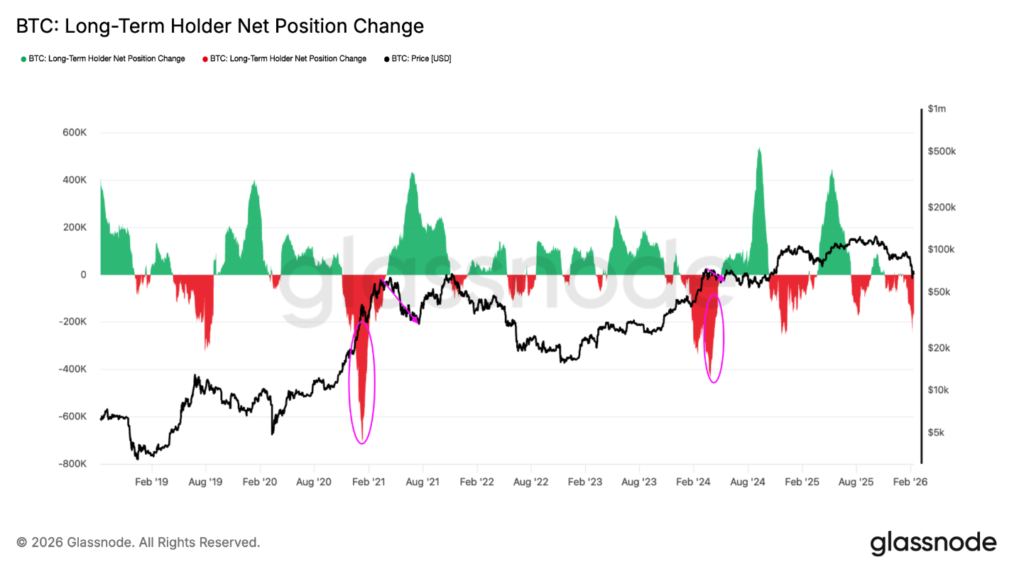
According to Glassnode’s net position change data for long-term holders (LTH), investors holding over 30 days reduced their holdings by 245,000 BTC on February 6, setting an extreme record for this cycle. Since then, this group has continued to reduce their holdings by about 170,000 BTC daily.
It’s worth noting that similar large declines in LTH net positions occurred during corrections in 2019 and 2021, periods that were followed by prolonged consolidation and further declines.
MVRV Z-Score drops to -2.66, “still in capitulation zone”
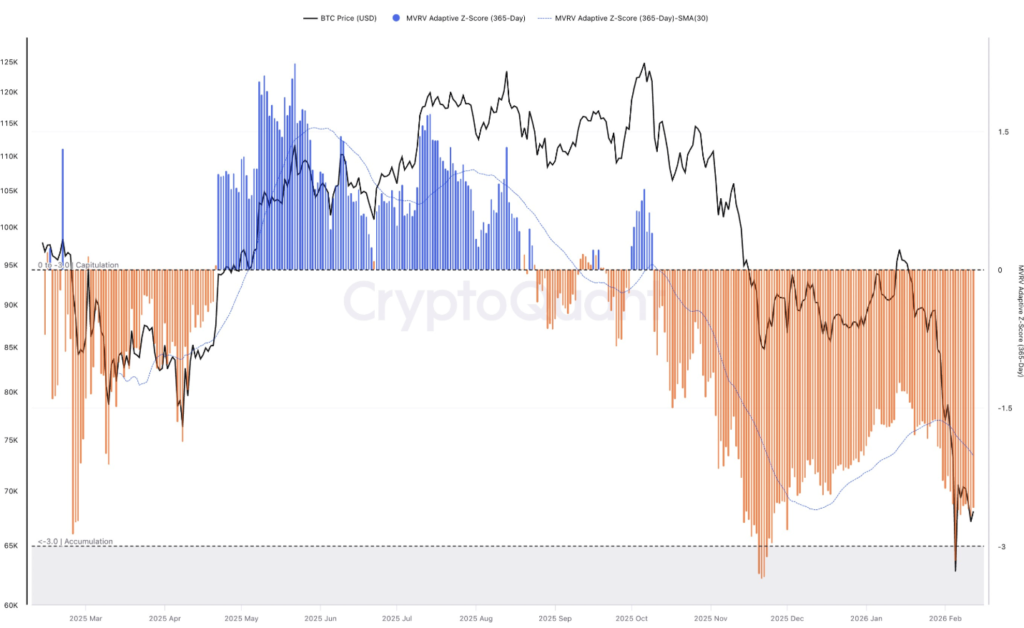
CryptoQuant’s data shows that Bitcoin’s MVRV adaptive Z-Score (365-day window) has fallen to -2.66, further confirming the severity of current selling pressure.
On-chain analyst GugaOnChain states:
“The current Z-Score reading of -2.66 indicates Bitcoin remains in capitulation. This metric suggests we are approaching a historic accumulation phase.”
Additionally, Glassnode’s realized profit/loss ratio is nearing the critical level of 1. Historically, when this ratio drops below 1, it indicates a market in “full capitulation” — meaning realized losses outweigh realized gains.
Analyst: BTC bottom may be in Q4, targeting $40K–$50K
Several analysts, based on technical and on-chain data, have made predictions about the timing of Bitcoin’s bottom. Crypto analyst Tony Research bluntly states:
“I believe BTC will bottom between $40,000 and $50,000, most likely between mid-September and late November this year.”
Another analyst, Titan of Crypto, points out that, looking back at the 2018 and 2022 bear cycles, lows typically occur about 12 months after the market top. Bitcoin’s all-time high of $126,000 was reached on October 2, 2025. If this cycle follows the same rhythm, the bottom could be around October this year.
On-chain analyst On-Chain College shared another key data point: Bitcoin’s net realized loss surged to $13.6 billion on February 7, reaching an extreme level comparable to the peak of the 2022 bear market. The analyst adds:
“The peak of losses in 2022 occurred five months before the actual bear market bottom.”
Based on this, BTC may bottom out around July this year.
The brutal consensus on a bear market year
Combining multiple forecasts, 2026 is widely regarded as a bear market year, with many analysts increasingly considering the possibility of Bitcoin dropping to $40,000. For investors still in the market, the key question is no longer “Will it fall?” but “How much more and for how long will it fall?”
This article is for informational purposes only and does not constitute investment advice. Cryptocurrency markets are highly volatile; please assess risks carefully before investing.

Disclaimer: The information on this page may come from third parties and does not represent the views or opinions of Gate. The content displayed on this page is for reference only and does not constitute any financial, investment, or legal advice. Gate does not guarantee the accuracy or completeness of the information and shall not be liable for any losses arising from the use of this information. Virtual asset investments carry high risks and are subject to significant price volatility. You may lose all of your invested principal. Please fully understand the relevant risks and make prudent decisions based on your own financial situation and risk tolerance. For details, please refer to
Disclaimer.
Related Articles
In the past hour, the entire network has liquidated $90.08 million, and crude oil futures contracts have liquidated $29.2 million.
Gate News Report, March 9th, Coinglass data shows that in the past hour, the total liquidation across the entire network reached $90,084,300, with long positions liquidated at $43,935,600 and short positions at $46,148,700. By asset type, XYZ:CL (Crude Oil Futures Contract) liquidation was $29.2 million, and BTC liquidation was $22.12 million.
GateNews16m ago
Bitcoin Price Bounces, But Bears Are Still in Control: Analysis
In brief
Bitcoin is up 4.78% today trading at $69,128.
Last week's apparent triangle breakout closed as a massive bullish wick — a classic false breakout signal.
On Myriad, prediction market traders are split among bulls and bears, with no clear consensus on which way the squeeze
Decrypt36m ago
BTC 15-minute increase of 1.42%: On-chain capital inflow and technical breakout points resonate to trigger buying interest
From 19:15 to 19:30 on March 9, 2026 (UTC), the BTC price experienced a 15-minute return of +1.42%, with trading ranges between 68,377.3 and 69,365.3 USDT, and a volatility of 1.44%. This fluctuation far exceeds the regular intraday volatility levels, with market attention significantly heightened, and short-term buying surges intensifying the volatility.
The main driver of this movement was net inflow of on-chain funds, triggered by large transfers from major holder accounts, along with buy orders breaking through key technical resistance levels.
GateNews45m ago
Bitcoin Leads $619M Weekly Inflows Amid Geopolitical Jitters and Oil-Driven Pullback
The digital asset market showed a strange kind of calm last week, not reckless, not euphoric, just strangely stubborn. According to CoinShares, investment products tied to cryptocurrencies pulled in a net US$619 million, a sign that, even amid geopolitical jitters tied to Iran, a meaningful chunk of
BlockChainReporter1h ago


