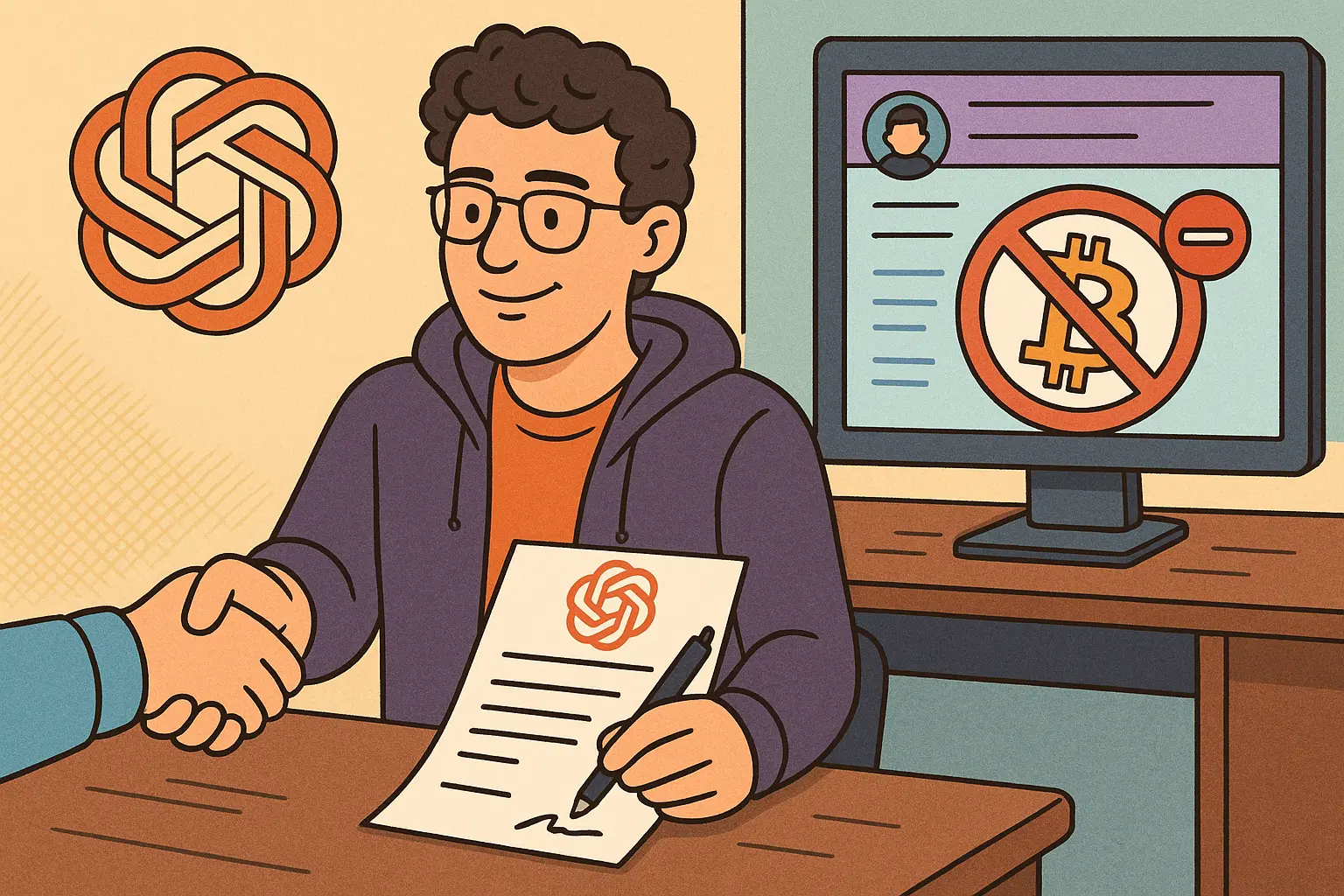
OpenClaw, the open-source AI agent framework founded by Peter Steinberger, has confirmed that its Discord server has completely banned discussions related to Bitcoin or any other cryptocurrencies. Violators will be directly banned. Steinberger stated that the rule was implemented because a large influx of crypto scammers had entered the community and started harassing members, severely disrupting normal technical discussions among developers.
Reason Behind the Discord Ban: Scammer Harassment
OpenClaw quickly gained about 147,000 stars on GitHub within just a few weeks, becoming one of the most prominent open-source frameworks in AI agent development. However, this rapid rise in popularity also attracted continuous influxes of crypto speculators.
In an interview with Lex Fridman, Steinberger described the severity of the issue, saying that every half hour, someone would flood the Discord server with spam promoting crypto tokens. Community moderators had to constantly ban these accounts, and genuine technical discussions were almost drowned out.
As early as January this year, Steinberger publicly stated on X (formerly Twitter): “To all crypto enthusiasts, please stop bothering me, stop harassing me. I will never issue any cryptocurrency. Any project that lists me as a token holder is a scam.”
Three Core Rules for OpenClaw Discord Ban Policy
Prohibit all mentions of cryptocurrencies: Including Bitcoin, Ethereum, and any token-related topics
Prohibit financial discussions: The server is solely for technical development and does not accept any financial advice or investment topics
Immediate ban for violations: Users agree to these rules upon joining; violations will result in immediate ban without warning
Steinberger clearly stated: “I am not interested in discussing financial matters here. This is a place to discuss the project.”
OpenClaw Joins OpenAI: Redefining the Technical Roadmap
OpenClaw was initially launched under the name “Clawdbot,” positioned as an open-source framework for building AI agents. AI agents are software systems designed to autonomously perform tasks for users and are considered a core infrastructure layer for AI applications.
Last week, OpenAI CEO Sam Altman announced that Steinberger would join OpenAI to help develop “intelligent agents capable of interacting with each other and providing practical services to people,” positioning this work as a key focus for the company’s next phase of products. In a blog post, Steinberger wrote: “What I want is to change the world, not build a big company. Collaborating with OpenAI is the fastest way for everyone to experience this change.”
Crypto Community Reactions: Contradictions and Altman’s Worldcoin Controversy
The ban has sparked widespread discussion on X, with some users attempting to persuade Steinberger to soften his stance. However, there are no signs that the policy will change.
A notable contradiction has emerged: Sam Altman is a co-founder of the crypto project World (formerly Worldcoin), which issues tokens to users who scan their irises and holds influence within the crypto community. Some X users questioned how Steinberger’s “zero crypto” stance aligns with his boss’s involvement in a crypto project, but there is no public evidence of a direct connection.
Another user raised a more substantive question: “What will these AI agents use for payments? Are you building an open-source decentralized network on the Visa platform?” This question points to the payment infrastructure for AI agents and touches on the potential use of cryptocurrencies as a settlement layer for AI transactions.
Frequently Asked Questions
What is OpenClaw, and why is it so prominent in AI?
OpenClaw (formerly Clawdbot) is an open-source framework for building AI agents, allowing developers to create intelligent software systems capable of autonomous task execution. It has amassed about 147,000 stars on GitHub in a few weeks, reflecting strong developer interest in autonomous AI agent technology and sparking broad discussions about autonomous systems and commercialization of AI agents.
Is the crypto ban on OpenClaw Discord related to OpenAI’s policies?
There is no public evidence linking Steinberger’s Discord ban rules to OpenAI’s official policies. Steinberger established these rules before joining OpenAI, citing the need to address harassment from crypto scammers, not due to corporate directives.
Could cryptocurrencies serve as the payment infrastructure for AI agents?
Some industry insiders believe blockchain and cryptocurrencies could serve as an autonomous settlement layer for AI agents, especially in cross-system micro-payment scenarios. However, OpenClaw’s current focus is on the agent framework itself, and Steinberger has explicitly stated that there are no plans for issuing cryptocurrencies or developing financial applications.
Disclaimer: The information on this page may come from third parties and does not represent the views or opinions of Gate. The content displayed on this page is for reference only and does not constitute any financial, investment, or legal advice. Gate does not guarantee the accuracy or completeness of the information and shall not be liable for any losses arising from the use of this information. Virtual asset investments carry high risks and are subject to significant price volatility. You may lose all of your invested principal. Please fully understand the relevant risks and make prudent decisions based on your own financial situation and risk tolerance. For details, please refer to
Disclaimer.
Related Articles
Cardano promotes stablecoin USDCx, aiming for direct withdrawals without bridges
Input Output Group (IOG) has clarified its strategy for expanding stablecoin integration on Cardano through the USDCx infrastructure. This system, backed 1:1 by USD Coin in Circle's xReserve smart contract, enables various DeFi activities, targeting direct USDC withdrawals to enhance liquidity without relying on bridges. IOG emphasizes that USDCx is a long-term upgrade for Cardano's financial infrastructure.
TapChiBitcoin3h ago
X Money Account Opening Process Revealed: Complete in Less Than 1 Minute, Supports Facial Recognition Verification
Crypto KOL AB Kuai.Dong revealed the account opening process for X Money. Users only need to enter basic information to open an account within 1 minute. X Money supports virtual and physical cards, offering withdrawal and spending functions, with a transfer limit of $1,000,000 and a withdrawal limit of $100,000.
GateNews4h ago
CEO BitGo: Crypto company has a structural advantage in the digital asset custody race
Mike Belshe, CEO of BitGo, highlights the structural advantages of native crypto companies in digital asset custody, contrasting with traditional banks' conflicts of interest. BitGo generates over 80% of its revenue from stable custody fees, recently receiving a federal banking license. As of September 2025, BitGo is safeguarding $104 billion in assets for over 4,900 institutional clients globally.
TapChiBitcoin6h ago
AI and the Operational Challenges of DeFi Funds
Crypto liquidity funds are rapidly growing as institutional investors show increased interest in digital assets and DeFi strategies. However, many fund managers still rely on inefficient tools like spreadsheets for portfolio tracking across various exchanges and protocols. The complexity of DeFi activities complicates accurate performance and risk assessments, highlighting the need for AI solutions to automate protocol classification and portfolio analysis.
TapChiBitcoin6h ago
Ripple’s Global Payments Expansion Strengthens XRP’s Institutional Role
Ripple’s global payments network is rapidly expanding as financial institutions increasingly seek full-service blockchain infrastructure partners, positioning Ripple’s ecosystem and XRP liquidity framework at the center of next-generation cross-border finance.
Ripple’s Expanding Payments Network
Coinpedia6h ago
Polkadot to Reset Tokenomics on March 12 With Major DOT Supply and Staking Changes
Polkadot will introduce a new monetary framework on March 12 that sets DOT’s supply cap at 2.1 billion and lowers emissions by 53.6%.
The overhaul will also create a Dynamic Allocation Pool and shorten the DOT unbonding period from 28 days to 24–48 hours.
On March 12, Polkadot will reset
CryptoNewsFlash11h ago


