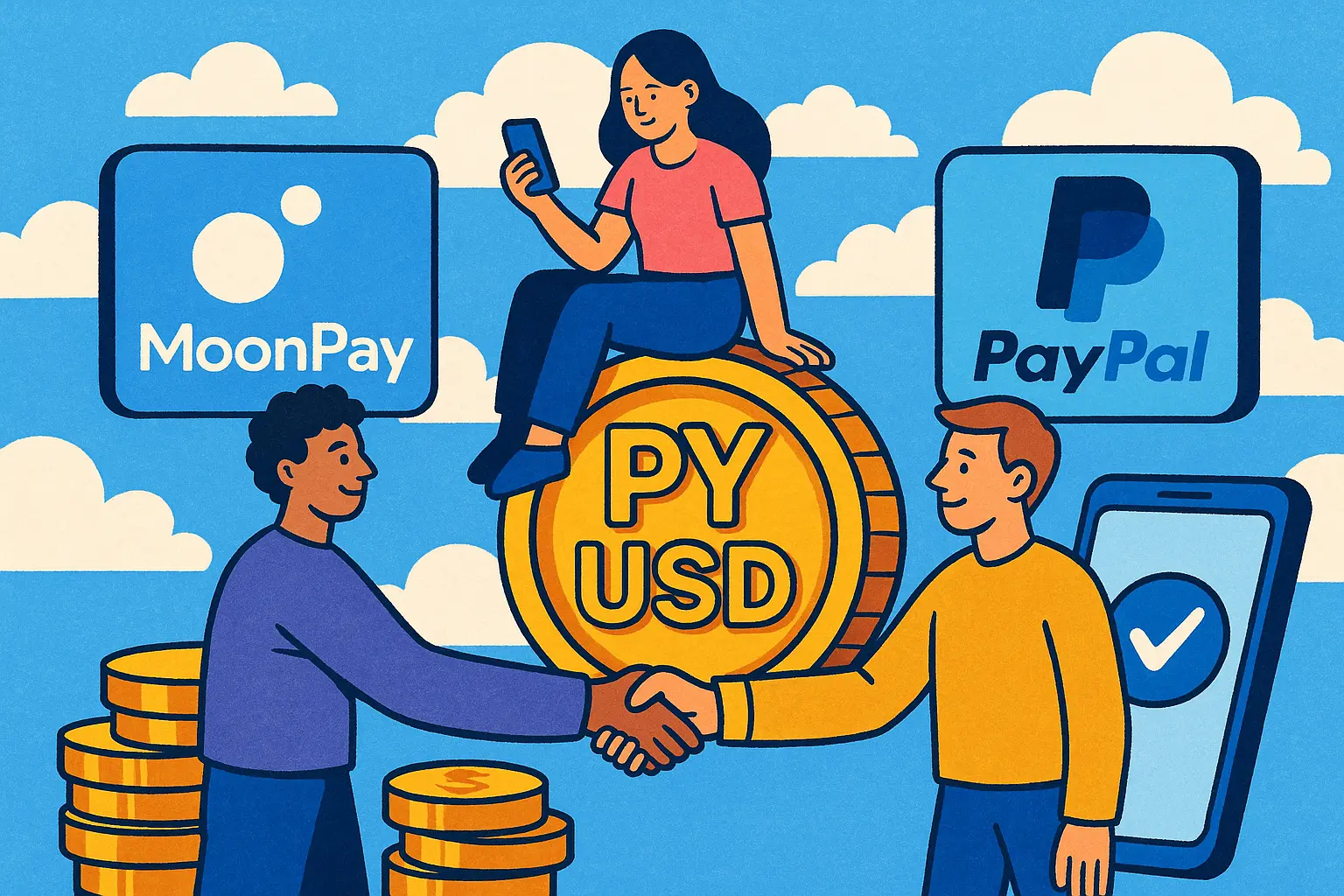
MoonPay and M0 announced the launch of the PYUSDx framework on February 27, allowing developers to quickly issue application-specific branded stablecoins using PayPal dollars (PYUSD) as a reserve asset, with the goal of reducing deployment time from months to days without the need to build issuance, custody and liquidity infrastructure themselves.
PYUSDx Framework: Infrastructure that lowers the barrier to entry for branded stablecoin deployment
PYUSDx’s core value proposition is to significantly lower the technical and compliance threshold for developers to launch their own stablecoins. Through this framework, developers can directly utilize PYUSD as a reserve asset, with MoonPay’s subsidiary MoonPay Digital Assets Limited as an independent tokenization and issuance framework operator, and PYUSD itself is issued and managed by the federally regulated Paxos Trust Company.
It is worth noting that tokens created through PYUSDx are two different assets from PYUSD itself - these branded tokens do not support storage or trading in PayPal or Venmo accounts, and their usage scenarios are defined by the deployed application party. This design allows PYUSD to extend to third-party ecosystems without directly integrating into PayPal’s consumer applications - PYUSD has long lagged behind USDC and USDT in circulation, and PYUSDx provides a differentiated expansion path.
MoonPay’s two-line layout: the stablecoin framework and AI agents are advancing in tandem
The launch of PYUSDx is not an isolated event but the latest step in MoonPay’s accelerated transformation. Just earlier that same week, MoonPay announced the launch of “MoonPay Agents,” a non-custodial layer designed to empower AI systems to autonomously create crypto wallets and execute transactions, representing MoonPay’s official foray into the AI-driven financial infrastructure space.
The two-line layout (PYUSDx framework + MoonPay Agents) shows that MoonPay’s positioning is shifting from a traditional fiat-to-crypto entrance to a middle-layer infrastructure provider between regulated stablecoin issuers and AI-driven financial application developers.
PYUSDx framework key architectural essentials
Reserve assets:P YUSD (issued by Paxos Trust Company, federally regulated)
framework operator:MoonPay Digital Assets Limited (a subsidiary of MoonPay)
Deployment velocity targets: Complete branded stablecoin deployment within a few days (compared to months of traditional processes)
Important Limitations:P YUSDx token is a different asset from PYUSD and does not support PayPal or Venmo account storage/trading
partners:M0 (technical partner of the collaborative launch framework)
Market Background:P YUSD circulation has been lower than USDC and USDT for a long time; PYUSDx offers a differentiated expansion path
Frequently Asked Questions
How does the PYUSDx framework relate to and differ from PYUSD itself?
PYUSDx is a tokenized issuance framework for PYUSD-based reserve assets, operated by MoonPay Digital Assets Limited as a standalone framework, while PYUSD itself is issued and managed by Paxos Trust Company. Branded tokens created through PYUSDx are separate assets that are not supported for use in PayPal or Venmo accounts, and their functionality is defined by the application party deploying the token.
How is MoonPay’s PYUSDx strategically connected to MoonPay Agents?
Together, the two form MoonPay’s infrastructure transformation strategy: PYUSDx allows developers to quickly deploy branded stablecoins, and MoonPay Agents enables AI systems to conduct crypto transactions autonomously. MoonPay is trying to become an intermediary layer between regulated stablecoins and AI-driven applications, serving the infrastructure needs of fintech developers and AI builders.
Why is PYUSD in circulation lower than USDC and USDT, and can PYUSDx improve this situation?
PYUSD lags behind in circulation, partly due to its primary channels being confined to the PayPal and Venmo ecosystems. The PYUSDx framework allows third-party developers to create their own branded tokens with PYUSD as a reserve, expanding its reach in the broader ecosystem without directly integrating PYUSD, but the ultimate effect depends on the scale of developer adoption.
Disclaimer: The information on this page may come from third parties and does not represent the views or opinions of Gate. The content displayed on this page is for reference only and does not constitute any financial, investment, or legal advice. Gate does not guarantee the accuracy or completeness of the information and shall not be liable for any losses arising from the use of this information. Virtual asset investments carry high risks and are subject to significant price volatility. You may lose all of your invested principal. Please fully understand the relevant risks and make prudent decisions based on your own financial situation and risk tolerance. For details, please refer to
Disclaimer.
Related Articles
Vitalik proposes replacing Casper FFG with Minimit to upgrade Ethereum's finality mechanism
Vitalik Buterin proposed on the X platform to replace Ethereum's finality component Casper FFG with Minimmit, claiming it offers better security and recoverability. Minimmit requires only one round of signatures, reducing the fault tolerance threshold to about 17%, which can enhance the network's competitiveness and coordinated recovery ability under attack.
GateNews3h ago
BlackRock updates its Ethereum staking ETF application documents, lowering the staking fee from 18% to 10%
Gate News Report, March 7 — Bloomberg analyst James Seyffart announced on X platform that BlackRock has updated its application documents related to the Ethereum Staking ETF (ETHB). The latest documents show that the staking fee for this product will be adjusted to 10% of staking rewards and may offer tiered fee discounts based on scale. In previous versions of the documents, the staking fee for this ETF was 18% of total staking earnings. This fee reduction is seen as part of BlackRock’s Ethereum product structure optimization.
GateNews3h ago
Kaito AI launches Kaito Studio beta, with 16 partners joining in the first batch
Gate News Announcement: On March 7th, Kaito AI officially launched the Kaito Studio beta on the X platform. The platform adopts a new model that enables brands and creators to achieve more targeted matching based on compatibility, preferences, and expectations. The first batch has integrated 16 partners, and more collaborators will be added gradually once the details are finalized.
Previously, the X platform revised its developer API policy, no longer allowing applications that provide rewards for users posting on the X platform (i.e.,
GateNews3h ago
Polkadot to Reset Tokenomics on March 12 With Major DOT Supply and Staking Changes
Polkadot will introduce a new monetary framework on March 12 that sets DOT’s supply cap at 2.1 billion and lowers emissions by 53.6%.
The overhaul will also create a Dynamic Allocation Pool and shorten the DOT unbonding period from 28 days to 24–48 hours.
On March 12, Polkadot will reset
CryptoNewsFlash8h ago
Ripple Director Spotlights New Crypto Regulatory Milestone in UK - U.Today
Cassie Craddock, CEO of Ripple Labs UK, announced the company's achievement of securing an EMI license and crypto registration from the FCA, marking a significant step in bridging traditional and decentralized finance. Ripple continues to expand its presence in the U.S. and EU with new partnerships and infrastructure developments.
UToday12h ago
Morpho Vaults V2 total deposits exceed $1 billion
Gate News Announcement: On March 6th, the lending protocol Morpho's Morpho Vaults V2 surpassed a total deposit of $1 billion.
GateNews13h ago


