After the United States and Israel launched airstrikes against Tehran, Iran’s largest cryptocurrency exchange Nobitex experienced a surge in crypto asset withdrawals within minutes of the first attack, increasing by over 700%. During that day, the hourly outflow nearly reached $3 million. However, as the Iranian government implemented strict internet blockades, nationwide network connectivity dropped by approximately 99%, and subsequent crypto outflows rapidly subsided.
Analysis of Nobitex’s Outflow Data Post-Airstrike
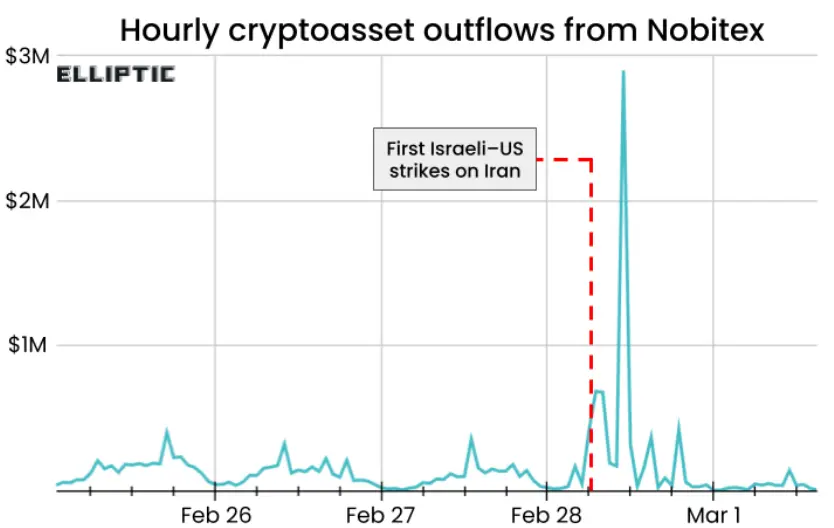
(Source: Elliptic)
Nobitex is Iran’s largest cryptocurrency exchange, handling about 87% of the country’s crypto trading volume. In 2025, it served over 11 million users and processed approximately $7.2 billion in transactions. According to an analysis report released by Elliptic on Monday:
Immediate response after the airstrike: Within minutes of the first strike, Nobitex’s crypto outflows surged over 700%, exceeding $500,000.
Peak intra-day: Later that day, the highest hourly outflow approached $3 million.
Subsequent trend: As internet restrictions were enforced, outflows sharply declined to near halt.
Elliptic’s preliminary tracking indicates that a large amount of outbound funds was transferred to foreign crypto exchanges. The company states this “enables funds to be moved out of Iran while avoiding some scrutiny from the global banking system.”
Diverging Assessments by Elliptic and TRM: Capital Flight or Blockade Effect?
Two major crypto forensic firms have drawn very different conclusions from the same data:
Elliptic’s stance: The sharp increase in outflows “may represent capital flight from Iran,” and the pattern of funds flowing to overseas exchanges aligns with risk-averse capital transfer behavior.
TRM Labs’ rebuttal: “There are no signs of accelerated growth or capital flight in Iran’s crypto ecosystem. Instead, with the government’s strict internet blockades, trading volume and value have declined.” TRM believes that after the initial short-term surge, Iran’s internet connectivity dropped about 99%, fundamentally cutting off subsequent fund transfer channels. Overall data suggests “market paralysis caused by blockade,” rather than ongoing capital outflows.
This disagreement centers on how to interpret the initial capital movements within minutes after the strike—whether they represent organized capital flight or panic-driven reactions that were later halted by network shutdowns.
Structural Context of Iran’s Cryptocurrency Dependence
Iranian reliance on cryptocurrencies is not incidental but a long-term strategic response to financial sanctions and a fragile banking system. Recent banking crises have further reinforced this trend: in October 2025, Ayandeh Bank, one of Iran’s largest private banks, went bankrupt after incurring losses of $5.1 billion and liabilities close to $3 billion, affecting over 42 million customers. The Central Bank of Iran warned that without reforms, eight other local banks face dissolution.
Against this backdrop, platforms like Nobitex have become vital tools for Iranians to evade sanctions, preserve assets, and conduct cross-border transfers. However, these platforms also face security risks: in June 2025, Nobitex was targeted by a hacker attack involving up to $81 million.
Frequently Asked Questions
Q: Does the 700% surge in Iranian crypto outflows confirm “capital flight”?
Currently, two leading blockchain analysis firms hold different views. Elliptic suggests the initial data points to capital flight, while TRM Labs argues that the rapid return to normal after the surge better fits an explanation of market activity being forced to halt due to government internet shutdowns, rather than systematic organized capital transfer. Definitive conclusions require further on-chain data analysis once the situation stabilizes.
Q: How does a 99% network outage affect cryptocurrency usage?
Crypto transactions require network connectivity for broadcasting, verification, and confirmation. When Iran’s internet connectivity drops by about 99%, users holding crypto assets are nearly unable to complete transactions, withdrawals, or transfers. This fundamentally cuts off the use of cryptocurrencies as a tool for capital transfer during crises, directly limiting the scale of capital outflows.
Q: Why do Iranians rely heavily on cryptocurrencies outside the banking system?
Due to extensive US-led sanctions, Iran has long been cut off from the global banking settlement system (including SWIFT), with strict restrictions on cross-border fund transfers. Additionally, Iran’s domestic banking system faces structural issues like high bad debt and currency devaluation, making it difficult for citizens to preserve wealth through traditional financial channels. The decentralized nature of cryptocurrencies makes them an alternative for some Iranians to store and transfer wealth.
Disclaimer: The information on this page may come from third parties and does not represent the views or opinions of Gate. The content displayed on this page is for reference only and does not constitute any financial, investment, or legal advice. Gate does not guarantee the accuracy or completeness of the information and shall not be liable for any losses arising from the use of this information. Virtual asset investments carry high risks and are subject to significant price volatility. You may lose all of your invested principal. Please fully understand the relevant risks and make prudent decisions based on your own financial situation and risk tolerance. For details, please refer to
Disclaimer.
Related Articles
REQ Soars 21.77% — What Does This Mean for Traders?
Request Network (REQ) surged 21.77% within an hour, reaching $0.0839 amid growing trader interest. Market conditions, bullish sentiment, and DeFi trends may be driving this rally, while traders monitor key resistance and support levels for future movements.
Coinfomania3m ago
Altcoin Season Index Reaches 40 as Top Performers Show Strong 90-Day Gains
Gate News bot message, the Altcoin Season Index has reached 40. Over the past 90 days, top-performing coins include $KITE with +222.86%, $CC with +113.17%, $STABLE with +86.83%, $MORPHO with +66.03%, $SKY with +41.20%, $JST with +37.99%, $ZRO with +37.37%, $DCR with +33.65%, $HYPE with +30.39%, and
GateNews9m ago
BTC 15-minute decline of 0.61%: Major wallet selling pressure combined with negative US employment data triggers adjustment
Between 2026-03-12 14:15 and 14:30 (UTC), BTC price declined from 70660.0 USDT to 69917.2 USDT, with a 15-minute return rate of -0.61% and volatility reaching 1.06%. Trading volume increased sequentially, with market attention rising notably, and heightened fluctuations triggering alerts among short-term traders.
The primary driver of this price movement was on-chain whale wallets concentrating approximately 2,100 BTC inflows to exchanges within a short timeframe, representing an 18% increase compared to the previous period. Large holders' active position adjustments and concurrent large sell orders in spot and perpetual markets were simultaneously released.
GateNews23m ago
ETH 15-minute rise of 0.72%: On-chain capital inflows and bullish sentiment dominating the market
2026-03-12 14:00 to 2026-03-12 14:15 (UTC), ETH spot price showed rapid upward movement with a 15-minute return rate of +0.72%, price range between 2065.45 to 2082.77 USDT, and overall volatility of 0.84%. During this market fluctuation, market attention increased, trading volume rose sequentially, and unilateral buy-side orders drove market sentiment to remain bullish.
The main driver of this price movement was large-scale on-chain capital inflows and the linkage effect between spot and futures markets. On-chain data shows multiple high-net-worth wallets
GateNews38m ago
Traditional Finance Alert: USDZAR has increased by over 1.5%
Gate News bot message: According to the latest Gate TradFi data, USDZAR has risen by 1.5% in the short term, with current volatility significantly higher than recent average levels, indicating increased market activity.
GateNews46m ago
Iran declares Hormuz Strait remains closed, whale makes long position on crude oil with $5.2 million scale
Iran's Supreme Leader announced that the Strait of Hormuz will remain closed, causing geopolitical tensions and raising international oil prices. U.S. oil stocks and crude oil ETFs surged significantly. Whale address neoyokio.eth opened a 4x leveraged long position on crude oil on the Hyperliquid platform, investing 5.2 million dollars, with current unrealized gains of 32,000 dollars.
GateNews49m ago


