
Arizona Attorney General Kris Mayes announced on March 17 that his office has filed criminal charges against the parent company of the prediction market platform Kalshi, including allegations of operating an illegal gambling business without a license in Arizona and offering election betting services that violate state law. A Kalshi spokesperson rebutted this, emphasizing that the company is lawfully under the exclusive jurisdiction of the federal Commodity Futures Trading Commission (CFTC).
Arizona’s Charges: Does “Prediction Market” Name Constitute Gambling?
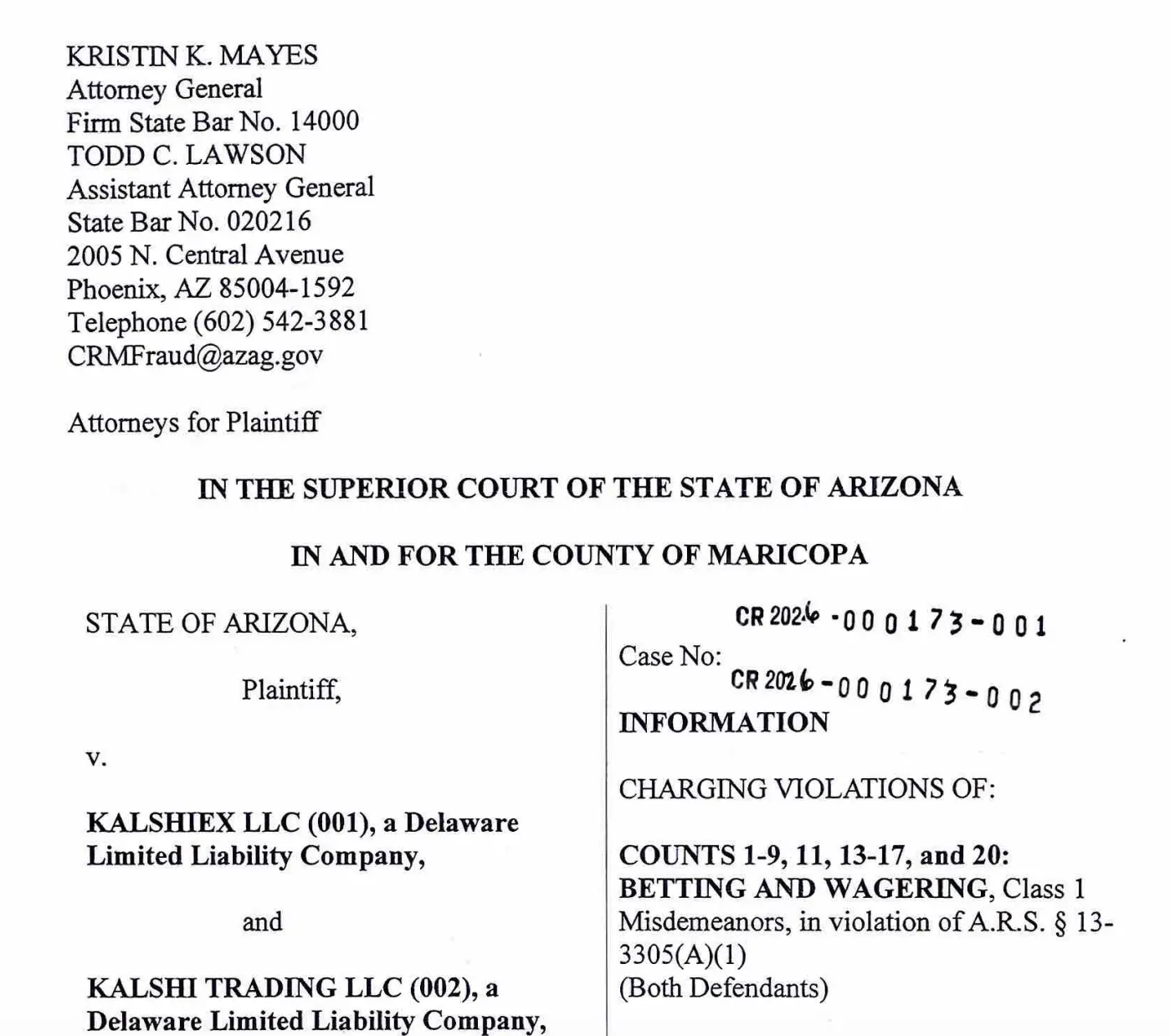
(Source: Office of the Arizona Attorney General)
Mayes stated that Kalshi’s platform allows Arizona residents to bet on contracts related to sporting events and state and federal elections, which violates Arizona law. Her position is direct: “Kalshi may call itself a ‘prediction market,’ but in reality, it is operating an illegal gambling activity and accepting bets on elections in Arizona, both of which violate Arizona law. No company has the right to decide which laws to follow.”
According to the Arizona Attorney General’s office, the criminal charges stem directly from Kalshi’s “preemptive” filing of a civil lawsuit against Arizona to attempt to evade state law responsibilities. The criminal charges are a countermeasure to this action. Arizona has previously filed similar lawsuits against Polymarket on similar issues.
Three-State Litigation Pattern: Three Cases, Three Outcomes
Kalshi is currently facing legal challenges regarding prediction market jurisdiction in at least three states, with markedly different results:
- Arizona (latest): The Attorney General has formally filed criminal charges for unlicensed gambling and offering election bets, representing the most severe state-level action to date.
- Ohio (last week): The court rejected Kalshi’s preliminary injunction request, ruling that the company failed to prove its sports contracts are under CFTC “exclusive jurisdiction,” and the case continues.
- Tennessee (February this year): A federal judge ruled to prohibit the state government from enforcing gambling laws against Kalshi, setting a favorable precedent for federal jurisdiction.
A Kalshi spokesperson cited the federal ruling in Tennessee to criticize Arizona, saying “they are trying every possible means to regulate a nationwide financial exchange on their own,” and emphasized that the CFTC has confirmed Kalshi’s federal jurisdiction, noting that its services differ from traditional sports betting companies and casinos.
CFTC Involvement: A Positive Signal at the Federal Level
While state-level lawsuits continue to escalate, developments at the federal level have also attracted market attention. CFTC Chairman Michael Selig, who took over from acting Chair Caroline Pham in December last year, has publicly stated that the federal regulator will protect prediction market platforms from interference by state lawsuits.
Last week, Selig proposed rules on how the Commodity Exchange Act applies to prediction markets and sought public comments. This move could further clarify CFTC’s jurisdiction over prediction markets legally. If the CFTC ultimately establishes formal rules affirming federal exclusive jurisdiction over prediction markets, it would fundamentally limit states’ ability to pursue legal action against platforms like Kalshi under local gambling laws.
Disclaimer: The information on this page may come from third parties and does not represent the views or opinions of Gate. The content displayed on this page is for reference only and does not constitute any financial, investment, or legal advice. Gate does not guarantee the accuracy or completeness of the information and shall not be liable for any losses arising from the use of this information. Virtual asset investments carry high risks and are subject to significant price volatility. You may lose all of your invested principal. Please fully understand the relevant risks and make prudent decisions based on your own financial situation and risk tolerance. For details, please refer to
Disclaimer.


