Summary
- Filecoin has antifragile mechanisms built into its protocol design, making it resilient to major QAP drops.
- These mechanisms provide strong economic incentives for new Storage Providers (SPs) to join the network and enable existing SPs to remain in the network after QAP drops.
- In general, after a large number of QAPs drop, the QAPs joining the network will obtain excess returns due to the sharp increase in reward concentration, and the QAPs will return to normal, demonstrating the strong resilience of Filecoin.
As Filecoin is a decentralized data storage network, SP needs to determine the QAP based on the stored data (whether it is real data) to determine the sector pledge and the block reward obtained.
Because of this unique structure, we can use the following model to actually confirm and see how Filecoin recovers with its own strong resilience under different QAP losses (a large number of SP exits) in the next assumptions.
We can envision two forms of QAP churn:
- When the SP sector expires, the SPs slowly leave;
- SPs suddenly shut down and leave, causing a sudden QAP drop;
Before interpreting the two model results mentioned above, we need to first understand the premise of this model setting.
This model Kiran calls Agent-Based Model (ABM). The environment of this model implements Filecoin’s encryption experience.
economic mechanisms (such as the interplay of locking, vesting, minting, and token supply) and try to accommodate all possible scenarios
The setting of the scene. include:
3 SP types:
- Only SPs that provide Committed Capacity (CC) sectors
- Only SPs for transaction sector (Fil+) are provided
- Provides both CC and Fil+ sector SPs
There are two types of behavioral logic that SPs will have:
- Based on average cost - In this mode, SPs will join the network with a pre-configured fixed number of
Continuously renewed until the expiration date, after which SPs will leave the network (by QAP expiration or termination).
- Based on ROI - In this model, SPs will use FIL-on-FIL Forecast of Return (FoFR) to determine required
How much storage to add will start investing if the predicted FoFR is greater than the pre-configured threshold.
There are also 4 initial network states tested: * CC, Fil+ and a uniform distribution of hybrid SPs
- Uniform distribution with CC and Fil+SP only
- FIL+ Skew: 70/30 distribution of FIL+ and CC
- CC Skew: 70/30 Distribution of CC and FIL+
Under the premise that the above situations are set to cover most situations, we obtained the following simulation results through model calculation and analysis: (This is just a partial excerpt that summarizes the entire point of view. Please see the original text for the full model report)
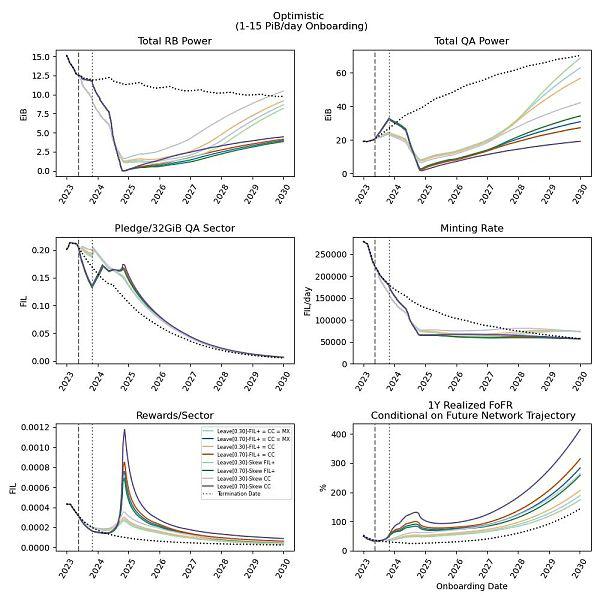
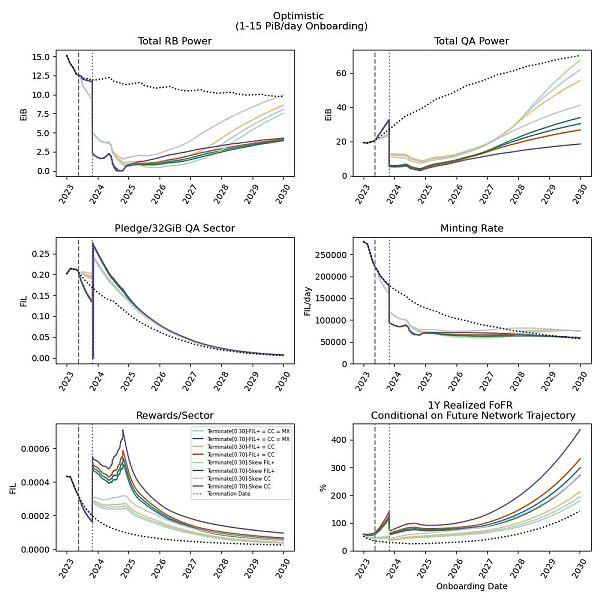
The above chart tests the Key Performance Indicators (KPIs) of the Filecoin network with different SPs leaving the network. Dashed vertical lines represent the start of the simulation, dotted vertical lines represent
Indicates the date the sector started leaving the network. A baseline scenario of simulating constant join using the DCA agent is also simulated to provide a basis for comparison (black dotted line)
From the above figure, we can find that when the SP in the network suddenly terminates the storage contract, the network will experience a sudden drop in QAP. but
Yes, we observed that the network QAP started to recover after the termination event. This is because the increased concentration of rewards leads to FIL-
on-FIL returns increased.
In this case, we recall that SPs behave logically according to ROI. In the current network situation, we can observe that participants who stay in the network get high FIL-on-FIL rewards. I
Our simulations reflect this phenomenon, and we observe high FIL-on-FIL returns at SP to exploit this situation and increase storage
Under this circumstance, Filecoin’s network QAP will naturally recover by virtue of its characteristics, thus proving its strong resilience.
Disclaimer: The information on this page may come from third parties and does not represent the views or opinions of Gate. The content displayed on this page is for reference only and does not constitute any financial, investment, or legal advice. Gate does not guarantee the accuracy or completeness of the information and shall not be liable for any losses arising from the use of this information. Virtual asset investments carry high risks and are subject to significant price volatility. You may lose all of your invested principal. Please fully understand the relevant risks and make prudent decisions based on your own financial situation and risk tolerance. For details, please refer to
Disclaimer.


